Sabina Baehr, Juliana Ludwig, Sebastian Lotz, Jens Wizl, Benjamin Burkard, Truong Le (2026). Extracurricular collaborative learning: Fostering understanding and interest in quantum technologies through escape games for future professionals. In: Human Systems Engineering and Design (IHSED2026): Future Trends and Applications. AHFE Open Access, vol. 237, pp. 458–468. https://doi.org/10.54941/ahfe1008185
Quantum technologies are gaining importance in applied research and industry, as they are increasingly developing towards industry-ready applications. This leads to a growing demand for qualified professionals in this sector. Accessible education formats are necessary to provide future professionals with an early and low-threshold introduction to this abstract and complex field. This work introduces the design, implementation, and evaluation of an escape game developed to convey quantum physics and quantum technologies, especially quantum sensing, to students from grade 9 onwards. The escape game workshop was applied in an extracurricular context, and its effects on students' interest in quantum technologies, perceived understanding, and quality of collaboration were investigated.The evaluation results from 87 students show that all examined outcomes (interest, perceived understanding, and quality of collaboration) were rated significantly above the neutral reference value. No significant differences were found with respect to gender, grade level, or prior knowledge, indicating broad accessibility.These findings provide initial evidence that educational escape games can serve as promising entry points for engaging secondary school students with complex key technologies such as quantum technologies.
Key technologies such as artificial intelligence, biotechnology or quantum technologies are transforming science, industry and society at an increasing pace. To prepare future professionals for these developments, educational approaches are needed that go beyond purely technical knowledge and foster cross-disciplinary skills such as collaborative problem-solving and the ability to tackle with complex challenges (Binkley et al., 2012). Moreover, introducing such technologies to secondary school students remains a challenge, as they are often highly complex and abstract and only marginally anchored in Received May 13, 2026 Revised June 29, 2026 Accepted July 18, 2026 Available online September 25, 2026
Extracurricular Collaborative Learning 459 curricula. This creates an urgent need for innovative, low-threshold learning formats that enable an early encounter with key technologies.
Quantum technologies serve as a particularly relevant case for this challenge. They are transitioning from basic research to industry-ready applications, creating a growing demand for qualified professionals (Greinert et al., 2023). For students, quantum phenomena remain highly abstract and counterintuitive (Krijtenburg-Lewerissa et al., 2017), and although basic quantum physics appears in many secondary curricula, the coverage varies widely and rarely extends to quantum technologies (Stadermann et al., 2019). Extracurricular formats may therefore offer promising opportunities for low-threshold engagement with these technologies.
One approach to designing this learning environment is game-based learning (GBL), in which an actual game serves as the central learning experience. This has already demonstrated positive effects on motivation, situational interest, and engagement in Science, Technology, Engineering, and Mathematics (STEM) education. One example of a GBL format are escape games, which have been proven to be particularly relevant in STEM education (Vörös and Sárközi, 2017; Borrego et al., 2017). In these games, participants must collaboratively solve interconnected puzzles under time pressure. This also gives rise to immersive learning environments characterized by narrative embedding and coordinated problem-solving (Fotaris and Mastoras, 2019). A systematic review by Veldkamp et al. (2020) indicates that educational escape games can promote active learning, encourage collaboration, and enhance student motivation. While GBL in STEM education in the broader sense is well researched and there are already initial game-based applications for quantum technologies, no study to date has examined physical escape games as a tool for introducing quantum technologies to secondary school students. This gap provided the motivation for the present study.
The overarching research question guiding this study is: How can an Escape Game foster interest, understanding, and collaborative learning in early exposure to quantum technologies?
To examine this question in more detail, three sub-questions can be identified: (1) To what extent do students report situational interest in quantum
technologies and perceived understanding of them following their participation in the workshop? (2) How do students perceive the quality of collaboration during the escape game? (3) How do students evaluate the difficulty, perceived learning relevance,
and flow experience of the four Quantum Escape Game puzzles?
DESIGN REQUIREMENTS AND GAME CONCEPT The game concept for the escape game was developed through a series of internal design workshops that explored the integration of escape room mechanics with quantum physics content. Central considerations included the intended venues, group sizes, target age ranges, and session duration.
While some of these parameters remained deliberately open to allow iterative adjustment during field deployment, one requirement emerged clearly at an early stage: the game needed to be mobile, as it is intended for schools, science fairs and other locations. This led to the central design decision of repurposing the transport containers themselves as puzzle units, shifting the format from “escape the room” to “free the object”.
The resulting system is modular: individual boxes can be added, removed, or replaced to adjust difficulty and session length (approx. 40 minutes). The system can also be duplicated for parallel play. Depending on the venue, a laboratory setting can be arranged around the boxes to enhance immersion.
Regarding content design, the coherent framing narrative required a linear sequence of puzzles and a structured progression of quantum physics concepts. This allows us to approach the fundamentals of quantum phenomena step by step, rather than simply providing a broad overview. Inspired by the “Particle Zoo” framework (DK, 2021), the game introduces magnetism, electrons, and photons, illustrates their relationships, and demonstrates how their interplay is harnessed in quantum technology. Where possible, the puzzles employ real physical mechanisms; however, it is inherent to quantum physics that certain phenomena can only be represented through simulation or analogy.
Puzzle Mechanisms Within and Between Boxes The typology of puzzle mechanics was based primarily on Nicholson’s (2015) study of design practices in escape rooms, which identified common elements such as uncovering hidden information, locating hidden objects, and combining various clues. During the internal workshops, the researchers also contributed their individual experiences with escape rooms and puzzle design. This process facilitated discussion about what makes for an engaging puzzle experience - primarily narrative immersion and a balance between challenge and solvability. Common puzzle types include revealing previously hidden information, locating concealed objects, or combining disparate elements. Physical tasks involving dexterity or time pressure may also be incorporated. Each box contains one or more such puzzles. Successful completion grants access to the subsequent box or game phase. Four-digit combination locks were selected as inter-box transition mechanisms, as they simplify content maintenance (Nicholson, 2015).
IMPLEMENTATION The game targets students in 9th grade and above in an (extra-)curricular context, with no prior knowledge of quantum physics required. It is designed for collaboration in small groups and embedded in a structured workshop format comprising an introduction, the game itself, and a debriefing phase.
The workshop begins with a 10-minute introduction which covers fundamental quantum concepts and quantum technologies, before narrowing the focus to quantum sensing and introducing the game-story. The operating principle and basic components of a quantum sensor based on nitrogen- vacancy (NV) centres in diamond are explained, along with its measurement
Extracurricular Collaborative Learning 461 capabilities and application potential. Subsequently, small groups are formed, and the escape game narrative is introduced. The game phase lasts 35 - 40 minutes, during which groups work through four puzzle boxes. A 10 - 15-minute debriefing concludes the session, linking each puzzle back to the underlying physics and real quantum sensors, reflecting on teamwork, and allowing time for questions.
The framing narrative of the game centres on a digital robot named Tom who has been damaged in an accident and lost the ability to interpret his sensor data. Tom navigates using a quantum magnetometer based on NV centers in diamond. Players must help him regain orientation by generating fresh measurement data through solving the puzzle boxes.
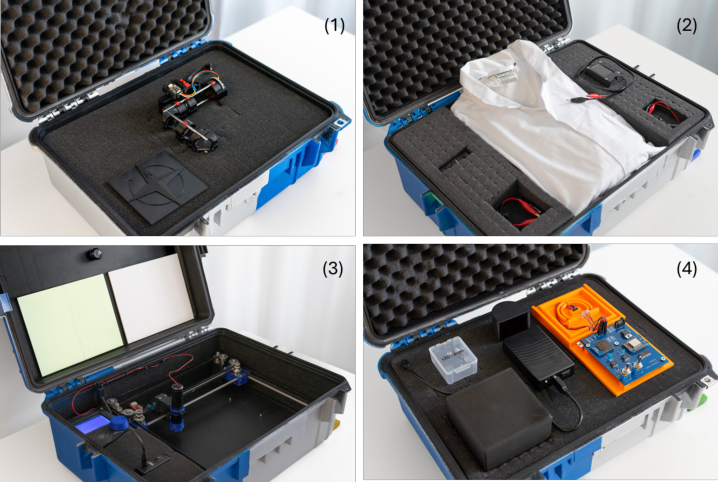
Overview of Puzzle Structure The game begins with Tom contacting the players via video call, explaining his situation, and providing a cryptic hint that unlocks the first box. Figure 1 shows the four different boxes.
The first box introduces what Tom wishes to perceive: the Earth’s magnetic field. It contains an augmented reality (AR) display which, coupled with a conventional magnetometer, detects the user’s viewing direction and projects a rudimentary visualisation of geomagnetic field lines. Four digits are hidden at cardinal directions; identifying them in the correct order yields the combination for the next box.
In the second box, electrons are used to generate photons. The second box requires players to connect a low-voltage source to three different output elements to generate light. The corresponding cables and LED matrices are sewn into two laboratory coats, with electrical contacts concealed in the sleeves. Once the coats are connected, a number is displayed on a small screen at the back of each coat’s collar - invisible to the wearer. A symbol- based instruction on a third display inside the box indicates how to derive the four-digit code for the next box from these two numbers.
The third box demonstrates how photons elevate electrons to a higher energy level, from which they subsequently relax and emit photons at a different wavelength. The box therefore houses a two-axis CNC apparatus that moves a UV lamp across a surface. When the correct phosphorescent element is placed inside and the appropriate program is selected, the emitted afterglow reveals the next code.
The final box contains a working experimental setup that uses a small NV diamond and green LEDs to detect magnetic fields. Once players activate the setup and verify its function by observing the sensor response to movable neodymium magnets, the game is won: Tom receives the measurement data he needs to regain his orientation.
Figure 1: Overview of the four puzzle boxes. (1) AR magnetometer display for geomagnetic field-line visualisation. (2) Laboratory coats with sewn-in LED matrices and low-voltage circuit. (3) CNC-driven UV lamp with phosphorescent element. (4) NV-diamond magnetometry setup.
METHODOLOGY
The study employed a cross-sectional survey design to evaluate the effectiveness of an educational escape game focused on quantum physics and quantum sensing. The game was implemented in two settings, both in the context of extracurricular workshops: in schools and at research institutes.
Analytical Framework
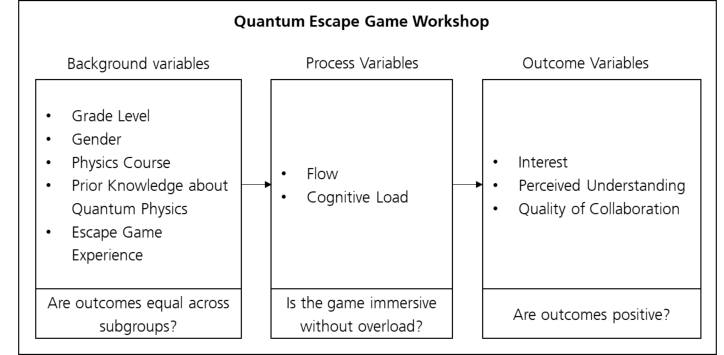
Figure 2 illustrates the analytical framework guiding this study. The ‘Quantum Escape Game’ workshop provides a shared learning context for all participants. The variables examined are divided into three categories: Background variables (grade level, gender, type of physics course, prior knowledge of quantum physics and previous experience with escape games) serve as grouping factors to investigate whether the results are robust across the target users.
Process variables (flow and cognitive load) measure the quality of the students’ gaming experience, serving as indicators of the validity of the game’s design. In particular, they indicate whether the game enables immersion in the game world without causing cognitive overload.
Outcome variables (interest, understanding and quality of collaboration) address the research questions directly. However, given the post-test design with a single group and no pre-test or control condition, no causal claims
Extracurricular Collaborative Learning 463 can be made. The analysis examines whether scores are significantly above the neutral scale midpoint, whether they are consistent across all groups, and whether process variables are associated with the outcomes.
Figure 2: Analytical framework of this study.
Instrument To gather insights about students’ experiences, learning outcomes and overall perception of the Quantum Escape Game, a questionnaire was developed for this study. It was administered immediately after participation and took approximately 10 minutes to complete. The instrument comprised three parts containing both quantitative and qualitative items.
Part A captured sociodemographic and background information, including grade level, gender, physics course type (none, basic, or advanced), prior knowledge of quantum physics and escape game experience, rated on a five- point scale (1 = none to 5 = very much).
Part B focused on puzzle-specific evaluations. Students rated the puzzles on three dimensions using a five-point Likert scale (1 = strongly disagree to 5 = strongly agree): difficulty (“The puzzle was challenging.”), learning relevance (“The puzzle helped me understand the topic better.”), and flow (“I was really in the flow during the puzzle.”).
Part C assessed overall perceptions across five theoretically grounded constructs, with all items from each scale rated on a five-point Likert scale (1 = strongly disagree to 5 = strongly agree):
Interest items were based on Hidi and Renninger’s (2006) four-phase model of interest development, capturing both situational interest triggered by the game format and its potential to foster sustained engagement with quantum technologies.
Understanding items assessed students’ self-reported comprehension of the workshop’s core content, including conceptual knowledge of quantum sensing, its working principles, and potential applications.
Collaborative Learning items were informed by collaborative learning frameworks addressing communication, inclusion and error tolerance (Johnson & Johnson, 2009).
Flow items drew on Csikszentmihalyi’s (1990) flow theory, operationalized following Rheinberg et al. (2003), targeting immersion and time distortion as central indicators.
Cognitive Load items were based on cognitive load theory (Paas et al., 2003), assessing perceived mental demand and frustration.
Participants The sample comprised 87 students from grades 9 to 13 (M = 11.70, SD = 0.94), with the majority enrolled in grade 12 (54.0%). Most participants identified as male (59.8%). Regarding physics course enrolment, slightly more than half attended a basic course (54.0%), and about one third an advanced course (36.8%). Prior experience with escape games was common, as over 70% had played at least one before. In contrast, prior knowledge of quantum physics was generally low (M = 1.92, SD = 0.85), with only 4.7% of students reporting high familiarity with the topic. The participation was voluntary and uncompensated.
Statistical Analysis All analyses were conducted using IBM SPSS Statistics (Version 30). Internal consistency of the multi-item scales was assessed via Cronbach’s alpha. Acceptable reliability (α ≥ .70) was confirmed for scales: Interest, Understanding, Collaborative Learning, and Flow. The Cognitive Load scale did not reach acceptable consistency (α < .60) and was therefore analysed at item level. As Kolmogorov–Smirnov tests indicated non-normal distributions for all scales, non-parametric procedures were used throughout: one-sample Wilcoxon signed-rank tests to assess whether scale medians exceeded the neutral midpoint (test value = 3), Kruskal–Wallis H tests for group comparisons, and Spearman correlations to explore bivariate associations between process and outcome variables. Given the single-group post-test design, results are interpreted as indicators of perceived experiences rather than causal effects.
RESULTS AND DISCUSSION
The results section is divided into three parts: puzzle-level findings informing game design, outcome variables addressing the research questions, and process variables validating design quality.
Individual Puzzle Analysis
Table 1 summarizes the puzzle-specific evaluations regarding their perceived difficulty, learning relevance, and flow across all four puzzle boxes.
Table 1: Means and standard deviations (SD) for puzzle-specific ratings.
Table available in the original PDF paper.
Puzzle Box Difficulty M (SD) Learning M (SD) Flow M (SD) Puzzle Box 1 2.67 (1.04) 2.83 (1.08) 3.55 (1.08)
Puzzle Box 4 3.20 (1.05) 3.65 (1.10) 3.48 (1.01) The data show that the perceived learning relevance increased across the puzzle boxes. Puzzle Box 4, which contains a functional quantum sensor, received the highest ratings for learning relevance but was also rated as the most difficult. The “flow” experience scores for Box 4 were slightly lower compared to the other boxes, possibly reflecting the higher cognitive demand of operating with the experimental setup. Furthermore, the increase in learning relevance supports the linear structuring of the content design, which builds from familiar phenomena (magnetism) towards the target technology (quantum sensing).
Overall Score Scales The one-sample Wilcoxon test confirmed that all median scores on the scales (with the exception of cognitive load) differed significantly from the neutral mean of 3 on the five-point scale. Quality of collaboration received the highest ratings (Mdn = 4.50, Z = 7.79, p < .001, r = .83), followed by flow (Mdn = 4.00, Z = 6.83, p < .001, r = .73), understanding (Mdn = 3.60, Z = 6.66, p < .001, r = .71), and interest (Mdn = 3.50, Z = 5.74, p < .001, r = .62). Regarding cognitive load, the two items - frustration/overload and mental demand - were analysed separately due to insufficient scale reliability (α < .60). Both indicated low to moderate levels of frustration/overload (M = 1.65, SD = 0.74) and high mental load (M = 2.4, SD = 0.96).
Interest in Quantum Technologies After the workshop, the students reported moderate to high interest in quantum technologies, significantly above the scale midpoint. Kruskal-Wallis tests revealed no significant differences in interest levels with respect to the background variables of grade level, gender, prior knowledge of quantum physics, or previous experience with escape games. This indicates that the game format has succeeded in sparking situational interest, regardless of the students’ backgrounds.
Conceptual Understanding Self-reported understanding was significantly above the scale midpoint, suggesting that participants felt they had gained a basic grasp of the topic. No significant differences between the groups were found. It is interesting to note that there were no differences in prior knowledge of quantum physics. Students who had only minimal prior knowledge at the start rated their
understanding after the workshop similarly to those with more background knowledge. This may be because almost all students reported that they had never encountered quantum sensing or the underlying principles before the workshop, so the topic was new to almost all of them.
Quality of Collaboration The Collaborative Learning scale received the highest score of all scales. This suggests that the cooperative structure of the game, which requires communication, role assignment, and coordinated problem-solving, has yielded extremely positive experiences in the area of cooperative learning. No significant differences between the groups were found in this category either.
Flow and Cognitive Load With regard to the process variables, the flow value was significantly above the scale midpoint. Also, no differences were observed between the background variables, which indicates that the game design elicited a high degree of immersion in most participants. With regard to cognitive load, both items showed a moderate level of perceived strain, with no signs of systematic frustration.
Correlation analyses were conducted to examine the relationships between process and outcome variables. These revealed positive correlations between the flow experience and all outcome variables: interest (r = 0.31, p = .003), understanding (r = 0.34, p = .001), and cooperative learning (r = 0.45, p < .001). This indicates that students who experienced greater immersion in the learning process also reported a greater interest in quantum physics. With regard to cognitive load, only the item “I sometimes felt frustrated or overwhelmed” showed a negative correlation with the comprehension scale (r = −0.31, p = .004). Therefore, the suggestion arises that periods of frustration or overload were associated with a lower level of under-standing of the newly introduced concepts.
The following limitations should be noted with regard to the study: A single-group post-test design does not allow for causal conclusions; all results reflect self-reported perceptions rather than objectively measured learning outcomes. It is not possible to determine whether the observed results are attributable to the game itself, the introductory briefing, or other factors. The sample size (N = 87) is sufficient for the analyses carried out, it nevertheless limits the statistical power for detecting small differences between subgroups. A further limitation is the cognitive load scale, which does not achieve acceptable internal consistency. Finally, without a control condition, it remains unclear how the escape game format compares to alternative teaching approaches.
CONCLUSION
This study provides initial evidence that a physical escape game that combines required collaborative structures, narrative frameworks and hands-on experiments with concepts in a specialized field can offer secondary school students enhanced encounters with key technologies in an extracurricular setting. The consistently positive outcomes in terms of interest, understanding and collaborative learning, regardless of the students’ gender, year group or prior knowledge, underscore the suitability of educational escape games as accessible entry points across all groups. The presented “quantum escape game” therefore holds significant potential to make complex and difficult- to-understand topics more accessible and to foster greater interest in them.
Future research should address the limitations of the present study by employing pre-post designs with validated knowledge assessments and control conditions to demonstrate causal relationships. The modular game architecture allows for systematic variation in the design parameters. The researchers are making use of this and are currently developing further puzzle boxes to offer future professionals even more variety when solving puzzles on this topic.
ACKNOWLEDGMENT
This study was conducted within the research project Quantum Open Innovation and was funded by the German Ministry for Research, Technology and Space (funding code: 13N16715).
REFERENCES
Binkley, M., Erstad, O., Herman, J., Raizen, S., Ripley, M., Miller-Ricci, M., and Rum ble, M. (2012). Defining twenty-first century skills. In P. Griffin, B. McGaw, & E. Care (Eds.), Assessment and Teaching of 21st Century Skills (pp. 17–66). Springer. Borrego, C., Fernández, C., Blanes, I., and Robles, S. (2017). Room escape at class:
Escape games activities to facilitate the motivation and learning in computer sci ence. Journal of Technology and Science Education, 7(2), 162–171. Csikszentmihalyi, M. (1990). Flow: The psychology of optimal experience. Harper & Row. DK. (2021). Simply Quantum Physics. DK (Dorling Kindersley). Fotaris, P., and Mastoras, T. (2019). Escape rooms for learning: A systematic review.
In Proceedings of the 13th European Conference on Games Based Learning. Greinert, F., Müller, R., Bitzenbauer, P., Ubben, M. S., and Weber, K.-A. (2023). The Future Quantum Workforce: Competences, Requirements, and Forecasts. Physi cal Review Physics Education Research, 19(1), 010136. Hidi, S., and Renninger, K. A. (2006). The four-phase model of interest development.
Educational Psychologist, 41(2), 111–127. Johnson, D. W., and Johnson, R. T. (2009). An educational psychology success story.
Educational Researcher, 38(5), 365–379. Krijtenburg-Lewerissa, K., Pol, H. J., Brinkman, A., and van Joolingen, W. R. (2017).
Insights into teaching quantum mechanics in secondary and lower undergraduate education. Physical Review Physics Education Research, 13(1), 010109.
Nicholson, S. (2015). Peeking behind the locked door: A survey of escape room facilities. White Paper. Paas, F., Renkl, A., and Sweller, J. (2003). Cognitive load theory and instructional
design. Educational Psychologist, 38(1), 1–4. Rheinberg, F., Vollmeyer, R., and Engeser, S. (2003). Die Erfassung des Flow-Erle bens. In J. Stiensmeier-Pelster & F. Rheinberg (Eds.), Diagnostik von Motivation und Selbstkonzept. Hogrefe. Stadermann, H. K. E., van den Berg, E., and Goedhart, M. J. (2019). Analysis of
secondary school quantum physics curricula of 15 different countries: Different perspectives on a challenging topic. Physical Review Physics Education Research, 15(1), 010130. Veldkamp, A., van de Grint, L., Knippels, M. C. P. J., and van Joolingen, W. R.
(2020). Escape education: A systematic review on escape rooms in educational contexts. Educational Research Review, 31, 100364. Vörös, A. I. V., and Sárközi, Z. (2017). Physics escape room as an educational tool.
AIP Conference Proceedings.
FIND THE COMPLETE VOLUME IN THE AHFE DIGITAL BOOKSTORE
Explore the complete digital volume
Human Systems Engineering and Design (IHSED2026): Future Trends and Applications
Read this individual research paper free through the original publisher, or explore the full digital proceedings book.