Mira Kern, Niklas Kluge, Benjamin Burkard, Marco Amorim, Nicolaj Motzer (2023). Acceptance analysis of value-creating service cooperations and extensions for Mobility-on-Demand solutions. In: Human Factors in Transportation. AHFE Open Access, vol. 95, pp. 335–342. https://doi.org/10.54941/ahfe1003818
The mobility sector is considered one of the key levers for achieving the climate targets specified in the Paris Agreement and reducing carbon dioxide emissions in cities. To achieve this goal, lower-emission mobility solutions such as public transport, cycling or shared forms of mobility are increasingly strengthened and expanded. Mobility-on-Demand (MOD) offers innovative transport solutions that can compete with the private vehicle in terms of comfort or flexibility. However, this mode of transport faces the following major challenges: the user group is still very small as the service is operating only in specific cities or regions and the operation is quite expensive. Thus, it’s quite difficult for MOD providers to elaborate a sustainable business model. A good way to achieve more profitability is to exploit potential synergies through service collaborations, which at the same time increases popularity. Therefore, this study addresses the research questions of whether and which specific service collaborations significantly increase the acceptance as well as the likelihood to use MOD. To answer the research questions, an online survey in Germany, Switzerland and Austria was conducted. Three different areas of cooperation were tested for acceptance: mobility service providers (e.g., public transit), other service providers (e.g., hotel, restaurant) and retail stores. A total of n=1403 respondents were included in the online survey. Univariate ANOVA with repeated measures and t-tests were used to analyse the potential cooperations. The results show that the cooperation between MOD providers and other business partners is generally accepted as a value creating service extension, and that cooperation with public transport is descriptively the most attractive. Furthermore, cooperations with mobility service providers and other service providers lead to a significantly higher probability of using on-demand shuttles (even among non-users). Therefore, it is hypothesized that these two collaborative opportunities are a suitable means to increase the use and profitability of on-demand shuttles and attract new target groups. It is recommended that those collaborations should be pursued and analysed in future research or pilots.
Mobility-on-Demand (MOD) is considered as an innovative transport alter- native that is intended to compete with the private car, especially in terms of flexibility and comfort. MOD can achieve a positive impact on the number of vehicles, congestions, and parking areas and therefore help to reduce emis- sions. However, on-demand mobility comes with a price. MOD systems in Germany, Switzerland or Austria are currently only implemented in several cities and are far from profitable. Many offers are currently running under special pilot or test phases and are thus subsidized by the state. Additionally, most mobility providers are still a long way from having a large customer base and have long idle times during low-demand periods. Thus, there needs to be a solution not only to attract new customers but also to use the idle time and low demand phases in an intelligent and profitable way. A solution to solve not only the lacking societal diffusion of MOD but also the load capacity might lie in value adding cooperations with other service providers. Those might not necessarily come from the mobility ecosystem but can also bring service adding value from other sectors and branches of the economy. Service cooperations can thus create a new business and financing model so that flexible and convenient on-demand mobility becomes profitable and via- ble. Since the acceptance of cooperations as a form of service extension for MOD was not investigated so far, the question is raised, which cooperations are accepted as service extension and whether they can help to increase the likelihood to use MOD.
THEORETICAL BACKGROUND In recent years, there has been a strong growth of Transportation Network Companies (TNCs) which offer different app-based MOD services (Koutsopulos et al. 2023). A very sustainable and increasingly popular form of MOD is ridepooling (or ridesplitting), in which ride requests from different passengers are intelligently bundled as spatially and temporally correspon- ding transport requests by algorithms in real-time (König 2022; Viergutz & Brinkmann 2018). Especially in combination with public transport the use of ridepooling is attractive (Knie et al. 2020). In course of the MOD Sandbox program of the Federal Transit Administration (FTA) in the U.S., the pro- ject examples of Los Angeles County and Puget Sound showed an increased use of public transport by cooperating with a TNC for MOD for the first and last mile. However, the MOD service was subsidized and had a poorer cost recovery than mobility alternatives like scheduled buses or the already existing vanpool (Martin et al. 2022). A comparable scenario emerges in countries such as Germany, where the provision of on-demand services is not economically viable and is therefore subsidized by the government (Mehlert & Schiefelbusch 2018).
There are only a few studies on cooperations of MOD with public tran- sport, but none on other service cooperations with MOD. Aside from optimizations within MOD, there has been no research to increase the cost- effectiveness of MOD based on service cooperations. Therefore, potentially
Acceptance Analysis of Value-Creating Service Cooperations and Extensions 337
attractive areas of cooperation will be explored below to enable MOD operators to achieve sustained profitability.
METHODOLOGICAL APPROACH Since only limited research exists on theoretical background on customers’ acceptance and potential of service extensions of MOD, this study investi- gates the acceptance of different cooperations and collaboration partners. To narrow the possible areas of cooperation, three scenarios were develo- ped in collaboration with a German on-demand provider, that is suitable or considered profitable for future cooperation. The potential cooperation partners and areas were developed together with an MOD provider and tested in advance for realistic feasibility. The three collaboration sections are: Cooperations with mobility service providers (public transport companies, sharing service providers, airports and park and ride services), cooperati- ons with other service providers (recreational operators, hotels, organizers of events, restaurants, and tourist localities) and cooperations with retail stores to integrate parcel delivery into MOD (grocery stores, other stores such as drugstores, local stores such as organic stores, and online retailers).
Based on the selection of possible cooperation areas, the following three research questions were explored in more detail: RQ1: Will collaborations be accepted to expand the service of MOD? RQ2: Which collaborations are accepted the most? RQ3: Are collaborations an appropriate way to increase the usage of MOD?
To provide comprehensive answers to the research questions, an online survey was conducted in the German-speaking DACH region which con- sists of Germany (D), Austria (A) and Switzerland (CH). A total number of n = 1403 respondents were gathered with the help of an online access panel provider. The participants came from Germany (n = 601), Switzerland (n = 200) and Austria (n = 602) and the online survey was conducted from the 2nd of November until the 9th of November 2022 (max. field time of seven days). The sample was quoted based on representative age and gen- der distribution whereas the usage or knowledge of MOD was not set as a participation requirement. The questionnaire consisted of four different sections. Section A included all sociodemographic and latent variables of per- sonality. The second section, B, was devoted to general mobility behaviour. Section C looked in more detail at the existing and potential use of on- demand shuttles and surveyed specific service requirements. The last survey section contained the assessment of the acceptance towards the service exten- sion of MOD. Each respondent evaluated each potential cooperation and the probability of using MOD. These cooperations were evaluated on a 5-point- Likert attractiveness scale as well as their probability of usage. Respondents indicated the likelihood of using MOD without a service extension and addi- tionally the probability of using MOD in combination with each of the three collaboration options.
To answer the first research question, the results of the survey were exami- ned descriptively to gain a first impression of whether the collaborations are accepted. To answer the second and third research questions, statistical tests
are conducted (univariate analysis of variance (ANOVA) with repeated mea- sures and t-tests). If significant results are found, post hoc tests are applied to interpret the results with higher detail.
RESULTS
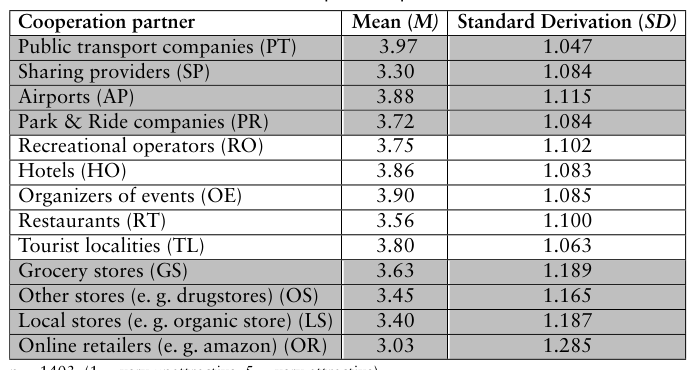
To get an impression of the general acceptance of service extensions of MOD by cooperating with other service providers, a descriptive analysis was conducted. Table 1 shows the average attractiveness rating of different collaboration opportunities within the three areas (mobility providers, other service providers, retail stores).
The results show that, in general, all the cooperation options that were presented to the respondents are perceived as attractive. All mean values are above the neutral value, three. Only cooperation with online retailers is rated close to neutral and meets with less approval. Public transport is rated as the most attractive cooperation partner. In sum, the results show that the respondents are open to cooperation in the MOD sector.
To answer the second research question, the three different cooperation sectors were analzsed in detail to identify if there are significant differences in the perceived attractiveness.
Mobility Providers The univariate analysis of variance showed that the perceived attracti- veness of the different mobility providers differs significantly F(2.903, 4069.61) = 218.48, p < 0.001. Table 2 shows the post hoc analysis for further detail.
The perceived attractiveness of cooperating with public transport is signi- ficantly higher than the attractiveness of cooperating with other mobility service providers. Furthermore, the attractiveness of the cooperation with air- ports is significantly higher than the attractiveness of the cooperation with
Table 1. General attractiveness of cooperation partners.
Acceptance Analysis of Value-Creating Service Cooperations and Extensions 339
Table 2. Comparison of mobility providers (post hoc).
Table available in the original PDF paper.
p (probability) 95% Confidence Interval SE (Standard Error)
PT = Public Transport, SP = Sharing Providers, AP = Airport, PR = Park & Ride Values based on Huynh-Feldt-Correction, adjustment for multiple comparisons: Bonferroni
sharing providers and park & ride. The attractiveness of the cooperation with park & ride services is also significantly higher than the attractiveness of the cooperation with sharing service providers.
Other Service Providers The ANOVA leads to the result that the perceived attractiveness of other services differs significantly F(3.90, 5473.30) = 53.74, p < 0.001. Com- parison of other services (post hoc) Table 3 shows the post hoc analysis in detail.
The perceived attractiveness of cooperation with recreational opera- tors is significantly higher than the attractiveness of cooperation with restaurants. The cooperation with hotels is significantly higher than coo- perations with recreational operators and restaurants. The cooperation with organizers of events is significantly higher than the cooperation with recreational operators, restaurants, or touristic localities. The coo- peration with touristic localities is higher than the cooperation with restaurants.
Table 3. Comparison of other services (post hoc).
Table available in the original PDF paper.
p (probability) 95% Confidence Interval SE (Standard Error)
RO = Recreational Operators, HO = Hotels, OE = Organizers of Events, RT = Restaurants, TL = Tou- ristic Localities Values based on Huynh-Feldt-Correction, adjustment for multiple comparisons: Bonferroni
Retail Stores The ANOVA leads to the result that the perceived attractiveness of retail sto- res differs significantly F(2.27,3185.48) = 115.05, p < 0.001. Table 4 shows the post hoc analysis in detail. The cooperation between MOD with a gro- cery store is perceived significantly more attractive as all the other retail options. The attractiveness of cooperation with other shops (such as gro- cery stores) is perceived significantly higher than the cooperation with online shops. The cooperation with local stores is rated significantly higher than the attractiveness of the cooperation with online shops.
To answer the third research question, the usage probabilities of on- demand shuttles with cooperative options are compared with the usage probability of classic on-demand shuttles (without cooperation). Thus, a t-test for dependent samples is performed.
Table 5 shows a statistically significant difference between MOD service only and MOD cooperating with Mobility Providers (t = −14.34, p <.001, n = 1403). The cooperation of Mobility Providers and a MOD service leads to a significant higher willingness to use the service (M = 3.45, SD = 1.207) in comparison to MOD only without cooperations (M = 3.13, SD = 1.145). The effect size is r =0.71, which means a strong effect as per Cohen (1992). There is also a statistically significant difference between MOD service only and MOD cooperating with other services (e.g., hotels) (t = −10.76, p <0.001, n = 1403). The cooperation of Other Services and a MOD service leads to a significant higher willingness to use the service (M = 3.41, SD = 1.193) than without the service extension. The effect size is r = 0.64 which is perceived as a strong effect. The comparison between MOD service
Table 4. Comparison of retail stores (post hoc).
Table available in the original PDF paper.
p (probability) 95% Confidence Interval SE (Standard Error)
Comparison Mean Difference
Lower limit Upper Limit GS - OS .18 .02 .000 .12 .23 GS - LS .23 .02 .000 .16 .29 GS - OR .60 .03 .000 .51 .69 OS - LS .50 .02 .180 -.01 .11 OS - OR .42 .03 .000 .34 .51 LS - OR .37 .04 .000 .28 .47
GS = Grocery Stores, OS = Other Stores, LS = Local Stores, OR = Online Retailers, Values based on Huynh-Feldt-Correction, adjustment for multiple comparisons: Bonferroni
Table 5. Impact of cooperations on likelihood to use MOD.
Table available in the original PDF paper.
Cooperation M SD t p (t-test) r P (r) MOD only 3.13 1.145 − MOD + Mobility Provider 3.45 1.207 -14.34 .000 .71 .000 MOD + Other Services 3.41 1.193 -10.76 .000 .64 .000 MOD + Retail Stores 3.20 1.223 -2.58 .010 .62 .000
n = 1403; (1 = very unattractive, 5 = very attractive) Q: How likely is it that you would use On-Demand-Shuttles if the following collaborations exist?
Acceptance Analysis of Value-Creating Service Cooperations and Extensions 341
only and the cooperation with MOD and Retail Stores is also showing a significant difference (t = −2.58, p < 0.001, n = 1403) that leading to a signi- ficantly higher likelihood to use MOD than the On-Demand-Service without the cooperation (M = 3.20, SD = 1.223). It can be assumed that each of the three cooperation options leads to a general increase in the intention to use MOD. The effect is most pronounced for cooperation with mobility services.
CONCLUSION
In general, the (potential) users of MOD seem to be very open towards the service extension of on-demand-shuttles. The results show that each coope- ration leads to a significant increase in usage probability. However, the effect of the cooperations with mobility service providers is the highest, followed by the cooperations with other service providers and the cooperations with retail stores. Within the cooperations with mobility service providers, coope- rations with public transport companies are significantly more attractive than other potential cooperation partners. This effect could be explained by the fact that in the countries covered by the study, on-demand-systems are often integrated in the public transport system and are considered in fare structu- res. Accordingly, this cooperation option could have been rated so well by the respondents due to existing positive experience. Within the cooperations with other service providers, the cooperation with organizers of events is the most attractive. However, this potential cooperation partner does not dif- fer significantly from the cooperation with hotels. Nevertheless, these results show the general interest and willingness to use MOD services to manage the trip to a hotel or event instead of the private car. The cooperation with restaurants is the least attractive one, differing significantly from all other potential cooperation partners. Within the cooperation with retail stores, the cooperation with grocery stores is the most attractive. Interestingly, the one with online shops is the least attractive, even though people ordering from these store types mostly online.
The results indicate that cooperations are an effective way to increase the usage and attractiveness of MOD. This is especially the case since the effects also apply to respondents who don’t have any usage experience. The results thus support the assumption that service expansion can address new target groups and thus not only increase the user base but also could enable more profitable business models. Due to the very high acceptance and the great potential of MOD cooperation with other mobility providers such as public transport operators or airports, as well as cooperation with other service providers such as event organizers or hotels, future research on this should investigate the implementation and effectiveness. In addition, future research on potential collaborations in other regions and countries is valuable.
A limitation of the study is the hypothetical approach. Querying the pro- bability of use for a potential service extension is not yet an indicator of whether such cooperation will ultimately lead to use. Accordingly, follow-up research should focus on designing and testing these collaborations. Based on the results, cooperation in the mobility sector is particularly suitable as an early implementation case. In addition, it must be verified whether a service
expansion will lead to substituting emission-supporting means of transport, for example. Substituting environmentally friendly means of transport would reduce the positive effect of MOD usage.
ACKNOWLEDGMENT
The authors gratefully thank the German Federal Ministry of Education and Research (BMBF) for funding (funding code: 02K20Z001).
REFERENCES
Cohen, J. (1992). Statistical power analysis. Current directions in psychological science, 1(3), 98–101. König, A. (2022). Flexible Public Transport - Analysis of User Requirements
on Mobility-on-Demand Systems (Doctoral dissertation, Technische Universität Braunschweig). Knie, A., Ruhrort, L., Gödde, J., & Pfaff, T. (2020). Ride-Pooling-Dienste und ihre Bedeutung für den Verkehr. Nachfragemuster und Nutzungsmotive am Bei- spiel von” CleverShuttle”-eine Untersuchung auf Grundlage von Buchungsdaten und Kundenbefragungen in vier deutschen Städten (No. SP III 2020-601). WZB Discussion Paper. Koutsopoulos, H. N., Ma, Z., & Zahedi, S. (2023). Increasing Shareability in
Ride-Pooling Systems. Reengineering the Sharing Economy: Design, Policy, and Regulation, 146. Martin, E., Wong, S., Cohen, A., Soysal, S., Shaheen, S., & Brown, L. (2022). Mobility on Demand (MOD) Sandbox Demonstration: Los Angeles County and Puget Sound First and Last Mile Partnership with Via Evaluation Report (No. FTA Report No. 0239). Mehlert, C., & Schiefelbusch, M. (2018). Rufbus meets Mobility 4.0: Lernen aus 40
Jahren flexiblem Nahverkehr. Nahverkehr, 36(10). Viergutz, K. K., & Brinkmann, F. (2018). Ridepooling – a model for success?
Digitisation in local public transport. SIGNAL+ DRAHT, 7(8), 13–18.
LISTED IN THE AHFE DIGITAL BOOKSTORE CATALOGUE
Explore the complete digital volume
Human Factors in Transportation
Read this individual research paper free through the original publisher, or explore the full digital proceedings book.
ISBN 978-1-958651-71-1
Explore this ISBN in the AHFE Bookstore ↗Listed in the July 2026 bookstore catalogue; search by ISBN to confirm current availability · Digital book purchase optional