Nicolaj Motzer, Marco Amorim, Michal Matowicki, Mira Kern, Pavla Pecherková (2023). Exploring various dimensions of perceived usefulness on the intention to use Mobility-as-a-Service. In: Human Factors in Transportation. AHFE Open Access, vol. 95, pp. 281–291. https://doi.org/10.54941/ahfe1003813
In response to society’s volatile and changing mobility requirements, many new mobility concepts and business models are currently being developed and piloted. The Mobility-as-a-Service (MaaS) concept attempts to meet rising customer demands in a needs-based and situational manner. For the success of innovative mobility offers, user acceptance and thus a user-centred business model and product development is crucial. The aim of this study is to provide deeper insights in the perception of society’s usefulness in a potential MaaS use to derive recommendations for the design and development of MaaS business models from a user perspective. This is done under consideration of the Importance-Performance-Matrix. The question is investigated to what extent differentiated usefulness dimensions (functional, emotional, social, economical, and ecological) influence the intention to use Mobility-as-a-Service. By applying the Technology Acceptance Model (TAM) in the context of an empirical study the relationships between perceived usefulness dimensions, attitude towards using MaaS and intention to use MaaS were examined. For that, an online survey with more than 6400 respondents from four European countries was conducted. In this, we took care to select latent constructs with the highest possible fit that had already been tested in other studies. This database allowed the proposed TAM to be modelled using structural equation models (SEM) to analyse the relationships between perceived usefulness and behavioural intention to use MaaS.The results show that the perceived emotional, functional, and economical usefulness dimensions significantly correlate with both, the attitude towards and the intention to use MaaS positively. Especially the perception of emotionally increasing elements were identified as main drivers for an intensified MaaS use: The more likely users are to enjoy, feel good about, or have fun using MaaS, the more likely they are to use such a system. One design approach for increasing emotional benefits is to add means of transport to a MaaS package whose use is characterized by a high degree of enjoyment, such as e-scooters and e-bikes. Here, we were able to investigate high correlations between the desire for those transport modes and the intention to use MaaS. Another approach is to remove "pain points" in the transaction process in the MaaS app. It is recommended to implement an integrated booking and payment function. Generally, a MaaS app should simplify the processes that users perceive as complicated in intermodal travel. However, no significant results could be found on the social dimension, which means there is currently no need for action in improving a MaaS system regarding social components. The ecological usefulness dimension shows a significant negative influence on the intention to use on the one hand, and a significant positive influence on the attitude towards using MaaS on the other. The results provide impulses for a user-centred development of MaaS, enable an approach for a differentiated consideration of usefulness dimensions in the context of Mobility-as-a-Service, and suggest a need for more in-depth research.
of digital technologies, traditional economies are being disrupted. This is leading to the emergence of new business models and product innovati- ons. Terms such as platformization, servitization, and everything-as-a-service (Lassnig et al., 2018) are shaping the shift from an ownership-oriented to a service-oriented approach to business models across industries (Caiati et al., 2020). In the mobility and transportation sector, too, the business models of established providers are adapting, innovative players are entering the markets, and new means of transportation are becoming available (Fridgen et al., 2019). In addition to political and economic factors, socio-cultural and technological factors have been identified as the main drivers of change (Gao et al., 2016).
Against this background, innovative and demand-oriented mobility systems are emerging under the term Mobility-as-a-Service (MaaS) (Kamar- gianni et al., 2019). These business models pursue the goal of intermodal integration of all available means of transportation (e.g., public transport, car sharing, bike sharing, ride hailing or pooling) and all services fundamen- tal to their use (e.g., information, planning, ticketing, payment) to provide mobility-as-a-service (Sochor et al., 2018). Hereby, processing is centrali- zed on a digital platform (Arias-Molinares and García-Palomares, 2020). By means of customized mobility packages, customer needs are to be met accor- ding to the situation and MaaS is to develop into an alternative to private vehicle ownership in the long term (Bundesverband Informationswirtschaft, 2018). MaaS is seen as an example of technology-driven innovation that crea- tes a foundation for the vision of future mobility and leads to a “user-centered mobility paradigm” (Goodall et al., 2017). This paradigm shift is considered as the “[...] biggest paradigm change in transport since affordable cars came into the market” (MaaS-Alliance, 2016). Some examples of MaaS systems available today are Whim (a.o., Helsinki) and Jelbi (Berlin).
The concept of MaaS is a new and comparatively under-researched area. Studies on the usage behaviour of MaaS currently represent only a small pro- portion of scientific work (Mola et al., 2020). To date, only a few works exist that address the usefulness of MaaS from a user perspective. The impact of perceived usefulness, differentiated into sub-dimensions, on the intention to use has not been considered in previous studies in the context of MaaS. In the case of user-oriented business models, it is the perceived usefulness from the user’s perspective that determines whether an offer is accepted and will be used (Haller and Wissing, 2020a).
Due to the relevance of the user perspective in the design of MaaS, the aim of this paper is to identify drivers for a MaaS use considering a behavioural science approach. Based on this, recommendations for the user-centred deve- lopment of MaaS business models can be derived. To derive specific implica- tions, this work deals with a subdivision of the perceived usefulness construct into differentiated dimensions and the analysis of their influences on the intention to use MaaS based on the Technology Acceptance Model (TAM).
BACKGROUND
As a complex construct, various differentiation approaches developed in uti- lity research based on the concept of the utility ladder by Vershofen and
Exploring Various Dimensions of Perceived Usefulness on the Intention 283
Proesler (1940), which are applied independently of the object of investiga- tion. About perceived usefulness in consumption decisions, Sheth et al. (1991) established a differentiation into five dimensions (social, emotional, functio- nal, epistemic, and conditional value). Their work provides an ideal basis for extending existing utility constructs, as it has already been validated in nume- rous interdisciplinary studies, also in the context of mobility. For example, Boenigk et al. (2019) investigated the impact of the dimensions of functional, social, hedonistic, and ecological usefulness in a study explaining the sha- ring behaviour, using eCargoBike-sharing as an example. Hartl et al. (2018) analysed drivers for a car-sharing use and considered economic, social, hedo- nistic, and ecological usefulness expectations. Further studies in the context of ride-hailing (Lee et al., 2018) and integrated mobility platforms (Scheuerle et al., 2017), identified hedonistic and economical usefulness dimensions as factors influencing the use of the mobility offers.
To ensure a holistic view of perceived usefulness of MaaS within accepta- nce research, this paper differentiates perceived usefulness into five dimen- sions based on approaches available in the literature. A distinction is made between functional, emotional, social, economic, and ecological dimensions.
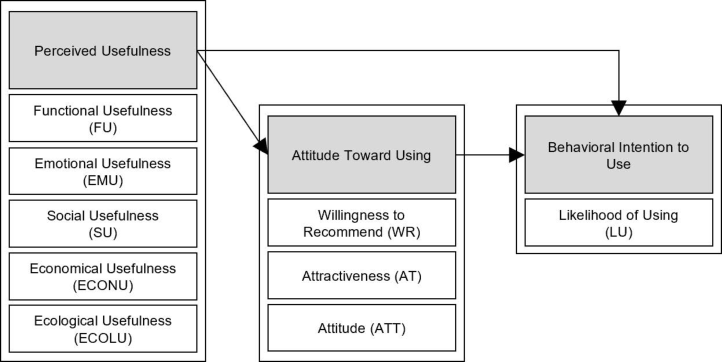
One model that depicts the relationship between perceived usefulness and usage behaviour is Davis’s Technology Acceptance Model (TAM) (Davis, 1985). It is a widely used instrument for measuring the acceptance and usage of information technologies and systems (King/He, 2006). As the core com- ponent of a MaaS system is information technology (MaaS app), the TAM is qualified for measuring technology acceptance (Mola et al., 2020). To examine the relationships between the dimensions of perceived usefulness, attitude towards using, and intention to use, Figure 1 illustrates the research model of this paper, based on the TAM.
As a core analysis of this work, the impact of usefulness dimensions on the intention to use is examined. The actual use and thus acceptance of MaaS follows from the intended use, which is why the intention to use is assigned
Figure 1: Research model.
special relevance in this study. Within the scope of the core analysis, the rese- arch question is examined to what extent the usefulness dimensions influence the intention to use MaaS. The positive impact of perceived usefulness on the intention to use (postulated in the TAM) indicates a positive relationship in the context of hypothesis formulation. The usefulness dimensions are each characterized as independent variables and the intention to use as dependent variable.
METHODOLOGY
Due to the context of the study and insufficient existing data to answer the research objective, an online survey was used within the framework of this research project to collect the required data. In the “MaaS together” pro- ject, a large-scale online survey (approx. 6400 participants) was facilitated in four countries: Germany, England, the Czech Republic, and Poland (Matow- icki et al., 2022). The intended population includes commuters of full age living in urban regions of the mentioned countries, as this represents the potential target group for MaaS usage (Nikitas et al., 2017). These persons could be identified as commuters if they regularly travel by means of tran- sport at least three days per week and thus have mobility needs suitable for MaaS use.
The survey was divided into five blocks (A-E) enclosed by an introduction and a conclusion. In addition, screening questions about participants’ socio- demographics and commuting behaviour were collected at the beginning. In block A, latent variables of personality were included and divided into three blocks for the sake of variety. Block B, C and E included questions not rele- vant for this study. Block D included the main questions relevant for this work which focused on the perceived usefulness of MaaS, differentiated into the 5 sub-dimensions, as well as questions about the attitude towards using and intention to use MaaS. When operationalizing these constructs, we sele- cted scales that have already been tested to ensure high reliability. To gain a uniform understanding of MaaS, a definition was included prior to block D.
There are various methods available in the existing literature for the analy- sis of direct and indirect effects of variables on the predicted outcome. During the end of 20th century, Structural Equation Modelling (SEM) emerged as a powerful multivariate data analysis tool in social science research, especially in the fields of psychology, sociology, and education (Mueller, 1999). Since it can handle numerous endogenous and unobserved variables, it allows to test more elaborate relationships among multiple explained and explanatory variables at the same time (Wang, 2013). Today, with the development and increasing availability of SEM computer programs, it has become a well- established and respected data analysis method utilizing many of existing analysis techniques. The ML approach for the estimation of structural equ- ation models is a so-called covariance-based method. Often LISREL (Linear Structural Relationships) is used as a synonym, though LISREL is the name of a widespread statistical software used in SEM. All covariance-based methods work with the sample variance-covariance matrix and all its information. Therefore, the ML approach is a so-called “full information approach”
Exploring Various Dimensions of Perceived Usefulness on the Intention 285
(Sarstedt et al., 2017). The ML estimation results are model parameter esti- mations. With these parameter estimates fitted values for the latent variables can be computed. This proceeding is reverse to Partial Least Squares (PLS) approach, where so-called scores for the latent variables get estimated first.
THE RESULTS In the analyses regression coefficients for the model were established. The numerical output of our investigated model is presented in Table 1. The first important finding is that the Attitude Towards Using (ATT) has a domi- nant influence on the Behavioural Intention (BI) to use MaaS with estimated regression coefficient of η6 = .561, and p - value <.001. Regarding the Percei- ved Usefulness, the influence degree of different latent variables on overall Behavioural Intention can be ranked as Emotional, Functional, Ecologic, Economic and Social in descending order.
The usefulness dimension with the greatest impact on BI is Emotional Use- fulness (η2 = .322), showing a significant causal relationship (p < .001). This result indicates that perceived usefulness of MaaS in relation to the inten- tion to use MaaS is strongly connected with emotions of the potential user towards this service. Second to this, are the Economical and Functional use- fulness dimensions with their moderately positive relationship with BI. The path coefficients for these latent variables are .146 and .135. On the other hand, quite surprising result is the negative relationship of perceived Eco- logical usefulness on BI among respondents. This relationship was not only adverse, but also relatively strong with η5 of −.176. The only exogenous vari- able that was revealed as statistically insignificant was the social usefulness of MaaS with p = .317 (.05 was chosen as significance criterion).
Functional Usefulness ATT 0.076 0.016 4.677 .000 0.044 0.107 Emotional Usefulness ATT 0.419 0.017 24.360 .000 0.385 0.453 Social Usefulness ATT 0.044 0.011 4.079 .000 0.023 0.066 Economical Usefulness ATT 0.181 0.013 14.267 .000 0.156 0.206 Ecologic Usefulness ATT 0.282 0.010 29.549 .000 0.263 0.301 Functional Usefulness BI 0.135 0.021 6.527 .000 0.095 0.176 Emotional Usefulness BI 0.322 0.026 12.611 .000 0.272 0.372 Social Usefulness BI −0.014 0.014 −1.002 .000 −0.042 0.013 Economical Usefulness BI 0.146 0.017 8.545 .000 0.112 0.179 Ecologic Usefulness BI −0.176 0.014 −12.169 .000 −0.205 −0.148 ATT BI 0.561 0.028 20.006 .000 0.506 0.616
DISCUSSION
Based on the results presented in the previous chapter, implications are given below. The following section classifies and interprets the results using the Importance Performance Matrix by Martilla and James (1977) as a basis. In
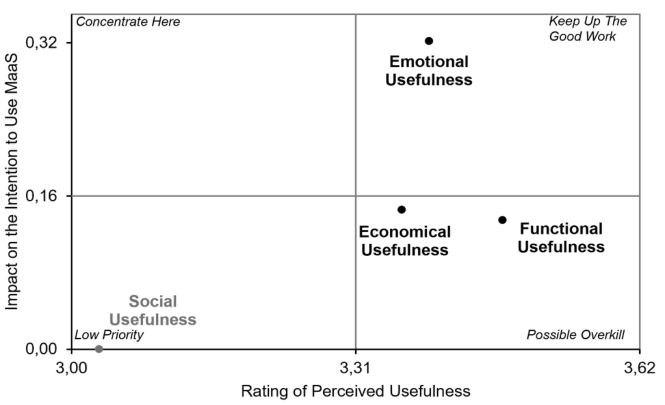
Figure 2, we address the usefulness dimensions results that have a positive impact on Behavioural Intention to use MaaS. Based on these, tendencies to drivers become clear that reinforce the use of MaaS and can be inclu- ded accordingly in a user-centred business model development as well as in strategic decision-making.
To provide implications from the model results, the participants agree- ment, to what extend MaaS provides utility on specific usefulness dimensions (arithmetic means on x-axis) and their impact on the intention to use MaaS (betas from SEM on y-axis) are shown in a two-dimensional matrix. Due to the comparison of the (performance) level of the usefulness dimensions and their impact on the intention to use, this procedure is particularly suitable for the simple derivation of recommendations for action (Schimmelpfennig, 2016). Following the Importance-Performance Matrix, the classification of the usefulness dimensions into quadrants is used to identify drivers as well as strengths and weaknesses (Schimmelpfennig, 2016). Interpretation of the grid as well as marketing strategies are explained in the following (as in Martilla and James, 1977):
1) Keep Up The Good Work: People perceive a MaaS use as (emotionally) beneficial. Fulfilling these expectations is important, as the perception of emotional elements has a high impact on the intention to use MaaS. Thus, business development should focus on constantly meeting those expectations and further implementing emotional elements in MaaS. 2) Concentrate Here: In this quadrant, people perceive elements of MaaS as rather unimportant for usage, however fulfilling these elements has a high impact on the intention to use MaaS. Thus, business development should concentrate on creating awareness of those elements to make them visible.
Figure 2: Importance performance matrix.
Exploring Various Dimensions of Perceived Usefulness on the Intention 287
3) Possible Overkill: People perceive a MaaS use as (economically and functionally) beneficial. Fulfilling these expectations tends to be rather unimportant, as the perception of economical and functional elements has a rather low impact on the intention to use MaaS. Thus, business development should only put effort into avoiding dissatisfaction when not fulfilling (as basic factors) those elements. 4) Low Priority: People perceive MaaS use as (socially) less beneficial. Ful- filling these expectations is rather unimportant, as the perception of social elements has a rather low impact on the intention to use MaaS. Thus, business development should not focus working on those elements.
Since the ecological usefulness dimension has a negative impact on the BI, we have not included the dimension in the matrix due to the low-constructive contribution to MaaS business development. The SEM results for the relati- onship between social usefulness dimension and intention to use MaaS are not significant, no valid statements can be derived here. Accordingly, we have depicted the social usefulness dimension in greyed out form in the figure.
Perceived Emotional Usefulness The matrix shows that the emotional usefulness dimension is located above the average usefulness rating and is based on a high impact factor. The emo- tional usefulness is the most important impact factor for an intended MaaS use. The more likely a MaaS use gives users pleasure or a good feeling, the more likely they are to use it. Currently, participants tend to perceive a higher emotional usefulness in a MaaS use, but its potential has not yet been fully exploited due to its great importance (high impact on BI). To increase the BI, MaaS should be designed so that fun and enjoyment (Georgi and Schaffner, 2017), pleasure (Hamari et al., 2016), or joy (Boenigk et al., 2019) are percei- ved by users. Due to the great importance of perceived emotional usefulness, the recommendation to “Keep Up The Good Work” (Martilla and James, 1977) from the Importance Performance Matrix should be followed. Alth- ough MaaS is seen as a mobility concept that already offers emotional added value, this must be established in the long term. Eliminating pain points (e.g., in transaction process) as well as considering elements that force a positive perception of MaaS on an emotional dimension (e.g., include e-kick-scooters) are just a few examples for optimization to exploit the potential on emoti- onal dimension. An increase of emotional usefulness dimension is strongly reflected in an increasing intention to use and thus acceptance of MaaS.
Perceived Functional Usefulness Further, the matrix shows that the functional usefulness of MaaS is perceived most strongly across all usefulness dimensions. In participants perception, MaaS provides a benefit through faster and easier transportation or effici- ency improvement. Further, the functional dimension is found to be below the average impact level, indicating a tendency for lower impact on BI. The already strongly perceived functional elements in MaaS could be caused by the fact that innovative mobility generally entail the expectation of an incre- ase in mobility performance. The basic usefulness in mobility, transportation
from A to B (Klopp, 2014), remains the basis of new mobility and should naturally be improved (e.g., improve effectiveness and efficiency of physical transport) (Gouthier and Nennstiel, 2018). The most strongly perceived use- fulness dimension is the functional one, which is one of the core elements perceived and expected in MaaS. Despite high expectations of MaaS as a value-generating mobility concept that makes transportation easier, faster, and more efficient, the impact on an intention to use through the fulfil- ment of requirements turns out to be rather moderate. The high expectation should be met moderately (avoid dissatisfaction), but due to the tendency of average impact on the BI, no excessive importance should be attached to it. Due to the already strong perception, an expansion of functional ele- ments in the MaaS development tends to be avoided, although this is assigned to the “Possible Overkill” (Martilla and James, 1977) recommendation. A disproportionately high investment would be required to significantly incre- ase the perceived usefulness on a functional dimension. Further, the impact of functional usefulness on the BI is to be regarded as slightly below the average.
Perceived Economical Usefulness The matrix shows that the rating of economical usefulness of MaaS is percei- ved to be above average. MaaS is seen as a concept for saving money or improving the financial situation. In between the emotional and functio- nal dimension, the economical usefulness has a value just below the average impact on the intention to use MaaS. A perceived economic added value thus has an impact on the intended MaaS use but should not be overestimated due to its moderate impact level. MaaS use is perceived as economically attractive but tends to have a low impact on the intention to use. For the present, the economical usefulness dimension is to be regarded as a “Possible Overkill” (Martilla and James, 1977), where to question whether investments in eco- nomic elements are “too much of a good thing” (Haller and Wissing, 2020b). Nevertheless, a quality reduction on economical dimension should be criti- cally discussed (for each target group). Due to an already adequate perception of economical usefulness above the average of all dimensions, there is no need for action. In this case, the impact on an intended MaaS use takes on a comparatively minor role than investments have a sustainable effect on an increase in use and thus acceptance. Pricing policy resources should be adapted sparingly.
Perceived Social Usefulness Ultimately, the matrix shows that the social perception of usefulness in MaaS was rated the lowest and shows no significant impact on the BI. No valid statement can be made about the impact of social usefulness perception affe- cting the intention to use MaaS. Nevertheless, the results reflect tendencies. Social usefulness can be classified as a “Low Priority” (Martilla and James, 1977) attribute and characterized as “not that significant” (Haller and Wis- sing, 2020c). Social usefulness is the only low-perceived usefulness dimension (below the average). Any investments should not be considered since it is not
Exploring Various Dimensions of Perceived Usefulness on the Intention 289
significantly proven if an increased perception of social added value leads to a higher intention to use MaaS.
CONCLUSION
The results show that the emotional, economical, and functional usefulness dimensions have a significant positive impact on the intention to use MaaS. The more likely usefulness is perceived on these dimensions, the more likely MaaS is used. The social usefulness dimensions, on the other hand, shows no significant influence on the intention to use MaaS. The ecological dimension, meanwhile, proves to be a factor having a significant negative impact on MaaS use.
This study provides a differentiated view of perceived usefulness in the context of MaaS and thus answers the research questions. It was possible to show the extent to which the usefulness dimensions contribute to a BI for- mation, and which dimensions are drivers from the user’s perspective. The results provide a valuable contribution to the state of research on psycho- logical factors influencing the usage behaviour in the context of acceptance research. It highlights the importance of including the user perspective in the development of mobility systems to ensure a sustainable use and acceptance. Nevertheless, it is important to further explore the usefulness dimensions in other markets and temporal realities.
ACKNOWLEDGMENT
This study is a result of the research done in the following projects: “Smart City - Smart Region - Smart Community”-project (CZ.02.1.01/0.0/0.0/17 048/0007435) financed by Czech Operational Programme “Research, Deve- lopment and Education”for the implementation of the European Social Fund (ESF) and the European Regional Development Fund (ERDF) and “MaaS components assessment and system planning for cooperative value creation (MaaS together)” financed by EIT Urban Mobility, as Activity 20006 of the Business Plan 2020.
REFERENCES
Arias-Molinares, D., & García-Palomares, J. C. (2020). The Ws of MaaS: Understanding mobility as a service fromaliterature review. IATSS research, 44(3), 253–263. Boenigk, M., Ulrich, S., & Georgi, D. (2019). Einflussfaktoren der Nutzung
von Sharing-Services. Digitalisierung und Kommunikation: Konsequenzen der digitalen Transformation für die Wirtschaftskommunikation, 349–367. Bundesverband Informationswirtschaft, T.u.n. M.e. V. (2018). White paper: MaaS – Mobility-as-a-Service: Chancen für Mobility-as-a-Service-Geschäftsmodelle. Technical Report. Berlin. Caiati, V., Feneri, A., Jittrapirom, P., Rasouli, S., & Timmermans, H. (2020). An
analysis of the potential adoption of Mobility as a Service across different age groups and lifestages: A mixed-methods approach.
Davis, F. D. (1985). A technology acceptance model for empirically testing new end-user information systems: Theory and results (Doctoral dissertation, Mas- sachusetts Institute of Technology). Fridgen, G., Röhlen, J., Guggenberger, T., Schlatt, V., & Schulze, M. (2019). Über-
prüfung der Machbarkeit eines offenen und dezentralen Mobilitätssystems (OMOS). Bayreuth. Gao, P., Kaas, H. W., Mohr, D., & Wee, D. (2016). Automotive revolution– perspective towards 2030: How the convergence of disruptive technology-driven trends could transform the auto industry. Advanced Industries, McKinsey & Company. Georgi, D., & Schaffner, D. (2017). Kaufentscheidungstreiber bei Dienstleistungen
4.0–Unterschiede zwischen digitalen B2C-und C2C-Services. In Dienstleistungen 4.0: Konzepte–Methoden–Instrumente. Band 1. Forum Dienstleistungsmanage- ment (pp. 141–152). Springer Fachmedien Wiesbaden. Goodall, W., Dovey, T., Bornstein, J., & Bonthron, B. (2017). The rise of mobility as a service. Deloitte Rev, 20(1), 112–129. Gouthier, M. H., & Nennstiel, C. (2018). Neue Mobilitätskonzepte – Eine konzepti-
onelle Analyse. Service Business Development: Band 2. Methoden–Erlösmodelle– Marketinginstrumente, 567–588. Haller, S., & Wissing, C. (2020a). Der Kunde in der Serviceökonomie. Dienstleistungsmanagement: Grundlagen–Konzepte–Instrumente, 41–83. Haller, S., & Wissing, C. (2022b). Qualitätsmanagement im Dienstleistungsbe-
reich. In Dienstleistungsmanagement: Grundlagen–Konzepte–Instrumente (pp. 489–551). Wiesbaden: Springer Fachmedien Wiesbaden. Hamari, J., Sjöklint, M., & Ukkonen, A. (2016). The sharing economy: Why people participate in collaborative consumption. Journal of the association for information science and technology, 67(9), 2047–2059. Hartl, B., Sabitzer, T., Hofmann, E., & Penz, E. (2018). “Sustainability is a nice
bonus” the role of sustainability in carsharing from a consumer perspective. Journal of Cleaner Production, 202, 88–100. Kamargianni, M., Yfantis, L., Muscat, J., Azevedo, C. L., & Ben-Akiva, M. (2019).
Incorporating the mobility as a service concept into transport modelling and simu- lation frameworks. In Special Report-National Research Council, Transportation Research Board. Transportation Research Board. King, W. R., He, J. (2006). A meta-analysis of the technology acceptance model, in: Information & Management, 43 (6), 740–755. Klopp, W., & Klopp, W. (2014). Individualisierung touristischer Leistungsbündel
durch Bausteinsysteme. Individualisierung touristischer Leistungsbündel: Nutzen- facetten der kundenspezifischen Gestaltung online buchbarer Reisen, 59–75. Lassnig, M., Stabauer, P., Breitfuß, G., & Mauthner, K. (2018). Geschäftsmodellinnovationen im Zeitalter von Digitalisierung und Industrie 4.0. HMD Prax. Wirtsch., 55(2), 284–296. Lee, Z. W., Chan, T. K., Balaji, M. S., & Chong, A. Y. L. (2018). Why people partici-
pate in the sharing economy: an empirical investigation of Uber. Internet research, 28(3), 829–850. Maas-Alliance (2016). The european mobility as a service alliance. URL: https://ma as-alliance.eu/2016/06/01/european-mobility-service-alliance/. Martilla, J. A., & James, J. C. (1977). Importance-performance analysis. Journal of
marketing, 41(1), 77–79. Matowicki, M., Amorim, M., Kern, M., Pecherkova, P., Motzer, N., & Pribyl, O.
(2022). Understanding the potential of MaaS–An European survey on attitudes. Travel Behaviour and Society, 27, 204–215.
Exploring Various Dimensions of Perceived Usefulness on the Intention 291
Mola, L., Berger, Q., Haavisto, K., & Soscia, I. (2020). Mobility as a service: An exploratory study of consumer mobility behaviour. Sustainability, 12(19), 8210. Mueller, R. O. (1999). Basic principles of structural equation modeling: An introdu-
ction to LISREL and EQS. Springer Science & Business Media. Nikitas, A., Kougias, I., Alyavina, E., & Njoya Tchouamou, E. (2017). How can autonomous and connected vehicles, electromobility, BRT, hyperloop, shared use mobility and mobility-as-a-service shape transport futures for the context of smart cities?. Urban Science, 1(4), 36. Sarstedt, M., Ringle, C. M., & Hair, J. F. (2017). Treating unobserved heterogeneity
in PLS-SEM: A multi-method approach. Partial least squares path modeling: Basic concepts, methodological issues and applications, 197–217. Scheuerle, T., Dyllick, T., & Grichnik, D. (2017). Entwicklung und Gestaltung sektorübergreifender Geschäftsmodellinnovationen für integrierte Mobilitätsdien- stleistungen in Städten (Doctoral dissertation, Universität St. Gallen). Schimmelpfennig, H. (2016). Bekannte, aktuelle und neue Anforderungen an Trei-
beranalysen. Marktforschung der Zukunft-Mensch oder Maschine? Bewährte Kompetenzen in neuem Kontext, 231–243. Sheth, J. N., Newman, B. I., & Gross, B. L. (1991). Why we buy what we buy: A theory of consumption values. Journal of business research, 22(2), 159–170. Sochor, J., Arby, H., Karlsson, I. M., & Sarasini, S. (2018). A topological approach
to Mobility as a Service: A proposed tool for understanding requirements and effects, and for aiding the integration of societal goals. Research in Transportation Business & Management, 27, 3–14. Vershofen, W., & Proesler, H. (1940). Handbuch der Verbrauchsforschung (Vol. 1).
Berlin: Heymanns. Wang, K. (2013). Causality between built environment and travel behavior: Structural equations model applied to Southern California. Transportation research record, 2397(1), 80–88.
LISTED IN THE AHFE DIGITAL BOOKSTORE CATALOGUE
Explore the complete digital volume
Human Factors in Transportation
Read this individual research paper free through the original publisher, or explore the full digital proceedings book.
ISBN 978-1-958651-71-1
Explore this ISBN in the AHFE Bookstore ↗Listed in the July 2026 bookstore catalogue; search by ISBN to confirm current availability · Digital book purchase optional