Wolfgang Weiss, Henrik Schneider, Sandra Draxler, Manuela Ferreira, Adriana Antunes, Celine Sommer (2024). PREPARIO - Service Design for a Connected and Automated Food Preparation Platform. In: Cognitive Computing and Internet of Things. AHFE Open Access, vol. 124, pp. 94–104. https://doi.org/10.54941/ahfe1004707
Existing solutions for meal preparation are insufficient for many aged people who struggle to re-heat their delivered meals. It often happens that the meals get over- or under heated which can ruin the meal itself as well as destroy the food experience. In some cases, this leads to malnutrition and severe illness and in other cases caregivers are needed to assist with food preparation on an everyday basis, which is time that could be spent better with the client and poses a great financial burden on society.We developed a holistic solution for the preparation of delivered meals. The goal is to enable aged people to prepare their meals safely and independently at home for longer. The solution consists of a novel microwave oven with wireless temperature control that enables fully automated heating of delivered meals to optimal serving temperature. The solution is supported by a digital voice assistance platform and a data-driven support system for external monitoring to allow for efficient care provision. This paper illustrates the applied design process and its accompanying activities and results. The focus is on developing and evaluating a whole service for a diverse user group with an end-user- and customer-centred design process. Co-creation workshops and field trials have been carried out. This lead to detailed insights in the needs and wants of the targeted groups. These activities lead to guide the further technical development of the components as well as to establish a new B2B2C business model with the aim to reduce the burden on the primary end-users.
Many elderly people rely on delivered food from municipalities, private food companies, and social services. The meals require manual heating at home to reach serving conditions and this is often done using a microwave oven. How- ever, the heating results of the microwave oven heavily rely on a manual trial and error process due to a lack of temperature control, which often leads to
PREPARIO - Service Design for a Connected and Automated Food Preparation Platform 95
a decreased food experience. Research has shown that the general complex- ity of microwave user interfaces poses a barrier for people with disabilities and ageing people. A market analysis revealed that the average quantity of buttons present on microwaves is 16 (Zallio, 2017). Automating the heat- ing process and simplifying the user interface have been presented and show promising results (Zallio, 2021) (Russo, 2004). However, there appears to be a huge lack of innovation for meal preparation in the field of assisted living systems (Fasoli, 2023) (Howells, 2007). This is a missed opportunity since the meal is found to be one of the most important drivers for well-being in assisted living homes and the health of ageing people (Howells, 2007) (Hestevik, 2020).
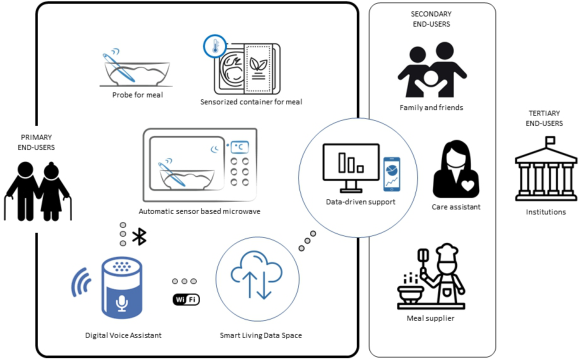
The PREPARIO1 project aims at developing a complete service for re- heating of delivered food and its associated processes for elderly people. This includes a connected and automated food preparation platform, which inte- grates a novel microwave oven with wireless temperature measurement, a voice assistant device and connection to a smart home environment, collect- ing data for efficient guidance and help. The project targets the following user groups: Primary end-users are people aged 65+ years who rely on delivered meals. Secondary end-users are people or organisations in direct contact with the primary end-users, namely family, caregivers or food delivery companies. Tertiary end-uses are all institutions that are influencing the other users, e.g. public sector, local government, social security systems etc. Figure 1 summa- rizes the system architecture of the solution and the relation to the end-users. The solution allows primary end-users living independently to heat their pre- prepared and home delivered meals to an adequate and safe temperature for consumption in a fully automated way. PREPARIO is funded within the Euro- pean AAL programme “Ageing well in a digital world” which has a focus on research and development for elderly people.
Figure 1: System overview of the PREPARIO service.
1https://www.aal-europe.eu/projects/prepario/
This paper illustrates the applied design process and its accompanying activities and results. The focus is on developing and evaluating a service for a diverse user group with an end-user- and customer-centred design pro- cess. Therefore, the paper describes the applied design process which includes a series of co-creation workshops. This follows a field trial where the system components were evaluated with primary end-users. The paper summarizes the results of these activities, discusses them and ends with a conclusion.
DESIGN PROCESS The following user groups were identified for the development of the PREPARIO service. The primary end-users are older adults (+65 years old) of any gender, with enough autonomy to live on their own, but who rely on delivered food. They will be active users of the sensor-based microwave, and smart home system to receive and finalise meal preparation in their homes for a better food and eating experience. Secondary end-users are all the people or organisations in direct contact with older adults for the food delivery, namely family, caregivers, or food delivery companies as well as care associations that provide home support. Tertiary end-users are all institutions, e.g., public sec- tor, local government, social security systems, etc., that may not be in direct contact with end-users but strongly contribute to enabling the product and service to reach them. They are potential buyers of the solution and have a crucial role in the organisation, decision making process, and purchasing of the food delivery service. We further distinguish between end-users of the ser- vice, the primary user group, and the customers. The latter group is the one who pays for the product. Depending on the targeted business model, this can be the family members of the primary end-users, the care organisation, or even the primary end-user group itself.
An established model for the development of services is the service design approach. This is the activity of planning and organizing a business’s resources (people, infrastructure, communication, and material components) and its processes in order to improve the service quality. This includes also the interaction between service providers and their actors as well as an under- standing of the users and their context. The service design approach aims to create value for the customer and to understand why customers buy a partic- ular service (cf. (Andreassen, 2016) (Patrício, 2011)). The PREPARIO service design process was structured as follows:
Identification of the actors involved in the enabling and use of the service
Understand the actors in terms of needs, wants, empathy, analysis of context of use.
Developing and evaluating prototypes of the service
Collecting feedback and improving the solution The first step started with identifying the actors and then mapping them to roles. Stakeholders have been identified and interviews have been carried out. In total 81 social institutions have been addressed with questionnaires to deepen the knowledge of the targeted primary end-users their needs and expectations. This was followed by a user-centred design process for the
PREPARIO - Service Design for a Connected and Automated Food Preparation Platform 97
solutions to be implemented. To better understand the various users and cus- tomers a series of co-creation workshops were held. The aim was to get early feedback about the digital solution, identify possible barriers, develop ideas for the use of the product, and to identify suitable potential business models. Prototypes of the service have been implemented and evaluated in a field trial with primary and secondary end-users. The details of the workshops and the field trial, its results and implications on further development are discussed below.
SYSTEM IMPLEMENTATION The Connected and Automated Food Preparation Platform PREPARIO inte- grates a novel microwave oven with a wireless temperature probe, a voice assistant device and connection to a smart home environment, collecting data for efficient guidance and help. Figure 1 gives an overview of the architecture of the solution and the relation to the various users groups.
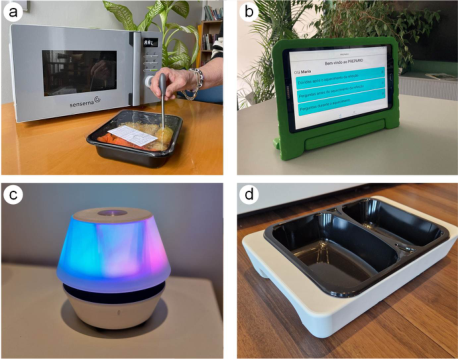
Figure 2: PREPARIO system components: a) the microwave oven with the wireless temperature probe, b) the survey app for end-users, c) the smart home voice assistant EMMA, d) the food tray with built in sensors.
A new wireless temperature sensor has been developed specialized for the usage within microwave ovens to measure the temperature of the food while the heating process is active. This has the potential to mitigate various prob- lems of microwaves. The user interface can be simplified, temperature control of the food is available, and there is a guarantee that the food is evenly heated. For the PREPARIO project, two solutions are developed: Solution one is a novel wireless temperature probe (Figure 2a). The probe contains temperature sensors and their values are sent to the microwave via radio communication. The microwave supports automated heating of meals and has a pre-defined target temperature of 75
C. In the second solution the probe is replaced by a tray, which incorporates the temperature sensors, see also Figure 2d. This is the most user-friendly solution where the microwave
oven senses the meals’ temperature and heats it up without any further user interaction.
This smart microwave system enables connections to other devices. In our case the personal smart voice assistant EMMA home was used (Figure 2c). The voice assistant can tell the status of the meal and the heating process and remind the user when the food is ready to be picked up. This broadens the range of the established EMMA product, which can be used as a connected smart home voice assistant to perform various tasks such as setting scenes, starting music, reminding of medicine and so on. EMMA is also connected to the user’s wireless LAN and will relay every information of the probe to the smart living data space (SLDS). Additionally, a survey app (see Figure 2b) deployed on a tablet, is used to ask the user short questions throughout the day. The SLDS collects information about the environment of the user. It can then trigger context sensitive questionnaires through the survey app or visualize collected data on a dashboard. This gives the secondary end-users feedback about the primary end-users.
CO-CREATION WORKSHOPS Three co-creation workshops have been carried out. Each of them were hosted by different organisations of the project consortium. Potential partici- pants were invited from the network of the organisations. At the workshops, the participants were introduced to the PREPARIO project, its service model, and its technical components. Videos were shown about the use of the sensorized microwave oven and the EMMA smart home system. Then the participants discussed the questions asked.
Workshop 1 A co-creation workshop was carried out as an online video conference with 9 participants in total. The stakeholders’ backgrounds ranged from manage- ment of care organisations, management of medical aid organisations in the departments of care for elderly at home, and from academia in the field of nursing research. The participating stakeholders are in close contact with the targeted primary user group. They know their needs, living conditions, and their daily structures.
The moderated discussion covered following topics (i) usage and useful- ness, (ii) functionality, and (iii) markets, business opportunities and revenue streams. The following statements were made regarding usage and usefulness:
New microwaves are often no more user-friendly than old ones. Because they have so many buttons that it becomes too complicated for people to use.
Think further about the system, it should be a complete service. Possibly with instructions to prepare a complete meal from the ingredients.
Not sure how useful the data about the smart home system is. The dash- board data shows only a small excerpt from a whole day of a person. Other data will be missing e.g., when person eats somewhere else.
PREPARIO - Service Design for a Connected and Automated Food Preparation Platform 99
The following statements were made about functionality:
Integration with existing smart home solutions e.g. Alexa is desired as some households already have those systems in use.
Clients living in a care organisation have a fixed daily routine; a system that reminds them would be helpful, for example when preparing meals.
One care organisation already uses a similar product for cooking (Ther- momix(R)). It works well for their clients in assisted living. It gives people independence and self-efficacy. Also virtual voice assistants (e.g. Alexa) are in use and it works well for cognitive impaired people.
A smart home system should speak in the voice of a familiar person, this would make things much easier.
The following statements were made about markets, business opportuni- ties and revenue streams:
It is a niche product, but demand is possible.
For many (poorer) people this product is not their top priority, they have other more fundamental problems to solve every day.
Possible new target group: cognitive impaired people.
Possible business models: rent or buy.
Target groups for selling this service could be: – Private customers who buy the microwave oven or the service. – Care organisation who buy the microwave oven or the service and then rent it to their clients. – A subscription from a food delivery service, with the microwave oven included for free (or for a reduced price).
Workshop 2 The second workshop was held in November 2023 in Lisbon by the organi- sation Santa Casa da Misericórdia de Lisboa (SCML). This is an institution governed by private law and of administrative public utility that has guided its work in the community by defending social values. They have around 6,300 collaborators and provide daily support to thousands of inhabitants in the city of Lisbon. With regard to the home support service, SCML provides support to around 1,800 clients and deliver around 850 meals a day, directly to their clients’ homes. The refrigerated meals are distributed by SCML and supplied by a private food company. 17 people participated in the workshop, coming from various departments of SCML and other external organisations such as private institutions of social solidarity, local city councils, and a meal supply company. The workshop was organised around three main discussion topics:
The current situation regarding the delivery of meals to clients living in home care.
The proposed PREPARIO solution.
A business plan for PREPARIO.
The current situation of food delivery at SCML has also its advantages. It is an established process. Especially for an organisation with lots of clients, it is not easy to adapt such a system. Whereas, this system needs clients who are sufficiently autonomous and carry out adequate heating of the delivered food. Some suggestions for improving the current process were discussed, namely adopting a daily distribution system. A recurring complaint by clients is the appearance and smell of the delivered food. This can also be the result of inadequately heating the food.
The following positive aspects about the PREPARIO solution are the most important for this stakeholder group: The simplification of the process due to the automatic temperature control. This also results in saving time and miti- gating the risk to destroy the food. Collecting information about the clients is deemed positive, as it can give feedback to the family and other stakeholders. The concerns are mainly around the extra costs of the product. Many pri- mary end-users cannot afford this. The wireless temperature probe is seen as not suitable for many people as it can be easily lost. Finally, the participants found it difficult to identify the extent to which the proposed solution could have an impact on reducing complaints about the service currently provided and the quality of the food guaranteed.
In the last round of discussions, the business opportunities were explored. A major point is that someone has to pay for the extra hardware that is needed. Therefore, 13 participants stated that they would pay 0 - 100 Euros for this solution. 4 would pay 101 - 200 Euro, and one person stated that not the primary end-user should pay for it. A solution could be support from public authorities or combining the microwave with a contract to provide meals. A further request was that the microwave should be able to heat more than one meal at the same time.
Workshop 3 A co-creation workshop was held by the municipality of Vila Nova de Cerveira as a face-to-face meeting. The municipality with its 9,000 residents is building social skills by promoting activities involving community-based social institutions that distribute daily meals to the elderly and also provide other services. The workshop took place in November 2023 and a total of 17 people participated. The participants were from the fields of political representatives from local authorities, public social services, public health services, social institutions and private companies that provide care for the elderly, companies in the food sector and new technologies for the elderly and a company in the plastics processing sector were invited to take part in this workshop. The workshop was organised around three main discussion topics in the same way as in the second workshop described above.
In summary, the current situation in home meal distribution is seen as an important factor to give people equal opportunities to obtain fresh, healthy and balanced meals and to make their everyday lives easier. The problems identified were congruent with those identified in the run-up to the project: no control over the heating process, difficulties handling food containers, and uneven temperature as well as no options for feedback.
PREPARIO - Service Design for a Connected and Automated Food Preparation Platform 101
What the project PREPARIO is offering was seen as valuable in follow- ing aspects: the heating process is easier to use and ensures food safety, it has audible reminders, and the possibility to collect feedback from the users directly via voice or through a big touch interface. It saves time and allows more time for the caregivers to be with the clients. Problems that were identi- fied: possible aversion against a new device; some training might be needed; the cost of the system; the possibility to lose the probe, as it is not physically connected to the microwave and the hygiene of the probe.
Regarding the business opportunities, the question of the cost of the system was in the focus. 12 participants stated they would pay 0 to 100 Euros and 3 participants stated they will pay 101–200 Euros. Here too it the prevalent opinion was that the care organisation should provide the system and include the costs into the monthly fees to clients.
FIELD TRIALS After the solution was carefully tested in the lab, it was delivered for a field trial which was carried out by the end-user organisation partners. The tri- als took place in two different locations in Portugal, one in Lisbon and one in Vila Nova de Cerveira. The goal of the first field trial was to test the PREPARIO solution with primary end-users. The solution for this trial consisted of the following components: the microwave oven with a wireless temperature probe (Figure 2a), a survey app on a tablet to fill in question- naires (Figure 2b). Data gathered at the field trial is anonymous and there is no way to link the answers and observations to a specific user. In detail, the following aspects were targeted for the field test:
Gather end-user data about usage of the whole system in a real-world environment.
Get feedback about usability and identify usability issues of each component.
Get insights and feedback from users about heating different types of meals.
Before the experiments, potential end-users were contacted by the end- user organisations and asked if they want to participate in the field trial. In case they agreed, they were asked to read and sign the informed consent. The experiments itself were carried out with one participant at a time and in the presence of a trial instructor. First, the participants were welcomed and got an introduction about the trial and the technological solution. They then had to fill out the pre-questionnaire of the field trial and then choose a meal to be heated. The participants had to place the temperature probe and start the heating of the meal on their own. After the heating was finished, the participants sensed the temperature of the meal and then ate it. After finishing this, they filled out the post-questionnaire.
In total 30 primary end-user participants took part in the field trial and all of them filled out the pre-questionnaire. The pre-questionnaire revealed the following information: 27% (N = 8) of the participants never heat up any meal with a microwave oven; 40% (N = 12) do so one to three times
per week and 33% (N = 10) heat up 4 to 7 meals per week. Choosing a program on a conventional microwave oven is perceived as easy for 80% (N = 24) of the participants. 67% (N = 20) of the participant find it easy to heat the meal with a conventional microwave oven to their liking. For 57% (N = 17) it never happens that their food is too hot after heating. For 10 par- ticipants (33%) this happens from time to time and for 3 (10%) this happens regularly. The other situation, that food stays too cold, happens for three par- ticipants (10%) regularly, for 50% (N = 15) from time to time and for 40% (N = 12) never. Regarding the experience with tablets and smartphones, the participants answered that 53% (N = 16) use such devices regularly but 47% (N = 14) not. 26 participant (87%) say that it is easy to use the survey app on the tablet, whereas 4 participants (13%) disagree.
The post-questionnaire was filled out by 28 participants and it revealed the following: All participants agreed that placing the temperature probe was easy for them. Likewise, 90% (N = 25) of participants found removing the probe easy after heating. 96 percent of the participants (N = 27) said that it was easy for them to heat up the meal. The duration for heating the meal was perceived for one person (4%) as short, for 9 participants (32%) as long, and for the majority (64%, N = 18) as adequate. Most of the participants (82%, N = 23) had no suggestions for improvements. Regarding the temperature of the meal, one participant (4%) said that it was too cold, for three (11%) it was too hot, and for the majority (86%, N = 24) it was perfect to eat. 27 of the participants (96%) said it was an advantage to use a microwave oven with a temperature probe over a conventional microwave oven.
RESULTS AND DISCUSSION OF FEEDBACK Carrying out co-creation workshops with various representatives and experts in the field of care services was a big benefit in developing and evaluating the PREPARIO service. The invited stakeholders have either direct contact to the primary end-users or they serve them indirectly. They have lots of expe- rience and knowledge about the end-users needs and their living situations. Therefore, they can draw from a wealth of experience
The co-creation workshops lead to the adaptation of the business model in the following aspect: A stronger focus should be placed on a business- to-business-to-consumer (B2B2C) business model. Options suggested were renting the system or creating a subscription model together with a care organisation or a food delivery service. In addition, support from public authorities is possible. The reason for this is to reduce the one-time costs for the primary end-users, as extra money for buying the solution is often not available. A new target group of cognitive impaired people was identified. The wish was expressed to enhance the system, so that primary end-users can cook their own meals with step-by-step instructions. There were two requests to improve the microwave. Especially for handicapped or elderly people plac- ing the probe could be a problem. This also has hygienic reasons. For this user group it is preferred to focus the development on the tray with the integrated temperature sensor. The second request was that the microwave should also be able to heat up more than one meal at the same time. The data driven
PREPARIO - Service Design for a Connected and Automated Food Preparation Platform 103
support was considered as important, but it should display information that is more meaningful. This can be achieved by including various information such as users’ context of activities. The aim is to remind the users when to cook, ask suitable questions at the right time, or just keeping them active. Some other needs where also identified. It is important that primary end- users receive adequate introduction and training in the usage of the system, in order to avoid possible aversion against a new device.
The field trials provided us practical feedback from primary end-users car- ried out in their everyday environments. Enough data could be collected through the questionnaires to ensure that the prototype is suitable for the primary target group. They could easily place and remove the temperature probe. The duration of the heating process was adequate for most partici- pants and also the temperature of the food satisfied most of them. The heating process should be fine-tuned to achieve the right temperature for the various dishes.
CONCLUSION
The aim of the PREPARIO project is to establish a complete service for re- heating of delivered food and its associated processes for elderly people. We established an end-user- and customer centred design process to ensure high service quality right from the beginning. The subject of the investigation was the individual technical components and the entire business service behind them.
The activities started with the identification of the user groups. The pri- mary end-users are adults (+65 years old) who live at home and use meal delivery services. The secondary end-users are people or organisations in direct contact with the primary group (e.g. family, caregivers). The tertiary group are the institutions that may not be in direct contact with the end- users. In order to include this variety of stakeholders in the design we carried out several activities. It started with a collection of questionnaires which addressed 81 social institutions. Three individual co-creation workshops have been carried out and they gave us valuable feedback for fine-tuning of already identified business models. Following the workshops, we developed a B2B2C business model to reach a wider range of customers and further identified a new target user group of cognitive impaired people. Potentially critical usability problems were identified which lead to focus the further development of the food tray. The data driven support was considered as important, but it should provide information that is more meaningful. This can be achieved by including various information such as users’ context of activities.
A first field trial was carried out which involved 30 primary end-users. The field trials provided practical feedback from primary end-users, which was carried out in their everyday environments. It proved that the system is suitable and useful for the primary end-user group. A second field trial is planned and will be carried out in the future.
In one of the workshops, the following statement was made: “The perfect meal is freshly cooked with personal accompaniment”. At least with our solu- tion we can guarantee that the meal is perfectly heated for optimum nutrition. Another important aspect is the time saved, and for people who live at home with care assistance, they get back more of the “quality time”.
ACKNOWLEDGMENT
The authors would like to thank the participants in the user trials and the health care assistants who made the tests possible as well as the attendees in the co-creation and stakeholder workshops for their open and valuable opinions.
The project PREPARIO (AAL-2021-8-158-CP) has received a funding from AAL JP, co-funded by the European Commission and National Funding Authorities of Austria, Denmark and Portugal.
REFERENCES
Andreassen, T. W., Kristensson, P., Lervik-Olsen, L., Parasuraman, A., McColl- Kennedy, J. R., Edvardsson, B. and Colurcio, M. (2016), “Linking service design to value creation and service research”, Journal of Service Management, Vol. 27 No. 1, pp. 21–29. https://doi.org/10.1108/JOSM-04-2015-0123 Fasoli, Annachiara, et al. (2023) “Mapping emerging technologies in aged care:
results from an in-depth online research.” BMC Health Services Research 23.1. Hestevik, Christine Hillestad, et al. (2020) “Older patients’ and their family caregivers’ perceptions of food, meals and nutritional care in the transition between hospital and home care: a qualitative study.” BMC nutrition 6: 1–13. Howells, Amber D. (2007) The impact of perceived quality on assisted living
residents’ satisfaction with their dining experience. Diss. Kansas State University. Patrício, L., Fisk, R. P., Falcão e Cunha, J., & Constantine, L. (2011). Multilevel Service Design: From Customer Value Constellation to Service Experience Blueprinting. Journal of Service Research, 14(2), 180-200. https://doi.org/10. 1177/1094670511401901 Russo, James, et al. (2004) “SmartWave intelligent meal preparation system to help
older people live independently.” 2nd International Conference on Smart Homes and Health Telematics (ICOST). Vol. 14. Zallio, Matteo, et al. (2017) “Design of a community-supported CapAble microwave system for people with intellectual and physical disabilities.” Ambient Assisted Living: Italian Forum 2016 7. Springer International Publishing. Zallio, Matteo, et al. (2021) “A co-Design approach to develop a smart cooking
appliance. Applying a Domain Specific Language for a community supported appliance.” arXiv preprint arXiv:2101.08886.
LISTED IN THE AHFE DIGITAL BOOKSTORE CATALOGUE
Explore the complete digital volume
Cognitive Computing and Internet of Things
Read this individual research paper free through the original publisher, or explore the full digital proceedings book.
ISBN 978-1-964867-00-7
Explore this ISBN in the AHFE Bookstore ↗Listed in the July 2026 bookstore catalogue; search by ISBN to confirm current availability · Digital book purchase optional