Safa Omri, Florian Urmetzer, Jens Neuhüttler (2026). Digital Personas in Immersive Learning: How Avatar-Mediated Interaction Shapes Competency Development in Higher Education: A Systematic Review. In: Human Factors in Design, Engineering, and Computing. AHFE Open Access, vol. 238, pp. 1522–1532. https://doi.org/10.54941/ahfe1008380
How do digital personas and avatar embodiment influence learning and behavior in metaverse environments? We systematically reviewed 184 studies on immersive technologies in higher education (2018 - 2025), focusing on the socio-behavioral mechanisms through which avatar-mediated interaction shapes competency development. Our findings are sobering: while the Proteus effect and social presence enhance short-term engagement, fewer than 25 studies employed experimental designs and no longitudinal evidence exists. We propose a causal mechanism chain from immersion to real-world skill transfer and identify specific break-points where the chain fails. Digital persona design emerges as a key moderating variable that has been conceptually recognized but barely investigated empirically. The integrative framework we develop positions ethical considerations as cross-cutting rather than peripheral and generates testable propositions for future research. We discuss implications for metaverse platform design and institutional adoption strategy.
What happens when a management student steps into someone else’s shoes, literally? In a metaverse environment, a junior associate can embody a CEO avatar and experience how communication patterns shift when others perceive her differently. A student from Heilbronn, Germany can collaborate with peers in Cambridge, UK through spatially co-present avatars, restoring social cues that Zoom strips away. A reserved learner can rehearse a high- stakes negotiation through a confident-looking digital persona before facing the real thing. These are not hypothetical scenarios; they are documented in the literature we review here. The question is whether they produce learning that lasts.
We have reason to be cautious. The metaverse hype cycle peaked in 2021 when Facebook rebranded to Meta; two years later, Reality Labs had accumulated losses exceeding $40 billion and enterprise adoption had stalled (Wiederhold, 2022). The technologies continue to mature, but the evidence for their educational effectiveness has not kept pace with the investment.
Digital Personas in Immersive Learning 1523 Academic work on immersive learning is scattered across information systems, educational technology, psychology, and management (Tinmaz and Fanea-Ivanovici, 2023). Immersive tools are adopted faster than instructional designs are developed to use them well (Hamilton et al., 2021), and the most confident effectiveness claims come from corporate white papers rather than peer-reviewed research.
Prior reviews have mapped metaverse education broadly (Tlili et al., 2022; Akour et al., 2024) or examined VR training as a generic category (Hamilton et al., 2021). What is missing, and what we attempt here, is a systematic analysis that foregrounds digital personas as a central variable rather than a peripheral feature, examines the socio-behavioral mechanisms through which avatar embodiment influences competency development, and evaluates the evidence base with the scepticism it deserves. We address three questions. Through what mechanisms does avatar-mediated interaction influence learning outcomes, and how robust is the evidence? What technological, institutional, and ethical factors moderate these mechanisms? And what causal chain links immersion to real-world skill transfer, and where does it break?
THEORETICAL BACKGROUND AND KEY CONSTRUCTS We use metaverse in the sense of Smart, Cascio and Paffendorf (2007): a persistent, shared virtual space in which users are represented by avatars and interact with each other and with the environment in real time. The term spans immersive virtual reality (VR), augmented and mixed reality (AR, MR), and desktop virtual worlds such as Gather.town. An avatar is the graphical representation through which a user acts in such a space. A digital persona is the avatar together with the identity the learner adopts through it: its appearance, the role it is assigned, the anonymity it allows, and the norms under which it is used. We study digital personas as a pedagogical design choice rather than a technical feature, because it is the persona, not the rendering, that carries the identity dynamics we examine. By competency development we mean the acquisition of knowledge, skills and attitudes that transfer to professional practice. Three theoretical lenses guided the review, chosen before coding because each speaks to a different link between embodiment and learning. The Proteus effect (Yee and Bailenson, 2007) holds that people adjust their behavior to match the characteristics they perceive in their own avatar; it makes avatar design a lever on behavior and predicts that assigned personas, not only self-chosen ones, change how learners act and are treated. Social presence theory (Short, Williams and Christie, 1976) describes the degree to which a medium lets participants experience each other as real and present; media richness theory (Daft and Lengel, 1986) adds that richer media suit equivocal tasks, and the Community of Inquiry framework (Garrison, Anderson and Archer, 2000) that social presence must combine with cognitive and teaching presence to produce learning. Experiential learning theory (Kolb, 2014) frames learning as a cycle of concrete experience, reflection, conceptualization and experimentation; immersive environments supply the first, and without deliberate reflection the theory predicts that experience will not become transferable knowledge.
METHOD
We followed the PRISMA 2020 guidelines (Page et al., 2021). The search was run in mid-2025 on the Fraunhofer INT KATI platform (Becker et al., 2016; John, Fritsche and Gulden, 2021), which integrates Web of Science, Scopus and Dimensions records and offers semantic filtering suited to interdisciplinary topics. The Boolean string was:(metaverse OR “virtual world*” OR “virtual realit*” OR VR OR “augmented realit*” OR AR OR “mixed realit*” OR “extended realit*” OR XR) AND (education* OR learning OR teaching OR pedagog* OR “business school*” OR MBA OR “higher education” OR “executive education”).
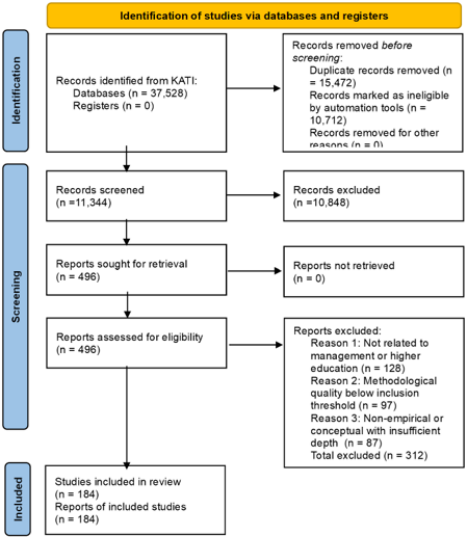
It returned 37,528 records. The string targets immersive technologies in education broadly and contains no avatar, embodiment or persona term, because studies that engage embodiment mechanisms often do not use these words in titles or abstracts. The cost is that avatar-mediated interaction is a central theme within the corpus rather than its selection criterion, so we identified the studies that treat the avatar or persona as an explicit object of study during full-text coding; only a minority of the final 184 studies do so.
Figure 1: PRISMA flow diagram illustrating the identification, screening, and inclusion process. From 37,528 initial records, 184 studies met inclusion criteria.
After removal of 15,472 duplicates and of 10,712 records flagged as ineligible by automated filtering rules (publication year outside 2018 to 2025, document type, and domain terms unrelated to management or higher education), 11,344 records were screened on title and abstract and 496 full texts were assessed. The rules were implemented in a reproducible
Digital Personas in Immersive Learning 1525 Python pipeline; scripts and decision logs are available from the authors. Quality screening assessed relevance to management or higher education, methodological transparency, and conceptual depth; studies rated insufficient on two or more dimensions were excluded (n = 97), as were studies without topical relevance (n = 128) or sufficient depth (n = 87), leaving 184 studies. The threshold screened for transparency and depth, not for research design, so inclusion does not signal strong evidence.
We read and coded the 184 studies thematically. The initial categories came from the research questions and the three lenses; further themes emerged during coding, including avatar identity effects beyond the Proteus literature, the gap between what studies claim and what their designs can support, and the role of institutional governance beyond pilots. Each study was also classified by technology type and research design. The framework was built by cross-theme analysis: for each theme we asked which conditions the studies report as necessary for an effect to appear and which they report as causing it to fail. The first set became the framework components, the second the break-points of the mechanism chain. The review is limited to English-language publications, to a mid-2025 cutoff, and to the databases aggregated by KATI, whose semantic filtering is not directly reproducible elsewhere; the corpus is dominated by management education.
FINDINGS We organize the findings around four domains and assess, in each, not just what the literature claims but how confidently it can claim it. Table 1 summarizes the evidence and shows where digital persona design enters each domain.
Table 1: Evidence map: what the literature supports in each domain, how strong that evidence is, and where digital persona design enters.
Table available in the original PDF paper.
Domain What the Evidence Supports, and How Strongly
Confidence building, bias reduction and freer participation, shown in laboratory experiments with small samples and immediate post-tests; almost none in sustained courses; no comparison with non- digital role-play Social presence and collaboration Higher perceived presence than video conferencing and workable cross-cultural projects; team outcomes rarely measured; initial cognitive load reported
Through identity: who learners appear to be shapes how presence turns into participation
Experiential learning and simulation
Engaging simulations and role-play at scale; fewer than 25 controlled designs; small self- efficacy gains; no retention or transfer data
Through role: the persona a learner embodies frames the experience to be reflected on
Assessment and analytics
Embedded assessment and AI scoring proposed; mostly conceptual, few implementations in higher education
Through data: persona behavior is the unit of analysis, raising surveillance and fairness questions
Digital Personas and Avatar-Mediated Interaction Avatar-mediated interaction is the domain most distinctive to metaverse environments and the least understood. For management education, avatar embodiment is a design variable with direct behavioral consequences. We found three documented affordances. Avatar customization supports confidence-building: reserved students communicate more openly through confident-looking personas (Won and Davis, 2024; Chen et al., 2021b). Embodying outgroup avatars can reduce implicit bias and increase empathy in controlled settings (Bertrand et al., 2018; Chen, Chan and Tan, 2021a; Chen and Ibasco, 2023). And anonymity can lower social barriers to participation (Crone and Kallen, 2022).
But avatar identity is double-edged. People respond differently to attractive and unattractive avatars, importing physical-world prejudices into the virtual setting (Bartl et al., 2021); the anonymity that frees a shy student also reduces the social consequences of disruptive behavior; and large gaps between real and virtual selves can create trust issues in group work (Cheymol et al., 2023). These are design problems, not inevitabilities: they call for avatar norms, structured debriefs, and psychological support for perspective-taking exercises that can evoke strong emotional reactions (Hamilton-Giachritsis et al., 2018).
The evidence base is thinner than it first appears. Only a minority of the 184 studies treat the avatar or persona as an explicit object of study; the rest mention avatars as a platform feature. Nearly all Proteus-effect studies come from HCI or social psychology laboratories, not from classrooms over sustained periods. Bias-reduction results rely on small samples and immediate post-tests; nobody has shown that these attitude changes survive a week, let alone shape workplace behavior months later. We identified no longitudinal research on repeated avatar embodiment and professional identity, and no comparison with the case exercises, role-play and structured dialogue that management educators have used for decades.
Social Presence and Virtual Collaboration Metaverse platforms promise richer remote collaboration than video conferencing. Avatars in spatially organized settings can walk, gesture, and cluster into side conversations, restoring social cues that flat-screen communication eliminates (Nguyen and Pham, 2024; Hendriks et al., 2024). VR environments enhance perceived social presence relative to Zoom (van der Meer et al., 2023), and collaborative online international learning (COIL) projects can foster cross-cultural understanding (Esguerra et al., 2024).
Social presence theory predicts exactly this. But the question that matters is whether better presence produces better team outcomes, and here the evidence drops off sharply: most studies measure perceived presence or satisfaction, almost none decision quality, conflict resolution, or professional networks. Persona design enters this domain through identity. Whether learners meet as realistic likenesses, stylized figures, or anonymous avatars changes who is speaking and how others respond, yet the collaboration studies in our corpus rarely report, let alone vary, the avatar settings they used.
Digital Personas in Immersive Learning 1527 Experiential Learning and Simulation Design
Metaverse platforms can deliver experiential learning at scale: crisis simulations, virtual factory walkthroughs, business games, interactive cases (Tonteri et al., 2023; Netland et al., 2020; Ketron et al., 2025), and avatar- based role-play with AI feedback for soft skills (Suarez, Jung and Lindeman, 2021). They supply Kolb’s concrete experiences, and presence can make those experiences feel consequential (Sin et al., 2023).
The problem is the evidence. Of our 184 studies, fewer than 25 used experimental or quasi-experimental designs with adequate controls; the rest are pilot descriptions, small-scale perception surveys, or conceptual pieces. The academic evidence is modest: Wu, Yu and Gu (2020) and Kim et al. (2020) report small gains in self-efficacy from small samples with immediate post- tests. Immersive environments enhance short-term engagement; we cannot say they produce better learning than a well-facilitated case discussion, and we found no data on whether competencies developed in VR transfer to workplaces or persist beyond the novelty period.
What does matter, the evidence suggests, is instructional design rather than technological fidelity. Well-designed simulations balance sensory and narrative elements with structured reflection and debriefing (Zak and Oppl, 2022; Vona et al., 2023), and reflection is precisely what technology-driven implementations most often neglect (Hamilton et al., 2021). Here the persona is the role the learner occupies. Netland et al. (2020) and Tonteri et al. (2023) place learners in a factory or a company, yet role assignment is almost never treated as a design variable, so we cannot tell whether a learner who embodies a plant manager reflects differently from one who tours the factory as herself.
Assessment and Behavioral Analytics Immersive environments generate data streams (decisions, navigation paths, communication patterns, response times) that could enable assessment embedded within learning rather than bolted on afterwards (Lampropoulos and Evangelidis, 2025; Zi and Cong, 2024). Almost none of this has been implemented in higher education; this domain has the largest gap between aspiration and evidence in our review. Here the digital persona is the unit of measurement: where personas are assigned rather than self-chosen, analytics capture behavior under an imposed identity, and the fairness of inferences drawn from it is an open question the corpus does not address.
FRAMEWORK AND CAUSAL MECHANISM CHAIN The reviewed literature treats technology, pedagogy, ethics, and institutional governance as separate concerns. Our framework (Figure 2) integrates them. Its six components are the conditions the reviewed studies repeatedly report as necessary for an effect to appear: Institutional Context (strategy, policy, resources, accreditation) enables Technological Infrastructure and guides Pedagogical Design; these shape Learner and Instructor Agency, including digital persona design; where they converge,
Immersive Learning Experiences produce Learning Outcomes that feed back through evaluation. Ethical Design (privacy, inclusion, wellbeing, fairness) is a cross-cutting layer rather than a standalone dimension, because ethical questions arose within technology (data granularity), pedagogy (avatar bias), assessment (surveillance), and governance (data policy).
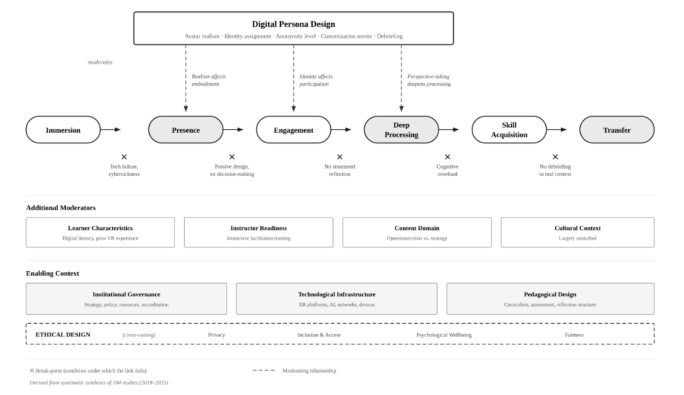
The Causal Chain and Its Break-Points The framework’s core analytical contribution is a specified mechanism chain: Immersion leads to Presence, which fosters Engagement, enabling Deep Processing, producing Skill Acquisition, and ultimately Transfer. The links map onto the three lenses: social presence and the Proteus effect, then experiential learning, then transfer. The reviewed studies report a failure mode at each transition. Immersion fails to produce presence when technology malfunctions, cybersickness intervenes, or environments are interactively shallow (Laine and Lee, 2024; Hendriks et al., 2024). Presence fails to produce engagement without tasks that demand active decision-making (Sin et al., 2023; Tonteri et al., 2023). Engagement fails to produce deep processing when structured reflection is absent (Hamilton et al., 2021; Zak and Oppl, 2022; Vona et al., 2023), the most common failure in the literature. Processing fails to produce acquisition under cognitive overload or emotional overwhelm (Hendriks et al., 2024; Hamilton-Giachritsis et al., 2018). And acquisition fails to produce transfer when debriefing does not bridge virtual and real contexts; the few outcome studies stop at immediate post-tests (Wu, Yu and Gu, 2020; Kim et al., 2020). This last link is the least studied and the most consequential (Figure 2).
Figure 2: Causal mechanism chain from immersion to real-world transfer. Digital persona design moderates three links. Break-points (×) identify failure conditions at each transition. Derived from the synthesis of 184 studies (2018–2025).
Digital Personas in Immersive Learning 1529 Digital Persona Design as Moderator: Three Propositions
Digital persona design, we propose, moderates the chain. The reviewed studies do not test it as such, so we state the claim as propositions built from the pattern of evidence.
P1: Avatar realism and embodiment quality moderate the immersion-to- presence link: the more a learner experiences the avatar as their own body, the more immersion produces presence (Bartl et al., 2021; Cheymol et al., 2023). P2: Identity assignment and anonymity moderate the presence-to-engagement link: assigned confident or outgroup personas increase participation among reserved learners and shift attitudes, while anonymity lowers both the barrier to participation and the cost of disruption (Won and Davis, 2024; Chen et al., 2021b; Crone and Kallen, 2022). P3: Debriefed perspective-taking moderates the engagement-to-processing link: embodiment deepens processing when a structured debrief connects the persona experience to the learner’s own development goals, and distorts it when strong emotional reactions go unaddressed (Bertrand et al., 2018; Hamilton-Giachritsis et al., 2018).
Figure 2 lists further moderators (learner characteristics, instructor readiness, content domain, cultural context) as open questions the corpus barely addresses.
IMPLICATIONS AND RESEARCH AGENDA Three findings translate into platform design guidance: structured persona assignment, not only open-ended customization, because controlled perspective-taking produces stronger effects than free self-expression; built-in reflection affordances such as replay and guided debriefing prompts, since absent reflection is the most frequent failure point in the chain; and privacy- preserving analytics by default.
For institutional adoption, pilots should build in reflection and debriefing from the start, investment decisions should rest on outcomes measured weeks or months later rather than on same-day satisfaction surveys, and avatar norms and data policies should be set at institutional level.
Five research priorities follow: (1) controlled comparisons with traditional instruction, measuring outcomes at 3, 6, and 12 months; (2) experimental manipulation of realism, identity assignment and anonymity to test P1 to P3; (3) longitudinal research across full programs; (4) pilot implementations of embedded assessment; and (5) cross-cultural comparison of avatar preferences and collaboration norms.
CONCLUSION
We reviewed 184 studies and found a field that has generated considerable excitement and remarkably little rigour. The affordances are real but conditional on reflection built into the design, governance that sustains investment beyond the pilot, and serious attention to privacy and psychological safety. Digital persona design emerges as a variable the field has recognized
but barely investigated. The mechanism chain and its break-points offer testable propositions: does avatar realism strengthen the immersion-to- presence link, does structured persona assignment deepen processing, does debriefing quality predict transfer? Answering them would move the field from showing that immersive learning is engaging to showing that it builds durable, transferable competencies.
REFERENCES
Akour, I., Al-Maroof, R.S., Alfaisal, R. and Salloum, S.A. (2024). A conceptual framework for determining metaverse adoption in higher institutions. Education and Information Technologies, 29, pp. 1–44. Bartl, A., Wenninger, S., Wolf, E., Botsch, M. and Latoschik, M.E. (2021). Affordable
but not cheap: A case study of the effects of two 3D-reconstruction methods of virtual humans. Frontiers in Virtual Reality, 2, 694617. Bertrand, P., Guegan, J., Robieux, L., McCall, C.A. and Zenasni, F. (2018). Learning empathy through virtual reality: Multiple strategies for training empathy-related abilities using body ownership illusions in embodied virtual reality. Frontiers in Robotics and AI, 5, 26. Chen, V.H.H., Chan, S.H.M. and Tan, Y.C. (2021a). Perspective-taking in virtual
reality and reduction of biases against minorities. Multimodal Technologies and Interaction, 5(8), 42. Chen, V.H.H. and Ibasco, G.C. (2023). All it takes is empathy: How virtual reality perspective-taking influences intergroup attitudes and stereotypes. Frontiers in Psychology, 14, 1265284. Chen, V.H.H., Ibasco, G.C., Leow, V.J.X. and Lew, J.Y.Y. (2021b). The effect of VR
avatar embodiment on improving attitudes and closeness toward immigrants. Frontiers in Psychology, 12, 705574. Cheymol, A., Fribourg, R., Lécuyer, A., Normand, J.-M. and Argelaguet, F. (2023).
Beyond my real body: Characterization, impacts, applications and perspectives of “dissimilar” avatars in virtual reality. IEEE Transactions on Visualization and Computer Graphics, 29(11), pp. 4426–4437. Crone, C.L. and Kallen, R.W. (2022). Interview with an avatar: Comparing online and virtual reality perspective taking for gender bias in STEM hiring decisions. PLoS ONE, 17(6), e0269430. Daft, R.L. and Lengel, R.H. (1986). Organizational information requirements, media
richness and structural design. Management Science, 32(5), pp. 554–571. Esguerra, J.R. et al. (2024). Collaborative online international learning in the metaverse. International Journal of IT and Global Education, 6(1), pp. 100–108. Garrison, D.R., Anderson, T. and Archer, W. (2000). Critical inquiry in a text-based
environment: Computer conferencing in higher education. The Internet and Higher Education, 2(2–3), pp. 87–105. Hamilton, D., McKechnie, J., Edgerton, E. and Wilson, C. (2021). Immersive virtual reality as a pedagogical tool in education: A systematic literature review of quantitative learning outcomes and experimental design. Journal of Computers in Education, 8(1), pp. 1–32. Hamilton-Giachritsis, C., Banakou, D., Garcia Quiroga, M., Giachritsis, C. and
Slater, M. (2018). Reducing risk and improving maternal perspective-taking and empathy using virtual embodiment. Scientific Reports, 8(1), 2975. Hendriks, P., Olt, C.M., Sturm, T. and Moos, C.C. (2024). Exploring team collaboration in the metaverse. Journal of Intellectual Capital, 25(4), pp. 686–710.
Digital Personas in Immersive Learning 1531 John, M., Fritsche, F. and Gulden, C. (2021). Where to start reading? Introducing
the reference-citation plot. In: Glänzel, W., Heeffer, S., Chi, P.-S. and Rousseau, R. (eds.) Proceedings of the 18th International Conference on Scientometrics and Informetrics (ISSI 2021). ISSI Society, pp. 539–544. Ketron, S. et al. (2025). Creating an immersive business simulation for marketing education. Marketing Education Review, 35(2), pp. 120–136. Kim, K.G., Oertel, C., Dobricki, M., Olsen, J.K., Coppi, A.E., Cattaneo, A. and
Dillenbourg, P. (2020). Using immersive virtual reality to support designing skills in vocational education. British Journal of Educational Technology, 51(6), pp. 2199–2213. Kolb, D.A. (2014). Experiential learning: Experience as the source of learning and development. 2nd ed. Upper Saddle River, NJ: Pearson FT Press. Laine, T.H. and Lee, W. (2024). Collaborative virtual reality in higher education:
Students’ perceptions on presence, challenges, affordances, and potential. IEEE Transactions on Learning Technologies, 17, pp. 280–293. Lampropoulos, G. and Evangelidis, G. (2025). Learning analytics in AR, VR, and the metaverse. Applied Sciences, 15(2), 971. Netland, T.H., Flaeschner, O., Maghazei, O. and Brown, K. (2020). Teaching
operations management with virtual reality: Bringing the factory to the students. Journal of Management Education, 44(3), pp. 313–341. Nguyen, T.-H. and Pham, X.-L. (2024). Enhancing social presence through metaverse platform. Policy Futures in Education. Page, M.J., McKenzie, J.E., Bossuyt, P.M., Boutron, I., Hoffmann, T.C., Mulrow, C.D.
et al. (2021). The PRISMA 2020 statement: An updated guideline for reporting systematic reviews. BMJ, 372, n71. Short, J., Williams, E. and Christie, B. (1976). The social psychology of telecommunications. London: Wiley. Sin, Z.P.T. et al. (2023). Toward an edu-metaverse of knowledge: Immersive
exploration of university courses. IEEE Transactions on Learning Technologies, 16(6), pp. 1096–1110. Smart, J., Cascio, J. and Paffendorf, J. (2007). Metaverse roadmap: Pathways to the 3D web. Acceleration Studies Foundation. Suarez, G., Jung, S. and Lindeman, R.W. (2021). Evaluating virtual human role-
players for the practice and development of leadership skills. Frontiers in Virtual Reality, 2, 658561. Tinmaz, H. and Fanea-Ivanovici, M. (2023). Bibliometric analysis of the metaverse in education. Education and Information Technologies, 28, pp. 17729–17751. Tlili, A., Huang, R., Shehata, B. et al. (2022). Is metaverse in education a blessing
or a curse: A combined content and bibliometric analysis. Smart Learning Environments, 9, 24. Tonteri, T., Holopainen, J. et al. (2023). Immersive virtual reality in experiential learning. In: Proceedings of the 56th Hawaii International Conference on System Sciences (HICSS). van der Meer, N. et al. (2023). Virtual reality and collaborative learning: A systematic
literature review. Frontiers in Virtual Reality, 4, 1159905. Vona, F. et al. (2023). Designing simulations of leadership for CAVE. In: HCI International 2023 Posters. Cham: Springer, pp. 324–331. Wiederhold, B.K. (2022). Ready (or not) player one: Initial musings on the metaverse.
Cyberpsychology, Behavior, and Social Networking, 25(6), pp. 345–346. Won, A.S. and Davis, D.Z. (2024). Avatar embodiment in the identity economy.
Convergence, 30(2), pp. 882–903.
Wu, B., Yu, X. and Gu, X. (2020). Effectiveness of immersive virtual reality using head-mounted displays on learning performance: A meta-analysis. British Journal of Educational Technology, 51(6), pp. 1991–2005. Yee, N. and Bailenson, J. (2007). The Proteus effect: The effect of transformed
self-representation on behavior. Human Communication Research, 33(3), pp. 271–290. Zak, K. and Oppl, S. (2022). VR learning scenarios for soft skills training. HMD Praxis der Wirtschaftsinformatik, 59(1), pp. 142–158. Zi, L. and Cong, X. (2024). Metaverse solutions for educational evaluation.
Electronics, 13(6), 1017.
SEARCH THE AHFE DIGITAL BOOKSTORE BY ISBN
Explore the complete digital volume
Human Factors in Design, Engineering, and Computing
Read this individual research paper free through the original publisher, or explore the full digital proceedings book.