Zoher Rafid-Hamed, Jay Kalra (2026). The Disclosure Paradox: A Human Factor Framework to Medical Error Disclosure. In: Human Factors in Design, Engineering, and Computing. AHFE Open Access, vol. 238, pp. 2174–2180. https://doi.org/10.54941/ahfe1008443
Disclosure of adverse events is essential to managing the consequences of medical error, yet the period immediately following an error may be when healthcare providers feel least prepared to communicate openly. Fear of blame, litigation, reputational harm, and damage to the physician-patient relationship may discourage disclosure. However, failure to disclose can compromise patient autonomy and trust while increasing provider isolation and distress. We propose a quadrant model in which two independent factors shape responses to medical error: transparency of disclosure and support for patients, families, and healthcare providers. Their interaction produces four states: Silence, when both transparency and support are lacking; Insulation, when providers receive support without appropriate disclosure; Exposure, when disclosure occurs without adequate support; and Restoration, when honest disclosure is accompanied by meaningful support. To promote Restoration and reduce recurrence, we introduce the seven-domain “RESTORE” Framework: Recognition of the adverse event and its impact; Ethical, patient-centred disclosure; Support for patients, families, and providers; Transparency about known and uncertain information; Opportunity to restore trust and professional integrity; Reflection on individual and systemic contributing factors; and Evaluation and improvement. A restorative approach keeps patients and families central while recognizing that disclosure without support and support without disclosure are incomplete responses. Integrating transparency, support, reflection, and quality improvement can move healthcare beyond blame and isolation toward healing, learning, and safer, higher-quality patient care.
Medical error remains a persistent concern in patient safety. Adverse events may arise from failures in planning, performance, communication, or the systems that deliver care. Canadian research has estimated that adverse events occur in 7.5% of hospital admissions and that more than one- third are preventable (Baker et al., 2004). The frequency of harm makes
The Disclosure Paradox: A Human Factor Framework to Medical Error Disclosure 2175 prevention essential, but prevention cannot be the only response. Healthcare organizations also need a reliable way to respond after harm has occurred.
Disclosure is central to that response. Patients need timely and accurate information to understand what happened, make decisions about further care, and exercise autonomy. Honest communication can also protect the therapeutic relationship when trust is most vulnerable. Canadian and international guidance accepts disclosure as an ethical responsibility, yet practice remains uneven (Kalra et al., 2020; Kalra et al., 2024). Recent comparative work found that Canadian jurisdictions generally endorse disclosure but provide inconsistent guidance on training, team coordination, follow-up, and enforcement (Rafid-Hamed et al., 2026).
This gap between principle and practice reflects a difficult paradox. Immediately after an error, patients and families most need honesty, acknowledgment, and direction (Hemmelgarn et al., 2017). At the same time, the clinicians involved may be shocked, ashamed, uncertain about the facts, or afraid of legal and professional consequences. A policy that simply orders disclosure does not resolve these pressures. A policy that supports clinicians but permits silence does not meet patients’ needs. A complete response must therefore consider two independent dimensions: communication transparency and the support available to everyone affected. This paper develops a four-quadrant model from those dimensions and proposes the RESTORE Framework as a practical route toward transparent, supported, and learning-oriented disclosure.
WHY DISCLOSURE BREAKS DOWN Providers generally recognize that they should discuss significant harm with patients (Benjamin et al., 2025). Their hesitation often concerns how, when, and with whom the discussion should occur. Fear of litigation, discipline, reputational damage, and loss of the patient’s confidence can encourage delay or carefully limited communication (Lawongsa K., 2025). Uncertainty also matters. An initial conversation may take place before an investigation has established the sequence of events or identified contributing factors. If clinicians believe disclosure requires a complete explanation, they may wait until they know all the facts. That delay can look like concealment to patients and families.
Emotional distress creates an additional barrier. Wu (2000) described the clinician involved in an error as a second victim who may experience guilt, anxiety, loss of confidence, and isolation. The term does not equate the clinician’s experience with the patient’s injury, nor should it shift attention away from the patient. It identifies a practical problem: a distressed and unsupported provider may struggle to take part in a clear, compassionate conversation. Studies of disclosure programs have consequently emphasized coaching, peer support, and institutional preparation alongside communication requirements (White et al., 2015).
Organizational culture can intensify or reduce these pressures. In a blame- oriented setting, reporting an event may feel like supplying evidence for punishment. Staff may protect themselves through silence, vague language,
2176 Rafid-Hamed and Kalra or premature blame-shifting. A just culture takes a different approach. It distinguishes reckless conduct from human error and system failure, preserves accountability, and focuses on how work conditions contributed to the event. This approach does not remove individual responsibility. It creates conditions in which facts can be reported and examined without assuming that every adverse outcome reflects moral failure (Rogers et al., 2017).
Training is also inconsistent. Disclosure requires more than a general instruction to be honest. Clinicians must know how to acknowledge harm, explain established facts, state what remains uncertain, respond to anger or grief, and plan next steps for communication. They also need clarity about team roles. Canadian policy reviews repeatedly identify provider education as one of the least consistently included elements, even though training is essential to reliable practice (Kalra et al., 2020; Kalra et al., 2024). These barriers show why transparency and support should be examined separately rather than treated as a single institutional quality.
THE FOUR QUADRANTS OF MEDICAL ERROR RESPONSE The proposed model (see Table 1) places transparency on one axis and support on the other. Transparency refers to prompt acknowledgment of the event, communication of known facts, disclosure of uncertainty, and a commitment to updates. Support includes practical and emotional assistance for patients and families, as well as preparation, peer support, and organizational guidance for providers. Combining low and high levels on each axis produces four states: Silence, Insulation, Exposure, and Restoration.
Table 1: The interaction between transparency and support yields four possible responses to medical error.
Table available in the original PDF paper.
Low Support High Support High Transparency Exposure Disclosure without adequate support Restoration Disclosure with meaningful support
Low Transparency Silence Neither disclosure nor support
Insulation Support without adequate disclosure
Silence Silence occurs when transparency and support are both weak. The event may be minimized, delayed, or left out of discussion, while patients, families, and healthcare providers receive little guidance. Patients may suspect that something has been withheld but lack the information needed to understand changes in their condition or care. Providers may cope alone and avoid reporting details that could help an organization learn. The result is not neutral. Nondisclosure can compromise autonomy, deepen mistrust, and prevent examination of the conditions that produced harm.
Unclear policy can sustain silence as much as deliberate concealment. If no one is assigned to lead the conversation, each team member may assume someone else will. If leaders respond to reports mainly by locating fault, staff learn that speaking openly carries personal risk. The absence of a structured
The Disclosure Paradox: A Human Factor Framework to Medical Error Disclosure 2177 response also leaves patients without a clear contact for questions, follow-up, or support. In this quadrant, the clinical event ends but its relational, emotional, and systemic consequences remain largely unaddressed.
Insulation Insulation combines provider support with limited transparency for patients and families. An organization may offer confidential peer support, legal advice, or internal debriefing while tightly controlling external communication. These resources can reduce provider distress and are valuable on their own. The problem arises when protection becomes the main objective, and the patient’s right to know becomes secondary.
This state can appear caring because providers are not abandoned after a difficult event. However, support without disclosure is ethically incomplete. It may reinforce the idea that openness is a threat rather than a professional responsibility. Patients may receive altered treatment without a satisfactory explanation, and families may be excluded from information affecting future decisions. Provider assistance should prepare clinicians for disclosure, not shield the system from a necessary conversation.
Exposure Exposure occurs when an organization requires disclosure but provides insufficient support. The patient may receive information, but the conversation is assigned to an unprepared clinician with little coaching, emotional support, or authority to arrange follow-up. Patients and families may also be left without a liaison, counselling, or practical help after the meeting. Transparency is present, but the process can feel abrupt and procedural.
Disclosure under these conditions may place an unreasonable burden on an individual provider. A frightened or uncertain clinician may use technical language, speculate about causes, or apologize without explaining what will happen next. The meeting may satisfy a policy requirement without meeting the needs of those involved. Patients need continuing access to information and care, while providers need preparation and a team that can help them communicate accurately.
Restoration Restoration joins transparent disclosure with meaningful support. The organization acknowledges the event promptly, communicates confirmed facts in understandable language, and states clearly what is not yet known. Patients and families receive a contact person, opportunities to ask questions, and updates as the review progresses. Clinicians receive coaching, peer assistance, and clarity about their responsibilities. The response remains patient-centred because support for providers serves accurate disclosure and safer care rather than replacing accountability.
Restoration does not promise that trust will return to its previous state. Some harms are irreversible, and some relationships cannot be repaired.
2178 Rafid-Hamed and Kalra The aim is a respectful and accountable response. An apology may be important, but words must be followed by action. Patients need to know how immediate needs will be addressed, how the event will be reviewed, and how they will be informed of improvements.
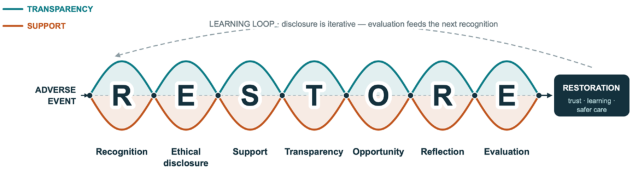
THE RESTORE FRAMEWORK The RESTORE Framework translates the restorative quadrant into seven connected practice areas (see Figure 1). Recognition begins with identifying the adverse event and acknowledging its clinical, emotional, and relational effects. Recognition should include the patient’s experience, not just the organization’s severity classification. It also requires attention to family members and staff who may be affected.
Figure 1: Illustration of the seven interconnected domains of the RESTORE Framework, which guide disclosure, support, reflection, and improvement after a medical error.
Ethical disclosure requires honest, patient-centred communication. The initial discussion should happen promptly, include reasonably established facts, and avoid speculation or premature blame. The person leading the conversation should use understandable language and allow time for questions. If the investigation is incomplete, the team should say so and explain when they will follow up.
Support must be available to patients, families, and providers. Patient support may include a designated liaison, assistance accessing continuing care, counselling, interpretation, or information about complaint and review processes. Provider support may include peer response, confidential counselling, disclosure coaching, and, when necessary, relief from immediate duties. These forms of assistance have different purposes, but both help sustain an honest process.
Transparency extends beyond the first meeting. Healthcare teams should distinguish known information from uncertainty, document what they have communicated, and provide updates as new facts emerge. This ongoing obligation matters because disclosure is usually iterative rather than a single conversation (Rafid-Hamed et al., 2026). A prompt acknowledgment followed by silence can reproduce the mistrust that disclosure was intended to prevent.
Opportunity refers to rebuilding trust and professional integrity through accountable action. Patients should be invited to describe their concerns and needs. Clinicians should have a constructive role in follow-up and improvement.
The Disclosure Paradox: A Human Factor Framework to Medical Error Disclosure 2179 Restoration cannot be demanded from a patient or measured only by satisfaction; the organization can only create a credible opportunity for it.
Reflection examines both individual decisions and system conditions. A review should consider workload, communication, supervision, technology, policy, and transitions in care, while still addressing conduct that falls outside acceptable practice. The purpose is to understand how the event occurred and what can reasonably change. This systems focus supports the non-punitive approach recommended in earlier Canadian disclosure work (Kalra et al., 2013).
Evaluation and improvement close the loop. Organizations should track whether disclosure occurred promptly, whether follow-up commitments were met, whether support was offered, and whether corrective actions were completed. Patients and providers should be able to comment on the process. Lessons should then inform education, policy, and care design. Without evaluation, the same weaknesses may persist even when an individual conversation is handled well.
PUTTING RESTORATION INTO PRACTICE Implementation requires more than adding RESTORE to a written policy. Health systems should define who initiates disclosure, who leads the conversation, what support can be activated, and how to document updates. Interprofessional simulation can prepare clinicians for difficult discussions and clarify team roles. Training should continue across education, residency, orientation, and professional development.
Organizations should create a rapid-response disclosure team to coordinate clinical leadership, patient relations, risk management, and peer support. It should organize a consistent response without taking the conversation away from clinicians who know the patient. Accreditation and regulatory bodies can reinforce the model by requiring training, support pathways, follow-up procedures, and quality-improvement review. A national Canadian framework would reduce variability while allowing local adaptation.
Evaluation should reflect both axes. Counting disclosures measures transparency but says little about support, while staff access to counselling does not establish that patients were informed. Assessment should examine timeliness, completeness, patient and family experience, provider preparedness, follow-up, and completion of safety actions. These measures would show whether an organization is moving toward Restoration.
CONCLUSION
Medical error creates obligations that extend beyond treating the immediate harm. Patients and families need truthful information, continued communication, and practical support. Healthcare providers need preparation and assistance so that fear and distress do not obstruct those duties. The quadrant model makes visible the incomplete responses that result when either transparency or support is missing. Silence neglects both; Insulation protects providers without adequately informing patients; Exposure discloses without providing the resources needed to manage the consequences.
2180 Rafid-Hamed and Kalra Restoration offers the most complete response by joining honest disclosure with support, reflection, and improvement. The RESTORE Framework provides a practical structure for this work while keeping patients and families at the centre. Its value will depend on clear roles, longitudinal training, accessible support, ongoing communication, and evaluation of whether promised changes occur. Used in this way, disclosure can become more than an isolated conversation after harm. It can become a standard process for respecting autonomy, addressing the needs of those affected, and learning how to deliver safer care.
REFERENCES
Baker, G.R. et al., (2004) ‘The Canadian Adverse Events Study: The incidence of adverse events among hospital patients in Canada’, Canadian Medical Association Journal. Benjamin, E. M., Peterson, A., Schweitzer, L., Calcasola, S., Korn, F., Lodato, P.,
Bradley, J., & Hemmelgarn, C. (2025). The power and pain of words: How language matters in responding to patients after harm. Frontiers in health services, 5, 1513670. Hemmelgarn C. Silence. In: Battles J, Azam I, Reback K, et al., editors. Advances in Patient Safety and Medical Liability. Rockville (MD): Agency for Healthcare Research and Quality (US); 2017 Aug. Kalra, J., Kalra, N., & Baniak, N. (2013). Medical error, disclosure and patient safety:
A global view of quality care. Clinical biochemistry, 46(13–14), 1161–1169. Kalra, J., Rafid-Hamed, Z., Johnston, B., Seitzinger, P. (2024). Patient Centered Care: Medical Error Disclosure Guidelines Across Canada. In: Jay Kalra (eds) Healthcare and Medical Devices. AHFE (2024) International Conference. AHFE Open Access, vol 130. AHFE International, USA. Kalra J., Rafid-Hamed Z., Seitzinger P. (2020). Disclosure of Medical Error:
A Necessary Step in Healthcare Improvement. International Conference on Applied Human Factors and Ergonomics. Springer Cham. Lawongsa K. (2025). Avoiding Deception and Nondisclosure in Clinical Practice: A Narrative Review of Ethical Principles, Legal Perspectives, and Communication Strategies. Cureus, 17(9), e92424. Rafid-Hamed, Z., Johnston, B., Saxena, A., Kalra, J. (2026). Bridging the Gap: Toward
a Unified Framework for Transparent and Patient-Centered Error Disclosure. In: Jay Kalra (eds) Healthcare and Medical Devices. AHFE (2026) International Conference. AHFE Open Access, vol 211. AHFE International, USA. Rogers, E., Griffin, E., Carnie, W., Melucci, J., & Weber, R. J. (2017). A Just Culture Approach to Managing Medication Errors. Hospital pharmacy, 52(4), 308–315. White, A.A., Brock, D.M., McCotter, P.I., Hofeldt, R., Edrees, H.H., Wu, A.W.,
Shannon, S. and Gallagher, T.H. (2015), Risk managers’ descriptions of programs to support second victims after adverse events. Journal of Healthcare Risk Management, 34: 30–40. Wu A. W. (2000). Medical error: the second victim. The doctor who makes the mistake needs help too. BMJ (Clinical research ed.), 320(7237), 726–727.
SEARCH THE AHFE DIGITAL BOOKSTORE BY ISBN
Explore the complete digital volume
Human Factors in Design, Engineering, and Computing
Read this individual research paper free through the original publisher, or explore the full digital proceedings book.