Masataka Kanzaki, Koichi Akagi, Hikaru Takashima, Manabu Sawaguchi (2026). Human-Centered Creative Support for VE Idea Realization Through Contradiction Analysis. In: Human Factors in Design, Engineering, and Computing. AHFE Open Access, vol. 238, pp. 2401–2411. https://doi.org/10.54941/ahfe1008465
In product development, value Engineering (VE) has been widely adopted in manufacturing as a standardized framework based on function-oriented thinking approach to meet increasingly diverse and sophisticated customer demands. However, the assessment of the feasibility of ideas generated through VE and the resolution of design conflicts (contradictions) still tend to depend heavily on the tacit knowledge of experienced designers. To address this challenge, this study proposes a systematic method that utilizes the concept of physical contradictions from TRIZ (a Russian acronym meaning “Theory of Inventive Problem Solving”) into the development phase of VE in order to support the realization of innovative ideas that often face obstacles due to conflicting requirements. A case study was conducted on the liquid end parts of a metering pump manufactured by TACMINA CORPORATION. As a result, concrete solutions based on TRIZ inventive principles were derived for several improvement proposals that had previously been considered infeasible due to contradictions when relying solely on conventional VE activities.
The advantages of utilizing TRIZ techniques for VE activities has already been discussed. As one practical and effective approach to generate the highly innovative solutions by applying, it has been proposed to apply the contradiction solution concept of TRIZ technique to the functional approach of VE (Sawaguchi, 2000). In addition, the development of enhanced VE flamework by applying TRIZ technique in order has been proposed to enhance the creative skills of VE team and guide the VE process, which effectively and efficiently produce the “Focussed” ideas for innovative solution to an essential problem (Mao, 2008). As the obstacles to realization of the idea generated by VE activity, on the other hand, there are “Limitation of Human”, “Restrictions by Regulations” and “Restrictions by Physical Phenomenon”.“Limitation of Human” includes the shortage of skills and knowledge of VE members, de-crease in motivation due to a fear of failure,
limitation of consideration time, etc.“Restrictions by Regulations” includes the obstacles to trying the ideas from the past rules of the organization, long approval process of ideas, etc.“Restrictions by Physical Phenomenon” includes the natural phenomenon such as limitation of strength and durability, environmental condition, etc. In addition to these factors, the feasibility assessment and contradiction resolution of VE ideas still depend heavily on the tacit knowledge of experienced engineers. As a result, the need for systematic support methods that can convert such tacit knowledge into explicit, knowledge has been pointed out.
In order to overcome these obstacles, by utilizing the TRIZ techniques, the followings can be expected.
1) Solving problems by contradiction basis TRIZ technique is better at leading the solutions by analysing the technical and physical contradictions. For example, technical contradiction is applicable to solve the conflicting matters between two parameters such as “reduce the cost and improve the quality”. Physical contradiction is applicable when a parameter A of a system is focused but this parameter A must be in the exclusive situation (self- contradiction situation) such as “object needs to be hot but cool at the same time”. 2) Utilizing the existing knowledge Existing inventions and technical patterns in the world is applicable to solve the problems as a model. 3) Reducing the consideration time
It becomes easier to find a new view and method by utilizing TRIZ techniques.
It has been already discussed that “Contradiction Matrix and Inventive Principles” and “Trend of System Evolution” are applicable to VE activities in the case study of work improvement verification in heavy-duty gas turbine (Akagi et al. 2021).
In this paper, a method to utilize the physical contradiction of TRIZ technique to the process of realization after generating and evaluating ideas through VE activity.
PROPOSED METHOD Generation of ideas in VE activity mainly has the following characteristics.
Generate the ideas based on the function.
At the first, use the divergent thinking and generate many ideas.
Generate ideas and realize by not just one person but many persons involved, that is a team.
This method allows to generate the ideas that were not currently existed. However, in order to realize the potentially good ideas from these generated ideas, a lot of experiences and knowledge are required. Although, the gathered
Human-Centered Creative Support for VE Idea Realization Through Contradiction Analysis 2403 team members may not have much experience and knowledge. Therefore, it is not easy to find the method to solve the problems of the idea.
Furthermore, the contradictions are often pointed out by others. This is one of the obstacles to realize the ideas.
With TRIZ technique, it provides a framework for efficiently solving problems since the technical problems solved in the past and invention patterns are systematized and utilized the “Law of Innovation” and “Patterns”, which were obtained by analysing thousands of patents for invention.
This benefit can be used to realize the ideas generated by VE activity. Therefore, we propose a method to realize ideas by utilizing the latter among the technical contradiction and physical contradiction of TRIZ technique. The characteristic of the physical contradiction that one system needs to satisfy “contradictory demands”. With TRIZ technique, “Separation Principle” is utilized to eliminate this contradiction. It is a method to derive the Inventive Principle which successfully separates and solves the contradictory demands using the change of space, time, and condition (Mann, 2002).
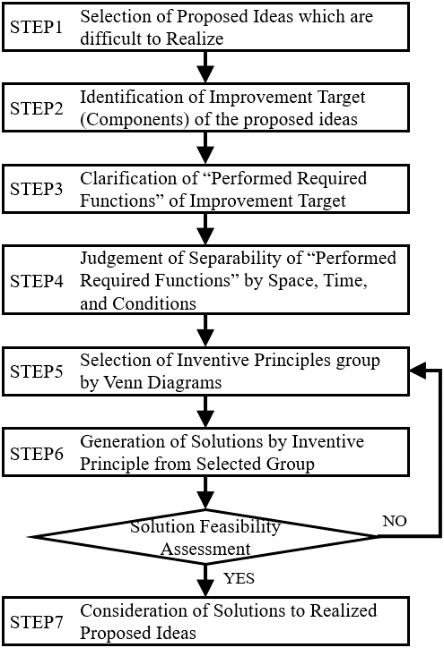
Proposed Specific Method The procedure of the proposed method is shown as a workflow in Figure 1. The details of each step are also described below.
Figure 1: Method for idea realization by utilizing physical contradiction of TRIZ.
Selection of Proposed Ideas Which Are Difficult to Realize (STEP 1 in Figure 1) Evaluate the feasibility of the ideas proposed through VE activities and select the ideas that are difficult to realize. The external factors such as technical issues, resistance of related members, and regulations and market conditions are cited.
Identification of Improvement Target (Components) of Proposed Idea (STEP 2 in Figure 1) Identify the improvement target (component) of the idea that has been evaluated as difficult to realize. Carefully identify the improvement target whether to set the material or process as the target in mind.
Clarification of “Performed Required Functions” of Improvement Target (STEP 3 in Figure 1) Clarify the propose for whom of the identified improvement target, that is “Performed Required Function”.
Judgement of Separability of “Performed Required Functions” by Space, Time, and Conditions (STEP 4 in Figure 1) Physical contradiction of TRIZ is related to conditions that requires different attributes for one parameter. This strategy “separates” by different space, different time, and different conditions that desire different attributes in the core of contradiction in order to determine which Inventive Principle is likely to be helpful in solving the problems.
The questions to separate by the space, time, and condition are as follows.
1) Separation in Space Where the “Performed Required Functions” is required? Where the “Performed Required Functions” is not required? 2) Separation in Time When the “Performed Required Functions” is required? When the “Performed Required Functions” is not required? 3) Separation based on Different Conditions In what situation the “Performed Required Functions” is required? In what situation the “Performed Required Functions” is not required?
Judge whether or not the “Performed Required Functions” can be separated by space, time or condition. In this process, “Performed Required Functions” is used as a single parameter.
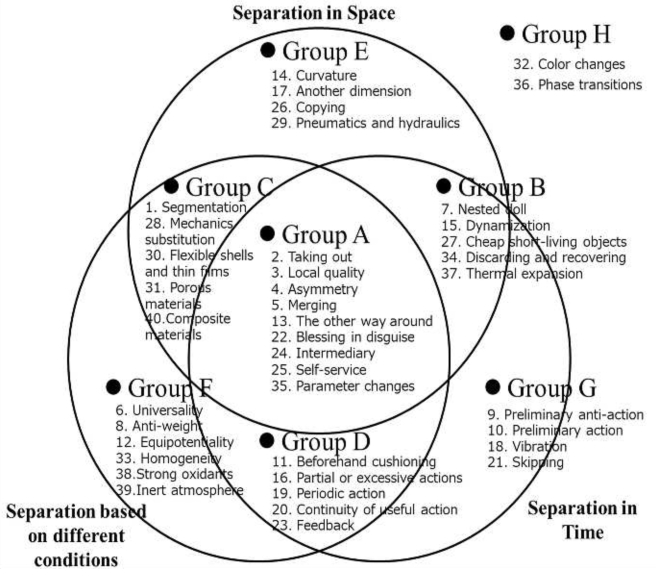
Selection of Inventive Principles Group by Venn Diagram (STEP 5 in Figure 1) Select a group of Inventive Principle from Venn diagram (Figure 2) by using the judgement of separability, that is space, time and condition (Mann, 2009). On the Venn diagram, there are eight Inventive Principles from Group A to Group H.
Human-Centered Creative Support for VE Idea Realization Through Contradiction Analysis 2405 Select a group of Inventive Principle based on the classification shown in Table 1 according to whether or not the space, time, and condition.
Table 1: Group of inventive principle.
Table available in the original PDF paper.
Separable Based on the Condition
Not Separable Based on the Condition Separable in time Group A Group A, B
Separable in space Not separable in time Group A, C Group A, B, C, E Separable in time Group A, D Group A, B, D, G
Not separable in time Group A, C, D, F Group H
Not separable in space
Figure 2: Quoted from inventive principles: separation strategy for resolving physical contradictions (Named by authors).
Generation of Solutions by Inventive Principle From Selected Group (STEP 6 in Figure 1) Generate the specific solutions by getting inspiration to imagine solution from the description of Inventive Principles of selected group and evaluate the possibility of realization. Generate ideas in order of the invention principles, starting with the lowest-numbered ones; if a feasible idea emerges, proceed to STEP 7.
Consideration of Solution to Realize Proposed Idea (STEP 7 in Figure 1) Form the possible solutions into realistic shape by combining together with actual techniques and resources. Consider the verification method as well.
CASE STUDY As a case study, VE activity is carried out with a specifically targeted, and the proposed TRIZ method of utilising physical contradictions to realise ideas, shown in Figure 1, is applied and the results is analysed.
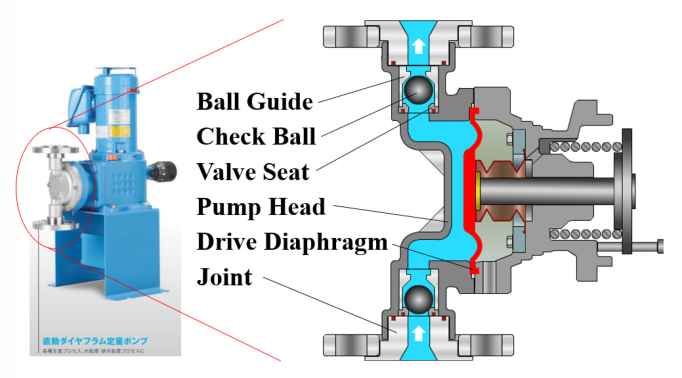
Target of Case Study The liquid end parts of metering pump manufactured by TACMINA CORPORATION, shown in Figure 3 (TACMINA, 2026) is selected as a target of case study. The reason is the pump is internally de-signed and the company is trying to define the function for passing on the design knowledge.
Figure 3: Liquid end parts of metering pump, target of VE activity.
Procedure of VE Activity Decide the implementing procedure of VE activity based on “VM Guide: A Guide to the Value Methodology Body of Knowledge (Adams et al. 2020)” proposed in SAVE International (SAVE, 2026). In accordance with the procedure, the results of VE activity are described as follows.
Preparation and Information Phase The specific component which has liquid end parts of metering pump, that is the target of VE activity, is set as an improvement target parts. Pareto analysis
Human-Centered Creative Support for VE Idea Realization Through Contradiction Analysis 2407 was performed by calculating each of the component cost. As a result, it was found that the component called “ball guide” is lightweight but costly. Therefore, this ball guide was selected as an improvement target parts.
Function Analysis Phase Collect the information for each element of ball guide from drawings and hearing of skilled designer and define the function.
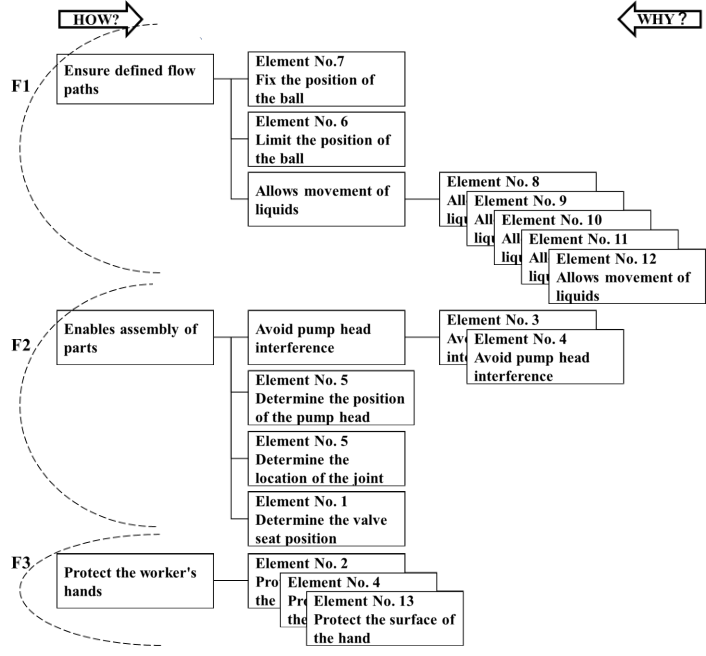
The functional diagram was created to organize the function by using the result of definition of function and shown in Figure 4. The functional diagram is a chart that visually organizes the relation between the purpose to be achieved and method to fulfill the purpose of each function in a system or process. With this functional diagram, it is clarified that the ball guide has following three functional areas; “F1: Ensure defined flow paths”, “F2: Enables assembly of parts” and “F3: Protect the worker’s hands”. However, functional areas are the groups of lower functions that are intended for a specific function in the functional diagram. Three functional areas are specified with dotted lines in Figure 4.
Figure 4: Functional diagram of ball guide.
In order to calculate the total of current cost for each functional area, the cost for each element was calculated by multiplying the contribution ratio to the functional area and calculate the cost of functional area for each element. Next, the element costs for each functional area were added to each functional area. We decided to generate ideas in order of currently highly costed functional areas; F3, F1 and F2.
Creativity and Evaluation Phase Based on the result of functional analysis, the ideas were generated and their realizability was briefly evaluated. Table 2 shows the number of ideas generated for each functional area, the number of ideas remained after brief evaluation, and the number of ideas that are expected to be difficult to realize. Additionally, no idea was generated for “F2: Enables assembly of parts” because the cost was small.
Table 2: Summary of result for alternative idea creation.
Table available in the original PDF paper.
Functional Area Generated Ideas
Ideas Remained After Brief Evaluation
Ideas Expected to Be Difficult to Realize F1: Ensure defined flow paths 22 22 2
F2: Enables assembly of parts 0 0 0 F3: Protect the worker’s hands 16 15 4
Development Phase Among the ideas that remained after the brief evaluation, there were some ideas that were expected to be difficult to implement due to “Limitation of human” and “Restriction by Regulation.” Table 3 shows the result of using the method to realize the idea by utilizing physical contradiction of TRIZ technique (Figure 1) and the number of ideas that has not yet been realized. As a result, two ideas had been realized.
Table 3: Summary of result for alternative idea creation by using TRIZ.
Table available in the original PDF paper.
Functional Area Ideas Expected to Be Difficult to Realize
Realized Ideas by Using the Proposed Method
Ideas That Have Not Yet Been Realized F1: Ensure defined flow paths 2 1 1
F2: Enables assembly of parts 0 0 0 F3: Protect the worker’s hands 4 2 2
The specific example of the idea realized by proposed specific method (Figure 1) is described below.
STEP 1: Selection of ideas difficult to realize among the proposed idea For the function “F3: Protect the worker’s hands”, “Appropriately perform chamfering” was proposed as an idea.
Human-Centered Creative Support for VE Idea Realization Through Contradiction Analysis 2409 STEP 2: Identification of improvement target (element) of proposed idea
“Chamfering Portion” was identified as the improvement target of the proposed idea STEP 3: Clarification of “Performed Required Function” of the improvement target Clarify the performed required function of “Chamfering Portion” as “Protect the worker’s hands”. STEP 4: Judgement of separability of “Performed Required Function” by
space, time and condition Judge the separability of this performed required function “Protect the worker’s hands” by space, time, and condition. Table 4 shows it is separable in space and time, but not based on the different conditions. STEP 5: Selection of Inventive Principles group by Venn diagram Inventive Principles group A and B of Venn diagram are selected since it is separable in space and time, but not separable based on different conditions. STEP 6: Generation of solutions from the Inventive Principle of selected
groupTable 5 shows the result of obtaining inspiration to imagine solutions from the Inventive Principles description of selected group. Based on the Table 5, the solution “eliminate the deburring process for the area chamfered with a processing machine” was obtained from the Inventive Principle 2 “Taking out”, and the solution “Use electric tool with a carbide bit for larger burrs” and “Use electric tool with grindstone bit for small smaller burrs and perform deburring for necessary part only” were obtained from Inventive Principle 3 “Local quality”. STEP 7: Consideration of solution to realize the proposed idea In order to investigate the solution to realize the proposed idea, the competitive product was disassembled and investigated. As a result, it was found that the idea “Chamfer appropriately” has already been applied. Therefore, it was predictable that this improvement idea had less risks.
Table 4: Judgement of separability by space, time and condition.
Table available in the original PDF paper.
Questions Required Not Required Where? (Separation in Space) It is the area where the worker’s hands will touch.
It is the area where the worker’s hands will not touch.
When? (Separation in Time)
It is at the stage of assembly and disassembly.
It is at the stage of processing and operation that are the processes before and after the assembly and disassembly.
In what situation? (Separation based on Different Conditions)
It will not be changed even when the parts specifications are changed.
It will not be changed even when the parts specifications are changed.
Table 5: Inspiration to image solutions obtained from inventive principles.
Table available in the original PDF paper.
Principle Description Inspiration to Imagine Solutions
2. Taking out
Chamfer the area where the worker may touch the sharp edges only.
Separate an interfering part or property from an object, or single out the only necessary part (or properly) of an object.
3. Local quality
Change an object’s structure from uniform to non-uniform, change an external environment (or external influence) from uniform to non-uniform.
Change the chamfering method based on the size of sharp edge.
Make each part of an object function in conditions most suitable for its operation.
Presentation and Implementation Phase The procedure that obtaining the managers’ approval at the internal accomplishment report of VE activity, performing the trial, then applying to the mass production was followed.
CONCLUSION
This paper proposes the procedures to effectively and creatively solve the obstacle to idea realization, which have been verified with the parts manufactured by TACMINA CORPORATION. By integrating TRIZ physical contradiction analysis into the development phase of VE, this study proposes that engineers on VE teams can systematically and creatively overcome physical constraints. Furthermore, this procedure is also able to address the challenge that the feasibility assessment and contradiction resolution of VE ideas often depend on the tacit knowledge and experienced engineers. In other words, this method is effective for efficient design activities to meet increasingly diverse and sophisticated customer demands, and it can be described as a rational approach that supports human-centered creative problem-solving.
It is also suggested that this method is applicable to VE activities targeted on the industrial products. It is considered that this was contributed to practical aspects such as making development and modification of products effective. Also, proposing a new method of utilizing TRIZ techniques to VE activities helps to widen the scope of utilization of TRIZ technique.
In the future, there are two tasks; applying to other products and further investigation and correction of proposed method, and confirmation of utilization of VE activities not only for products but also for process improvement.
and Yokota, H. (2020). VM Guide: A Guide to the Value Methodology Body of Knowledge. SAVE International. Akagi, K. and Sawaguchi, M. (2021). Proposal of method to utilize TRIZ techniques for work improvement verification in heavy-duty gas turbine. Proceedings of the 12th International Conference & Global Competition on Systematic Innovation (ICSI/GCSI), 15–17 October, Guangdong, China. Mann, D.L. (2002). Hands-on Systematic Innovation. CREAX Press. Mann, D.L. (2009). Matrix 2010: Re-updating the TRIZ Contradiction Matrix. FR
Press. Mao, X. (2008). The Framework of TRIZ-enhanced-Value Engineering Analysis and Its Knowledge Management. University of Alberta. SAVE International (2026). SAVE International | Adding Value. Enhancing Ideas.
Available at: https://www.value-eng.org/ (Accessed: 24 August 2026). Sawaguchi, M. (2000). Effective approaches to solving technical problems by combining TRIZ with VE. The TRIZ Journal. TACMINA CORPORATION (2026). TACMINA CORPORATION | leading the
way in precision pumps. Available at: https://www.tacmina.com/ (Accessed: 24 August 2026).
SEARCH THE AHFE DIGITAL BOOKSTORE BY ISBN
Explore the complete digital volume
Human Factors in Design, Engineering, and Computing
Read this individual research paper free through the original publisher, or explore the full digital proceedings book.