Xiaobao Yu, Miao Fu (2026). From Resources to Stories: An Experiential Narrative Design for Children’s Ecological Field Studies in OCT Wetland Park. In: Human Factors in Design, Engineering, and Computing. AHFE Open Access, vol. 238, pp. 568–578. https://doi.org/10.54941/ahfe1008289
This study constructs an experiential narrative design framework for children’s ecological field studies in urban constructed wetlands. This framework was practically validated at Shenzhen Overseas Chinese Town (OCT) Wetland Park, China. The study explores the mechanisms through which the experiential narrative design fosters a connection between people and ecological systems, evokes emotional resonances, and fosters recognition of sustainable development values. For this research, a thematic field study activity – the ‘Nature Wetland Magic Academy’ – was designed and implemented. The children’s observations and feedback were recorded for qualitative analysis. The results indicate that experiential narrative designs can effectively transform ecological knowledge into emotionally engaging exploration narratives, significantly enhancing children’s emotional connection to wetland ecosystems and the complexity of their cognition of such systems. The interweaving of narrative threads and the integration of role-based tasks are key to transforming children from passive observers into active story participants. This study provides a theoretical framework and a practical paradigm for deeply integrating knowledge transmission, emotional connection, and ecological responsibility cultivation into wetland ecological field studies. Future research should further explore balancing scientifically accurate ecological knowledge with narrative appeal in field study designs and establishing evaluation mechanisms for long-term educational outcomes.
With the comprehensive advancement of sustainability education, field tripss – as an important extension of such education – are gradually becoming a key means of enhancing the comprehensive literacy of primary and secondary school students. Thus, such tours have attracted widespread attention from families, society, and schools. According to Aimei Research’s ‘2025 China field trips market development status and consumer behaviour survey data’, which evaluated Chinese consumers’ willingness to have their children participate in field tripss, 63.03% expressed ‘strong willingness’, 32.55% were ‘indifferent’, and 4.42% were ‘unwilling’ (Aimei Network, 2025). Among the preferred types of field tripss, natural landscape exploration
From Resources to Stories: An Experiential Narrative Design 569 ranked highest at 42.22%, highlighting parents’ focus on ecological education. Such activities enrich not only students’ natural knowledge but also their practical skills, innovative thinking, and environmental responsibility by facilitating immersive experiences. However, the Aimei survey data also reveal three major issues that currently impact field trips experiences and outcomes: ‘monotonous content formats in which children fail to learn anything’ (32.05%), ‘schools not continuing relevant research and development’ (31.12%), and a ‘lack of field trips resources’ (29.12%) (Aimei Network, 2025). Research by The Nature Conservancy indicates that children who learn about nature through storytelling are 60% more likely to demonstrate environmental responsibility. (Paths of Learning, 2026). As this finding suggests, compared to traditional research-based learning methods centred on knowledge transmission, ecological research experiences structured around narrative frameworks are more effective in fostering children’s emotional engagement and capacity to recognise ecological value. Therefore, transforming ecological resources into research experiences structured by a narrative logic represents a critical priority for enhancing the quality and effectiveness of children’s ecological research- based education.
The 2016 ‘Opinions on promoting study-travel programs for primary and secondary school students’ issued by China’s Ministry of Education and 10 other departments spurred the vigorous development of ecological study-travel practices nationwide while sparking academic discussions on issues such as curriculum design, teaching models, and industrial pathways. Research by Yue Wei and others on the value of ecological field trips has established it as a key vehicle for comprehensive practical education and the dissemination of ecological awareness concepts, providing a cognitive paradigm for subsequent studies. Building on this foundation, Chinese scholars have conducted systematic research on ecological field studies, examining topics such as product development, curriculum design, teaching model innovation, industrial pathways, and synergies with rural revitalisation in settings such as national parks, nature reserves, rural areas, and cultural heritage sites.
International research has introduced into mainstream education the concept of a harmonious coexistence between humans and nature, initiating an integrated shift in the literature towards place-oriented significance. Research perspectives have increasingly favoured narrativity, transitioning from describing ecological knowledge to fostering the recognition of ecological value. Methodologically, there has been a shift towards experiential approaches, with the focus transitioning from knowledge transmission to exploration of the intrinsic mechanisms of experiential learning. With the implementation of the ecological civilisation strategy, urban wetlands – which are rich in natural biological landscapes – are recognised as holding significant value for ecological education. Designs for educational programmes centred on urban wetlands have garnered considerable attention from scholars across disciplines. Currently, research-based wetland ecological education in China is undergoing a comprehensive shift from theoretical frameworks to
570 Yu and Fu practical activities. However, effective methods for enhancing the depth and appeal of learning content remain lacking.
To improve the effectiveness of research-based urban wetland ecological learning, the integration of diverse theories and methodologies is crucial. Urban wetland ecological field tripss represent a promising educational practice in terms of fostering learners’ acquisition of wetland ecosystem knowledge, understanding of complex human–land relationships, and cultivation of ecological values and responsible behaviours. Analysing such tours’ educational effectiveness requires understanding the process by which urban ecological resource information is recontextualized and its cognitive implications. Experiential narratives can be effective tools for establishing deep connections, conveying complex meanings, and enhancing engagement, thereby offering new perspectives on the design of experiential education in urban wetland ecological field tripss.
Against this background, the present paper takes Shenzhen Overseas Chinese Town (OCT) Wetland Park as a case study. Using experiential narrative design theory, it deconstructs and reconstructs the wetland ecological resource context and field trips scenarios through narrative analysis. Adopting an integrated ‘resource – story – experience’ perspective, the study systematically decodes and creatively encodes narrative themes, plot threads, knowledge nodes, and cognitive stages in urban wetland education.
THEORETICAL FOUNDATION AND RESEARCH FRAMEWORK Narrative as an Effective Approach for Wetland Ecological Field Studies
A ‘narrative is a symbolic representation of events connected by time or causality. It can be constructed through various media, such as written language, visual images, gestures, actions, or a combination of these forms’ (Yang et al., 2022). Far from a mere story, a narrative represents a fundamental human method for organising and comprehending the world. ‘A compelling narrative structure effectively guides participants through an orderly journey of exploration. For children, this structure transforms abstract, complex ecological processes into an understandable story filled with wonder and discovery’ (Xiang et al., 2025). Ecological storytelling is an educational method that cultivates ecological awareness by conveying narratives; it aims to establish effective human–nature connections by evoking emotional resonances in children.
Emergence of Experience Design Theory and the Narrative Shift The emergence of ‘experience’ as a central topic in design research began with the rise of the experience economy and user experience studies. In 1988, Don Norman introduced the concept of ’user experience’, emphasising the holistic feelings and meanings users derive from interacting with products and systems (Norman, 1995). This marked a shift in design research from a functional orientation towards a user-centred, experience-driven approach. In 1998, Joseph Pine and James Gilmore introduced the theory of the
From Resources to Stories: An Experiential Narrative Design 571 ‘experience economy’. They defined experience as a form of value that can be designed and managed, laying the theoretical foundation for subsequent experience design research. Under the combined influence of the experience economy concept and user experience research, experience gradually came to be viewed as a process-oriented structure amenable to design.
Building on this foundation, narrative research was progressively integrated into experience design, yielding a narrative-driven approach to experience design research. Grimaldi (2018) introduced ‘narrative experiences’, positioning them as higher-level user experiences shaped by narrative dimensions. This perspective posits that products, much like carefully crafted stories, can unfold through structured narrative arcs to foster deeper emotional engagement and create memorable user journeys. Yuji Yamada further proposed a narrative-driven service design methodology, arguing that story-based experiences of service processes enhance user involvement and forge deeper emotional and cognitive connections. Accordingly, field tripss, which are educational services at their core, facilitate the systematic design and management of student experiences through service design tools such as user journey maps.
An Experiential Narrative Framework for Wetland Ecological Field Studies Wetland ecological field studies transcend the mere dissemination of ecological knowledge and identification of species. They aim to transform ecological cognition, foster emotional connections, and inspire responsible actions, thus shifting the learning process from rote memorisation to the internalisation of ecological literacy. From an experiential narrative design perspective, the key to designing wetland ecological field studies lies in understanding and applying experiential design theory and narrative construction theory. This involves translating ecological knowledge – such as knowledge of tidal patterns and mangrove symbiosis – into narrative form and designing experiences across the sensory, behavioural, and reflective dimensions of field study activities.
Whether such experiential design can achieve ecological education outcomes requires further exploration into how experiences are transformed into cognition within learners. Kolb’s experiential learning theory provides a theoretical foundation for understanding this transformation process from an educational mechanism perspective. Kolb proposes four stages of experiential learning: concrete experience—reflective observation—abstract concept—active experimentation, offering a clear structural framework for understanding the conversion of experience into learning (Kolb, 2014). However, this framework primarily serves general learning contexts and does not fully capture the unique aspects of ecological field studies—namely, their natural settings, emotional resonance, and value formation. Therefore, integrating the external organizational methods and internal cognitive mechanisms of ecological field studies, we can divide the ecological field study experience into four progressive cognitive stages: “Physical Experience— Emotional Resonance—Value Internalization—Action Reflection.” The target levels and logical order differ across these stages.
572 Yu and Fu To systematically organise wetland ecological narrative elements, scattered ecological features (such as specific plants or birds) can be linked through narrative threads to form linear exploration paths. These paths connect key ecological nodes and integrate diverse ecological values, fostering comprehensive ecological awareness with broad influence. Resource elements at different features within wetland ecosystems exert varying effects in terms of conveying ecological information and shaping experiences due to differences in presentation and interaction formats.
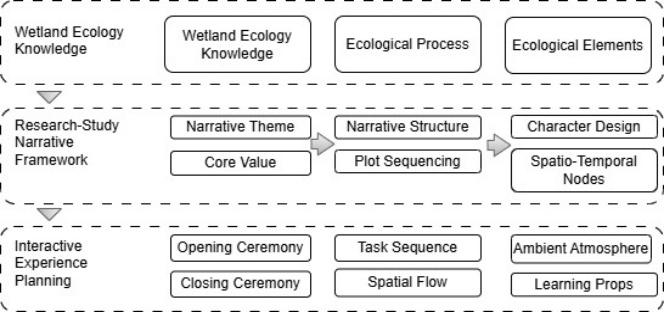
Against this background, the present study integrates narrative theory with experiential theory to structure wetland ecological study programmes into three progressive phases: ecological knowledge decoding, study narrative architecture, and interactive experience planning (Figure 1). This sequence establishes a logical framework for ecological study design from an experiential narrative perspective. The ecological knowledge deconstruction phase involves systematically analysing and filtering complex scientific knowledge of wetland ecosystems to establish a rigorous, objective content foundation for subsequent design. This includes identifying and organising core ecological elements, key ecological processes, and major ecosystem service functions. The research narrative architecture phase imbues the deconstructed ecological knowledge with meaning, emotion, and exploratory logic to construct the framework for the experience. Its core involves transforming the ‘knowledge units’ from the first stage into narrative elements organised according to established narrative theories. Interactive experience planning converts this narrative framework into concrete activities and scenarios in which learners can actively participate, perceive, and interact. This includes planning specific spatial pathways, learning props, and task sequences based on the narrative script.
Finally, the systematic design solution established through these three stages is validated against the chosen wetlands’ resource endowment, management philosophy, and requirements for educational experiences. By interpreting core wetland conservation demands and experiential narrative design theory from the perspective of nature education, we propose three practical pathways: implementation of narrative elements, creation of embodied scenarios, and establishment of interactive experiential rituals.
Figure 1: Diagram representing the relationship between ecological research and the narrative logic of this study.
MATERIALS AND METHODS
Covering approximately 68.5 hectares, Shenzhen OCT Wetland Park is China’s only coastal mangrove wetland located within an urban core. It thus offers a unique geographical opportunity for wetland research and education. The park pioneered China’s first ‘Nature School’ by systematically delivering wetland-based ‘nature education’ (Zijing et al., 2025). Boasting over a decade of dedicated cultivation, OCT Wetland Park has meticulously developed 42 courses and 197 educational programmes conveying rich natural education content. Existing programmes, such as ‘Mangrove Lessons’ and ‘Nature FUN Classes’, implement specific narrative scenarios (e.g. observing migratory bird movements or exploring mangrove ecosystems) to foster emotional resonance and deepen cognitive understanding among participants, particularly children. Thus, selecting Shenzhen OCT Wetland Park as a case allows this study to offer representative and exemplary insights regarding wetland research programme design in other cities.
Following the research logic of “theoretical construction—prototype design—practical validation,” this study translates the experiential narrative framework into concrete design prototypes and, through a satisfaction survey of children’s ecological field study programs, explores the specific effects of experiential narrative in the planning of field study activities. The research team’s affiliated institution signed a framework cooperation agreement with OCT Wetland Park. The park thus provided extensive wetland ecological materials, past educational programme manuals, and corporate development records to support the research. Building on this foundation, the research team conducted multiple phases of experiential narrative-based field study prototype design, implementation, and iteration between March and May 2024.
Employing a design practice methodology, multidimensional ecological information from this mangrove wetland was actively encoded into narrative activity prototypes and tested within authentic field study scenarios.
ECOLOGICAL RESEARCH AND EXPERIENTIAL NARRATIVE DESIGN IN OVERSEAS CHINESE TOWN WETLAND Decoding Ecological Resources in OCT Wetland
The first phase of the ecological resource decoding process for OCT Wetland Park in our experiential narrative design can be summarised as a three- step process: identifying the ecological foundation, interpreting cultural values and positioning the thematic concept. By leveraging this localised wetland’s distinctive flora and fauna resources alongside its hydrographic and geological environment, interpretable cultural content was uncovered to establish the narrative theme. The ecological foundation was identified by specifying OCT Wetland’s unique habitat structure and historical roots while addressing fundamental questions about its origin and distinctiveness. This identification served as the semantic foundation and logical starting point for subsequent thematic storytelling. During this phase, the research team confirmed OCT Wetland’s unique identity as an artificially restored wetland within an urban centre.
574 Yu and Fu Second, the three core principles guiding OCT Wetland’s conservation and sustainable development approach – ‘Restoring nature to nature’, ‘Zero waste’, and ‘Leave no trace wetland’ – represent cultural concepts worthy of interpretation. Existing educational programmes primarily use observation and lectures; however, students commonly report insufficient engagement and exploration during these activities. This results in low absorption and retention of wetland knowledge, prompting a desire in children for more playful approaches to understanding the wetland, such as games.
Finally, the positioning of the thematic concept involved establishing an ecological narrative theme to guide students beyond passive observation and foster intersubjective empathy with wetland flora and fauna. By integrating the shortcomings of existing offerings, the core student desire for experiential learning – including hands-on engagement, self-expression, and learning through practice – and OCT’s unique identity as an urban artificial wetland restoration site, we developed the core thematic concept of our intervention: a role-playing exercise called ‘Guardians of The Wetland Magic World’.
Narrative Framework The narrative framework developed for this study enriched and refined the ecological perspectives embedded within the aforementioned theme. It determined how the learners perceived the ecological resources of OCT Wetland, linking ecological knowledge with prior learning to foster emotional resonance through human–nature symbiosis. This framework comprises three key components: narrative thread integration, role-based task embedding, and ecological responsibility engagement.
Narrative thread integration involved organically linking the various knowledge points, observation points, interactive tasks, and emotional touchpoints that emerged during the field trips along a clear, coherent, and compelling logical path centred on the narrative theme. Following the narrative structure of exposition, development, turning point, and resolution, the story unfolds as follows:
1. students study magic at the Natural Magic Academy (exposition); 2. a crisis suddenly emerges in the magic world of the natural wetland (development); 3. a team of sprites from the wetland’s five elemental races – Gold, Wood,
Water, Air, and Earth – embarks on an adventure to confront monsters formed by the dark medium of pollution (turning point); 4. the magic world regains vitality and restores balance (resolution).
Character–task embedding transformed ecological knowledge into character designs and mission points tailored to the wetland scenario. The project team drew inspiration from OCT Wetland’s natural landscapes and biodiversity – including mangroves, mudskippers, white spoonbills, wetland soils, and the four- spotted damselfly – to design fairy characters, whose distinctive appearances facilitated student recognition of related biological knowledge. Characters progressed through three stages during activities – initiation, exploration,
From Resources to Stories: An Experiential Narrative Design 575 and growth – completing seven key quests: Enrolment at the Magic Academy, Learning Magic, The Invasion of the Magic World, Exploring and Saving the Magic World, Crafting Magic Weapons, The Ultimate Rescue Mission to Defeat the Monster, and Attending the Magic Academy Graduation Ceremony. By completing a series of ecological restoration tasks, students helped revitalise the natural wetlands. Ultimately, they pledged to become wetland guardians, completing a closed-loop learning experience that progressed from cognition and empathy to active responsibility.
Interactive Experiential Design The interactive experiential design involved systematically integrating user interactions and touchpoints with information, environments, and other dimensions based on narrative threads and spatial contexts, thereby guiding students from passive reception to active participation. Consistent with the programme’s narrative framework and task objectives, the research team developed in-depth and creative interactive content for each phase of the Natural Wetland Magic Academy programme.
During the Academy Enrolment segment, students assumed roles within the storyline. Mentors guided them to select guardian spirits, transforming them into junior wizards to awaken their sense of purpose in protecting the natural magical world.
1. In the ’Learning Magic’ segment, the students explored wetland flora and fauna through five playful elemental spirits representing Gold, Wood, Water, Air, and Earth. 2. During the ‘Magic World Invasion’ segment, instructors explained that
the students had to collect magical energy outdoors to help the spirits restore the natural ecosystem. 3. In the ‘Explore and Save the Magic World’ phase, instructors led students deep into the wetlands to gather ‘Starlight Wood’ (fallen branches and leaves) imbued with natural spirit. 4. The ‘Crafting Magical Weapons’ session taught students techniques
to transform Starlight Wood into ‘Guardian Wands’ and ‘Energy Bookmarks’. 5. In the ‘Ultimate Rescue Mission: Defeating the Monster’, students collaboratively completed a series of purification tasks grounded in ecological knowledge, pooling ‘Energy Bookmarks’ to collectively ‘purify’ a monster formed from pollution. 6. Finally, in the ‘Magic Academy Graduation Ceremony’, the principal
awarded diplomas and ‘Wetland Guardian Medals’, enabling the students to build a sense of meaning through recognition.
Teaching aids played a crucial role in this field study programme, providing robust and effective support to ensure that the students deeply explored the essence of wetland conservation and sustainable development within an intuitive, interactive, and engaging learning environment. To aid the pedagogical effort, the research team designed three types of teaching aids:
1. Identification cards specifically developed for the field trips, primarily to
help participants better recognise and understand wetland ecosystems 2. Fun educational toys based on five unique fairy designs, aimed at stimulating participants’ learning interest and engagement 3. A series of essential tools and raw materials for the field trips, meeting
the needs of practical operations and exploration, such as dragonfly flashlights
EVALUATION OF OCT WETLAND ECOLOGICAL FIELD TRIPS ACTIVITIES The design team distributed satisfaction evaluation questionnaires to the 30 participants of this field study program. In terms of the extent to which the program’s objectives were achieved, the overall average satisfaction score was 4.3, highlighting the positive impact of the event. Specifically, 75% of participants indicated that the program greatly deepened their understanding and mastery of OCT’s wetland conservation methods; 87.5% of participants believed the program significantly enhanced their awareness and understanding of sustainable wetland management practices.
DISCUSSION AND CONCLUSION
Discussion
How can we overcome the limitations of monotonous formats and superficial engagement in ecological field tripss? This has been a key challenge in wetland ecological education and the cultivation of sustainable ecological behaviours. To surmount this challenge, this study implemented a systematic narrative design, contextualising ecological knowledge to facilitate students’ cognitive transition from fleeting observation to deep learning and from passive reception to emotional resonance and critical reflection.
Taking Shenzhen OCT Wetland Park as a case study, we integrated narrative theory with experiential design theory to construct an experiential narrative design sequence: ecological knowledge decoding – educational narrative framework construction – interactive experience planning. The study articulates an ecological practice pathway featuring narrative element integration (represented by the ‘Natural Wetland Magic Academy’), embodied scenario creation, and interactive experiential rituals. This intervention illustrates an operational paradigm for achieving the deep integration of knowledge transmission, emotional connection, and ecological responsibility cultivation in wetland ecological education.
Therefore, the limitations of this study are primarily reflected in two aspects: First, there is still a lack of systematic design principles regarding how to strike a balance between the scientific accuracy of ecological knowledge and the artistic quality of narrative plots; second, as the study is based on the OCT Wetland as a single context, the generalizability of the design methods requires further validation, and there is a lack of long- term tracking of children’s ecological cognition and behavioral outcomes.
From Resources to Stories: An Experiential Narrative Design 577 These shortcomings should be addressed by optimizing the mechanism for translating knowledge into narrative, expanding the range of educational settings, and strengthening long-term tracking of educational outcomes.
CONCLUSION
This research used Shenzhen OCT Wetland Park as a case study to explore how knowledge and meaning embedded in wetland ecological resources can be systematically enhanced through narrative, thereby transforming abstract natural knowledge into compelling, behaviour-transforming nature stories. This study provides theoretical support and practical pathways for designing ecological education methods and constructing experiential frameworks. However, research on ecological education methods in wetland parks remains nascent.
This paper points to several promising areas for future research. First, while the experiential narrative design enhances the appeal of study activities, it risks misleading cognition through oversimplification or entertainment. Balancing the accuracy of ecological knowledge with the artistic nature of narrative plots requires ongoing practical exploration. Second, while the experiential narrative design proposed in this study has been validated in the specific context of OCT Wetland Park, there is room for further systematic theoretical extension and critical reflection regarding its universality, adaptability across different wetland types, generalisability across cultural contexts, and capacity for long-term tracking and evaluation of educational outcomes. Therefore, our team will continue to focus on experiential design in the OCT Wetland Park, Shenzhen, further exploring the connection between narrative mechanisms, the deep structures of ecological cognition, and the synergistic role of digital media in immersive experiences.
ACKNOWLEDGMENT
This study was supported by the management of OCT Wetland Park.
REFERENCES
Aimei Network. 2025 China Study Tour Market Development Status and Consumer Behavior Survey Data. Available online: https://www.iimedia.cn/c400/108371. htm (accessed 13 January 2026). Kolb D A. Experiential learning: Experience as the source of learning and develop
ment[M]. FT press, 2014. Norman D A. The psychopathology of everyday things[M]//Readings in human– computer interaction. Morgan Kaufmann, 1995: 5–21. Paths of Learning. 11 ways to engage children with nature through storytelling that
spark wonder. Available online: https://www.pathsoflearning.net/2070/engaging- children-with-nature-through-storytelling/ (accessed 3 January 2026). Xiang, C; Rosni, N.A.B.; Ab Ghafar, N. A Landscape narrative model for visitor satisfaction prediction in the living preservation of urban historic parks: A machine- learning approach. Sustainability 2025, 17(12), 5545. https://doi.org/10.3390/ su17125545
environmental awareness and environmental attitudes in children aged 6–8. International Journal of Environmental Research and Public Health 2022, 19(11), 6483. https://doi.org/10.3390/ijerph19116483 Zijing, S; Junxi, Q; Hong, Z; Shuang, Tian. Between binary- and mono-ontologies: The rewilding practice of Shenzhen Overseas Chinese Town Wetland Park. Geoforum 2025 2. https://doi.org/10.1016/j.geoforum.2025.104201
SEARCH THE AHFE DIGITAL BOOKSTORE BY ISBN
Explore the complete digital volume
Human Factors in Design, Engineering, and Computing
Read this individual research paper free through the original publisher, or explore the full digital proceedings book.