Sarah Rudder, Audrey Haque, Todd Jackson, Will Harper, Amy Florentino, Amna Greaves (2026). Incorporating User Research Findings Into a Model-Based Enterprise Architecture to Protect the Ocean. In: Human Factors in Design, Engineering, and Computing. AHFE Open Access, vol. 238, pp. 766–779. https://doi.org/10.54941/ahfe1008309
Human-centered design (HCD) practices provide many benefits to the architectural design process, however, there is a discontinuity when attempting to use HCD artifacts as input for model-based techniques such as model-based systems engineering (MBSE). This results in a loss fidelity in the transition between HCD and MBSE, where valuable insights from human stakeholders have no corresponding representation in the architectural model. To ad-dress this shortcoming, pathways need to be established between the disciplines of HCD and MBSE. In this paper, we use the U.S. Coast Guard's role as protector of the marine environment as a case study to explore how these two methodologies can be synchronized. First, we look at how HCD can be per-formed, and the process of collecting, analyzing, and sorting user research findings. The resulting data is then mapped into the Unified Architecture Frame-work (UAF), which establishes traceability between HCD and MBSE. We then discuss how this mapping provides a clear and manageable link between the disciplines, amplifying the impact of both.
The U.S. Coast Guard (USCG) needs to rapidly identify and respond to events to effectively conduct operations. Since 2022, the Massachusetts Institute of Technology (MIT) Lincoln Lab’s (LL) research team has been supporting the USCG’s efforts to increase data-driven maritime domain awareness (MDA). To facilitate this goal, MIT LL practices human-centered design (HCD) primarily by conducting user research and co-designing with USCG stakeholders. This data aligns project decision-making with operator needs, concerns, and processes. In parallel, the USCG is pursuing a strategic initiative to modernize its technology acquisition process through Force Design 2028. This modernization leverages industry standard approaches to enterprise architecture by using model-based systems engineering (MBSE) techniques. To fully realize the value of user research findings, this information should be incorporated into a queryable model to provide reusability, traceability, and scalability of the collected data.
Incorporating User Research Findings Into a Model-Based Enterprise 767 Our motivation for this work is to demonstrate how user research can inform digital transformation models to increase human-centeredness, traceability, reliability, and data-informed decision-making. This paper builds on previous research focused on integrating HCD and MBSE to support organizational decision-making. This case study analyzes the USCG’s Living Marine Resources (LMR) enforcement mission to address the current disconnect between HCD and MBSE. By leveraging the Unified Architecture Framework (UAF), the strategy and operations of LMR were modeled, with a subset of the model shown in this paper.
Background
Conducting user research to guide project direction reduces project risk, saves time and resources, and helps ensure that end users receive valuable outcomes (Hall, 2013). However, building modeling semantics for user research discoveries has not had much traction within the HCD or systems engineering communities, contributing to the problem of hu-man-systems considerations being addressed after the architecture and major design decisions have been made (Orellana & Madni, 2014). In accordance with ISO 15288, humans should be considered as a subsystem to encourage analysis of interactions and emergent behaviors (International Organization of Standards, 2023).
Human-Centered Design (HCD) HCD is an approach to problem-solving that develops solutions by inviting participation from the humans experiencing the said problem into the problem solving and decision-making processes (Bravo, 1993; Norman, 2018). To effectively practice HCD, project teams must make decisions in the best interest of those they are designing for (or with) and must utilize accurate data to inform their decisions. If a design is uninformed by data or systems, it is neither human-centered, nor efficient. MIT LL follows HCD principles by incorporating USCG veteran and active-duty personnel into project teams to ensure project goals are aligned with real operator needs. Additionally, MIT LL practices HCD by codesigning and conducting user research to enable data-informed project decisions. As Hall, 2013 notes: “Relevance to the real world is what separates innovation from invention. Understanding why and how people do what they do today is essential to making new concepts fit into their lives tomorrow”.
Model-Based Enterprise Architecture As the systems engineering (SE) discipline continues to adopt a model-based approach, research has been mostly focused on conceptual development and solution architecture (Henderson & Salado, 2021). The reusability and traceability inherent to a scalable model improves enterprise architecture (EA) efforts (Martin & O’Neil, 2021). To bridge the gap between solution
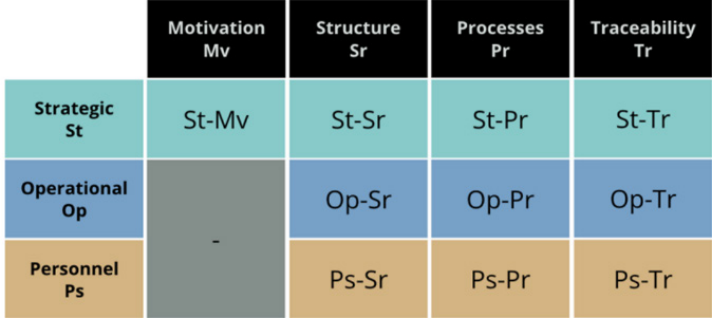
and enterprise architecture, the UAF is suggested because it unifies various enterprise architecture frameworks, such as the Department of Defense Architecture Framework (DoDAF), for commercial applications (Morkevicius et al., 2017). The UAF enables practitioners to express architectural model elements and organize them in a set of viewpoints, aspects, and view specifications, as shown in Figure 1.
Figure 1: Subset of UAF grid (Object Management Group, 2022).
Each row of the UAF represents a viewpoint and each column shows an aspect for a specific domain. The intersection of each is considered a view specification, composed of several allowable diagram kinds. For example, the intersection of the Strategic (St) viewpoint and Motivation (Mv) aspect is referred to as the Strategic Motivation (St-Mv) view specification and has an allowable set of elements and diagrams. Benefits of the UAF outlined by Martin & O’Neil, 2021 include:
Model-based EA complements MBSE activities
Integration with existing OMG standards, such as SysML
Common modeling vocabulary and mission ontology
Intuitive naming convention However, this list focuses on advantages from an SE perspective and fails to mention how this methodology improves interfacing domains, such as Personnel. This highlights the disconnect between the semantics of the two disciplines (Orellana & Madni, 2014). Within the UAF, the Personnel domain is intended to replace the NATO Architectural Framework (NAF) human factors views to better understand the role and effects that the human agent has on system performance (Hause & Wilson, 2017). However, the disconnect is still pervasive when using HCD processes to improve a system.
Incorporating User Research Findings Into a Model-Based Enterprise 769 Selection of Living Marine Resources (LMR) Enforcement Use Case
As a case study for this paper, we selected the USCG LMR enforcement mission. MIT LL is located within USCG District Northeast and proximate to Sector Boston, enabling quality, in-person collaboration with USCG personnel who actively conduct LMR enforcement. In addition to continued engagement with LMR stakeholders, the team had access to existing LMR user research findings. To facilitate this research on LMR, MIT LL collaborated with Sector Boston, Northeast District, and the Northeast Region Fisheries Training Center (NRFTC).
The LMR mission is focused on the enforcement of both domestic and international laws that protect fisheries and marine resources. LMR enforcement plays a crucial role in ensuring the sustainability of marine ecosystems, safeguarding endangered species, and preserving the economic viability of commercial and recreational fishing by enforcing laws that include limits on catch quotas, legal seasons, gear requirements, and area closures. The LMR mission provides an accessible way to illustrate how HCD processes can be used with MBSE to help the USCG.
RESEARCH PROCESS This section outlines both the user research and modeling processes. Each step is considered recursive and iterative.
Identify Project Needs and Goals Prior to conducting user research activities, the project needs and goals are identified. If a sponsor is funding the project, they are involved in this step.
Identify User Research Needs The objective is to understand what knowledge is necessary for all project team members to adequately perform their designated job functions in support of the project goals. This can be accomplished virtually or in-person with the entire team to ensure understanding of what each individual needs to accomplish their tasks. For example, the project lead and a teammate responsible for designing a particular piece of technology to solve a specific problem might require very different information about a USCG user’s pain points or work processes. Research needs can be synthesized and written in the form of research objectives and research questions.
Plan User Research Once user research objectives and questions are established, research methods most amenable to gathering the relevant information are selected. Depending on what information is needed, research teams may choose to conduct primarily qualitative methods, quantitative methods, or a hybrid of the two (Hall, 2013).
To minimize bias and increase accuracy of findings, it is recommended to choose research methods that span both self-reporting, such as interviews, and non-self-reporting, for example, observational data. Planning this effort requires coordination among many stakeholders to confirm participant interest, availability, and feasibility of the proposed activities.
Conduct User Research Traditional user research methods include observation, interviews, contextual inquiry, and questionnaires (Gordon & Rohrer, 2022). Interactive workshop activities, such as post-ups, affinity diagramming, and ideation exercises, are often utilized in larger groups to elicit ideas for improvement and to facilitate collaborative design (Gibbons, 2020).
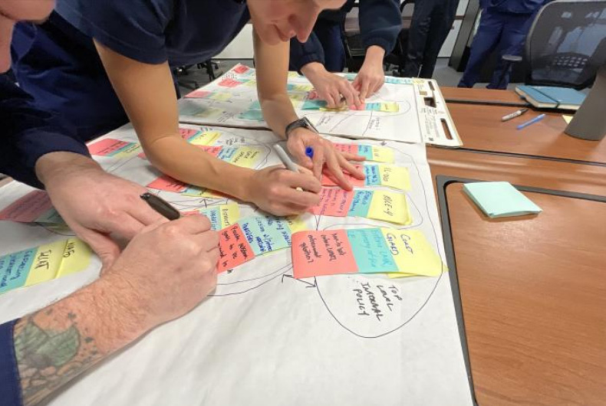
For this effort, traditional research methods and interactive workshop methods were used. A common workshop activity, stakeholder mapping, was modified to elicit specific information relevant for modeling. This activity was designed to understand, from the USCG perspective, who is involved in LMR enforcement, what their roles are, how they interact with each other, and their concerns. Figure 2 shows this exercise, with stakeholders on yellow sticky notes, their roles on blue sticky notes, their concerns on red sticky notes, and arrows describing relationships between them.
Figure 2: Image of USCG personnel at NRFTC mapping stakeholders involved in LMR enforcement.
Create User Research Artifacts Many research artifacts are a direct result of user engagement, such as documentation of a stakeholder map activity, and many artifacts are created during or after synthesizing the information gathered, like personas.
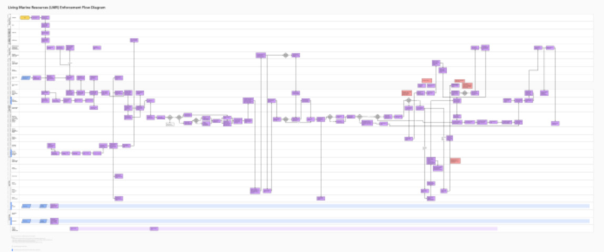
Incorporating User Research Findings Into a Model-Based Enterprise 771 The process flow diagram (PFD) shown in Figure 3 was created from multiple use. This particular PFD was created to synthesize information from four different engagements with LMR stakeholders and at various USCG locations.
Figure 3: Digital user research artifact showing an LMR process involving many stakeholders.
Common research deliverables include reports, experience or process maps, and interview summaries. To import data easily and reliably into an SE model, this information should be captured in a machine-readable format. One strategy is to collect findings in a report that identifies stakeholders, their pain points/concerns, and how each finding impacts the project.
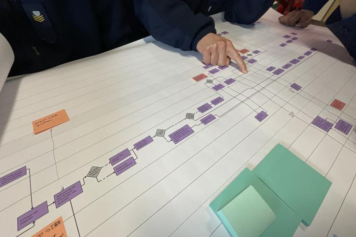
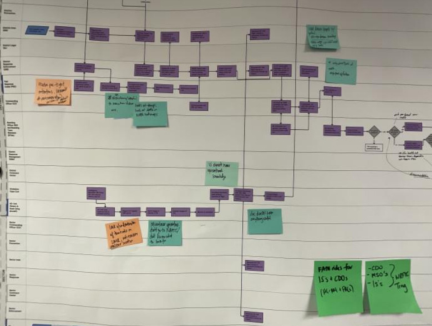
Verify User Research Results The verification of research results is crucial for ensuring data accuracy. The process is conducted iteratively with subject matter experts. In Figure 4, USCG personnel critique and correct a PFD that shows how LMR is conducted from various perspectives.
Figure 4: LMR PFD being critiqued by USCG personnel on FRC in Boston.
Though the digital PFD was created from multiple user research engagements, it was primarily informed by ashore USCG personnel who manage LMR from a command center and not afloat USCG personnel who physically board fishing vessels to conduct the inspections. Using a printed
version of the digital PFD, fast response cutter (FRC) crew members were asked to verify and correct the PFD in Figure 3. Figure 5 shows an iteration that incorporates their additional input.
Figure 5: Documentation of corrections made to the LMR PFD.
USCG ENTERPRISE ARCHITECTURE (EA) MODELING STRATEGY Based on the UAF Enterprise Architecture Guide (EAG) recommended by the OMG, the overall USCG strategy is modeled prior to the LMR mission (Martin & O’Neil, 2021). The Strategic view enables process improvements that address enterprise challenges. Creating traceability between the «EnterpriseGoals» and LMR «EnterpriseObjectives» provides a high-level view of how the mission supports the organization. After establishing the relationship between the USCG enterprise and LMR strategies, user research findings are imported into the model as part of the UAF Strategic and Operational domains.
Modeling the USCG Strategic Domain The USCG Force Design 2028 Execution Plan Summary serves as the source for the enterprise strategy. Table 1 shows the mapping between USCG strategy terms and the equivalent UAF model elements.
Table 1: USCG strategy terms mapped to UAF model elements.
Table available in the original PDF paper.
USCG Term UAF Element UAF Definition Campaign EnterpriseVision An element that describes the future state of the enterprise
Key Enabler Driver A factor that has a significant impact on an EnterpriseGoal Key Enabler Statement VisionStatement A comment describing the future state of the enterprise
Strategic Imperative
EnterpriseGoal The indicator for what must be satisfied to attain the EnterpriseVision
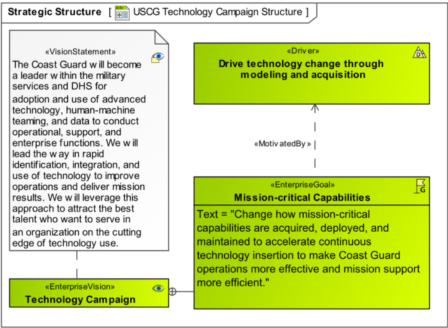
Incorporating User Research Findings Into a Model-Based Enterprise 773 The Force Design Technology Campaign that supports the overall USCG contains these model elements, shown by the UAF Strategic Structure (St- Sr) diagram in Figure 6. The high-level USCG enterprise strategic elements provide the motivation for the LMR mission.
Figure 6: UAF St-Sr diagram for the USCG technology campaign.
Modeling the LMR Strategic Domain The LMR «EnterpriseObjectives» and «Capabilities» identified in the USCG LMR Ocean Guardian, 2014, are captured in the model by using the mapping shown in Table 2. This table also includes HCD element mapping to UAF.
Table 2: HCD terms mapped to UAF model elements.
Table available in the original PDF paper.
Ocean Guardian Term UAF Element UAF Definition Pain Point Challenge A difficulty, circum-stance, or obstacle that must be overcome to achieve an EnterpriseGoal
Goal EnterpriseObjective A target that the enterprise must meet to achieve the EnterpriseGoal Objective/Strategy Capability The ability to Achieve a desired Effect
HCD Term UAF Element UAF Definition Person OperationalPerformer An entity capable of performing OperationalActivities
Decision Concern Interest in a system relevant to stake- holder(s) Ocean Guardian Term UAF Element UAF Definition
Process OperationalActivity Activity that captures a logical process Opportunity Opportunity A circumstance that can be advantageous when addressing a Challenge
Organization OperationalArchitecture An aggregation of Operational Performers
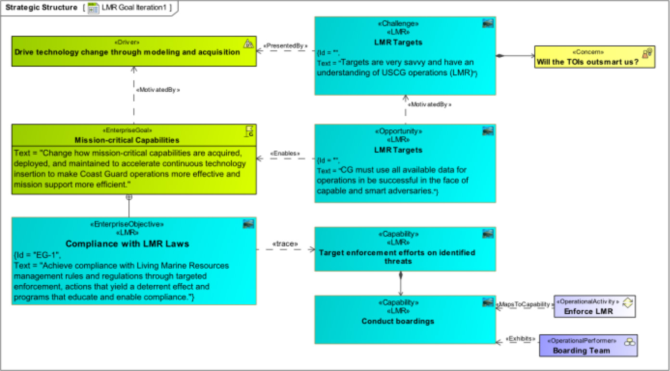
The UAF Strategic Structure (St-Sr) diagram in Figure 7 shows the relationships constructed between USCG strategic elements and LMR.
Figure 7: UAF St-Sr diagram for LMR.
This diagram shows cross-cutting dependencies between the UAF Strategic and Operational domains with the «OperationalPerformers» that exhibit an LMR «Capability» and the «OperationalActivity» that maps to it.
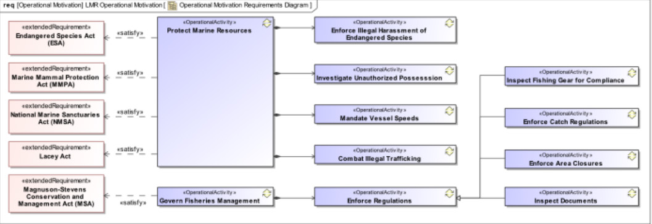
Modeling the LMR Operational Domain Following the UAF EAG, the Operational Motivation (Op-Mv) viewpoint specification for the LMR mission should be evaluated prior to additional aspects of this domain. Table 3 maps industry terms to UAF model elements. Figure 8 maps LMR regulations with a SysML requirements diagram.
Table 3: Industry terms mapped to UAF elements.
Table available in the original PDF paper.
Industry Term UAF Element UAF Definition Act / Regulation Requirement A condition which must be satisfied
Figure 8: SysML requirements diagram for LMR.
Incorporating User Research Findings Into a Model-Based Enterprise 775 This diagram demonstrates governing regulations of the LMR mission and the «OperationalActivities» that satisfy the requirements of each applicable regulatory act.
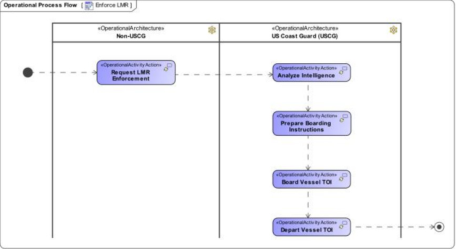
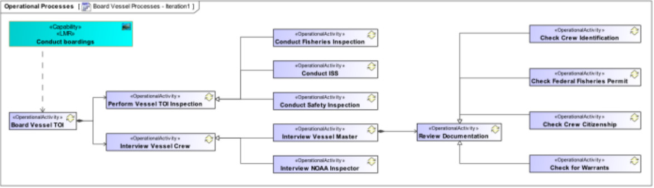
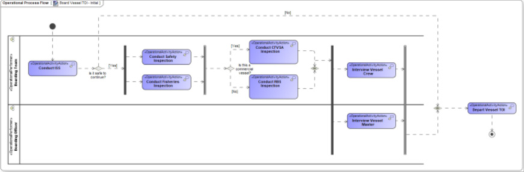
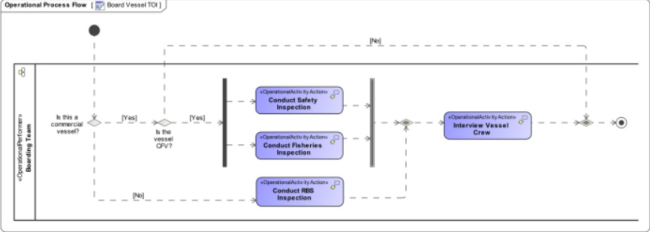
A high-level view of the LMR operational process flow was modeled to create relationships between the «OperationalArchitectures» and the functions that each is responsible for executing within a UAF Operational PFD, as shown in Figure 9. The UAF Operational Processes (Op-Pr) diagram in Figure 10 shows the functional decomposition of the “Board Vessel TOI” «OperationalActivity». This view represents the LMR «OperationalActivities» that map to strategic «Capabilities». To elaborate on the “Board Vessel TOI” «OperationalActivity», a UAF Operational Process Flow Diagram (PFD) was constructed, as shown in Figure 11. Meanwhile, Figure 12 shows a refinement made to the UAF Operational PFD based on received stakeholder feedback.
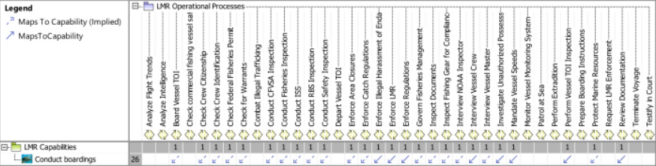
The changes to the process include a different set of decisions and the type of inspections conducted, based on the stakeholder responses. The Boarding Officer was also removed from the PFD to consolidate the responsibility of actions to the Boarding Team «OperationalPerformer». The dependency matrix in Figure 13 shows both the direct and implied «MapsToCapability» relationships. The implied relationships represent how traceability is realized through the concept of inheritance between the classes by the generalizations shown in Figure 10.
Figure 13: Operational activities mapped to LMR “Conduct Boarding” capabilities.
Iterating the USCG EA Model To ensure model accuracy, follow-on sessions with stakeholders were conducted from both the Strategy and Operational perspective. The usability of the model was discussed with the project sponsor and other experts. The sponsor identified some strategic questions the model could help answer such as:
How can we optimize boarding violation findings without disturbing the peace and while still ensuring marine safety?
What is the optimal asset laydown?
What data types, such as weather, are available?
What assets, such as aircraft, are available for a given operation?
DISCUSSION
This section discusses research results with regards to incorporating data from user research into a UAF model. Dynamically linking user research findings from the field into a model allows queries to be executed to answer specific questions. After user research results from engagement activities
Incorporating User Research Findings Into a Model-Based Enterprise 777 with the LMR operators are captured within the model, these elements can be reused to show additional information, expanding the organization’s collective knowledge of a mission in near real-time. The USCG architecture provides a scalable foundation of all collected data within a single repository that supports versioning, providing the potential to greatly reduce rework throughout iterations.
A hindrance to the incorporation of user research into a model is the ambiguous direction for mapping industry terms to elements within the modeling language. The UAF model element definitions leave ample room for the misinterpretation of findings, challenges, and impacts within the model environment. UAF model elements are often very similar, meaning that an extensive knowledge of the modeling language is required.
For example, “Person” is one of several Personnel domain elements, listed in Table 4, that could have been used in the USCG EA model. might have been captured by any of the Personnel domain elements defined in Table 4. If a second model was created that used one of the other terms for the stakeholders, then the basic nomenclature of the two models would not be compatible, causing errors or confusion in understanding for anyone using both models.
Table 4: UAF personnel domain model elements.
Table available in the original PDF paper.
UAF Element UAF Definition Person A single human being
Post A position that a Person can fill Organization A group of resources, including Persons, that share a particular purpose
However, the allowable relationships between an «Operational Performer» and other model elements is better suited for the perspective that user research offers. Without modeling experience, the similarity among UAF domain terms is easily misconstrued. Another consideration for integrating the HCD and MBSE disciplines is the ability to gather findings from the field and model them in parallel to increase accuracy and reduce the number of iterations.
RESEARCH LIMITATIONS AND FUTURE WORK This paper focused on a subset of the LMR mission, leveraging existing research and focusing on modeling to produce meaningful artifacts for this paper. As such, the model should be expanded to include the full breadth and depth of the USCG mission and its enterprise. For example, the accessibility to user research for the LMR mission limited the results to the local Boston area. Additionally, not all stakeholder concerns were verified, meaning not all of the user research findings are valid from an organizational perspective. Though the USCG LMR Ocean Guardian document is outdated, it provides a solid foundation for this case study as a proof-of-concept.
Future work will investigate additional UAF domains for a more complete picture of the LMR mission and its integration into the USCG enterprise architecture. This is likely to better utilize user research results to improve compliance with human-centered design best practices. Mapping a separate mission to the USCG Force Design 2028 strategy will also confirm the value of a reusable and scalable enterprise architecture model.
CONCLUSION
This research proposes a viable approach to incorporate user research findings into an enterprise architecture model using UAF. By engaging LMR operators throughout the iterative processes, a greater accuracy of user research findings, impacts, and concerns is captured in a model-based environment. Incorporating these HCD elements in the larger organization provides a reusable and scalable solution that reduces rework and improves upon each iteration. Because there is a single repository for mission data, currency of the data is ensured. To enable better decision-making, tables and matrices are created within the model so queries can be executed to answer specific questions regarding the effects of user research findings within the overall mission.
RECOMMENDATIONS To facilitate the integration of user research findings with EA modeling, a better understanding of user goals is necessary. Traditionally, the input has been from systems engineers and is not based in a common ontology to translate information about what users do and need. The above mappings show a potential way to transform user research data into a UAF model, but this is still largely subjective and based on the allowable relationships between model elements. It is worthwhile to re-visit the UAF element definitions and dependencies between elements as identified in the UAF domain metamodel to consider the results of this research for similar implementations for enterprise architectures.
ACKNOWLEDGMENT
The research was conducted in collaboration with the U.S. Coast Guard. Our sponsor provided valuable guidance throughout this effort. This work would not have been possible without our USCG collaborators at Northeast Region Fisheries Training Center (NRFTC), Sector Boston, and Northeast District.
DISTRIBUTION STATEMENT Approved for public release. Distribution is unlimited. This material is based upon work supported by the Department of Homeland Security under Air Force Contract No. [redacted] or [redacted]. Any opinions, findings, conclusions or recommendations expressed in this material are those of the author(s) and do not necessarily reflect the views of the Department of
Bravo, E. (1993). The Hazards of Leaving Out the Users. In D. Schuler & A.
Namioka (Eds.), Participatory Design (1st ed., pp. 3–11). CRC Press. https://doi. org/10.1201/9780203744338-1 Gibbons, S. (2020). 7 FUNDAMENTAL ACTIVITIES FOR UX WORKSHOPS.
NN/g. nngroup.com/articles/workshop-activities Gordon, K., & Rohrer, C. (2022). A Guide to Using User-Experience Research Methods. https://www.nngroup.com/articles/guide-ux-research-methods/ Hall, E. (with Zeldmaneditor, J.). (2013). Just enough research (R. Fox, Ed.). Book
Apart. Hause, M., & Wilson, M. (2017). Integrated Human Factors Views in the Unified Architecture Framework. INCOSE International Symposium, 27(1), 1054–1069. https://doi.org/10.1002/j.2334-5837.2017.00412.x Henderson, K., & Salado, A. (2021). Value and benefits of model-based systems
engineering (MBSE): Evidence from the literature. The Journal of The International Council on Systems Engineering, 24(1), 51–66. https://doi. org/10.1002/sys.21566 International Organization of Standards. (2023). ISO/IEC/IEEE 15288:2023 Systems and software engineering—System life cycle processes. International Organization of Standards. Martin, J. N., & O’Neil, D. P. (2021). Enterprise Architecture Guide for the Unified
Architecture Framework (UAF). INCOSE International Symposium, 31, 242–263. https://doi.org/10.1002/j.2334-5837.2021.00836.x Morkevicius, A., Aleksandraviciene, A., Mazeika, D., Bisikirskiene, L., & Strolia, Z. (2017). MBSE Grid: A Simplified SysML-Based Approach for Modeling Complex Systems. INCOSE International Symposium, 27, 136–150. https://doi. org/10.1002/j.2334-5837.2017.00350.x Norman, D. (Director). (2018). Principles of Human-Centered Design [Video
recording]. https://youtu.be/rmM0kRf8Dbk Object Management Group. (2022). Unified Architecture Framework Modeling Language (UAFML) v1.2 (Formal/22-07-05; Version 1.2). Object Management Group. https://www.omg.org/spec/UAF/1.2 Orellana, D. W., & Madni, A. M. (2014). Human System Integration Ontology:
Enhancing Model Based Systems Engineering to Evaluate Human-system Performance. Procedia Computer Science, 28, 19–25. https://doi.org/10.1016/j. procs.2014.03.003
SEARCH THE AHFE DIGITAL BOOKSTORE BY ISBN
Explore the complete digital volume
Human Factors in Design, Engineering, and Computing
Read this individual research paper free through the original publisher, or explore the full digital proceedings book.