Weizhen Xiao (2026). A Human-Centered Multi-Node Multimodal Design Framework for Interactive Installations in Cultural Heritage Sites: A Case Study of Qingcheng Mountain. In: Human Factors in Design, Engineering, and Computing. AHFE Open Access, vol. 238, pp. 984–993. https://doi.org/10.54941/ahfe1008329
Interactive installations are increasingly used to support cultural heritage interpretation and smart tourism. However, existing studies often focus on individual technologies or stand-alone installations, with limited attention to the systematic coordination of visitor needs, spatial nodes, and interaction modalities. This study proposes a Human-centered Multi-node Multimodal Design Framework (HMMD Framework) for interactive installations in cultural heritage sites, using Mount Qingcheng as a case study.The framework integrates experience economy, human-centered design, sense of place, and multisensory experience and operationalizes these perspectives through five visitor-need constructs. Survey evidence from 162 respondents informed five design requirements, which were consolidated into three core dimensions: Human-centered, Multi-node, and Multimodal. The framework was then operationalized through functioning prototypes for entrance navigation, cultural interpretation, and landscape experience. Cross-case analysis examined the correspondence between the survey-derived design requirements, the three framework dimensions, and the interaction strategies implemented in each prototype. The cases provide application-oriented evidence of the framework’s design applicability by linking visitor needs, site-specific nodes, and appropriate interaction modalities within a coherent visitor journey.
Digital technologies, artificial intelligence, and immersive interaction are reshaping cultural heritage tourism. Augmented reality, virtual reality, embodied interaction, and intelligent media offer new possibilities for interpretation and visitor engagement (Bekele et al., 2018; Gretzel et al., 2015). Nevertheless, many projects remain organized around isolated devices or single technologies, resulting in fragmented cultural narratives, weak continuity between spatial nodes, and limited participation across the visitor journey.
Prior research has established the value of interactive media for engagement and cultural communication, but less attention has been given
A Human-Centered Multi-Node Multimodal Design Framework 985 to coordinating multiple installations across functionally different spaces. A systematic approach is therefore needed to connect visitor needs, place characteristics, and interaction modalities at the scale of the complete visit.
Mount Qingcheng, a UNESCO World Heritage property and a national 5A tourist attraction, combines Daoist cultural heritage with a distinctive mountain landscape (UNESCO World Heritage Centre, n.d.; Ministry of Culture and Tourism of the People’s Republic of China, n.d.). Its entrance, landscape, and cultural nodes involve different visitor tasks, making it an appropriate context for examining node-specific yet continuous interaction design.
This study proposes the Human-centered Multi-node Multimodal Design Framework (HMMD Framework). It integrates four theoretical perspectives, derives five visitor-need constructs, uses survey evidence to formulate design requirements, and applies the framework to three interactive prototypes. The contributions are: (1) a framework oriented toward the complete visitor journey; (2) an empirical pathway that translates visitor-needs evidence from 162 questionnaires into design requirements; and (3) a case-based validation showing how these requirements can be operationalized across three representative spatial nodes.
THEORETICAL FOUNDATION Interactive installation design in cultural heritage sites involves experiential value, user requirements, spatial meaning, and interaction technology. Experience economy theory positions memorable participation as a source of value rather than treating information delivery as the sole objective (Pine and Gilmore, 1998). Human-centered design emphasizes users, tasks, contexts of use, and iterative evaluation (International Organization for Standardization, 2019). Together, these perspectives establish visitor experience quality and visitor needs as the framework’s goal and starting point.
Sense-of-place theory highlights the cultural, historical, and emotional meanings embedded in spatial settings (Relph, 1976), while multisensory research shows that tourism experiences emerge through coordinated visual, auditory, tactile, and embodied cues (Agapito et al., 2014). These perspectives support place-specific node organization and the selection of interaction modalities that fit each node’s task, environment, and cultural content.
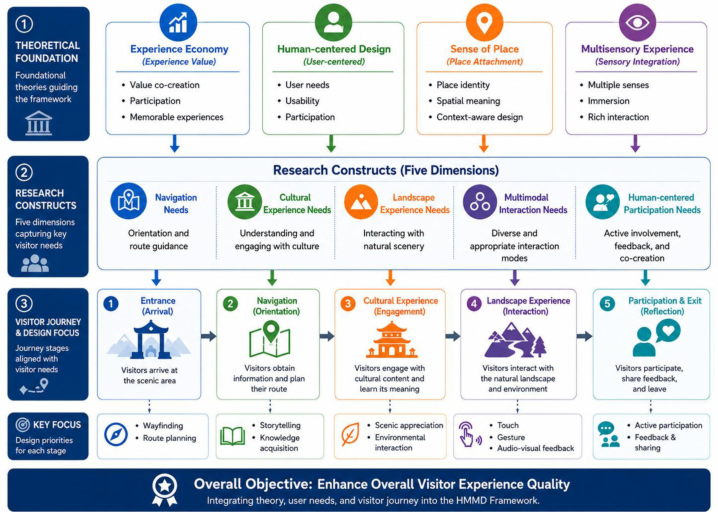
Theory Integration The four perspectives answer complementary design questions: why interaction is introduced (experience value), for whom it is designed (visitor needs), where it is situated (spatial nodes), and how it is implemented (interaction modalities). Human-centered design informs the Human- centered dimension, sense of place informs Multi-node organization, multisensory experience informs Multimodal configuration, and experience economy defines the overarching objective of improving visitor experience quality (Figure 1).
Figure 1: Theoretical foundation and research constructs of the HMMD framework.
Research Constructs Five constructs operationalize the theoretical model across the visitor journey: Navigation Needs (NN), covering orientation and route planning; Cultural Experience Needs (CE), covering interactive cultural understanding; Landscape Experience Needs (LE), covering environmental engagement and immersion; Multimodal Interaction Needs (MI), covering visual, auditory, tactile, and embodied interaction; and Human-centered Participation Needs (HP), covering active exploration, autonomy, and immediate feedback. The first three are node-related needs, whereas MI and HP operate as cross- node requirements.
USER SURVEY AND DESIGN REQUIREMENTS Questionnaire Design
A theory-driven questionnaire was developed to identify visitor requirements for interactive installations. It comprised demographic and visit-related questions and 25 Likert items (1 = strongly disagree; 5 = strongly agree), with five items assigned to each construct (Hinkin, 1998; Likert, 1932). The survey constituted the empirical stage of the design-oriented research process, providing evidence for translating the five research constructs into design requirements. Table 1 summarizes the measurement focus.
Table 1: Research constructs and measurement focus.
Cultural Experience Needs (CE) 5 Interactive learning, storytelling, context, and emotional resonance Landscape Experience Needs (LE) 5 Landscape interaction, immersion, dwell time, and memory
Multimodal Interaction Needs (MI)
5 Visual, audio, gesture/body, touch, and combined modalities
Human-centered Participation Needs (HP)
5 Participation, content choice, timely feedback, and usability
Data Collection The online questionnaire was distributed through Wenjuanxing, social media, and travel-related groups. All 162 responses were included. Respondents were predominantly young and middle-aged: 64.20% were aged 18-35, 74.69% held a bachelor’s degree or above, 70.37% had visited Mount Qingcheng, and 72.84% had prior experience with interactive installations at tourist sites.
Reliability and Validity Analysis SPSS 27.0 was used to assess internal consistency and factor-analysis suitability. Overall Cronbach’s alpha was 0.960; construct-level values ranged from 0.792 to 0.861, indicating acceptable to good reliability (Cronbach, 1951). The KMO value was 0.942 and Bartlett’s test was significant (χ² = 2686.49, df = 300, p < 0.001), supporting exploratory factor analysis (Bartlett, 1950; Kaiser, 1974). Because all responses were retained without quality screening, the high overall alpha should be interpreted cautiously.
Analysis of Visitor Needs All five constructs received mean scores above 4.00 (Table 2). Navigation Needs ranked highest (M = 4.142), followed by Human-centered Participation
988 Xiao Needs (M = 4.083), indicating that visitors prioritize clear orientation, active involvement, intuitive operation, and timely feedback. Cultural and landscape needs were also high, while the slightly lower multimodal score suggests that modality appropriateness matters more than technological complexity. Taken together, the findings show that visitors value a continuous, intuitive, and culturally meaningful experience. These findings provide empirical support for translating the five visitor-need constructs into the design requirements used to develop the HMMD Framework.
Design Requirements The theoretical and survey findings were translated into five requirements: human-centered interaction, continuous multi-node experience, appropriate multimodal interaction, integration of culture and place, and active visitor participation. Installations should therefore be intuitive and participatory, distributed according to the visitor journey, matched to node-specific tasks, culturally and spatially contextualized, and connected through a coherent experience sequence.
DEVELOPMENT OF THE HMMD FRAMEWORK Framework Development
The theoretical review and survey findings indicate that heritage interaction design must coordinate visitor experience, spatial organization, cultural interpretation, and modality selection across the complete visit. The HMMD Framework was therefore developed as a design method rather than a technology-specific solution.
Its development follows four steps: theoretical foundation, user-needs evidence, design-requirement extraction, and framework synthesis. Experience economy defines the experience-quality goal; human- centered design establishes user orientation; sense of place supports node organization; and multisensory experience guides modality configuration. The five survey-derived requirements are consolidated into three interdependent dimensions—Human-centered, Multi-node, and Multimodal. Human-centered integrates requirements related to visitor needs, usability, autonomy, and active participation; Multi-node addresses continuity across spatial nodes and the integration of culture and place; and Multimodal addresses the selection of interaction modalities appropriate to different visitor tasks and contexts.
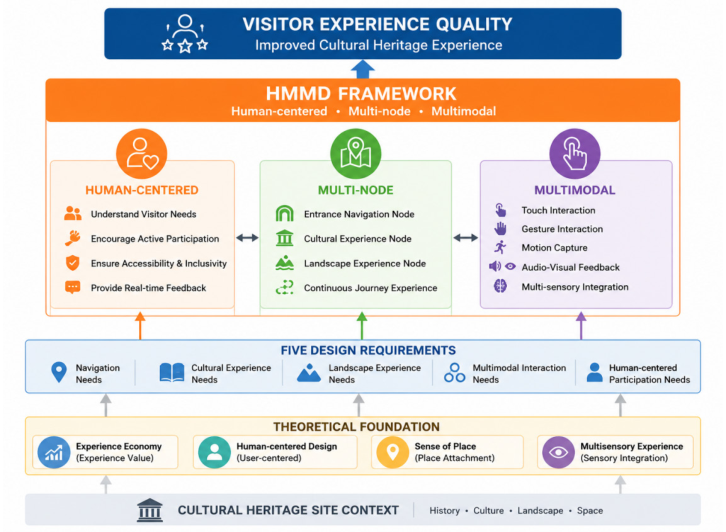
Architecture of the HMMD Framework The framework comprises a Goal Layer, Framework Layer, and Design Layer (Figure 2). The Goal Layer defines enhanced visitor experience quality as the overarching objective. The Framework Layer integrates three dimensions: Human-centered starts from visitor needs and capabilities; Multi-node
A Human-Centered Multi-Node Multimodal Design Framework 989 organizes locations according to the visitor journey and place functions; and Multimodal matches touch, gesture, visual, and auditory modalities to node- specific tasks. These dimensions are interdependent rather than sequential, allowing visitor needs, spatial continuity, and interaction configuration to be considered together throughout the design process.
The Design Layer translates these dimensions into concrete installations. At Mount Qingcheng, the entrance supports orientation through touch and visual guidance; Yuecheng Lake supports landscape experience through Kinect interaction, seasonal ink animation, and sound; and Tianshi Cave supports cultural interpretation through MediaPipe hand tracking and particle feedback.
Figure 2: Architecture of the HMMD framework.
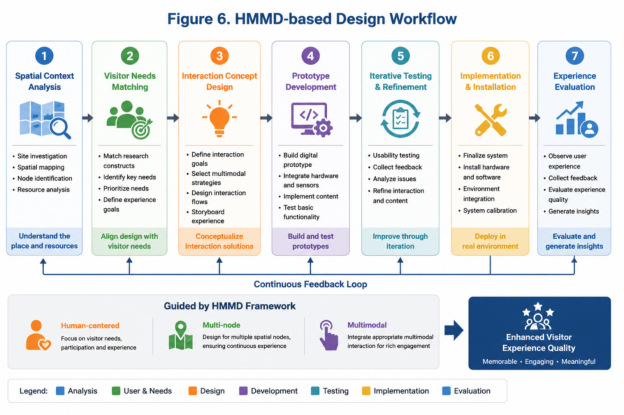
Design Workflow Based on HMMD The framework is operationalized through four stages (Figure 3): (1) Space Analysis identifies candidate nodes from spatial structure, visitor behavior, and cultural resources; (2) Needs Matching maps node-specific and cross- node requirements; (3) Interaction Design aligns input actions, content, and feedback; and (4) Experience Integration coordinates functions, cultural narratives, and interaction rhythms across the journey.
Figure 3: HMMD-based design workflow.
FRAMEWORK VALIDATION THROUGH QINGCHENG MOUNTAIN CASE STUDY Validation Strategy
Design applicability was examined through three functioning prototypes representing entrance navigation, landscape experience, and cultural interpretation. The analysis assessed whether the framework could guide node selection, cultural-content translation, and interaction configuration; it did not constitute a statistical test of visitor-experience outcomes. Specifically, the validation examined whether the five survey-derived design requirements could be mapped onto the three framework dimensions and operationalized across distinct spatial and experiential contexts.
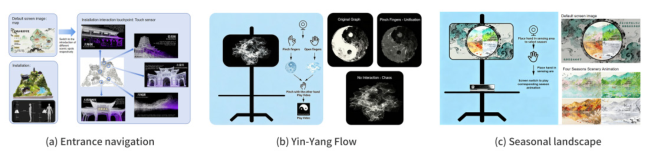
Case 1: Entrance Navigation Interactive Installation The entrance node addresses orientation, information acquisition, and route planning. A physical model of Mount Qingcheng is combined with capacitive touch sensors, Arduino, and TouchDesigner. Touching an attraction triggers synchronized location, cultural, and route information. Direct tangible input lowers the access threshold, while the model and dynamic visual feedback support rapid spatial understanding. Within HMMD, the case responds to Navigation Needs, establishes the first node in a continuous journey, and configures touch and visual modalities for the information task. This provides application-level evidence that the framework can translate navigation needs into a node-specific interaction solution.
A Human-Centered Multi-Node Multimodal Design Framework 991 Case 2: Yin–Yang Flow Cultural Interactive Installation
The Tianshi Cave node supports Daoist cultural interpretation. The Yin–Yang Flow installation uses MediaPipe to detect pinching and releasing gestures and maps gesture intensity to the aggregation and dispersion of ink-like particles. This action-feedback relationship translates yin-yang transformation, gathering and dispersal, and dynamic balance into an observable and controllable experience. The case connects embodied interaction, visual metaphor, and place-specific cultural content while enabling self-directed exploration. This provides application-level evidence that the framework can translate cultural requirements into embodied, context-specific interaction.
Case 3: Yuecheng Lake Seasonal Landscape Interactive Installation Yuecheng Lake functions as a landscape-experience node. A Kinect-based installation allows visitors to select seasonal scenes through bodily gestures, generating corresponding ink animations and environmental sound. The design supplements rather than replaces the natural setting and makes seasonal change experientially accessible. The case integrates embodied participation, immediate feedback, visual animation, and audio within a node oriented toward environmental appreciation and rest. This provides application-level evidence that the framework can coordinate landscape- oriented participation with context-appropriate multimodal feedback.
Figure 4: Interactive installation cases: (a) entrance navigation, (b) Yin–Yang Flow, and (c) Yuecheng Lake seasonal landscape.
Framework Validation
Table 3 shows that all three cases operationalize the Human-centered and Multi-node dimensions while employing modalities appropriate to their tasks. Cultural integration is strongest at Tianshi Cave and Yuecheng Lake, whereas the entrance installation primarily serves orientation. Collectively, the prototypes demonstrate a traceable mapping from theoretical foundations and visitor needs to design requirements, framework dimensions, and node- specific implementation. This makes explicit how the empirical requirements identified in the survey were translated into context-specific design decisions.
The evidence supports the design applicability and implementation feasibility of the framework across distinct spatial contexts, but does not yet establish its long-term effectiveness in improving visitor-experience outcomes. Field deployment and user evaluation are required to test effects on engagement, satisfaction, learning, and cultural understanding.
Table 3: Evidence-to-framework validation matrix.
Table available in the original PDF paper.
HMMD Dimension Design Requirement Case 1 Case 2 Case 3
The findings also suggest that the three HMMD dimensions should be interpreted as complementary rather than independent design choices. Human-centered establishes visitor needs and participation as the starting point, Multi-node organizes interaction according to spatial and experiential continuity, and Multimodal supports context-sensitive selection of interaction modes. Across the three cases, the value of multimodality lies not in increasing technological complexity, but in matching modalities to visitor tasks, cultural content, and spatial conditions. This indicates that the framework can support differentiated interaction strategies while maintaining a coherent visitor journey.
CONCLUSION
This study proposes the HMMD Framework to address fragmented interaction design in cultural heritage sites. Integrating experience economy, human- centered design, sense of place, and multisensory experience, it develops five visitor-need constructs and translates evidence from 162 respondents into five design requirements. Navigation Needs ranked highest, followed by Human-centered Participation Needs, emphasizing clear orientation, active involvement, intuitive operation, and coherent experiences rather than technological complexity alone.
The framework organizes these findings through Human-centered, Multi-node, and Multimodal dimensions under the goal of improving visitor experience quality. Its application to entrance navigation, Yin–Yang cultural interpretation, and seasonal landscape interaction demonstrates how visitor needs, spatial functions, cultural content, and modalities can be systematically aligned. The principal contribution is a traceable and potentially replicable pathway from theoretical foundations and empirical visitor-needs evidence to design requirements, framework construction, and node-specific implementation.
A Human-Centered Multi-Node Multimodal Design Framework 993 The study is limited by case-based validation, the absence of controlled and long-term field testing, and a predominantly domestic sample. Future research should deploy the framework in operational heritage sites and evaluate behavioral, experiential, and learning outcomes through observation, interviews, standardized scales, and longitudinal analysis. Cross-cultural testing and adaptive applications involving AI, digital twins, and XR also warrant investigation.
REFERENCES
Agapito, D., Valle, P. and Mendes, J. (2014) “The sensory dimension of tourist experiences: Capturing meaningful sensory-informed themes in Southwest Portugal”, Tourism Management, 42, pp. 224–237. https://doi.org/10.1016/j. tourman.2013.11.011 Bartlett, M.S. (1950) “Tests of significance in factor analysis”, British Journal of
Statistical Psychology, 3(2), pp. 77–85. https://doi.org/10.1111/j.2044-8317.1950. tb00285.x Bekele, M.K., Pierdicca, R., Frontoni, E., Malinverni, E.S. and Gain, J. (2018) “A survey of augmented, virtual, and mixed reality for cultural heritage”, Journal on Computing and Cultural Heritage, 11(2), Article 7. https://doi.org/10.1145/3145534 Cronbach, L.J. (1951) “Coefficient alpha and the internal structure of tests”,
Psychometrika, 16, pp. 297–334. https://doi.org/10.1007/BF02310555 Gretzel, U., Sigala, M., Xiang, Z. and Koo, C. (2015) “Smart tourism: foundations and developments”, Electronic Markets, 25, pp. 179–188. https://doi.org/10.1007/ s12525-015-0196-8 Hinkin, T.R. (1998) “A brief tutorial on the development of measures for use in
survey questionnaires”, Organizational Research Methods, 1(1), pp. 104–121. https://doi.org/10.1177/109442819800100106 International Organization for Standardization (2019) ISO 9241-210:2019 Ergonomics of human-system interaction—Part 210: Human-centred design for interactive systems. Geneva: ISO. Kaiser, H.F. (1974) “An index of factorial simplicity”, Psychometrika, 39, pp. 31–36.
https://doi.org/10.1007/BF02291575 Likert, R. (1932) A Technique for the Measurement of Attitudes. Archives of Psychology, 22(140), pp. 1–55. Ministry of Culture and Tourism of the People’s Republic of China (n.d.) National
5A Tourist Attractions. Available at: https://sjfw.mct.gov.cn/site/dataservice/ rural?type=10 (Accessed: 16 July 2026). Pine, B.J. II and Gilmore, J.H. (1998) “Welcome to the experience economy”, Harvard Business Review, 76(4), pp. 97–105. Relph, E. (1976) Place and Placelessness. London: Pion. UNESCO World Heritage Centre (n.d.) Mount Qingcheng and the Dujiangyan
Irrigation System. Available at: https://whc.unesco.org/en/list/1001/ (Accessed: 16 July 2026).
SEARCH THE AHFE DIGITAL BOOKSTORE BY ISBN
Explore the complete digital volume
Human Factors in Design, Engineering, and Computing
Read this individual research paper free through the original publisher, or explore the full digital proceedings book.