Houn-Gee Chen, Yu-Qian Zhu (2019). User Experience as Service at Social Networking. In: Advances in The Human Side of Service Engineering. AHFE Open Access, vol. 8. https://doi.org/10.54941/ahfe100245
Despite the popularity of social networks, there is a lack of a systematic way in which different social networking services can be categorized, and what users’ expectations and motivations for each type of social networking services are. This paper presents a framework of social networking services. We then proceed to elaborate on how to provide best user experiences from a need-satisfaction lens for each type of social networking services.
Social networks have profoundly changed how we interact with each other, as well as how we use the internet. Nowadays, people get their daily share of news by looking at stories and updates posted by friends on Facebook or from people they follow on Twitter, instead of reading news websites. We use social networks to stay in touch with friends, meet new friends, look for jobs, and play games. We share our thoughts, pictures, music and videos online with friends and comments on what our friends have posted. Although the term “social networks” covers a wide range of “web-based services that allow individuals to (1)construct a public or semi-public profile within a bounded system, (2) articulate a list of other users with whom they share a connection, and (3) view and traverse their list of connections and those made by others within the system”(Boyd & Ellison, 2008), there are considerable variations among the nature and mode of interaction of user activities performed at these websites. Some are centered around relationship maintaining and building, e.g., Facebook; while some are more geared toward content creation and sharing, e.g., Pinterest; and still others have specific goals and purposes, for example, asking and finding answers with social networking, like Quora.
Despite the many hours we spend on social networking each day, there is a lack of a systematic way in which different social networking services can be categorized, and what users’ expectations and motivations for each type of social networking services are. A classification scheme of social networking services can help us organize academic discussions, understand the difference and similarities among various services, and provide more in-depth insights for social networking services. Social networks have been frequently referred to as SNS, or social networking service, reflecting the service nature of these sites. Indeed, as service is defined to be “the application of specialized competences (knowledge and skills), through deeds, processes, and performances for the benefit of another entity or the entity itself” (Vargo & Lusch, 2004), and service should correspond to the customers’ expectations and satisfy their needs and requirements(Edvardsson, 1998). Social networks fit into the service definition with unique functionalities that benefit their users and satisfy users’ needs by making it easier to connect, make friends, and share with each other.
With the service nature of SNS in mind, we herein present a typology of social networking services based on prior research of social networks, as well as service literature, then proceed to elaborate on how to provide best user experiences from a need-satisfaction lens for each type of social networking services..
CHRACTERISTICS OF SOCIAL NETWORKING SERVICES Prior literature identified profile–based versus content-based as a major distinction among social networking services (Childnet International, 2008), which distinguishes SNS into two distinct groups with different purposes, nature of information, and nature of connections. Profile-based social networking services are primarily organized around members’ profile pages that consist of information about an individual member, and users make connections mainly because they are interested in the user behind the profile. Facebook, Twitter, Line, Whatsapp are typical examples of profile-based social networking services. Profile-based social networking services are centered around the person that’s behind the profile, so topics are more related to the person: what they do, what they like, and what they think. Typically, developing and maintaining relationships are of key concern with profile-based social networks. In content-based social networking services, however, the user’s profile remains an important way of organizing connections, but plays a secondary role to the posting of content, and users make connections mainly because they like the content a certain profile provides and want to follow updates of that particular profile. Photo- sharing sites Flickr, Instagram, Pinterest and Video-sharing site Youtube are examples of this type of service. Content-based social networks are more focused on contents, and discussions and comments are based around pictures and videos, i.e. the content that are shared, with much less focus on the person per se.
Schmenner (1986) identified customization as a key element of services. Customization captures the degree to which the service is customized to satisfy an individual’s particular preferences(Schmenner, 1986). In the context of social networking services, customization refers to the intended audience of the messages posted by users. There are two types of postings: one type is customized and intended for a specific person or a small group of audience, for example, leaving a comment to a friend, or posting updates to a closed circle of friends; and the other contains messages that are broadcast and are intended for everyone that is interested to read, for example, twitter accounts by the Wall Street Journal, President Obama or other celebrities. Thus, level of customization captures the differences of the intended audience. Customized messages have specific audiences, are generally exclusive (i.e., with certain level of permission setting); whereas broadcast messages are intended for the general public to view and inclusive of everyone, with no viewing permission restrictions.
A SOCIAL NETWORKING SERVICES FRAMEWORK Using profile-based versus content-based, and customized versus broadcast as the two defining features, we create a two-by-two matrix that categorizes the whole range of diverse social networking services into four types. Figure 1 shows a social networking services matrix and indicates some of the applications or services that fit neatly in one of the four quadrants.
Customized Message Broadcast Message Relationship Allowing users to connect,
reconnect, communicate,
Self-Media Allowing users to broadcast their updates
and build relationships. e.g., Facebook, Linkedin,
and others to follow. e.g., Twitter, Weibo,
Line, Whatsapp
Facebook fan sites.
Collaboration
Creative-outlet Allowing users to share their interest, creativity and
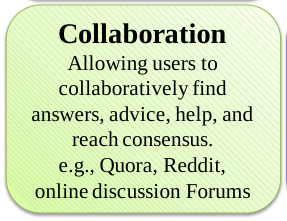
Allowing users to collaboratively find answers, advice, help, and
Relationship Social networking services that are profile-based and consist most of customized messages are labeled as “Relationship”. It includes services such as Facebook, Linkedin, and mobile APPs such as Line and Whatsapp. These profiled-based services usually require two-way confirmation of the establishment of a connection, and enable active screening of friends and varying levels of privacy protection, and are mostly used for relationship building and maintaining. In these social networks, most connections are made by acquaintances, or at least, friends of acquaintances, and people post messages on each other’s pages, leave comments on a friend’s photo, or update their status to a closed circle of friends. The messages are customized for one person, or a small group of friends, and are functionally equivalent to phone calls, emails, and family Christmas letters.
Self-media In the “self-media” type of social networking services, people connect to profile-based accounts that are established by well-known organizations, celebrities, or products. Instead of relying on traditional media channels that are owned and operated by media companies, this kind of SNS offers organizations, celebrities, and products the chance of managing a social media communication channel owned and operated by themselves. Typical examples of this type of services include Twitter, Weibo (The Chinese version of Twitter), and Facebook Fan sites. The connection requires only one-way initiation, and there’s very limited screening of accounts. People can “follow”, for example, president Obama and get updates whenever he posts on Twitter, or the New Agency Reuters, and get the latest breaking news before major television and website accounts are available. Similarly, brand managers can also establish fan sites of their products and broadcast the latest development of their new product and propagate promotions via self-media on Twitter or Facebook fan page.
Creative outlets For content-based social networking services, those that offer broadcast messages to the whole audience are labeled “creative outlets”. These include services that allow people to share their interest, creativity, and hobbies with each other, for example, video sharing websites Youtube, picture sharing services Instagram, Flickr, and Pinterest, and recipe sharing APP Foodily are all types of creative outlets. People post their photos, self-made funny video, or recipes online to share with people with similar interest. User can go through the website and follow whoever has the most interesting contents for updates, and exchange tips and thoughts with each other. This type of social network services connects people based on their creative outputs, and provides a meaning outlet for their creativity, while as the same time, provide entertainment and esthetic content for the followers.
Collaboration The last type of social network services consist of sites that are content-based, yet provides messages that are customized for specific questions or topics. These sites include social question answering site Quora, that allow users to ask and answer questions via collaboration, or Reddit, where users read and rate news, and discuss hot topics. On these sites, messages are customized for a specific question or topic, usually what the previous user has commented or asked, however, people are connected mainly because of the content or what they’re interested in, not that they know each other. These sites allow users to collaboratively find solutions to answers, get advice for life’s difficult situations, try to reach agreement among certain topics, and find the most interesting news and content of the day. Thus, we label these sites “collaboration”.
USER EXPERIENCES IN SCOIAL NETWORKING SERVICES With the different types of social networking services that exhibit great variations in nature of services and audiences, how does each type provide unique user experiences? To answer this question, we first look at what constitutes user experiences. Although there has not been a common accepted definition of user experiences yet, scholars tend to agree that user experience is something dynamic, context-dependent, subjective, that emerges from interacting with a product, system, service, or an object(Law et al, 2009). Hassenzahl(2008) defined user experience as a momentary, primarily evaluative feeling while interacting with a product or service, and are consequence of fulfilling human needs.
Hassenzahl(2008) proposed that people perceive interactive products along two different dimensions: pragmatic quality and hedonic quality. Pragmatic quality refers to the product's perceived ability to support the achievement of tasks such as "making a telephone call" or "finding a book in an online-bookstore". Pragmatic quality calls for a focus on the product – its utility and usability in relation to potential tasks. In contrast, hedonic quality refers to the product's perceived ability to support the achievement related to human needs, such as "being competent", "being related to others", "being special". Hedonic quality calls for a focus on the self, where more general human needs beyond the instrumental come into play, such as a need for novelty and change, personal growth, self-expression and/or relatedness.
Hassenzahl(2008) further argue that the fulfillment of basic human needs, such as being autonomous, competent, related to others, stimulated, and popular through technology use is the driver of experience. When people experience fulfillment of their needs through a product, they will attach hedonic attributes to Hedonic quality, which contribute directly to the core of positive experience. In a study aimed at exploring the structure of positive experiences with technology, Hassenzahl(2008) found that experienced autonomy and competence are sources for positive experiences while using technology, while there is a lacking of this to reflect a available technologies that address relatedness in current technology usage. Hassenzahl(2008) called for future research to broaden the palette of needs to "pleasurable stimulation," and "popularity / influence over others", to test whether these are able to produce the lacking facets of positive affect (i.e., excitement and enthusiasm).
Social networking services seem to be able to address what is found lacking in current user experiences per Hassenzahl(2008): relatedness and popularity. Beyond that, social networking services may also address other fundamental human needs, which contribute to the rich, addictive experience of using social networks.
IMPLICATIONS FOR USER EXPERIENCE DESIGN From a user experience design perspective, each type of social networks should support the accomplishment of their main corresponding human needs. Beyond general functionalities, designers must keep the underlying human needs in mind and focus on creating seamless experience that addresses these needs via the social power that SNS offers. What specifically, then, should each type of SNS designers pay attention to? Below we offer some advice based on the need-satisfaction paradigm.
Relationship The most important activities for relationship-oriented SNS are relationship maintaining and building, which nourish people’s relatedness and self-esteem. However, people vary in their degrees of emotional expressiveness, and many people may find it difficult to express their feelings and emotions to their family and friends. Sheldon et al.(2011) reported that people that feel disconnected in their social relationship tend to resort to Facebook to feel connected. Relationship-oriented SNS can facilitate the relationship building and maintaining of its users with simple yet effective mechanism to help.
Collaboration People go to collaboration SNS for topics they are interested in, to hear about other’s opinions, and to help other people. Essentially, they’re driven by the content and the interactions. To satisfy the need for autonomy, competence and self-actualization, the following aspects are important: (1) facilitating asking and helping behavior; (2) recognition of expertise and participation.
Self-media People go to self-media SNS for influence, self-esteem, and relatedness. For celebrities and corporations, self-media such as Twitter and Weibo allow them individualized channel of influence, reaching millions of users. For followers, they get the opportunity to get the most updated news, information, and tidbits from their favorite celebrities and brands, which in turn, lead to the need satisfaction of relatedness and self-esteem.
Creative-outlet Creative-outlet SNS features creativity from the crowd, and attract people looking for inspiration, fun, and enjoyment. Content providers find sense of competence and self-actualization, whereas viewers are entertained. To make the user experience unforgettable and satisfying, the following features might be adopted: (1) celebrating creativity; (2) encouraging exchange of thoughts.
CONCLUSIONS
Social networks are now an integral part of many people’s life, however, there is a lack of a systematic approach to understand how SNS works and how to best serve SNS users. This paper tries to address this issue by first providing a typology for social networks, and then examining social networks from a need-satisfaction lens with the user experience perspective. We explore the different types of social networks, and elaborate on the needs each type of services address, and provide implications for user experience design for SNS.
REFERENCES
Bargh, J. A., McKenna, K. Y., & Fitzsimons, G. M. (2002). Can you see the real me? Activation and expression of the “true self” on the Internet. Journal of Social Issues,58, 33−48 BizReport(2013) Social media access via mobile on the rise. Retrieved 26 August 2013:
<http://www.bizreport.com/2013/01/social-media-access-via-mobile-on -the-rise.html> Boyd, D.M., & Ellison, N. B. (2007). Social network sites: definition, history, and scholarship. Journal of Computer-. Mediated Communication, 13(1) 210-230 Cha, M., Haddadi, H., Benevenuto, F., & Gummadi, K. P. (2010). Measuring user influence in twitter: The million follower
fallacy. 4th International AAAI Conference on Weblogs and Social Media (ICWSM) pp. 10-17 Childnet International (2008). Young people and social networking services, A Childnet International Research Report. Retrieved 26 August, 2013 <http://digizen.org/socialnetworking/downloads/Young_People_and_Social_Networking_Services_full_report.pdf Clark, L. A., & Watson, D. (1988). Mood and the mundane: Relations between daily life events and self-reported mood. Journal
of Personality and Social Psychology, 54, 296-308 ComScore (2011). It's a Social World. Top 10 Need-to-Knows About Social Networking and Where It’s Headed. ComScore.
Retrieved 10 May, 2013 : <http://www.comscore.com ... about_social_networking> DeCharms, R. (1968). Personal causation: The internal affective determinants of behavior. New York: Academic Press Derrick, Jaye L., Gabriel, Shira, & Tippin, Brooke (2008) 'Parasocial relationships and self-discrepancies: faux relationships have benefits for low self-esteem individuals', PersonalRelationships, 15(2): 261–280 Edvardsson, B. (1998) "Service Quality Improvement", Managing Service Quality. Vol. 8 (2). pp. 142-149 Ellison, N.B., Steinfield, C., & Lampe, C. (2007). The benefits of Facebook “friends:” Social capital and college students’ use of
online social network sites. Journal of Computer-Mediated Communication, 12(4), article 1. Retrieved December 2007, from http://jcmc.indiana.edu/vol12/issue4/ellison.html Fragidis, G., Ignatiadis, I. & Wills, C. (2010). Value Co-Creation and Customer Driven Innovation in Social Networking Systems. In Morin, J. H., Ralyté, J. & Snene, M. (Eds.).Exploring Services Science, Lecture Notes in Business Information Processing, 53, 254-258 Friedenthal, S. Moore, A. Steiner, R. (2008), “A Practical Guide to SysML: The Systems Modeling Language”, Morgan
Kaufmann; Elsevier Science Folds, D. Gardner, D., Deal, S. (2008). “Building Up to the Human Systems Integration Demonstration”, INCOSE INSIGHT Volume 11 No. 2. Law, E. C., V. Roto, M. Hassenzahl, A. P. Vermeeren, and J. Kort, J.(2009) "Understanding, scoping and defining user
experience: a survey approach". In Proceedings of the 27th international Conference on Human Factors in Computing Systems. CHI '09. ACM, New York, NY, 719-728
LISTED IN THE AHFE DIGITAL BOOKSTORE CATALOGUE
Explore the complete digital volume
Advances in The Human Side of Service Engineering
Read this individual research paper free through the original publisher, or explore the full digital proceedings book.
ISBN 978-1-4951-2091-6
Explore this ISBN in the AHFE Bookstore ↗Listed in the July 2026 bookstore catalogue; search by ISBN to confirm current availability · Digital book purchase optional