Tai-Lin China, Yu-Shuan Tsaia, Raymund J. Linb (2019). Shopping Experience as a Service for On-line Group Purchasing. In: Advances in The Human Side of Service Engineering. AHFE Open Access, vol. 8. https://doi.org/10.54941/ahfe100249
Group purchasing has become an important trading activity in today's e-commerce. Most of current group purchasing websites provide a platform for sellers to list products and process transactions. Consumers are attracted and gathered by bonuses or discounts provided by the websites. In such traditional group purchasing scenario, product information is listed in one specific website and consumers have to find the products which they are looking for on the specific website. The impact of social opinions and experiences on group purchasing activities are not fully utilized and studied. In this paper, we design a novel group purchasing system which can directly embed grouping service in any webpages rather than establishing a traditional web store. In addition, user experiences are collected and employed to increase the possibility of group purchasing activities. The impact of other users’ preferences and purchasing activities on a buyer’s purchasing choice is further studied.
E-commerce has grown rapidly in recent years. It has dramatically changed traditional shopping scenarios and activities of consumers. People look for products on the World Wide Web (WWW) and place orders for products of their interest. The products are then delivered to the consumers by package delivery companies. Through the Web, people can find products with lower prices and read comments from other buyers of the products. Recently, people can also form groups for on-line shopping in order to get better prices or specials provided by sellers (Kauffman and Wang, 2001; Anand and Aron, 2003). The new shopping scenario of on-line group purchasing creates great opportunities to further increase sales for sellers and reduce prices for consumers. This paper develops a novel system for on-line group purchasing and investigates the impact of user preferences on consumer purchasing behaviors.
On-line group purchasing has drawn considerable attentions from people who look for better prices for products on the Internet. Current group purchasing system provides a platform on the Web for both sellers and consumers. Sellers have to list their products on the provided platform and follow the product list format of the system. Consumers have to join the group purchasing with a lot of unknown people and without customized choices. In general, people look for the products of interest and join purchasing groups based on the decisions of themselves. Other users’ experiences and preferences are not shown with the product and have no impact on people’s purchasing behaviors. However, users’ experiences and preferences are expected to be important factors when people make the decision to buy a product.
This paper develops an on-line group purchasing system with the flexibility to create purchasing groups in any place on the WWW. The system provides two particular services, namely ‘group purchasing service’, and ‘user experience display service’. The services are designed as a small piece of code which can be embedded into any webpages. Registered customers who want to sell products with group purchasing functionality can plug in the code in their own webpages and users who are interested in the listed products can create purchasing groups with their own choices. The ‘user experience display service’ provides a mechanism for users to show their preferences on the product list and through their social networks on the Internet. The service is not only being able to create more browsing traffics, but also may improve the potential of consumers joining purchasing groups. In particular, the provided services can benefit both sellers and consumers. On the one hand, sellers can increase their sales by the browsing traffics incurred from users’ social relations. User preferences shown on the product list can further attract people when purchasing a particular product. On the other hand, consumers can get even better prices through group purchasing. Consequently, the developed system is expected to have more competitiveness and sales efficiency as compared to traditional web stores or group purchasing websites.
Investigations are conducted to show the impact of the developed system on people’s purchasing behaviors. Twenty- six students join the trial of the developed system. The investigation is divided into two phases. In the first phase, the developed services are turned off and the system looks like a traditional web store. In the second phase, the developed services are turn on and the students can create and join groups for purchasing products. Their preference information is also shown on the product list pages and through Facebook. Questionnaire based on the decomposed theory of planned behavior (Davis 1989; Taylor and Todd, 1995, 1995b; Lin 2008) is given to the students after the trial. The results show that the developed services have significant impacts on users’ behaviors of on-line purchasing. In addition, user experience information does create positive influence on the on-line group purchasing activities.
THE GROUP PURCHASING SYSTEM DESIGN The group purchasing system is built on the World Wide Web and integrates web services, like social connections and third-party payment, from other on-line service providers. It provides a total solution to create an on-line group purchasing page including the on-line payment, marketing through social networks, and user intention display. Two major services are developed, namely ‘user preference display service’ and ‘group purchasing service’. Sellers may have their own on-line web stores or any webpages to list the products which they want to sell. In order to make the developed services easy for sellers to use, the developed services are designed as a short piece of embedding codes. For sellers who are interested in using our services, they only need to register their products on our group purchasing server and get the embedding codes with a specific ID for each product. Sellers just need to insert the embedding codes into appropriate locations in their own list pages and our services will be shown on the corresponding pages. The simple design brings many advantages. First, sellers do not need to re-build their web stores in order to use the services provided by our system. They can save the cost for maintaining two list pages, i.e. the original list page and the group purchasing page, for the same product in different locations. Second, it is easy for sellers to add user preference information and the group purchasing function to their own websites. Anyone who has a webpage can embed the service to create an on-line sale for a certain product. Third, it can reduce sellers’ marketing efforts. The system integrates the services of on-line payment and is able to propagate users’ intention for a specific product through social networks. Attention for the listed products can be drawn through users’ social relations. Fourth, the system already integrates the on-line payment services. Sellers do not need to maintain their own payment system.
Although the above described services are provided for sellers who have their own webpages, the system also provides a web store for sellers who do not have webpages. Therefore, users can create their own web stores with the built functions of user intention display and group purchasing.
System Outlook The user interface of the system is shown in Figure 1. The main portal page, shown in Figure 1(a), lists all the goods of the store. For an amateur seller, this page may look like a general homepages without any on-line business functions. Buyers can click a product and enter the page listing the product details as shown in Figure 1(b). Our user preference display service and group purchasing service are embedded in this page. The user preference display service is enclosed by the large red rectangle shown in the figure. The “Intend to Buy” button is developed by Facebook Open Graph Interface. It provides the connection to the social networks of perspective users. A user who is interested in the product may click the button to show his/her preference of the product. Users’ Facebook portraits are also shown in the bottom with user agreement. A message along with the link of the product is also posted on the user’s Facebook wall at the same time. The function of this service is to collect users’ interest from Internet. Through social networks, the users’ friends can be attracted and brought to this product page. By collecting user preferences and propagating the preferences through social networks, general public’s interest to this product may increase significantly in a short time. The increasing interest is expected to create a mood of group shopping and increase the sale of the product.
The small red rectangle shown in Figure 1(b) encloses a button for the ‘group purchasing service’ which provides another mechanism to improve the sales of the product from general public’s interest. If a user intends to buy the product but looks for a lower price, he/she can find companion for purchasing the product together by click the ‘Group Purchasing’ button. In general, the sellers would be willing to reduce the price if they can sell a bunch of products at once. In particular, the more the users join a purchasing group, the lower the price may be given by the seller. When a user clicks the group purchasing button, the group purchasing page is presented as shown in Figure 1(c). The page provides two functions for the perspective buyers. One is to create a new purchasing group and the other is to join an existing group. For users who want to create a new purchasing group, the user can set the due date and time for the new group. The price given to the purchasing group will depend on the number of buyers joining the group and the rules for the price decrease are set by the seller. For example, if there are five buyers at the end of the purchasing group, the buyers can get ten percent off. If ten buyers join the group, the buyers get fifteen percent off, and so on so forth. A phenomenon can be expected is that people would choose the group with the most buyers and the group buyers’ social relations may create another momentum to increase the product sale as the time approaches the due. In addition, sellers do not need to manipulate payment processes. In our implementation, PayPal is integrated into the system. For users who find appropriate group for their choice, they can just join the group.
(a) The store home (b) The ‘Intend to Buy’ and ‘Group Purchasing’ functions
(c) The group purchasing page
Figure 1. The user interface of the group purchasing system
Figure available in the original PDF paper.
Finally, when the deadline of a group is reached, the server would decide the final price and execute the transactions. It will inform the seller of each buyer’s address for product delivery. In particular, in Taiwan, some stores, like 7-Eleven, can help receiving packages from shipping company, which is a service for users who are not at home during daytime. Taking the advantage of this convenient service, in the system design, a buyer can set a 7- Eleven as a final delivery destination. Since all the products will be sent to the same location, sellers can reduce delivery cost and set a lower shipping fee for the group or even have free shipping for the whole group. This is also a feature for attracting people to use the group purchasing service.
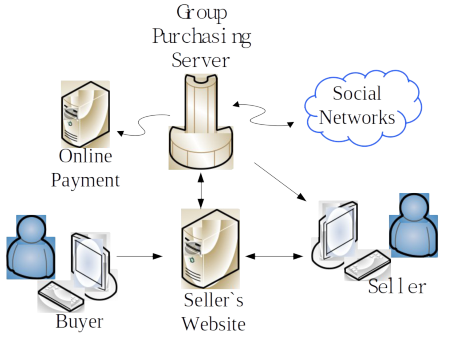
System Architecture The system is made of several components as shown in Figure 2. It includes the group purchasing server developed by the administration team, the sellers’ website maintained by seller themselves, and web services provided by other third party providers, like the online payment service provided by PayPal, the social relation services provided by Facebook. The function of each component is described as follows:
[Equation or mathematical symbol available in the original paper PDF]Group purchasing server: This is the major component of the System. The server has a database to maintain all the members’ information including sellers and buyers. It also maintains each product’s information registered by a seller and the users who click the ‘intend to buy’ button and are interested in a particular product. In addition, it manipulates the group purchasing activities, including creating groups, maintaining group status, and executing group purchasing transactions. [Equation or mathematical symbol available in the original paper PDF]Seller’s website: Sellers may prefer to have their own website and show their products in their own styles. As
a result, sellers can build a special image in users’ mind. In the system architecture, sellers can have their own website composed of any general webpages. One seller just need to register his/her products to the group purchasing server and get a specific ID for each product. Then, insert the ID into a short piece of codes provided by our server and just embed the codes into webpages to plug-in the provided ‘Intend to Buy’ and ‘Group Purchase’ functions. [Equation or mathematical symbol available in the original paper PDF]On-line payment: It provides an easy and convenient way to process transactions. Currently, a transaction goes through the group purchasing server and the server manipulates the transaction between sellers and buyers. Depending on the business model, the group purchasing team can decide to charge sellers for each successful transaction or creates revenue from advertisements with free transaction for users. [Equation or mathematical symbol available in the original paper PDF]Social Networks: Utilizing users’ social relations to increase purchasing interest is an important issue studied
in this paper. Facebook’s ‘Open Graph Interface’ is an easy and effective tool to employ users’ social relations for our group purchasing purposes. When a user clicks the ‘Intend to buy’ button, this user’s interest can be shown with the product and the user’s Facebook. The mood of group shopping can propagate to other people who browse the corresponding webpage. The ‘Intend to buy’ message on Facebook can also attract people’s attention to a particular product. Moreover, it is easier to create purchasing groups among friends than among strangers.
This system architecture can have several advantages. First, the system administration team does not need to maintain sellers’ web stores. It can reduce the load of the system administration. Second, sellers can have better flexibility to design and control their own web product list or bulletin boards. Third, products can get exposed to more people through users’ social links and need not to be listed in a centralized website.
Figure 2. System Architecture
IMPACT OF THE DEVELOPED SERVICES ON GROUP PURCHASING Trial Investigations
Trials are conducted to evaluate the effectiveness of the developed user experience display service and group purchasing service. Twenty-six students in National Taiwan University of Science and Technology are invited to try the system and provide their feedback after the trials. Some of the users have friend relationship in Facebook. The trials are performed in two phases. In the first phase, the user preference display service and group purchasing service are turned off. The trial users are given 3000 dollars for buying products in two days as on a normal online web store. The purchasing activities are just like general online shopping and performed by each individual user. In the second phase, the user preference display service and group purchasing service are turn on. The trial users are given 5000 dollars to buy products within eight days. In this phase, the trial users can show their preference of a particular product by clicking the ‘Intend to buy’ button. His/her friends on Facebook will see this message in the trial users’ Facebook and may be attracted to the product webpage. A user can also create a purchasing group for a product and the price decreases as the number of buyers joining the group increases. The users are asked to use the system every day in our lab during the trial. All the users when using the system are recorded by a video camera and their computer screens are simultaneously recorded by a screen recording program. The videos are used to observe the users’ reactions when using the system.
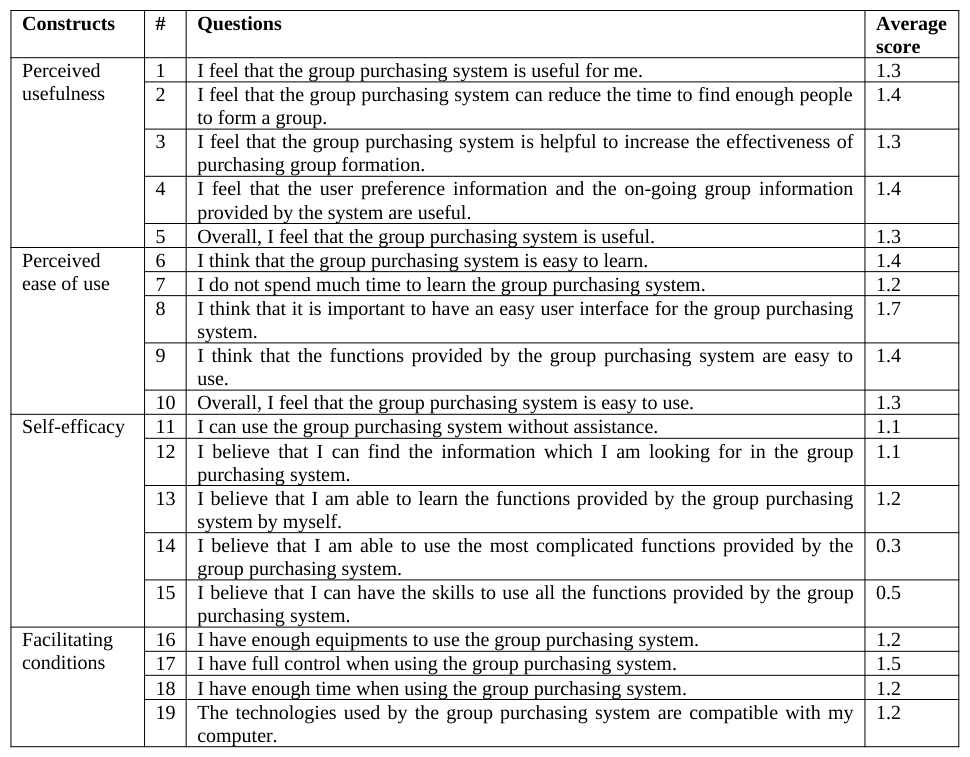
Evaluations and Analysis To evaluate the effectiveness of the developed system, a questionnaire is designed and given to the users after finishing the two phase trials. Basically, the questionnaire is designed based on the decomposed theory of planned behavior (Taylor and Todd, 1995, 1995b). The Likert scale is used to measure the score from the users. The levels of evaluation are from -2 to +2 where -2 stands for the lowest score and + 2 stands for the highest score. The resulting statistics are listed in Table 1.
Due to the number of sample size being smaller than 30, this study does not intend to make statistical conclusions in this section. On the contrary, user insights are summarized from questionnaire results and user videos captured during experiments as following:
1. The major experience failure observed from user videos is in the Paypal process. Most users are concerned about the complexity and safety of online purchases in the beginning. However, after a few trials, most users got used to the system, and appeared to be relaxed from the tension of shopping alone online. In other words, they feel safe knowing that friends are going through the same shopping process, and might be able to help him/her if problems arisen. The questionnaire results somehow confirm the observation by showing low scores in question #14 (0.3 points) and #15 (0.5 points) but high scores in overall "facilitating conditions".
2. The major experience success observed from user videos is in the social networking process. Users simply take it for granted when using ‘intend to buy’ and ‘group purchasing’, not even questioning why such buttons exist on a normal online store page and how to use them. It sort of echoes our assumption that some user experiences can be "added" onto other online experiences without causing much trouble. In the questionnaire constructs of "perceived usefulness" and "perceived ease of use", the average scores are higher than other constructs. Moreover, in many responses to questions of highlighted constructs, there are no users’ rating lower than zero (#2, #4, #5, #6, #8, #9).
3. Although users perceive the usefulness of group purchasing system (#1 - #5), they reported comparatively low score to question #24, #29 & #30, indicating that some of them are still hesitating in using the system frequently in the future. Our hypothesis is that people are concerning about the security of online shopping, instead of the overall shopping experiences. However, we will need to conduct more experiments to verify that.
4. Overall we found that people care most about the ease of use of new systems (#8), and whether they have full control of the system (#17). By introducing the “intend to buy” button with similar behaviors of a commonly used “like” button on social websites, people are quickly mapping their social experiences to the proposed group purchasing system, therefore speeding up the learning curve. The proposed system further demonstrated the value of providing “group shopping experience as a service” to any existing online store via Mashup-like technologies (Soylu et al. 2012).
Table 1: The questionnaire and the score statistics
CONCLUSIONS
On-line group purchasing is one of the most popular services for shopping on today’s Internet. This paper develops a novel group purchasing system and provides new on-line group purchasing experiences for both sellers and consumers. In particular, it benefits both sellers and consumers for their different requirements. Investigation results show that the developed system is easy to use and can be accepted by users without difficulties. Furthermore, the provided user experience information does show a significant impact on the purchase decisions made by consumers. It obviously builds consumers’ confidence for the products and increases the willingness of users for on-line purchase. For future work, a larger scale trial and investigation is required to make statistical conclusions and to prove the usefulness of the system.
REFERENCES
Anand, K. S. & Aron, R. (2003). “Group-buying on the web: A comparison pf price-discovery mechanisms.” Management Science, 49(11), 1546-1562. Davis, Fred D (1989), “Perceived Usefulness, Perceived Ease of Use, and User Acceptance of Information Technology.” MIS
Quarterly, 319-335. Kauffman, R. J. & Wang, B. (2001). “New buyers' arrival under dynamic pricing market microstructure: The case of groupbuying discounts on the Internet.” Journal of Management Information Systems, 18(2), 157-188. Lin, H. F. (2008). “Predicting Consumer Intentions to Shop Online: An Empirical Test of Competing Theories.” Electronic
Commerce Research and Applications, 6(4), 433-442. Soylu, A., Mödritscher, F., Wild, F., Causmaecker, P., & Desmet, P. (2012). “Mashups by Orchestration and Widget-based Personal Environments: Key Challenges, Solution Strategies, and an Application.” Program: Electronic Library and Information Systems 46(4), 383–428. Taylor, S. & Todd, P. A. (1995). “Understanding Information Technology Usage: A Test of Competing Models.” Information
Systems Research, 6(2), 144-176. Taylor, S. & Todd, P. A. (1995b). “Decomposition and crossover effects in the theory of planned behavior: A study of consumer adoption intentions.” International Journal of Research in Marketing, 12(2), 137-155.
LISTED IN THE AHFE DIGITAL BOOKSTORE CATALOGUE
Explore the complete digital volume
Advances in The Human Side of Service Engineering
Read this individual research paper free through the original publisher, or explore the full digital proceedings book.
ISBN 978-1-4951-2091-6
Explore this ISBN in the AHFE Bookstore ↗Listed in the July 2026 bookstore catalogue; search by ISBN to confirm current availability · Digital book purchase optional