Frederik Diederichsa, Gloria Pöhlerb (2021). Driving Maneuver Prediction Based on Driver Behavior Observation. In: Advances in Human Aspects of Transportation: Part II. AHFE Open Access, vol. 16. https://doi.org/10.54941/ahfe100705
With respect to an increasing amount of driver assistance systems and automated driving functions, a higher chance of unappreciated action and intervention of these systems can be registered, which in turn lowers the acceptance by drivers and passengers. A reduction of unnecessary warnings and interventions can be achieved by making them adaptive to driver’s intentions and maneuvers planning. In order to learn which driver behavior indicates certain maneuver intentions, a rater-based method using video recordings is proposed in this paper. Three driving maneuvers, namely turning, changing lane and braking for a pedestrian who intends to cross the road, were chosen for analyzing their predictability due to behavior observation. As a first step, a driving simulator study was conducted in order to collect behavior data of 24 drivers. Subsequently, clearly distinguishable behavior classes for each maneuver were extracted from video data, resulting in five superior behavior categories with 29 behavioral classes. Based on these classes four human observers were trained to detect at the earliest convenience maneuver intentions. Overall in 97 % of all cases the observers could predict the maneuvers. Inter-rater reliabilities showed to be between κ= 0.30 and κ = 1.00.
Modern driving assistance systems have to deal with a warning dilemma between timely intervention and false alarms. Rigid thresholds have proven to fail in this dilemma which calls for thresholds that are driver state adaptive. In addition future assistance systems and Car2x applications leading towards automated driving come up with the demand for anticipating planned driving maneuvers and conclude on driver’s intentions when the system needs to take a decision whether to take over control. In such situations it is of upmost importance to guess the drivers intentions in time and correctly in order to avoid system interventions that are counteracting the driver’s planning.
In this context Blaschke (2007) comments that a reduction of false warnings and interventions decreases driver stress and leads to a gain in security and acceptance. Typical examples of the need to guess drivers intentions are autonomous emergency breaking interventions. These systems fail too often when drivers plan close distance passing of vehicles or pedestrians. In a future which is introducing more and more automated driving maneuvers it Human Aspects of Transportation II (2021) will be also necessary to guess drivers intentions i.e. for lane changes and turning maneuvers in order to suppress corrective safety interventions and initiate supporting assistance (Kopf, 2005). Further Car2x based applications will broadcast information on driver and maneuvers intentions in order to organize a collaborative traffic behavior (TEAM-project, 2012).
Although there are many definitions of driver intention (see Kobiela, 2012), a good summary of the relevant aspects is provided by Kopf (2005). He describes driver intention as one of the influencing factors on driving next to emotion or attention, changing on a short-term basis (minutes or seconds), compared to long-term factors such as personality or driving experience and daily rhythm or tiredness, which are changing on middle-term. Intentions include the travel or arrival time, the planned route and especially the driving manoeuvres or manoeuvre order planned for the imminent future. Or more simply put driving intention refers to the manoeuvre planned next.
The remaining question however is how intentions can be detected. Ajzen (2002) acknowledges that intentions are defined not to be directly measurable, but rather detectable through observable behavior. If this behavior leads to manipulation of a machine (pedal or steering wheel) it can be observed indirectly via these actuators. A direct observation is assumed when human behavior is observed via video analysis. This approach is well known from social science (König, Heintz, & Scheuch, 1962) and is characterized by a systematic observation with a variety of specific methods ranging from simple annotation to classification methods and even magnitude estimation approaches (Schnell, Hill, & Esser, 2011).
Following Ajzen’s advice the authors of this paper planned and conducted an observation study with direct behavior observation in order to determine driver’s behavior which indicates intentions. The results can be used to detect intentions with sensors that would measure behavior directly, such as the emerging video camera sensors (InCarIn- Project 2014). Systematic direct behavior analysis also provides good reference for indirect measures as well in correctness as in timing matters. The research questions of this approach were
- to describe and classify the behavior that precedes driving maneuvers, - create a set of behavioral classes and magnitudes that allow anticipation of most driving maneuvers, - and to develop a procedure to predict maneuvers based on human rater observation.
An exemplary subset of maneuvers were selected from a set of basic maneuvers provided by Dambier (Dambier, 2010 and Manstetten et al., 2011) with a consciously broad range of behavior variance, including longitudinal and perpendicular maneuvering, maneuvers with high potential for assistance and – for practical reasons – to be simulatable in our immersive driving simulator. This resulted in three maneuvers:
- lane change, - left-turn and - close bypassing a pedestrian.
With respect to the state of the art on drivers intention recognition predicting lane change maneuver was subject to quite a view studies (Pentland & Liu (1999), Kuge et al. (2000), Oliver & Pentland (2000), Salvucci (2004), Gerdes (2006), Feyer et al. (2007), Henning et al. (2009), Berndt et al. (2008), Schroven & Giebel (2008)).
Turn prediction was investigated by Pentland & Liu (1999), Oliver & Pentland (2000), Takagi et al. (2000), Färber (2005), Gerdes (2006), Blaschke et al. (2007), Berndt et al. (2008) and Schroven & Giebel (2008).
A potential braking intention when passing a pedestrian has so far not yet been investigated according to our systematic literature review (planned for publication). The most related maneuver would be stopping at an intersection which was part of the extensive investigation in the studies of Pentland & Lui (1999) and Oliver & Pentland (2000). Those authors also investigated on turn prediction and lane change.
By means of velocity, steering data and acceleration Pentland and Liu (1999) were able to predict maneuvers with an accuracy of 95%. In their study dynamic Markov models were used to detect lane change, turning, following, overtaking maneuvers and stopping at the next section. 2 Seconds after the instruction for the maneuver or 1.2 seconds after the beginning of action, the prediction accuracy reached 90%. The maneuver to be executed was displayed via text in a 20-minute driving simulation with surrounding traffic, houses and road markings. For the included 72 stop maneuvers this happened approximately 70 m before the stopping point and for the 24 analyzed overtaking maneuvers (including lane change) with a speed of 30-35 mph, ca. 30 m before the preceding vehicle. After the driving simulator study Oliver and Pentland (2000) run a study with 70 participants who drove a test vehicle on urban and highway routes around Boston, during which driving instructors judged and instructed the maneuvers. Here they used dynamical graphical, hidden Markov and coupled hidden Markov models for the prediction of five different maneuvers. With just vehicle related data (brake, steering angle, acceleration and gear) their hidden Markov model predicted overtaking, start and stop with 100% accuracy. A combination of vehicle data with GPS and headway distance information, together with head and viewing direction was effective for turn and lane change. Here precisions of 6% (lane change right) to 86% (right turn) could be achieved.
The prediction probabilities and times achieved by these authors are all based on indirectly measured behavior. It was hence time to introduce also direct behavioral observation and apply human observer based methods from social sciences to this field of application. Our approach uses extensive data recording in a driving simulator, a video based analysis of the drivers’ behavior, a behavior classification and the development of an observer based intention analysis method. Intra and inter-rater correlations are reported for the likelihood of detecting a maneuver intention.
DATA RECORDING The data recoding was carried out in the Fraunhofer IAO driving simulator lab. The simulator is equipped with video recording technology and delivers synchronous vehicle sensor data. The test participants where balanced with respect to driving style, age and gender.
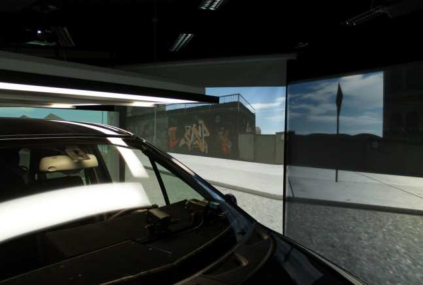
Driving Simulator and Scenarios The driving simulator, in which the data recording was performed, is a real vehicle with automatic transmission surrounded by seven screens to attain maximum immersion into the simulation. The chosen setting, which is roughly displayed in figure 1, enabled almost 360° view and included a projection for looking backwards behind the shoulder (right picture of figure 1). Road noises as well as surface irregularities could be displayed in the driving simulator.
Figure 1. Driving simulator at Fraunhofer IAO.
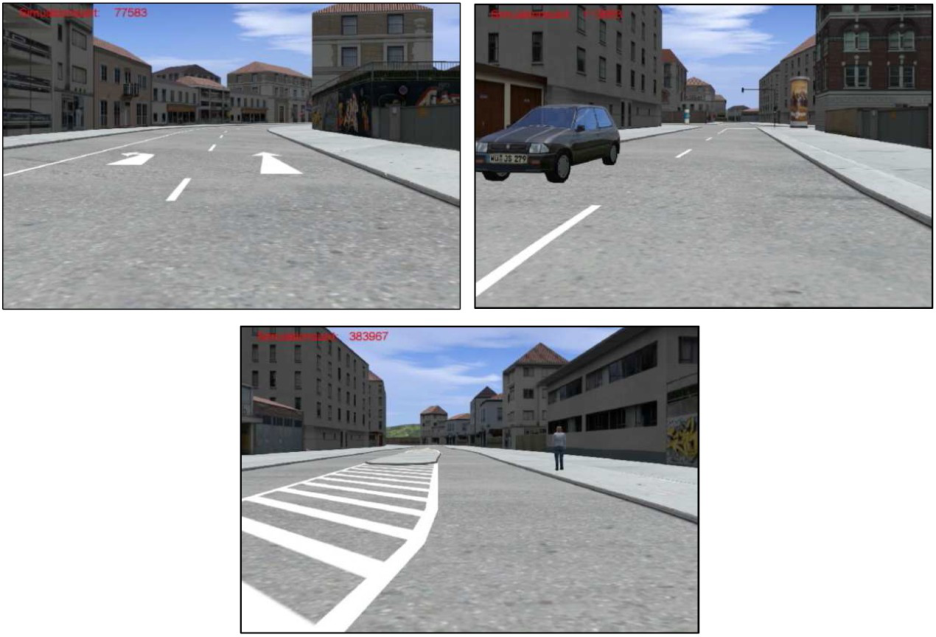
The simulated urban driving environment itself was implemented by using the pc-based simulation software SILAB 3.0 (WIVW, 2013). The three maneuvers where settled into a city with random curves, houses, trees, parks, pedestrians and traffic. None of the scenario scenes contained dynamic objects to avoid distracting the driver from the maneuver itself. For each maneuver a baseline scenario was included which was identical to the test scenario but without introduction to carry out the maneuver. Each maneuver and each baseline was included 5 times and cued up in random order resulting in 30 maneuver recordings per participant. Further road strips where included in-between and sum up the trip to 36 km / 45min driving. A screenshot of all three maneuver’s can be seen in figure 2.
Figure 2. The three driving maneuvers "lane change" (top left), "left turn" (top right) and "close bypassing a pedestrian" (bottom) in the simulation software SILAB.
The first maneuver, turning left, was implemented as an intersection turn. The traffic signal turned green at viewing distance. At the same time, the driver was instructed to turn left via an acoustic navigation command. This command was missing in the respective baseline condition. This setup allowed to discover different behavior between baseline and maneuver condition.
With regards to the second driving maneuver, changing lane to the left, a gauge widening has been realized in SILAB. Two seconds after passing the gauge the lane change command was given (no command in the baseline). At this time a car which was following the ego vehicle changed lane to the left and accelerated slightly in order to make backwards checking necessary.
The third and last driving maneuver, bypassing a pedestrian, differed in terms of the baseline condition. A pedestrian was walking on a pavement close to the street with a traffic island on the opposite site. In a similar scenario participants had experienced a road crossing here. This indicated a probability that the pedestrian may cross the road without looking. The objective here was to detect at an early stage in time whether the driver showed any intentions of braking – or not. Experiences collected in former experiments where used to design a scenario which would stimulate a braking readiness in many but not all drivers (Diederichs et al., 2011 and Ganzhorn et al., 2011) Recording Procedure
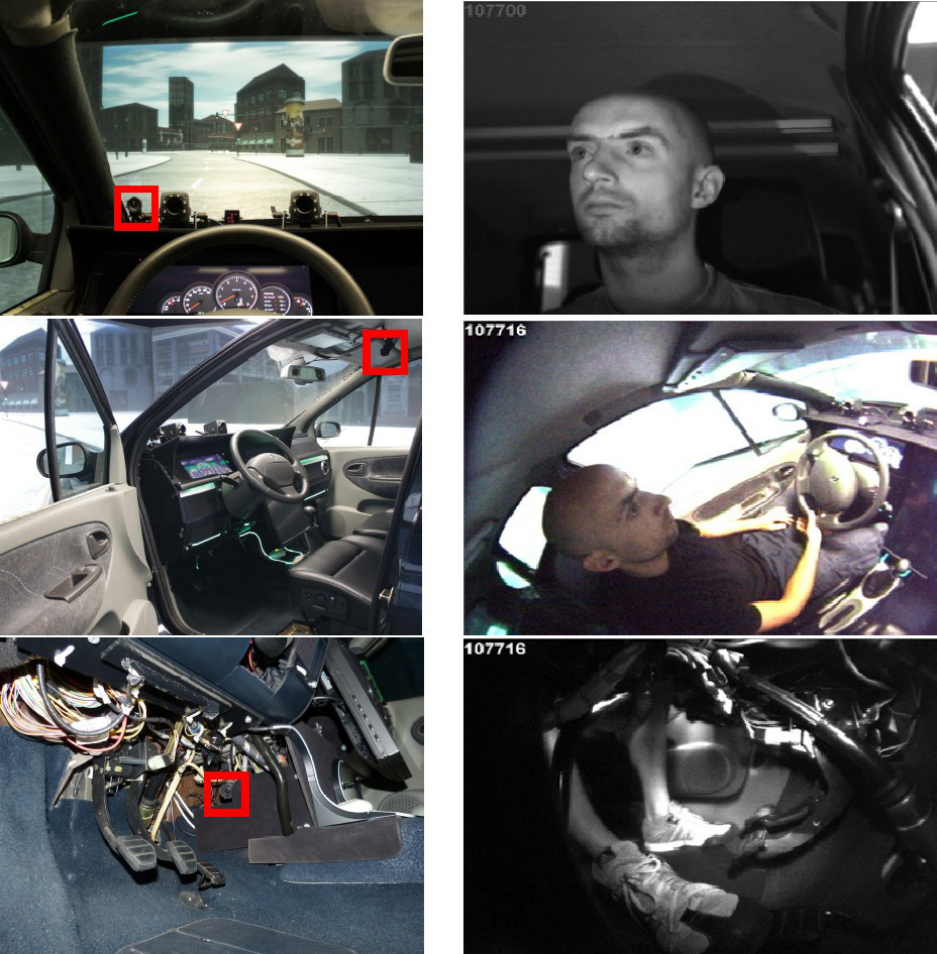
To gather video recordings, three IP cameras were built into the vehicle to record driver behavior from different perspectives. The first camera was installed leftwards in front of the driver to log gaze and head movements. The second camera with a fisheye lens was fixed on the ceiling to record the driver’s body and hands. The third camera in the pedal room records foot movements. The exact positioning of each camera and their corresponding shots can be seen in figure 3.
Figure 3. Position of the three IP cameras (left, red tag) and their corresponding camera pictures
(right).
The three IP cameras recorded with a frequency of 30 Hz and the SILAB scenario itself recorded with 60 Hz. Time stamps were used for synchronization.
Test Participants Altogether, 40 participants took part in the data gathering, of which 16 participants had to be excluded due to simulator sickness although the participants had been pre-selected for driving simulator robustness. Especially urban scenarios seem to cause a comparable high number of simulator sickness related data loss. For future studies we recommend to use curves with wide radius, reduce turning situations and reduce braking until full stop.
Consequently, 24 participants provided basis for further analysis with eight people classified to a driving style. As reported by Färber (2005) the individual driving style has an important influence on driver’s intentions, therefore a standardized questionnaire was utilized. This questionnaire allowed classifying three different driver styles, namely Human Aspects of Transportation II (2021)
“less-experienced, indecisive driver”, “ordinary driver” and “sporty and ambitious driver”. Participants were selected with an equal representation of these driving styles, having within the driving style groups a balanced number of young and old and female and male drivers.
The experiment itself started with reading various documents such as a declaration of consent and information about the project itself as well as filling in a demographic questionnaire. A training ride was included to familiarize the participants with the driving simulator and the simulation environment. The actual test ride took around 45 minutes. Subsequent to the preceding steps a final questionnaire was presented to the test subjects, asking them about the recent simulator ride. The whole procedure took approximately 90 minutes.
DRIVER BEHAVIOR OBSERVATION AND CLASSIFICATION Driver behavior was then categorized based on the video recordings. In a first step behavior categories and their classes where defined. Secondly the videos where analyzed for each maneuver and the observed behavioral differences where specified. Finally a procedure for human raters was developed which allows standardized behavior observation and prediction of the maneuvers.
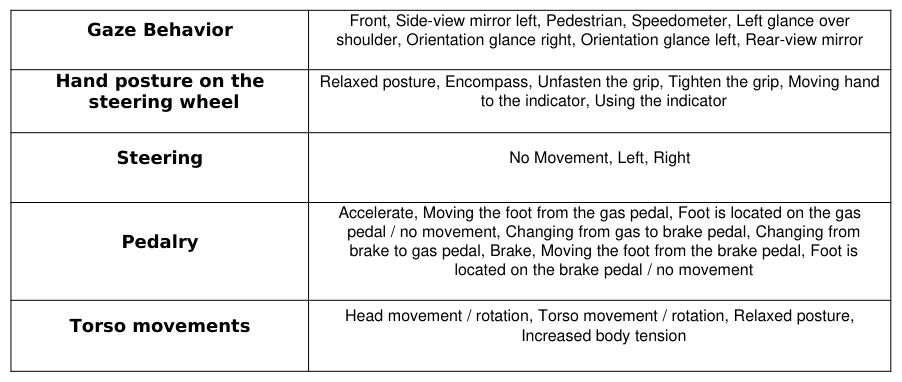
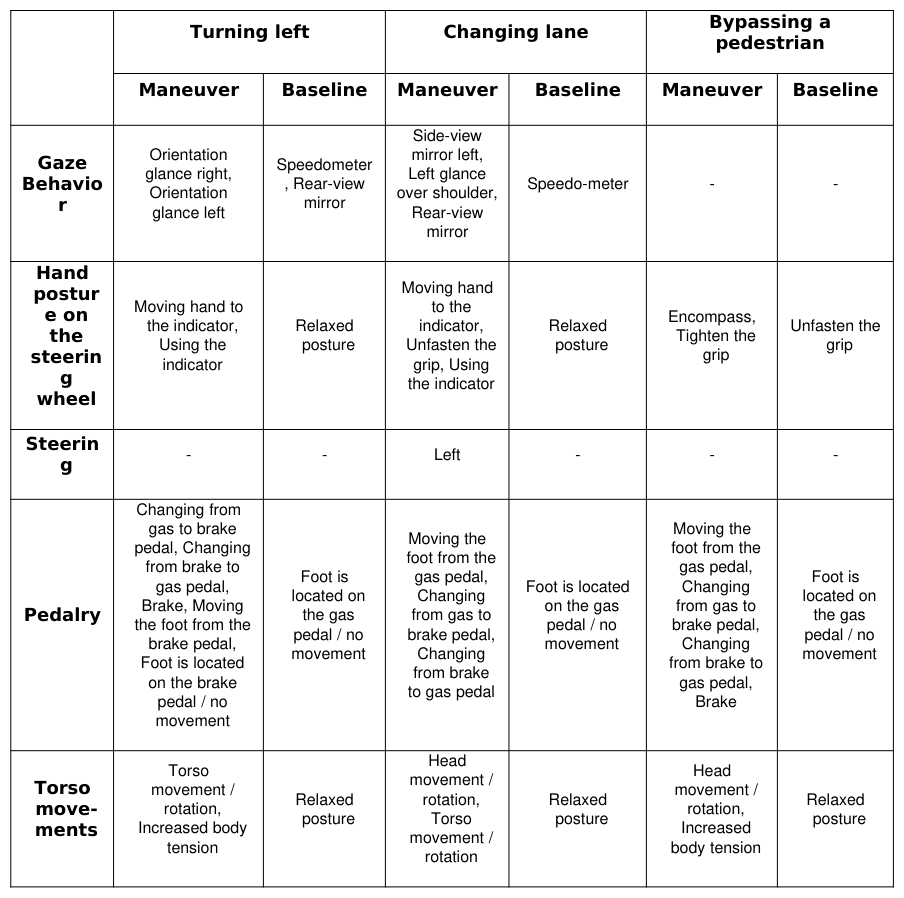
Behavior Categories and Their Associated Behavior Classes The data gathering led to 720 videos in total, 19 videos had to be excluded from further analysis in consequence of insufficient quality. Due to the effort encoding the single videos, both in an organizational and timely manner, only a representative part of 67 videos of this sample was used to develop the rater-based observation method. The analysis of the videos yielded five superior behavior categories with 29 behavioral classes collectively, which are listed in table 1.
Table 1: Superior behavior categories and their assigned behavioral classes.
The behavior classification was designed for time windows of 500 ms. Thus every 500 ms one class per category is marked which results in a behavior description composed of five behavior classes per 500 ms. The raters were instructed to rate the current video as long as their subjective assurance changed from either “very unsure”, “unsure” or “sure” to “very sure”, with respect to maneuver / no maneuver. After rating four times in a row “very sure”, raters were told to stop coding the video and go on for another video.
Specific Behavior for Baseline and Maneuver Conditions Using the introduced coding scheme, specific behavior classes for the three driving maneuvers were defined, aiming for distinguishable behavior between one of the maneuvers and their baseline. Table 2 provides an overview of specific differences in driving behavior, forming behavioral patterns for the three selected driving maneuvers.
Table 2: Overview of behavioral classes, which appear (almost) exclusively in one of both possible conditions.
Concerning the driving maneuver turning to the left, the executed analysis indicates that drivers show more dynamic sequences of movements in the maneuver condition in comparison to the baseline condition. This observation applies to all five behavioral categories. It can be said that in the maneuver condition visual exploration of the environment was obvious from the driver’s gaze behavior. On the other hand, in the baseline condition, the drivers seemed to focus on controlling their speed rather than exploring their environment. Moving the hand to the indicator and using it has naturally only been detected in the maneuver condition.
A similar observation has been found for the second driving maneuver, changing lane. It has also been found that dynamic movement appears in the maneuver rather than the baseline condition, especially regarding behavior for exploring the environment. For this driving maneuver it can also be concluded that the baseline condition was rather spent on controlling speed parameters, whereas in the maneuver condition drivers focused on ensuring a safe lane changing. Again, moving the hand to the indicator and using it has only been detected in the maneuver condition.
Detecting behavior differences for bypassing a pedestrian was more difficult than for the other two driving maneuvers. No differences could be found in gaze behavior, which however might be attributed to an uncentralized Human Aspects of Transportation II (2021) camera position. Also steering behavior showed no difference. The main differences resulted from the behavioral categories torso movements and hand posture on the steeling wheel, in a kind that drivers who were about to show a braking behavior are more likely to show a tensed body language accompanied with hand movements than drivers who do not intend to use their brake pedal. Clearly distinguishable behavior could be found in the pedalry behavior category, as dynamic movements in interaction with the gas or brake pedal only occurred in situations where the driver showed an intention to brake, whereas no movements could be registered when the driver did not intend to use the brake pedal.
Observer Training and Rater-Based Observation Method To instruct the observers with the above-mentioned findings, an observer training has been performed which lasted five days and included four student raters in total. The aim of the training was to familiarize the raters with both: the behavior classes rating in 500ms scenes and the coding program Mangold Interact Version 9. The observers were trained in the behavior classification for each baseline and maneuver condition. They were instructed to rate the behavior classes and additionally to indicate at each interval if they consider intention for a baseline or maneuver condition. Raters were informed about the potential driving maneuver, e.g. turning left, changing lane or bypassing a pedestrian; their overall objective was to decide whether a baseline or maneuver condition was to be performed.
Due to timely limitations so far the raters coded only a subset of all recorded videos, consequently every observer decoded 27 videos whilst the first three and the last three videos were redundant in order to compute intra-rater- reliabilities. The videos to be coded were randomly chosen, the only constraint was to have one video of every of the 24 participants in the simulator data recording to ensure an even appearance of driving style. This random selection of videos also avoided any anticipation of the driving maneuvers condition. All of the raters decoded the same videos but in a randomly assigned order.
The rating itself lasted for three days, with a daily video decoding of four hours maximum to decrease any effects of fatigue.
VALIDATION OF THE OBSERVER METHOD The above-mentioned rating with four student raters yielded 108 codings altogether of which 97 % of all codings proved to be correct with only seven videos coded wrongly. The majority of all correct codings, namely 72 codings, were correct at the first attempt, whilst in the other cases the participants decided on the wrong condition at first but corrected later to chose the right condition.
To reveal conclusions about the accuracy of the developed rating, three different methods were executed.
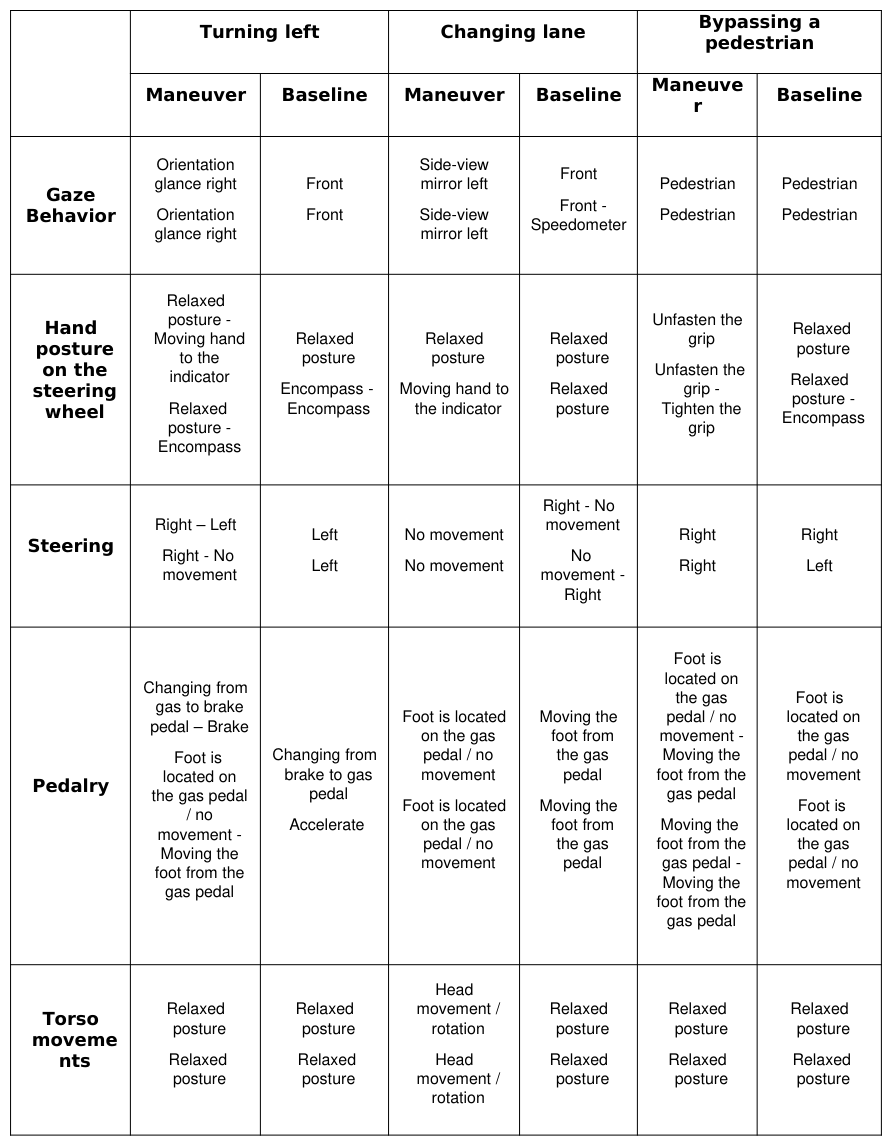
Extraction of Crucial Behavioral Classes It was of interest to understand which behavioral classes supported an observer most. No chronological sequence of single behavioral classes could be extracted from the observers’ codings. However, there were apparently certain behavioral classes, which seem to be crucial and led to a change in the observers’ choice between baseline or maneuver condition. They are summarized in table 3.
It can be noted that the specific behavior for each condition does not completely correspond to the behavior classes which led to the change in their subjective assurance. Additionally, some behavior classes occur at a very short time before the maneuver is started or is indicated with the indicator.
Table 3: Overview of behavioral classes, which had the most influence on changing observers' choice for a certain condition. The first behavioral class in each cell indicates the driver's behavior in the 500ms time frame before the observers' decided for maneuver or baseline. The second behavioral class indicates the behavior which led to the change.
Inter- and Intra-Rater-Reliability Inter- and intra-rater measurements were performed using Cohen's kappa coefficient for categorical items of two raters. The translation of values into categories according to Altman (1991) is displayed in table 4.
Table 4: Altman's kappa values.
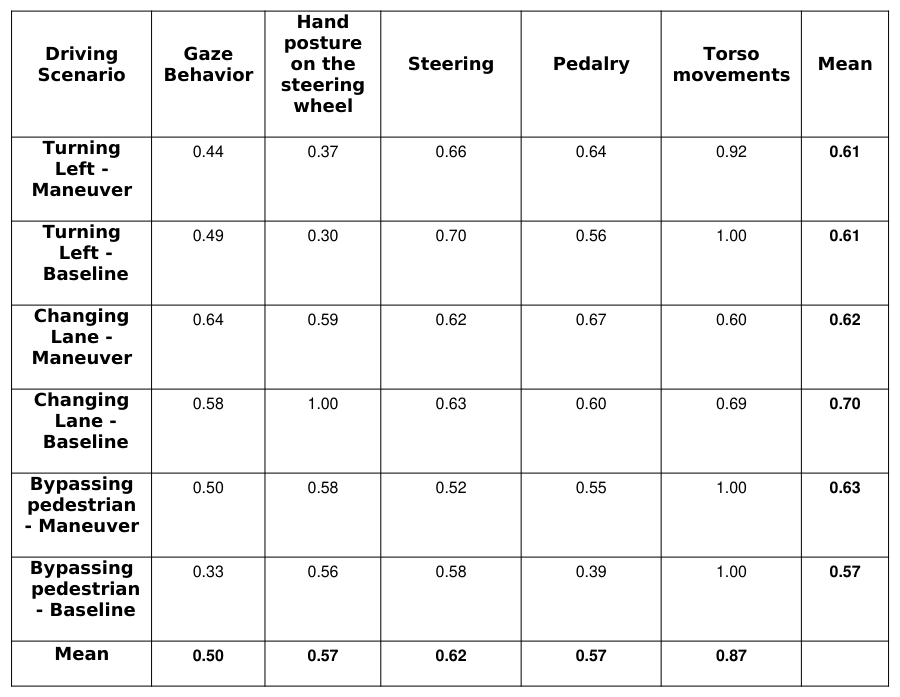
Inter-rater reliability calculations revealed κ - values between κ = 0.30 and κ = 1.00. Table 5 provides an overview of the inter-rater-reliability, arranged according to the different driving maneuvers and the distinct behavior categories.
Table 5: κ overview per behavioral class, which appear (almost) exclusively in one of both possible conditions.
Torso movements (κ = 0.87) and steering (κ = 0.62) showed substantial inter-rater reliability, while hand position and pedal position (both κ = 0.57) showed moderate correlation. Gaze behavior resulted in the smallest kappa value (κ = 0.50), which was probably due to a non-optimal camera position. In order to interpret gaze direction adequately from video images the camera should be positioned centrally in front of the driver’s face.
With respect to the maneuvers the inter-rater reliability showed for all maneuvers a substantial correlation. Changing lane yielded the highest inter-rater-values (κ = 0.70 and κ = 0.62) whereas the choice in behavioral classes of the scenario “bypassing a pedestrian” varied most (κ = 0.57 and κ = 0.63).
The intra-rater-reliability amounted to be in a similar range between κ = 0.50 (Hand posture on the steering wheel) and κ = 0.80 (Torso movements).
Observers’ Subjective Feedback The questionnaire, which was presented to the raters on the last day of their rating, was supposed to deliver ideas for forthcoming edited versions of the observation method. Overall, the raters were satisfied with the developed coding scheme, although they thought the scheme to be insufficient in some situations during the rating. Therefore some behavior categories, in particular pedalry and hand posture on the steering wheel, should be described by more classes. They commented that in some scenarios it was impossible to attribute a behavior either to any intention or to a situational context, specifically curves result in corrective steering which could be confounded with preparation of a lane change or turn.
Another important part of the final questionnaire was dealing with the predictability of the single driving maneuvers. All four raters indicated that they found turning left and changing lane easily detectable whereas again all of them thought that an intention to use the brake pedal when passing a pedestrian was rather difficult to foresee.
CONCLUSIONS
We found in our observation study that driving maneuvers are preceded by observable behavior. The classification of driver’s behavior allows identifying the differences between a maneuver preparation (driver intention) and continuation of the current maneuver, following the lane in our case. Moreover it was possible to specify the behavior classes so objectively, that even different raters showed an acceptable correlation.
Hence, we assume that an observation approach is suitable to classify driver behavior and to predict driving maneuvers. The behavior classes need to be specified for each maneuver separately. It seems that for each maneuver, or even variation of maneuver, a specific set of behavior classes is needed. Only generally speaking, longitudinal maneuvers are mainly predicted by foot movements, perpendicular maneuvers are predicted by hand and steering movements as well as shoulder glances and side mirror views. The study however showed that each maneuver is different and needs specific investigation.
Our raters indicated a high influence of the situation on the behavior. On curved road strips and even shortly after curves steering wheel movements could ether be attributed to the curve, or to a lane change maneuver preparation. In those cases a correct maneuver prediction was not possible - fact that should be even more relevant in real driving. Typical situational contexts influence the behavior and interfere with the behavior reflecting intention.
Another important aspect are inter- and intra-individual behavior differences of drivers. Simulator studies allow, in contrast to real life driving, a high level of scenario and maneuver standardization. And even here we discovered a wide range of individual behavior. Some drivers raise the foot over the brake pedal when they prepare to brake, others only lift the gas pedal. Some drivers change hand position before turning, others keep their hands in a suitable position all the time. Left glance over shoulder may happen when chaining lane, but may also not.
In conclusion maneuver prediction by driver behavior classification is influenced by driver’s intention, the situational context and personal states and traits.
AKNOWLEDGEMENTS The work presented in this paper is part of our activities in the UR:BAN project “Human in Traffic” (Urban-project, Human Aspects of Transportation II (2021)
2012-2016) which is co-funded by the Federal Ministry for Economic Affairs and Energy according to a resolution of the German Bundestag. The authors express their special thanks for the fruitful discussions within the consortium and especially thank Paul Czech, Matthias Beggiato and Dietrich Manstetten for their stimulation and support of this study. At Fraunhofer IAO the technical staff around the vehicle interaction lab and its driving simulator receives a special thanks for their support and Prof. Dieter Spath for his advice and support of this publication.
REFERENCES
Ajzen, I. (2002). Constructing A Theory of Planned Behaviour Questionnaire. Website of University of Massachusetts http://people.umass.edu / aizen / pdf / tpb.measurement.pdf Altman, D. G. (1991). Practical Statistics for Medical Research. Boca Raton: Chapman & Hall / CRC. Berndt, H.; Emmert, J.; Dietmayer, K. (2008): Continuous Driver Intention Recognition with Hidden Markov Models. 11th
International IEEE Conference on Intelligent Transportation Systems. Institute of Measurement, Control, and Microtechnology University Ulm. Beijing, China, 12.10.2008. Blaschke, C.; Schmitt, J.; Färber, B. (2007): Fahrmanöver-Prädiktion über CAN-BUS Daten. In: VDI-Bericht (2015), S. 165–
172. Dambier, M. (2010): Adaptive Information Flow Control Recognition and Prediction of Factors Contributing to Driver's Stress.
Dissertation. Universität der Bundeswehr, München. Diederichs, F.; Weber, B.; Ganzhorn, M. (2011): Experimental evaluation of ITST based school bus stop notifications for car drivers. In: 11th International Conference on Intelligent Transport Systems Telecommunications, ITST 2011. Proceedings. Piscataway, NJ: IEEE, S. 345–350. Färber, B. (2005): Erhöhter Fahrernutzen durch Integration von Fahrerassistenz- und Fahrerinformationssystemen. In: Markus
Maurer und Christoph Stiller (Hg.): Fahrerassistenzsysteme mit maschineller Wahrnehmung. [basiert auf ausgewählten Vorträgen eines Workshops in Walting (Altmühltal)]. Berlin: Springer, S. 141–160. Freyer, J.; Deml, B.; Maurer, M.; Färber, B. (2007): ACC with enhanced situation awareness to reduce behavior adaptations in lane change situations. IEEE Intelligent Vehicles Symposium. Istanbul, Turkey, 13.06.2007. Ganzhorn, M.; Diederichs, F.; Widlroither, H. (2011): Enhancing the reproduction of road signs in automotive HMIs to protect
children. In: 11th International Conference on Intelligent Transport Systems Telecommunications, ITST 2011. Proceedings. Piscataway, NJ: IEEE, S. 338–344. Gerdes, A. (2006): Driving Manoeuvre Recognition. German Aerospace Center. Braunschweig, Germany. Henning, M.; Georgeon, O.; Krems, J. (2007): The Quality of Behavioral and Evironmental Indicators Used to Infer the Intention to Change Lanes. Vision in Vehicles 11. Dublin, Ireland, 2007. InCarIn-project: Project website: http://www.incarin.de 2014-2016 Kobiela, F. (2012): Fahrerintentionserkennung für autonome Notbremssysteme. Dissertation. Technische Universität Dresden,
Dresden. König, R., Heintz, P. R., & Scheuch, E. K. (1962). Beobachtung und Experiment in der Sozialforschung. Köln: Kiepenheuer & Witsch. Kopf, M. (2005): Was nützt es dem Fahrer, wenn Fahrerinformations- und -assistenzsysteme etwas über ihn wissen? In: Markus
Maurer und Christoph Stiller (Hg.): Fahrerassistenzsysteme mit maschineller Wahrnehmung. [basiert auf ausgewählten Vorträgen eines Workshops in Walting (Altmühltal)]. Berlin: Springer, S. 117–139. Kuge, N.i; Yamamura, T.; Shimoyama, O.; Liu, A. (2000): A driver behavior recognition method based on a driver model framework. In: Intelligent vehicle systems, S. 47–54. Manstetten, D.; Dambier, M.; Krautter, W.; Quander, M. & Rimini-Döring, M. (2011): Adaptive und kooperative Technologien
für den intelligenten Verkehr: Forschungsinitiative Aktiv. Schlussbericht. Beitrag des Zuwendungsempfängers: Robert Bosch GmbH zum Teilprojekt: Aktiv-Verkehrsmanagement Teil 4. Stuttgart Oliver, N.; Pentland, A. (2000): Driver Behavior Recognition and Prediction in Smart Car. Proceedings of IEEE Conference and Intelligent Vehicles. Dearborn (MI), USA, 2000. Pentland, A.; Liu, A. (1999): Modeling and prediction of human behavior. In: Neural Computation 11, 1999, S. 229–242. Salvucci, D. (Hg.) (2004): Inferring driver intent: A case study in lane-change detection. In: Proceedings of the Human Factors
Ergonomics Society 48th Annual Meeting. Santa Monica, USA. Schnell, R., Hill, P. B., & Esser, E. (2011). Methoden der empirischen Sozialforschung. München [u.a.]: Oldenbourg Wissenschaftsverlag. Schroven, F.; Giebel, T. (2008): Fahrerintentionserkennung für Fahrerassistenzsysteme. Driver Intent Recognition for Advanced
Driver Assistance Systems. In: VDI-Bericht (2048), Wolfsburg. Düsseldorf: VDI-Verlag. Takagi, T.; Nishi, T.; Yasuda, D. (2000): Computer Assisted Driving Support based on Intention Reasoning. Dept. Of Computer Science, Meiji Univ. Kanagawa-ken, Japan. TEAM-project: Project website: http://www.collaborative-team.eu 2012-2016, UR:BAN project: Project website: http://www.urban-online.org 2012-2016 WIVW. (2013). Produkte und Dienstleistungen: SILAB. Website of Würzburger Institut für Verkehrswissenschaften:
Advances in Human Aspects of Transportation: Part II
Read this individual research paper free through the original publisher, or explore the full digital proceedings book.
ISBN 978-1-4951-2098-5
Explore this ISBN in the AHFE Bookstore ↗Listed in the July 2026 bookstore catalogue; search by ISBN to confirm current availability · Digital book purchase optional