Ümit Kilincsoyab, Alexa-Sibylla Wagnerac, Klaus Benglerb, Heiner Bubbb, Peter Vinkc (2020). Comfortable Rear Seat Postures Preferred by Car Passengers. In: Advances in Social and Organizational Factors. AHFE Open Access, vol. 9. https://doi.org/10.54941/ahfe100308
The joint angles of three most common postures of passengers sitting in the rear seats (sleeping, standard, upright) were recorded to develop an ideal posture model for rear seat passengers within a car. The passengers were positioned in a realistic mock-up of a whole car interior with a fully adjustable back seat and postures recorded. The results showed that the upright and standard postures have similarities to the postures of the driver’s seat in the literature. The relaxed posture showed a higher angle between trunk and thigh compared with the driving position and the variation in leg postures was much larger, which can be explained by the fact that the legs have more freedom in the rear seat than in the driving position.
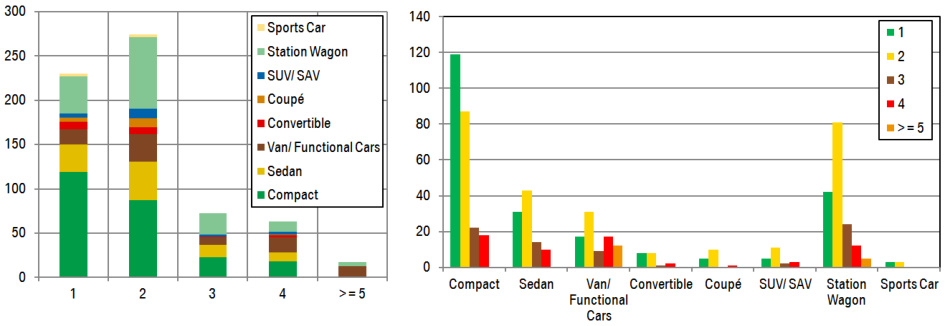
Today’s traffic situations show a diversified use of cars differentiating in two typical ones: commuting and vacation. The number of passengers can vary massively regarding to the various situations with compacts, station wagons and sedans as the most frequently seen car concepts (see Fig.1). Even if the number of SUVs would increase and new car concepts emerge like rear passenger focused ones, in commuting and vacation those three car types remain the most frequent ones for a while. Interestingly, a traffic observation showed that those car concepts also proved to be the ones that are most flexible as they can be used for both use scenarios (see Fig. 1).
Figure 1. Traffic analysis (trip from Munich to Delft on a Sunday: 850 km/530 miles on a highway). In the left picture the frequency distribution of passenger numbers in different car types is shown, the right picture illustrates the car types with the related passenger numbers.
Especially for long travels comfort plays an important role. However there are not many rear seat comfort models. Whereas a lot of research exists about the comfort of the driving seat e.g. by seating pressure distribution (Mergl, 2006; Zenk, 2008), comfort angles (Looze et al., 2003) and seating design (Franz, 2010), only little knowledge exists about the rear seat. In spite of the forced posture of the driver resulting from the maneuvering of the car (reaching the pedals, steering wheel, changing gears, view up forwards and backwards), the back seat passenger lacks a concrete task. Therefore an indefinite number of possible postures unfolds only restricted by the cabin and design of the back seats.
From a prior train passenger observation and analysis (Kamp et al., 2011) three typical sitting postures were seen most often. These positions are chosen for further study in the rear seats. It is important to select these three positions as the number of postures is indefinite. The examination of comfort angles in relation to those sitting postures is of importance in designing back seats as it can be assumed that the often chosen postures in trains, where there is also much freedom of posture choice could be transferred to the rear seats.
Thus for an insight in passenger habits and postures in passive driving situations the train study on 580 travelers was used (Kamp et al., 2011). The train movement was evaluated to be more comparable to a car’s movement, because of the similar impact on passengers regarding longitudinal and lateral acceleration, as well as decelerating. Therefore the activities can be transferred to those rear seat passengers would conduct in various travel situations (commuting, vacation, etc.).
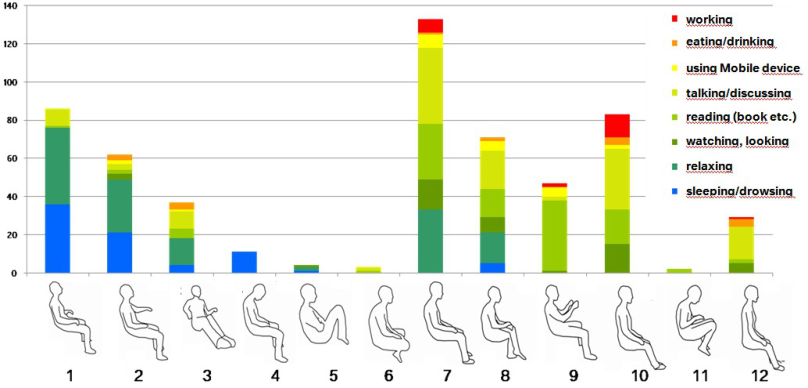
Figure 2. Research of typical activities of train passengers and the resulting postures.
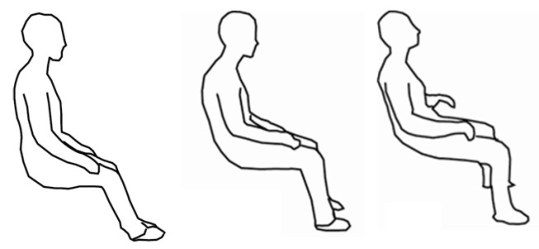
In Fig.2 on the left, postures for relaxing and sleeping activities are shown and in the middle the tasks are reading, watching and talking. These activities show a more upright posture. On the right side, postures seen for activities like working, eating, drinking and using mobile gadgets are illustrated. Based on these 12 postures, which were observed during travelling, a selection was made for the rear seat of a car. Most of these postures are not applicable for the rear seating of a car, because of safety requirements and physical constraints due to the car’s package. For instance, there is a shaft tunnel in the middle between the seats which limits space for your feet and lower legs. However three positions out of the 12 observed postures are possible and most observed (Kamp et al., 2011). Fig. 3 represents those possible three postures a back seat passenger could choose.
Figure 3. Resulting 3 possible postures applicable for back seat passengers after a selection from the 12 observed postures.
The left posture represents an upright position for short term travelling, watching the surrounding, using your mobile phone, talking to other front seat car passengers and eating. Additionally, Kamp et al. (2011) illustrated that this posture could be the most frequent one for diverse activities with high, medium and low activity levels in trains which is a comparable travel situation to the rear seats. In the middle the posture would need more space for a slightly relaxed seating, still awake and typically performing activities like listening to music. The right one is a special position for bigger cars and long term travelling with relaxing, maybe sleeping and drowsiness as major characteristics. This position maybe even more important for long term travelling (Khan & Sundström, 2007). For car manufacturers it is also important to consider these three postures, because in smaller cars only the upright position is possible and larger cars allow the relaxed position to be possible. Also, for software (like RAMSIS) it is important to further specify the posture for the different body parts. Therefore, it is interesting to have a closer look on these postures and analyse these more deeply. The research question for this study is: What are the angles in space with respect to a reference position of the different human body parts while sitting in the three described positions in a sedan?
METHOD
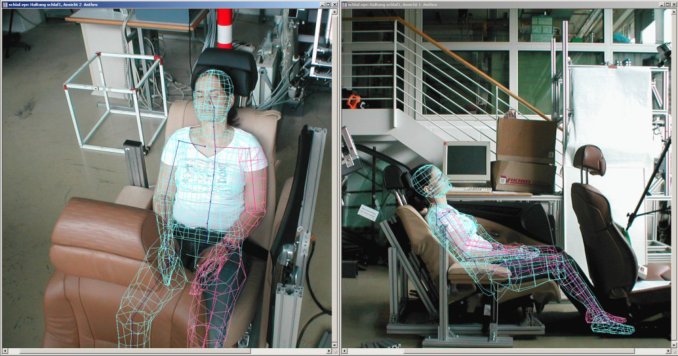
To answer the research question first the previously defined three typical postures derived from the study of Kamp et al. (2011) were more precisely analyzed. For this purpose 20 subjects were positioned in these three postures in a mock-up of a car interior which had the same size as a real car: a luxury limousine with adjustable back seats (see Fig. 4). Posture and comfort were recorded for all subjects sitting in this mockup. The measurement of the posture was done by using PC-Man, which is a software for measuring anthropometry based on stereophotography.
Figure 4. The typical PC-man net of a subject sitting in a sleeping position in the mock-up.
The experiment started with collecting anthropometric data of each subject like age, body height, sitting height, leg length. A total of 20 subjects took part in the experiment (11 male and 9 female). The subjects were between 21-36 years old and with body height from 1.58-1.97 meters. According to Seidl (1994) the comfort angles do not necessarily depend on the body height which means that we can hypothesize that the same comfort angles will be obtained for everyone.
The comfort was checked by using a questionnaire and the posture was recorded by taking pictures for the stereophotography right after the position (see Fig. 4). The stereo photogrammetry delivered data on complete body segments and for comparing the joint angles to the literature. The joint angles in the sagittal plane were calculated with the support of RAMSIS.
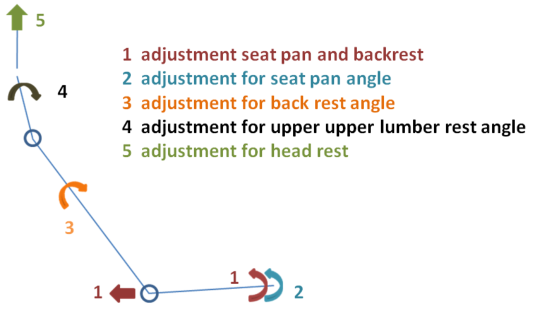
The backseat itself was fully adjustable, including angle of seat pan, backrest and upper lumbar rest (see fig. 5). Also the height of armrest (left hand side and right hand side) and headrest were variable which is important to enable a good position in order to achieve a high comfort situation (= posture).
Figure 5. Fully adjustable mock-up seat. Overview of the adjustment possibilities.
Protocol The experiment started by putting a subject in the initial situation. In this initial situation: the seat was adjusted in a very uncomfortable position in order to ensure that subject has to adjust the entire seat according to the own preferences and not just take over the predefined settings of previous subjects. For each subject the following sequence was defined:
1. Fasten the seat belt (a lap belt for more realistic rear seat posture, important for pelvis position in relation to the seat pan)
2. Adjust seat for standard posture.
3. Adjust seat for a relaxed posture.
4. Adjust seat for the upright posture.
All three postures were recorded via stereophotography, after the subject reported that the position is taken and after each posture a questionnaire was completed. The intention of using this sequence was to avoid that the subject uses same posture for upright and standard position. The upright position was also seen as the ideal one for the last sequence for answering the questionnaire using a blotting pad.
RESULTS
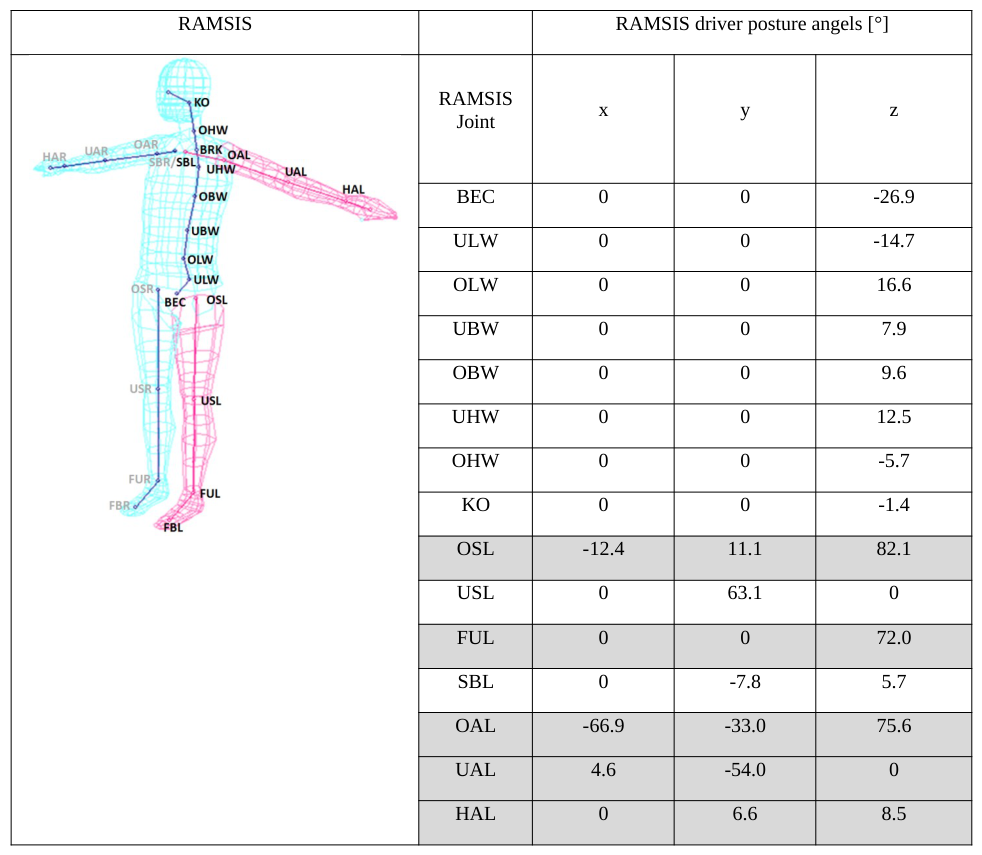
All of the subjects declared that they feel like sitting in the backseat of a real car. For this reason the mockup was considered as suitable for the test series. As planned the subjects did indeed adjust their seat to another position in all three situations. In Table 1 the measured joint angles for the three passenger postures are compared with the RAMSIS driver posture. The thigh angles are comparable between driving posture, the upright and standard posture. Only the relaxed posture differs as the subjects show a larger angle of the trunk, because the subjects were stretching their legs: z = 61.1° instead of 82.1° of the driving posture.
Noticeably, in the upright position the thighs are closer with y = 5.5° than 11.1° which can be explained by using the thighs as support for notebooks, books, etc. The foot opening angle of the driving posture (z = 72.0°) is bigger than the one of the passenger model (z = 59.0°), because of the missing pedals. Therefore the foot can be kept relaxed.
The whole chain of arm, elbow and shoulder of the relaxed passengers’ position differs intensively from the driving posture as the arms lack a concrete task and consequently can rest in a relaxed but manifold position.
Table 1: Average of measured joint angles for 20 subjects in three different postures with standard deviation (SD).
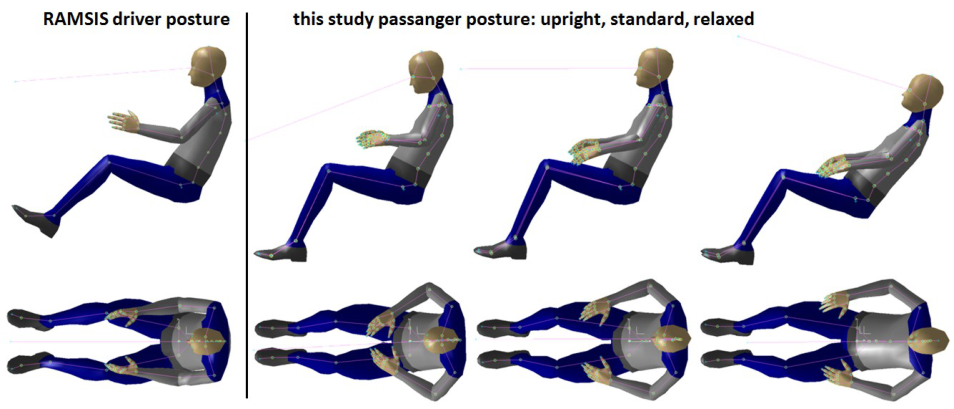
The visualization of the three different postures in RAMSIS can be seen in Figure 8 with presenting the mean values for each joint angle.
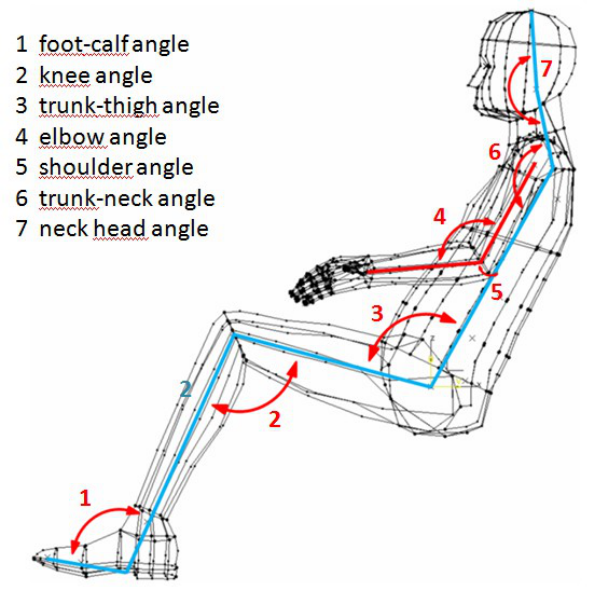
Figure 6. Visualization of the results in RAMSIS: upright posture (left), standard posture (middle), relaxed posture (right) In order to highlight the differences and to compare the findings of the study to the established values of the literature, the 3D angles were projected on a 2D surface:Figure 7. Projection of RAMSIS manikin in 2D-plane showing the measured joint angles.
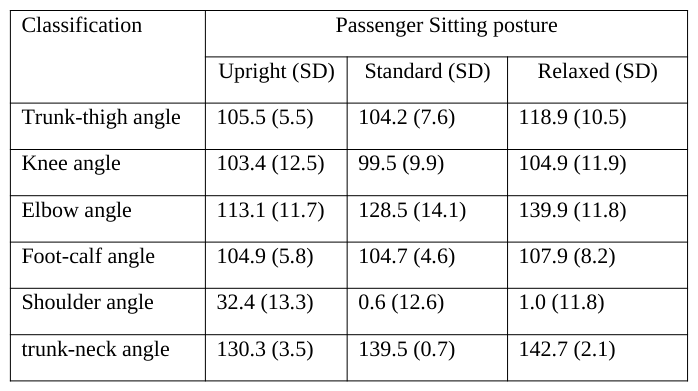
A comparison of the three different passenger positions is shown in Table 2.. The average angles with the standard deviation (SD) the subjects took in the comfortable position are shown in Table 2. The difference between the upright and standard position was not that large. The only significant difference can be seen in the shoulder angle which has an average value of 32.4° for the upright position and 0.6° for the standard posture. This is obvious because subjects were using their hands for doing tasks like filling out the questionnaire (representing tasks like using a mobile device, eating, reading in a magazine etc.). The difference in the sagittal plane was largest between relaxed and the other two (see table 1), while the trunk-thigh angle is 104.2° for the standard posture the relaxed position showed here 118.9° because subjects sit more relaxed. Accordingly, the elbow angle in the relaxed position is 139.9° compared with 128.5° for standard position. Also foot-calf angle and trunk-neck angle show a slighty more open angle. The questionnaires showed that the majority of the subjects could take their ideal position.
Table 2: Average of measured joint angles for 20 subjects projected on the sagital plane:
DISCUSSION AND CONCLUSION Regarding the research question this study shows that it was possible to detect differences in postures. The three positions found in the study of Kamp et al. (2011) did show different angles in space in a sedan mock-up. Analogous to Kamp’s study, the armrests were excluded, as even in passenger trains the support was seldom used.
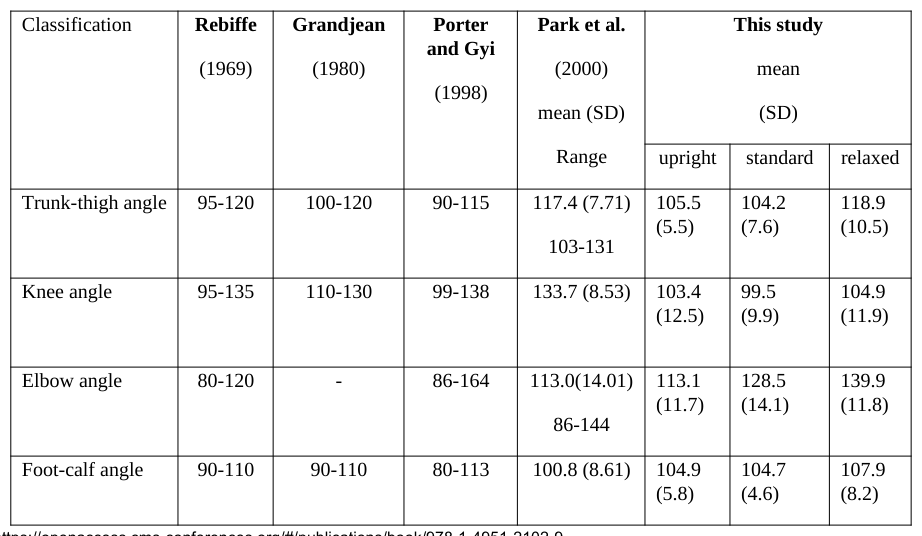
The differences were largest between the relaxed and both other positions (upright and standard). In Table 3 a comparison with the literature is shown. Most values are comparable with the literature and fall within the range that is described in the literature. Differences are especially found in the relaxed position. The trunk-thigh angle in the relaxed position is close to the highest recorded in the literature. In the literature sometimes this trunk angle is also compared to the horizontal and the upper leg is usually not equal to the horizontal, enforcing the difference to the literature. This difference is easy to explain as in the literature the driving position is taken. Probably the head position in our study is also more backwards than in the driving position.
So for the rear seat it is important to use somewhat different guidelines than often used for the driver’s seat, as there are also advantages of a reclined and slumped posture (Fujikmaki & Mitsuya, 2002). Important differences are the lacking driving tasks and therefore the increase probability of posture variation. The standard deviation was also high in some recordings like for the lower leg and upper leg which can also be explained by the fact that the driving task is missing. Because of this variation it is perhaps wise to further investigate the findings with more subjects or even in different cultures in order to identify the influence of cultural differences.
In the market there is a growing popularity of SUVs and new vehicles possible due to the electric cars. Therefore in a new study the advice is also to pay attention to the posture in a SUV. And for instance, pressure mat data are missing. As Mergl (2006) and Zenk (2008) identified the ideal pressure distributions for the position in the driver’s seat. Further research is needed also to identify long term effects of comfortable postures in the rear seats. So this study should integrate pressure distribution data in order to be able to design the ideal rear seat.
Table 3: Comparison of measured joint angles of this study with the angles measured in the literature Classification Rebiffe
REFERENCES
Branton, P. and Grayson, G., (1967) “An evaluation of train seats by observation of sitting behavior” in Ergonomics, 10 (1): 35–
51. Franz M. (2010) “Comfort, experience, physiology and car seat innovation” PhD thesis, Delft University of Technology. Fujimaki, G. Mitsuya, R. (2002) “Study of the seated posture for VDT work.” Displays, 23 (1-2): 17-24. Groenesteijn, L., et al., (2009) “Effects of differences in office chair controls, seat and backrest angle design in relation to tasks” in Applied Ergonomics, 40 (3), 362–370. Harrison D. (2000) “Optimal Car river’s Seat and Optimal Driver’s Spinal Model” in Journal of Manipulative and
Physiological, 23 (1). Kamp et al. (2011) “Chosen postures during specific sitting activities” in Ergonomics (54:11): 1029-1042. Khan, S.M. Sundström, J. (2007) “Effects on vibration on sedentary activities in passenger trains.” Journal of Low Frequency Noise, Vibration and Active Control, 26 (1): 43-55. Looze MP de, Kuijt-Evers LFM, Dieen J van. (2003) “Sitting comfort and discomfort and the relationships with objective
measures” in Ergonomics 46: 985-997. Looze et al (2003) “Sitting comfort and discomfort and the relationships with objecitive measures” in Ergonomics, 46 (10): 985-
997. Lueder R . (2004) “Ergonomics of seated movement. A review of the scientific literature.” in Humanics ergosystems, Encino. Mergl C. (2006) “Entwicklung eines Verfahrens zur Objektivierung des Sitzkomforts auf Automobilsitzen“ Doctoral Dissertation, Lehrstuhl für Ergonomie, TU München: Herbert Utz Verlag. Park S.J. (2000) “Comfortable driving postures for Koreans” in International Journal of Industrial Ergonomics (26): 489-497. Porter J.M (2003) “Interfae pressure data and the prediction of driver discomfort in road trials” in Applied Ergonomics, 34:
207-214. Zenk R. (2008) “Objektivierung des Sitzkomforts und seine automatische Anpassung“ Doctoral Dissertation TU München.
LISTED IN THE AHFE DIGITAL BOOKSTORE CATALOGUE
Explore the complete digital volume
Advances in Social and Organizational Factors
Read this individual research paper free through the original publisher, or explore the full digital proceedings book.
ISBN 978-1-4951-2102-9
Explore this ISBN in the AHFE Bookstore ↗Listed in the July 2026 bookstore catalogue; search by ISBN to confirm current availability · Digital book purchase optional