Patricia Stock, Barbara Deml (2020). Ergonomic Design of Working Time Models. In: Advances in The Ergonomics in Manufacturing: Managing the Enterprise of the Future. AHFE Open Access, vol. 12. https://doi.org/10.54941/ahfe100457
Enterprises in high-wage countries are facing an increasing shortage of skilled workers due to demographic change. In coping with this problem, companies are forced to provide incentives that help them recruit and retain qualified staff. As a result, enterprises have to deal with increasing wages, which means that the employment of staff must be highly efficient in order to avoid idle times of the personnel. At the same time, the working conditions have to be designed ergonomically in order to preserve the work ability of the employees. Altogether, the enterprise is forced to create good working conditions in order to find employees and bind them to the enterprise. The design of employee-oriented and ergonomic working time models is an important prerequisite for mastering this challenge. Commercial software usually compares a working time model with the existing legal regulations as well with ergonomic recommendations in order to provide an ergonomic evaluation. Capacity requirements are taken into account only statically. However, capacity requirements usually are subject to several dynamic influences resulting from stochastic operation times, stochastic intermediate arrival times of orders or customers. This makes it more difficult to adjust the available capacity to stochastic capacity requirements. With the help of a discrete-event simulation, various working time models can be compared in a specific case of application and assessed in quantitative terms. This paper discusses the situation of enterprises in high-wage countries and the resulting need for the ergonomic design of working times. Then, the paper presents the OSim-GAM simulator developed by the Institute of Human and Industrial Engineering (ifab) of the Karlsruhe Institute of Technology for the ergonomic design of working time models. The OSim-GAM assessment concept for working time models is presented and its use is illustrated within the framework of a case study.
As a result of the change towards a knowledge and service society and due to demographic change, self-perception of employees has changed, at least in the so-called high-wage countries. For many employees, the work-life balance (i.e. the compatibility of job and private life) and professional self-fulfillment have shifted into the focus. This reduces their preparedness to adapt to external conditions of companies and employers, which do not correspond to their conception, wishes, and needs. While the rule “People Follow Jobs” applied to the industrialized society in the past, the currently prevailing situation may be described by ”Jobs Follow People“ (Zukunftsinstitut, 2013, p. 55).
This change directly affects the design of working time systems (i.e. the sum of all working time models practiced at a department or company). These models can no longer be tailored to the enterprise’s needs exclusively. Instead, holistic consideration of the interests of both the enterprise and the employees is required. In February 2011, the German Federal government, German industry associations, and the German Trade Union Federation launched the Ergonomics in Manufacturing (2020) initiative "Familienbewusste Arbeitszeiten" (family-conscious working times) to improve the compatibility of job and family. Under this initiative, guiding principles and guidelines were developed for the flexible and family- conscious design of working times in practice. In addition, a database of good examples was offered (BMFSFJ, 2013a, 2013b). However, good practices of individual enterprises cannot just be copied, but may only be used as first ideas when designing working times.
ERGONOMIC DESIGN OF WORKING TIME MODELS Framework Conditions of Working Time Design
Holistic design of working time is associated with high requirements on the business planner, as it is necessary to adequately consider not only legal provisions, collective agreements, and labor science recommendations, but also the specific situation of the enterprise and employees (cf. Knauth, 2002, p. 52). Hence, there are no standard solutions for the design of working times. The specific situation of the enterprise always has to be analyzed to find an individual solution. This situation is even aggravated by the fact that many decision-makers have little knowledge about which options exist for the design of working time models and which impacts these might have (see Ferreira and Landau, 2001, p. 245). As the period of validity of a working time model often is several years in practice, a wrong decision may have a very long-lasting effect.
For this reason, a systematic approach to planning and implementing working time models is required. This approach should adequately account for the multitude of alternatives. The resulting complexity can be managed by using a software that often includes an ergonomic assessment when designing working time models.
Restrictions Resulting from Legislation, Collective and Individual Agreements Legal working time provisions define the framework conditions for the design of working times. In the European Union, the Working Time Acts of the member states are based on the Working Time Directive (Directive 2003/88/EC of 4 November 2003). Article 2 specifies the following definitions among others:
”‘working time’ means any period during which the worker is working, at the employer's disposal and carrying out his activity or duties, in accordance with national laws and/or practice;
‘rest period’ means any period which is not working time.“ The Working Time Directive specifies minimum safety and health requirements for the organization of working time, including (a) minimum periods of daily rest, weekly rest, and annual leave, breaks and maximum weekly working time and (b) certain aspects of night work, shift work, and patterns of work. The main provisions of the Working Time Directive are (Eurofound, 2012):
“a maximum average working week of 48 hours, including overtime (calculated over a four-month reference period)”; an opt-out clause allows to exceed the 48 hours, if the individual worker voluntarily agrees;
“a limit of eight working hours, on the average, per 24 hours for night workers – defined as a person who normally works at least three hours during night time;
a rest break after six consecutive hours of work;
rest periods of at least 11 consecutive hours per 24-hour period and 35 consecutive hours per seven-day period;
a minimum of four weeks’ paid annual leave which needs to be taken during the leave year stipulated and cannot be paid in lieu except where the worker’s employment is terminated or in the case of a short-term casual worker, where it may be translated into pay”.
This Working Time Directive is translated into national more detailed laws by the EU member states. In Germany, for example, working time regulations can be found in the Arbeitszeitgesetz (ArbZG, Working Time Act), the
Gesetz zum Ladenschluss (LadSchlG, Shops Closing Act), the Gesetz zum Schutz der arbeitenden Jugend (JArbSchG, Youth Labor Act) or the Gesetz zum Schutz der erwerbstätigen Mutter (MuSchG, Employed Mothers Protection Act).
Legal regulations are complemented by a number of collective and individual agreements. In Germany, the so-called “Günstigkeitsprinzip“ (benefit-of-the doubt principle, Art. 4, par. 3 Tarifvertragsgesetz, TVG (Collective Agreements Act)) applies. This means that in case of conflicting legal standards for the protection of employees, the prevailing regulations shall be those that are more beneficial for the employees rather than those that are of higher level. Hence, it is no longer sufficient for the planner of working time systems to know legal regulations. All agreements relating to working time have to be taken into account. Depending on the enterprise, the planning task may turn out to be highly complex, as some enterprises have entered a number of in-house agreements.
Ergonomic Recommendations Relating to Working Time Design For many years now, ergonomic recommendations have been existing for the design of shift work (e.g. Seibt et al., 2006). Paridon et al. (2012) carried out a meta analysis of the literature covering shift work in order to identify its impacts on health and prevention options. In contrast to this, hardly any substantiated findings have been made available so far with respect to the design of flexible working times. As many aspects of shift work also apply to flexible working time models, such as the location or length of the working time, the corresponding findings may be transferred to the design of flexible working time models.
Shift work differs from normal working time by changing times of duty in the different shifts. Work during the night or on the weekend is required. According to studies, the frequency of complaints is much higher for employees who are regularly working in shifts, during the night or on weekends than for employees having normal working times (Bauer et al., 2004, pp. 177). The authors point out that work in shifts and on weekends frequently occurs in jobs associated with high physical stress or strenuous postures. It is also deemed to be confirmed that the strain of shift work results from the shifting of the working time relative to the biological daily rhythm (Paridon et al., 2012, pp. 81). Shift work may have various effects on health. It is considered certain that shift work may cause sleep disturbances (Paridon et al., 2012, p. 92). According to studies, other impacts of shift work are gastro-intestinal diseases, changes of nutrition and body weight, cardiovascular diseases, psycho-vegetative diseases or even cancer (e.g. Bauer et al., 2004, pp. 177; Paridon et al., 2012, pp. 93 ff.). The meta analysis of Paridon et al. (2012, pp. 93) shows, however, that these relationships are far from being confirmed and sometimes discussed controversially.
Irrespective of the working time model, various studies have been performed to identify the effects of working time duration on the employee. In a representative secondary analysis by Wirtz (2010, pp. 79 ff.), it was proved for the European Union that the risks of adverse impacts on health increases with increasing duration of weekly working time. Moreover, work productivity decreases with increasing weekly working time (Wirtz, 2010, p. 31). It has also been confirmed that work efficiency decreases considerably when work duration reaches more than seven or eight hours (Janßen and Nachreiner, 2004, p. 17). The meta analysis of Paridon et al. (2012, pp. 108 ff.) also revealed that the risk of accidents increases with both an increasing duration and a more unfavorable location of the working time.
Ergonomic recommendations for the design of shift work define e.g. the minimum duration of a shift, the minimum and maximum number of consecutive working days, forward rotation of the shift sequence (early, late, night shift), the minimum rest period after a night shift, and the number of free weekends in the rest period (for details cf. Seibt et al., 2006).
Work-life Balance of Employees In the early 1970-ies Knauth and Rutenfranz (1972, p. 181) already analyzed the impacts of shift work on the work- life balance. The authors studied the relationship between working, travel, and sleeping time and real leisure time for different shift schemes. Compared to days off where sleeping takes place during the night, leisure time is restricted significantly on working days. The percentage of leisure time as well as its location and duration vary considerably for different shift schemes, such that the working time may well be assumed to affect sleep and leisure time. However, use of the leisure time available does also depend on its location. According to Knauth and Hornberger (1997, pp. 38), leisure time can be used best in the evening hours and on weekends for e.g. individual activities with the family, friends, relatives, and for participation in social and political life. Long-term studies of the social impacts of shift work on family and leisure life are still lacking (Paridon et al., 2012, pp. 108).
As regards the compatibility of professional and private interests, a secondary analysis of two representative European samples revealed that the balance worsens with increasing working time. A deep drop is observed for a working time of more than 40 hours per week (Wirtz, 2010, pp. 139). Employees, whose variable working times were determined by others, rated the compatibility worst, whereas no differences were observed for regular working times determined by others and self-determined variable working times (Wirtz, 2010, pp. 147). Extra-professional activities (e.g. honorary work, child care, household, care, advanced training, sports, leisure activities, cultural activities) were found to decrease significantly with increasing weekly working time (Wirtz, 2010, pp. 161). Leisure activities in particular were influenced strongly by the variability of working times (Wirtz, 2010, pp. 167 ff.).
Hence, assessment of the work-life balance of the employees is determined by the location, duration, and variability of working time as well as by the possibility to influence it. Moreover, the fulfillment of the working time wishes of the employees and the number of conflicts with individual working time preferences should be considered.
Impacts of Working Time Models on Business Processes A working time model does not only affect health and the work-life balance of the employees, but usually also the business processes at the enterprise. Holistic assessment of a working time model therefore has to be based on business characteristics that may vary for different sectors. In the fabrication sector, e.g. process costs, cycle times, and utilization rates may be appropriate assessment criteria, whereas characteristics of relevance to hospitals are more patient-oriented, such as waiting times, service levels, and quality of treatment. An overview of relevant characteristics can be found in Bogus (2002, pp. 126), or Leupold et al. (2013).
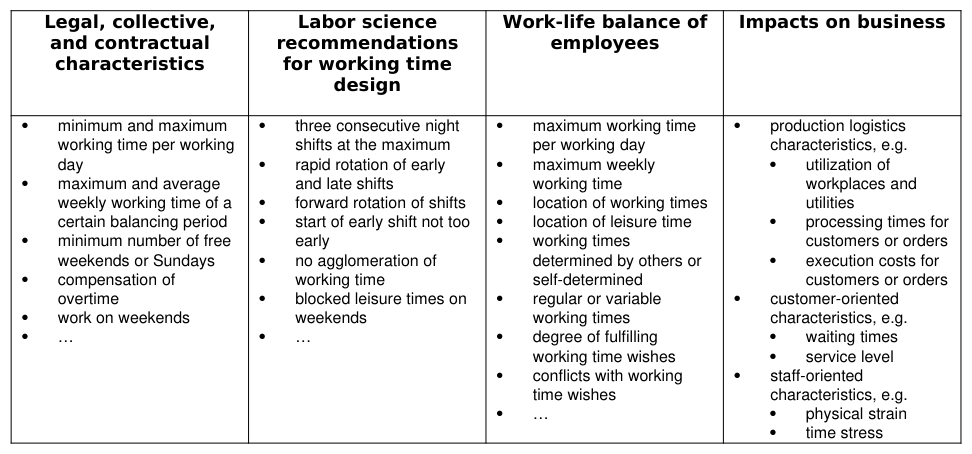
Table 1 lists the elements of a holistic characteristics-based system for the ergonomic assessment of working time models.
Table 1: Elements of a holistic characteristics-based system for the ergonomic assessment of working time models
COMPUTER-SUPPORTED DESIGN OF WORKING TIMES As a rule, commercial software programs for the design of working times are based on a static assessment (irrespective of the process flow at the enterprise) exclusively. Assessment is made by comparing the capacities available and the capacities needed. In addition, it is usually checked whether legal framework conditions and ergonomic recommendations are met by the department studied. Collective and individual agreements are not taken into account. Target conditions are compared with the current situation. The planner may assign a weight to the different criteria. Ergonomics in Manufacturing (2020)
The four commercial software programs that are based on such a static assessment and most frequently used for the design of shift plans in Germany were tested by Böker (2011). Ergonomic assessment of the four tested programs is based on the following assessment criteria (Böker, 2011, p. 30):
BASS 4.0 (GAWO 2007) uses a definition pool for all legal requirements and labor science recommendations, the values of which may be adjusted in a defined range by the planner. Weighing of the assessment criteria is possible. Calculation of the staff needed is based on qualifications, needed workforces or shifts.
e-Shift-Design (ifaa 2009) gives six criteria, the weighing of which may be adjusted by the planner. Need determination calculates possible shift groups, the number of employees, the resulting weekly working times, and the validity of the plan.
Optischicht (TÜV Nord 2012) gives twelve criteria, the values and priorities of which can be adjusted. The shifts needed, the shift teams, and the weekly working times are calculated using business and working time data.
Ximes-OPA/-SPA (Ximes 2014) considers all legal and ergonomic criteria, the relevance of which can be adjusted. The need can be calculated in an activity-related manner. On this basis, possible shift groups, spare staff needs, full-time and part-time employment, and individual assignments are calculated. Ximes- OPA and -SPA are also offered in English.
Böker (2011, p. 28) concludes that the programs tested differ considerably in terms of costs and performance. However, he does not make any final recommendation or provide any ranking of the software products, as target groups and their needs differ significantly.
Under the initiative “Neue Qualität der Arbeit“ (INQA, new quality of work), counseling and support services offered for the design of working time were compiled. In particular, a cost-free program for online risk assessment of working time models was developed (INQA 2013). This program is also based on a comparison of target conditions with the current situation for the assessment of the working time model and calculates a risk index. This index allows for the comparison of different working time models.
The work-life balance of employees has not yet been assessed using commercially available software. If at all, programs existing for the design of working time models consider working time preferences, but not the individual stress situation resulting from work and private life. Only the online program for risk assessment developed by the Neue Qualität der Arbeit (INQA) initiative checks the probability of limited participation in social life (cf. Dittmar et al., 2010, p. 154).
For the holistic assessment of a working time system, this static approach often is not sufficient, as business is associated with dynamic effects aggravating an adaptation of the capacities available to the capacities needed. Such effects may be stochastic execution times of work processes or fluctuations of the capacities needed that are typical of the service sector. When combining several working time models in a working time system, complexity increases, if employees of various working time models cooperate and the individual working time models have to be synchronized.
SIMULATION OF WORKING TIME SYSTEMS Simulation Study Procedure
Computer-supported simulation is a tool allowing for the dynamic assessment of working time systems, also under stochastic influences. Computer-supported simulation is understood to be the modeling of a real system with its dynamic processes in a computer model. This model is used for simulation experiments (i.e. variation of model parameters) to obtain findings that can be transferred to reality (VDI 3633, Sheet 1, p. 2). As a rule, an abstraction is required, since an exact reproduction of the real system would require too large an expenditure and often is not needed for problem solution. Due to the abstraction made, it has to be ensured that the model still reflects the behavior of the real system correctly and with sufficient accuracy. Hence, a validation is needed to find out whether the model and the original are in sufficient agreement (VDI 3633, Sheet 1, p. 36). A complete agreement between the original and the model is impossible, as the abstracted model cannot take all aspects and influencing parameters into account. Agreement can only be reached within a given acceptable tolerance range that is agreed upon by the simulator and the customer. Often, validation is based on a comparison with historical data. If these are lacking, the simulator’s modeling experience and qualification are required (VDI 3633, Sheet 1, p. 36).
Simulation is an expert process, the use of which requires knowledge of the simulation tool used and the execution of simulation experiments as well as in-depth knowledge of the system to be modeled. Hence, quality of a simulation model largely depends on the simulator and the capacity planning data available. Nevertheless, simulation has proved to be a reliable tool for the planning, implementation, and operation of work systems (VDI 3633, Sheet 1, p. 2).
The advantage of simulating working time systems consists in the fact that the latter can be assessed holistically without any practical implementation (i.e. without direct interference with business). The system behavior can be studied over long terms. The parameters of the working time systems can be varied with a relatively small expenditure (e.g. location and duration of working times, rotation of shifts, number of consecutive working days). Causal relationships between these parameters and the resulting impacts on the employees can be derived. In practice, such a variation is impossible, as the staff deployed cannot be varied for study purposes. Moreover, possible working time models are often too complex for being tested in practice over a longer term, in particular when several alternative working time models are discussed.
The OSim-GAM Simulation Method The OSim-GAM (Object Simulator for the Design of Working Time Models; Bogus, 2002) simulation tool was developed by the Institute of Human and Industrial Engineering (ifab) of Karlsruhe Institute of Technology (KIT) to analyze working time models. For this purpose, the work system studied is modeled with all relevant elements. These are the work processes and their temporal and logical relationships, the resources needed for the execution of the work processes (i.e. staff, utilities, workplaces, material), and the number and arrival times of the orders (or customers) in the period under study (for details see Bogus, 2002, pp. 99). The simulation period chosen should be representative of and longer than the planning period of the working time system studied. For production with a constant entry of orders, a simulation period of four weeks may be sufficient. For a call center with high fluctuations over the year, a complete year may have to be simulated to check the suitability of a working time system.
The working time schemes studied are modeled using contents-related design elements, such as duration (weekly working time in hours, minimum and maximum possible daily working time in hours) and location (working time corridors available, cycle period), and formal design elements (validity period, planning period, balancing period). In this way, any working time models and systems can be defined (for details see Bogus, 2002, pp. 55).
Apart from business conditions, the design process considers the working time preferences of the simulated employees. For modeling, a list of periods is stored, during which the employee has or wishes to fulfill private obligations and which may conflict with work. In addition, a severity is indicated for every conflict. In this way, working time preferences are assigned to every employee of a working time system in addition to his qualification. For details, it is referred to Leupold et al. (2013).
Since the development of OSim-GAM, several simulation studies have been performed in the production, service, and hospital sectors to prove the efficiency of the method and to analyze the impacts of various working time systems on the target criteria of the assessment concept (e.g. Bogus, 2002; Leupold et al., 2010; Zülchet al., 2011).
CASE STUDY Modeling of the Customers
The following case study describes a fictitious bakery shop which was created according to former simulation projects of the ifab-Institute. The bakery shop is located at a railway station. Therefore, its customers are usually commuters and travelers. The opening hours are from 5:30 a.m. to 10:00 p.m. However, the employees have to be at work at 5:00 a.m. in order to prepare the shop as well as the goods.
The volume of work mainly varies with regard to the frequency of customer arrivals. Figure 1 shows fluctuations in capacity required over the course of the day as well as the week. The intermediate arrival times of the customers are exponentially distributed while the service is beta distributed. Additionally, a number of indirect activities which are not directly associated with customers exist. For the most part, these are measures relating to the cleaning of the counter and the shop as well as preparing the goods. Occurrence and duration of these indirect activities are stochastically distributed, too.
Figure 1. Total capacity requirements over the course of the day and the week All activities are modeled as netgraphs which generally only consist of one activity each. The netgraphs are started by so-called triggers which represent the instigation of the task in terms of their start. To this end, the start date of the task must be indicated. Multi-level priorities for activities are also modeled in order to ensure that only non- important duties remain uncompleted. The highest priority is accorded here to the customer service. Moreover, some tasks may be cancelled if they have waited for too long. For example, the customers are only willing to wait five minutes for service before they leave the shop without a purchase.
Figure available in the original PDF paper.
Modeling of the Staff The bakery shop has 13 full-time employees which work 38.5 h per week each. Every employee is modeled, with data stored on their weekly working hours and their minimum and maximum shift durations. The employees and activities are then linked using the definition of qualifications. Here, the employees work as generalist which means that everybody can execute each activity.
The software BASS 4.0 was used in order to find the best working time system for the capacity requirements of the bakery shop (see Figure 1). Thereby, the capacity required is always rounded up in order to ensure that there is a buffer for unforeseen customer arrivals. The calculated capacity requirements are 9.6 employees while the rounded capacity requirements are 12 employees. An additional employee is used as backup.
Three different working time system could be derived:
Working time system 1: Each shift has to be at least six hours and at most eight hours. The time slide for planning shift is one hour which means that all shifts cover full hours.
Working time system 2: Each shift has to be at least six hours and at most eight hours. The time slide for planning shift is 30 minutes.
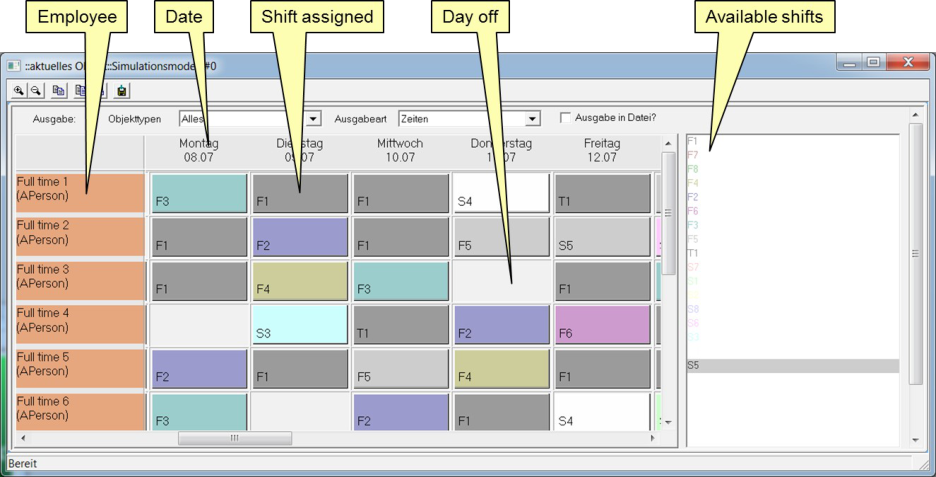
Working time system 3: Each shift has to be at least four hours and at most eight hours. The time slide for planning shift is 30 minutes. An excerpt of the resulting shift plan is shown in Figure 2.
In order to ensure a good Work-Life Balance, the criteria concerning the spare time (a minimum number of free weekends or Sundays, the compensation of overtime and the number of days consecutive) have been rated as very important. However, all resulting working time systems cannot assure that every employee has at least two days off per week. Additionally, there are some weeks where the employees have to work more than 38.5 hours per week which is compensated afterwards.
Figure 2. Modeling of working system 3 in OSim-GAM
The so-called social roles are representing restrictions on working time, i.e. by specifying the periods of time in which potential conflicts with employees’ private lives may occur.The social roles for the retail trade have been investigated at the ifab-Institute using an employee survey (for more information please refer to Zülch, Stock and Schmidt 2012). Cluster analysis was used to identify six different social roles that differ in terms of their working time preferences. It is apparent that the employees are not equally distributed between the defined clusters. Only 8.8% of employees are almost always available to work and would only experience a slight scheduling conflict if they were required to work nights. On the other hand, 49.8% of employees experience constant conflicts with their private lives, although these are described as slight during the day and moderate or severe at other times.
In order to analyze the effects of different distributions of social roles among the employees, 20 different scenarios were constructed randomly. Each of those scenarios uses the same absolute frequency of social roles corresponding to the frequency observed in the employee survey. Each of the scenarios attributes one of the social roles to each of the 13 members of staff employed in the bakery shop.
Design of Experiments and Simulation Results The simulation covers a period of four weeks. Within the simulation study, the three different working time systems were combined with the 20 different distributions of the employee types to form a total of 60 test scenarios. To eliminate stochastic effects, each scenario was simulated 20 times using different random numbers for the stochastic modeled activities. Each simulation run takes three seconds.
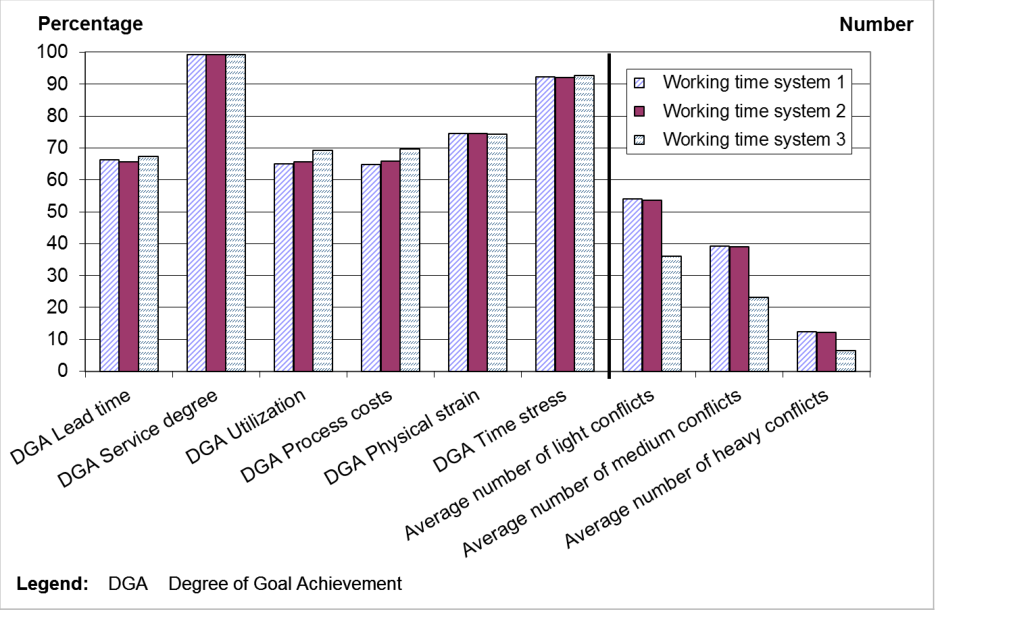
Figure 3 shows a comparison of the results of the working time systems simulated. The assessment concept of OSim-GAM uses so-called goal achievement degrees (following Wedemeyer 1989) which has proven favourable for the evaluation of simulation results. A goal achievement degree has a value between 0% and 100%, the former being the pessimistic state of a key figure, the latter the ideal one.
It can be seen that with all working time systems nearly every customer can be served since the Degree of Goal Achievement (DGA) Service degree is close to 100%. However, there are some waiting times for activities since the DGA Lead time is about 66%. Especially the indirect activities (like cleaning or preparing goods) are waiting to be proceeded since they have a low priority. The DGA Utilization of the employee varies between 64.9% and 69.2% which means that the employees still have some idle times. Therefore, none of the three working time systems has an ideal match to the capacity requirements. Finally, the DGA Process costs 64.8% and 69.6%. This means that the choice of the working time model has an impact to the monetary and logistical key figures of the bakery shop.
Figure 3. Modeling of working system 3 in OSim-GAM
The DGA Physical strain and the DGA Time stress (see Figure 3) are nearly the same for all simulated working time systems because the software BASS 4.0 tried to find the best working time system following the ergonomic recommendations. However, the compatibility between work and private live varies heavily for the three working time systems since. Working time system 1 and 2 have the most conflicts while working time system 3 has reduced the average conflicts significantly.
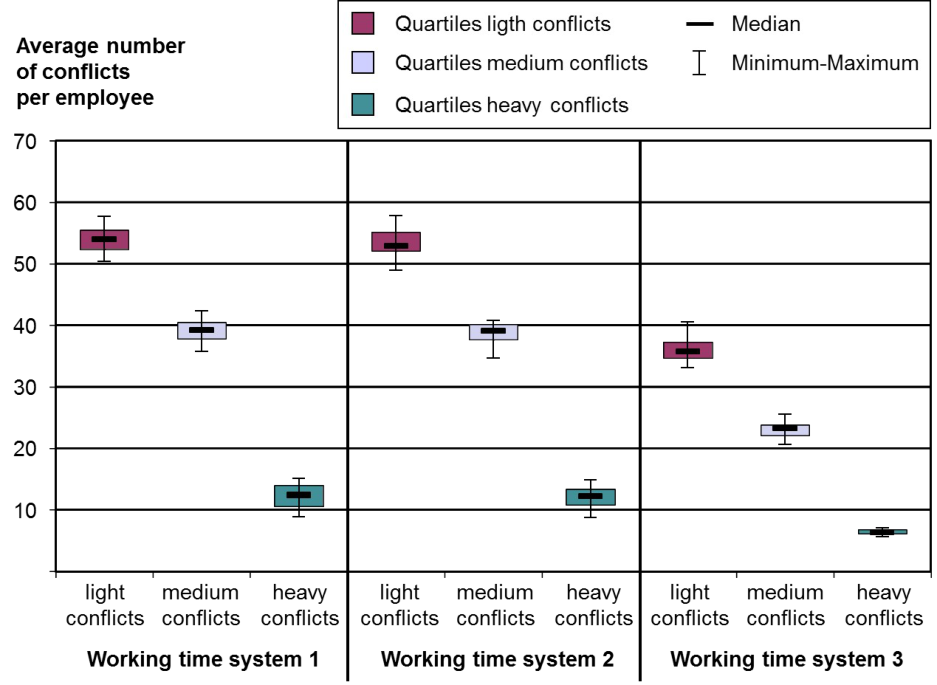
Finally, the number of conflicts varies considerably for the different distributions of the social roles (see Figure 4). Working time system 3 has not only the lowest number of conflicts but also the least spread of the conflicts for the different distributions of social roles.
The results of the simulation study show that the choice of the working time system has a high impact on the logistic, monetary as well as the employee-oriented key figures. Furthermore, the distribution of the social roles within the enterprise is important since it interferes heavily with the working time system. Therefore, there is no one-for-all working time system. For each enterprise a customized working time model has to be developed which takes the operational processes as well as the personnel structure into account. Thereby, the challenge is to find a working time model that is on the one hand sufficiently individualized to take the working time preferences of the employees into account but that is on the other hand robust to fluctuations of the employees. Hence, enterprises should check regularly whether their working time system still meets the demands of the enterprise and employees.
CONCLUSIONS
Holistic assessment of working time systems with equal consideration of the enterprise’s and the employees’ interests requires appropriate characteristics taking into account both static and dynamic aspects. Commercial tools for the design of working time so far have been offering a static assessment only. Staff-oriented simulation allows for the consideration of dynamic effects of working time design through experiments using a simulation model. Contrary to the commercial tools available, staff-oriented simulation thus allows for an analysis of the behavior of complex work systems and other solution options. However, it represents an expert process that requires comprehensive capacity planning data relating to the system studied for generating the simulation model. These data are not always available in business and sometimes have to be collected for the simulation study. Due to the often very long validity period of working time systems, however, this expenditure may still be worthwhile.
Figure 4. Average number of conflicts for the different distributions of the social roles
REFERENCES
Bauer, F. Groß, H. Lehmann, K. et al. (2004), “Arbeitszeit 2003: Arbeitszeitgestaltung, Arbeitsorganisation und Tätigkeitsprofile”, Köln: Institut zur Erforschung sozialer Chance. BMFSFJ - Bundesministerium für Familie, Senioren, Frauen und Jugend (2013a), Material zur Initiative ‘Familienbewusste
Arbeitszeiten’. http://www.erfolgsfaktor-familie.de/default.asp?id=518, Retrieved: 01.03.2014. BMFSFJ - Bundesministerium für Familie, Senioren, Frauen und Jugend (2013b), Datenbank der Guten Beispiele.
http://www.erfolgsfaktor-familie.de/default.asp?id=520, Retrieved: 01.03.2014. Bogus, T. (2002), “Simulationsbasierte Gestaltung von Arbeitszeitmodellen in Dienstleistungsbetrieben mit kundenfrequenzabhängigem Arbeitszeitbedarf”, Aachen: Shaker Verlag, 2002. Böker, K.-H. (2011), “Spezielle Software für ‘Gute Schichtarbeit‘. Schichtplan-Modellierungs- und Bewertungs-Software im
Vergleichtstest”, Computer und Arbeit, No. 1, pp. 28-32.
Directive 2003/88/EC of the European Parliament and of the Council of 4 November 2003 concerning certain aspects of the organisation of working time. http://eur-lex.europa.eu/LexUriServ/LexUriServ.do?uri=CELEX:32003L0088:EN:HTML, Retrieved: 01.03.2014. Dittmar, O. Schomann, C. Nachreiner, F. (2010), “Online-Risikobewertung von Arbeitszeiten”, in: Einfluss der
Arbeitszeitgestaltung auf die Work-Life-Balance, Zülch, G. Stock, P. (Eds.). Karlsruhe: Karlsruher Institut für Technologie, 151-165. Eurofound (2012), Working time. http://www.eurofound.europa.eu/areas/industrialrelations/dictionary/definitions/ WORKINGTIME.htm, Retrieved: 01.03.2014. Ferreira, Y.; Landau, K. (2001), “Umsetzungen flexibler Arbeitszeitregime am Beispiel eines deutschen Großflughafens”, in: Arbeitsgestaltung, Flexibilisierung, Kompetenzentwicklung. Dortmund: GfA-Press, pp. 245-250. GAWO – Gesellschaft für Arbeits-, Wirtschafts- und Organisationspsychologische Forschung e.V. (2007), BASS 4 (Version
Dezember 2007), http://www.gawo-ev.de/cms/index.php?page=bass-4, Retrieved: 01.03.2014. ifaa – Institut für angewandte Arbeitswissenschaft e. V. (2009), e-Shift-Design - Die Praxishilfe zur Schichtplanung, http://www.arbeitswissenschaft.net/e-Shift-Design-Die-Praxishil.766.0.html, Retrieved: 01.03.2014. INQA – Initiative Neue Qualität der Arbeit (2013), INQA Online-Tool für gesündere Schichtarbeit: Softwaretool unterstützt
Betriebe bei der ergonomischen Schichtplangestaltung, http://www.inqa.de/DE/Lernen-Gute-Praxis/Handlungshilfen/Chancengleichheit-und-Diversity/INQA-Online-Tool-fuer- gesuendere-Schichtarbeit.html, Retrieved: 01.03.2014. Janßen, D. Nachreiner, F. (2004), “Flexible Arbeitszeiten”, Bremerhaven: Wirtschaftsverlag NW. Knauth, P. (2002), “Arbeitszeitflexiblisierung aus arbeitswissenschaftlicher Sicht”, in: Arbeitszeitflexibilisierung im Dienstleistungsbereich, Zülch, G. Stock, P. Bogus, T. (Eds.). Aachen: Shaker Verlag, pp. 51-74. Knauth, P. Hornberger, S. (1997), “Schichtarbeit und Nachtarbeit: Probleme – Formen – Empfehlungen”, 4th edition, München:
Bayerisches Staatsministerium für Arbeit und Sozialordnung, Frauen und Gesundheit. Knauth, P. Rutenfranz, J. (1972), “Untersuchung über die Beziehungen zwischen Schichtform und Tagesaufteilung”, International Archives of Occupational and Environmental Health, Volume 30 No. 3, pp. 173-191. Leupold, M. et al. (2010), “Simulationsbasierte Bewertung von Arbeitszeitmodellen bezüglich der Work-Life-Balance”, in:
Integrationsaspekte der Simulation: Technik, Organisation und Personal, Zülch, G. Stock, P. (Eds.). Karlsruhe: KIT Scientific Publishing, pp. 365-372. Leupold, M. Stock, P. Zülch, G. (2013) “Simulationsunterstützte Gestaltung flexibler Arbeitszeitmodelle” in: Arbeitszeit - Zeitarbeit, Bornewasser, M. Zülch, G. (Eds.). Wiesbaden: Springer Fachmedien, pp. 223-242. Paridon, H. Ernst, S. Harth, V. et al. (2012), “Schichtarbeit: Rechtslage, gesundheitliche Risiken und Präventionsmöglichkeiten”,
Berlin: Deutsche Gesetzliche Unfallversicherung (DGUV). http://publikationen.dguv.de/dguv/pdf/10002/iag-schicht- 1.2012.pdf, Retrieved: 01.03.2014. Seibt, A. Knauth, P. Griefahn, B. et al. (2006), “Arbeitsmedizinische Leitlinie der Deutschen Gesellschaft für Arbeitsmedizin und Umweltmedizin e.V.: Nacht- und Schichtarbeit”, Arbeitsmedizin, Sozialmedizin, Umweltmedizin (ASU), Volume 41 No. 8, pp. 390-397. TÜV Nord (2012), Optischicht: Schichtpläne gesundheitsgerecht und sozialverträglich gestalten, http://www.tuev-nord.de/de/optischicht-99912.htm, Retrieved: 01.03.2014. VDI 3633, Blatt 1 (2012), “Simulation von Logistik-, Materialfluss- und Produktionssystemen - Grundlagen (Entwurf)“, Berlin:
Beuth Verlag. Wedemeyer, H.-G. (1989), “Entscheidungsunterstützung in der Fertigungssteuerung mit Hilfe der Simulation”, Fortschritt- Berichte VDI, Volume 2 No. 176. Düsseldorf: VDI-Verlag. Wirtz, A. K. (2010), “Lange Arbeitszeiten – Untersuchungen zu den gesundheitlichen und sozialen Auswirkungen langer
Arbeitszeiten”, Oldenburg: Universität Oldenburg. http://oops.uni-oldenburg.de/928/1/wirlan10.pdf, Retrieved: 01.03.2014. Ximes (2014), Personalplanung, http://www.ximes.com/, Retrieved: 01.03.2014. Zukunftsinstitut (2011), Heidelberger Leben Trendmonitor 2011, http://www.eaf-bund.de/fileadmin/user_upload/ Paare_Navipunkte/Studie_Heidelberger_Leben.Trendmonito_2011_final.pdf, Retrieved: 01.03.2014. Zülch, G. Stock, P. Leupold, M. (2011). “Simulation-aided design and evaluation of flexible working times”, in: Proceedings of the 2011 Winter Simulation Conference, Jain, S. et al. (Eds.). Piscataway, NJ: IEEE, pp. 2159-2170. http://www.informs- sim.org/wsc11papers/194.pdf, Retrieved: 01.03.2014. Zülch, G. Stock, P. Schmidt, D. (2012), “Analysis of the strain on employees in the retail sector considering work-life balance”,
Work: A Journal of Prevention, Assessment and Rehabilitation, No. 41(Supplement 1), pp. 2675-2682. http://iospress.metapress.com/content/w9716708601264kv/fulltext.pdf, Retrieved: 01.03.2014.
LISTED IN THE AHFE DIGITAL BOOKSTORE CATALOGUE
Explore the complete digital volume
Advances in The Ergonomics in Manufacturing: Managing the Enterprise of the Future
Read this individual research paper free through the original publisher, or explore the full digital proceedings book.
ISBN 978-1-4951-2103-6
Explore this ISBN in the AHFE Bookstore ↗Listed in the July 2026 bookstore catalogue; search by ISBN to confirm current availability · Digital book purchase optional