Gyula Szabó (2018). ErgoCapture – A Motion Capture Based Ergonomics Risk Assessment Tool. In: Advances in Physical Ergonomics and Human Factors: Part II. AHFE Open Access, vol. 2. https://doi.org/10.54941/ahfe100084
In the reduction of the work-related musculoskeletal disorders risk assessment tools have a central role. Although plenty of ergonomic risk assessment tool is availably their application is limited due to the inhomogeneity of the work, the difficulty of the selection of the proper assessment tool, the difficulty of the measurement of forces, joint angles and movement speed and the difficulty in the determination of risk modifying factors like vibration and heat.According to the EN 1005 standard the Composite Ergonomics Risk Assessment includes posture, force extension, manual handling and repetitive movements analysis, and in addition a subjective fatigue assessment. Since the Composite Ergonomics Risk Assessment (CERA) is based on the direct wMSD risk factors, the pages reflect to the posture and movement of the user and the evaluation of the working environment. The ErgoCapture system not only makes the risk assessment more precise and easy, but also opens possibilities to eliminate some general limitations of the ergonomic risk assessment methodology. In this paper some findings of a research and development process of a 3D camera based ergonomic risk assessment tool is presented. The report includes the data acquisition environment, the data analysis framework, and the perspectives of the underlying risk monitor approach. A motion capture technology based human posture analysis is presented, where nearest-neighbor analysis was used for data processing.
The work related musculoskeletal disorders are still in the center of international interest of the occupational safety and health professionals. The WHO and the EU include musculoskeletal disorders in their priorities, trying to reduce its negative impact with the improvement of work places.
Estimating work related musculoskeletal risks in the occupational safety and health field several ergonomic evaluation tool have been developed. The wide range of ergonomic risk assessment tools range from simple paper- pencil check list and screening sheets to automated or internet based documents. Unfortunately the usability, reliability and the quality of the supporting material of these tools is often limited.
The paper-pencil version of CERA includes the evaluation of posture, manual handling, repetitive movement and force extension according to the harmonized European standard series EN 1005 Safety of machinery- Human physical performance. This new usable and understandable tool increases the competency of the Hungarian OSH professionals with the evaluation of ergonomic risks in the workplaces. (Szabó, 2012).
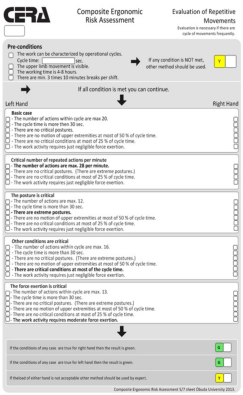
Figure 1. Paper-pencil version of the Composite Ergonomics Risk Assessment Although the paper-pencil version of the Composite Ergonomics Risk Assessment has became a widely used risk assessment method in Hungary, the common risk assessment limitations urge us to create a new paradigm in which the risk of the workload to the given individual in given work situation should be more exactly estimated.
A year later in 2013 the spreadsheet version was launched including the quantitative analysis of the EN 1005 series, providing a detailed ergonomics risk assessment tool to EHS and ergonomics specialist.
Ergonomic assessment tools
Expert systems
Motion Capture + New Paradigm
CAD systems
Workplace modelling + Human modelling
IT implemented tools
Web based Speadsheet or document based
Paper - pencil
Check list Evaluation forms
tools
Figure 2. Evolution of Ergonomic Risk Assessment Tools
Figure available in the original PDF paper.
The collection of existing ergonomics risk assessment methods produced over 150 tools and several studies on the tools. In the literature lots of classifications of tools are available regarding e.g. the purpose (from screening to detailed analysis), validity (level), usability, advantages / disadvantages, popularity (among professional), instrumentation (paper-pencil, web, xls, CAD etc.), training requirements (up to certification), legislation / standardization history (is it obligatory or recommended by law or OSH inspectorate), translation diversity (in how many language is available), result type (qualitative – semi-quantitative – quantitative), body part (given part to full body), application field (industry), hosting institution (where was developed), lifespan (for how long has it survived).
It was found that the majority of ergonomic tools reflect to the requirements of the work type, the application field and technical level at the time of development of the given tool. The emerging pattern of the collected ergonomic risk assessment tools can be interpreted as an evolution driven by the progress of information technology.
At the beginning ergonomic risk assessment tools were implemented as check lists or paper-pencil evaluation forms with tables, computing and human figures. These tools later reborn on the web in the form of spread sheets or automatic / working documents with more sophisticated counting based on standard IT applications.
With the improvement of CAD systems the workplace and human modeling become inevitable part of the design process. The advanced biomechanical models and detailed anthropometrics database allow designers and HSE specialist to carry out more detailed ergonomic evaluation. Leading edge research utilize advanced IT solutions like motion capture technology, 3D imaging, mobile / portable / wearable devices, virtual reality, telepresence. These opportunities seem to create a new paradigm of the prediction of the risk of WMSD.
In figure 2. the ergonomics risk assessment tools evolution is presented from the paper-pencil tools which is easy to use after a short training, spread sheet or web-based interface accessible, from simple methods based on 3D imaging, till methods used by qualified ergonomics professionals.
MOTION MEASUREMENT TECHNOLOGY To improve the reliability of the input data of the ergonomic risk assessment the measurement of the posture and joint angles is the possibility. Body-mounted sensors have been used to obtain kinematic values, mainly different kind of goniometers, accelerometers and gyroscopes. These systems permit the recording of continuous motion e.g. the following kinematic parameters in the sagittal plane: shank angle, thigh angle, knee angle, shank angular velocity, thigh angular velocity, knee linear acceleration, shank angular acceleration and thigh angular acceleration. (Ruth, 2002). These sensors together with a portable data logger, and using simple biomechanical models allow capture of outdoor and long-term movements, and to monitor physical activity in the daily environment. (Aminian, 2004) An application is the smart garment which is a portable monitoring system fixed onto the body and collects the trunk posture information about daily postural habit of the users. (Wai, 2008)
Starting from photographs various optical motion analysis systems are used in the study of human movement. Video Analysis Systems, optoeletric and magnetic systems, utilize passive markers, light-emitting diodes and magnetic imaging systems respectively, dispensing with digitization procedures. Video analysis systems allow for the assessment of the angles between line segments specified by the markers and make possible three dimensional assessment of body kinematics. (Vieira , 2004)
Factors related to movements:
The subject sometimes doesn’t remain inside the workspace. This difficulty can be compensated with different settings, camera movements or workplace limitations, but all these three solution creates new problems.
In special cases, like sitting work, fixed camera can be used, but camera movements are unavoidable in most cases.
It’s very likely that more than one person are present in the workspace.
The subject doesn’t face the camera.
Movements don’t parallel to the camera-plane.
There are different movements, not only slow and continues ones.
The whole body can move, not only move one or a few limbs.
The motion pattern of the subject is not known, and there are several subjects.
Usually subject moves on a flat ground plane, but this depends on the working environment.
Factors related to appearance of the environment and subject:
Lighting differences
Various background
Known camera parameters and special hardware
Start pose can be controlled, but it means more time and effort
Subject parameters can be collected, but it means more time and effort
Markers placed on the subject should be eliminated
The subject wear his/her own working clothes, which is not designed for motion capturing, e.g. its color or fitting.
Adapting the requirements for methods and calculation techniques for the measuring and recording techniques for capturing gait patterns. (Kocsis, 2004) In industrial settings the requirements of optical ergonomics assessment tools are the following:
Preparation for the measurement and the whole procedure takes up to one hour in average.
Measurement can be done by no more than two persons.
The procedure for the post-processing of the measured data and printing does not require more than one additional hour from one expert person.
The wearable components should be eliminated.
The evaluation technique takes several cycles (min 5–15) into consideration.
The system can be resistant to industrial environment and portable.
KinectTM in ergonomic assessment Low-cost range sensors like Microsoft’s KinectTM or ASUS Xtion sensor can be used as 3D motion capture systems, thus being an alternative to more expensive devices. These devices automatically record body positions at high sampling frequency. However, the application of these devices often problematic, and these sensors can be used like a tool to support the ergonomics tasks, but its technology is not enough developed (Diego-Mas, 2013)
Microsoft KinectTM could validly assess kinematic strategies of postural control in laboratory setting, and it was found as a useful tool. (Ross, 2012) In a training environment another system was implemented to correct the problems with individuals lifting motions. That system provided real-time ergonomic analysis of lifts but has not been tested in a factory environment. (Martin, 2012) Haggag presented a real time KinectTM application for rapid upper limb assessment (RULA) for assembly operations in industrial environments. (Haggag, 2013)
Although several requirement and factors mentioned above still wait for solutions a portable 3D motion capture system for performing ergonomic assessments in the field can be expected in the next decades. (Dutta, 2012)
THE ERGOCAPTURE SYSTEM In the ErgoCapture system a current version of the display program for the ASUS Xtion Pro camera was used. The application was written in C++ and uses the ASUS Xtion Pro motion tracker camera as the input device. The key feature of the system is its motion tracking capabilities and the application builds on the OpenNI library to utilize these functionalities. The current state of the implementation offers the following services:
An easy-to-use user interface to track the motion of the users. This is capable of presenting the real-time view of the camera.
Recording and playing back video.
The coordinates of the skeleton can be serialized in real-time and played back synchronized.
Several user interface tweaks: mirror switching, customization of the skeleton tracking, etc.
Multi-user scenario: the application is able to present the skeleton of a remote user too on the local display along with the local skeletons. The program uses a server module (XtionServer) and communicates through TCP sockets.
Provides joint coordinates of the skeleton
Export and import data
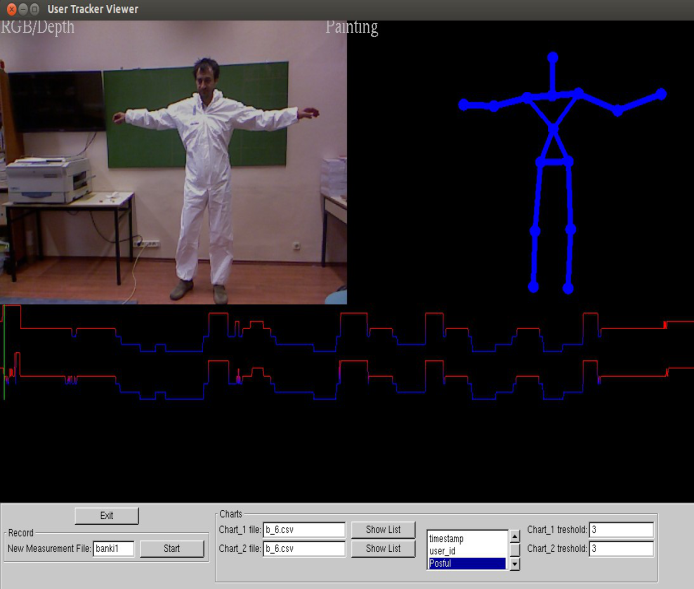
Visualizes data created or imported The software shows a video, a skeleton and two graphs of selected values, and a process indicator, and able to 30 capture per second.
A snapshot of the experimental software is shown on Fig 3.
Figure 3. Snapshot of the ErgoCapture experimental software
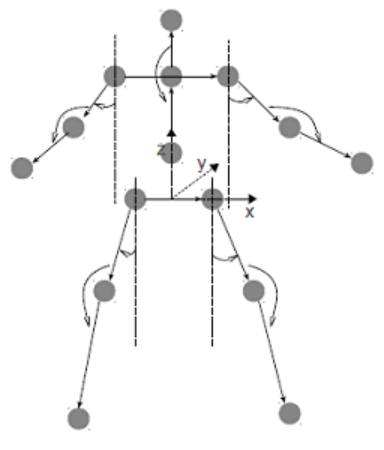
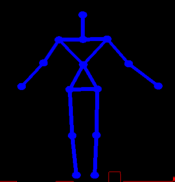
Assessments was based on the joint coordinates of the skeleton and on joints angles calculated from the captured 3D images according to the simplified biomechanical model shown on the schematic skeleton in Fig. 4.
Figure 4. Schematic skeleton used
RESULTS
The main aim of this explorative research was to discover limitations and possibilities of the capture technology. For this purpose a laboratory short time scenario, a laboratory long time scenario and several in field (industrial settings) recording was made. For the recording and visualization the ErgoCapture, for data analysis SPSS 19 software was used.
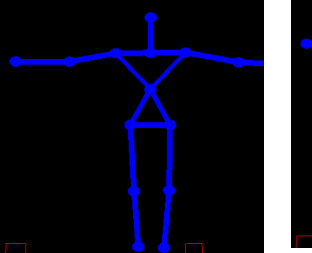
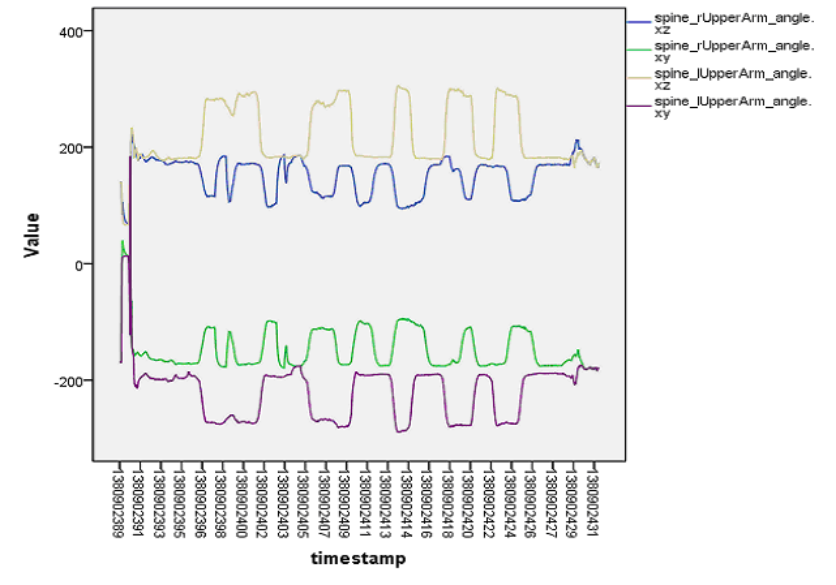
Laboratory short time scenario As shown in Figure 3. a total of 1163 posture of one person in four seating positions (both hands up, hands down, left hands up, right hands up Fig. 5.) was recorded. At the beginning and at the end of the record some transient can be seen due to the handling of the device, but in the majority the movement of the upper arms and shoulders are clearly visible. Calculated values of joints are shown on Fig. 6.
a. both arms
b. both arms up c. right arm up, left arm down d. right arm down, left arm up down
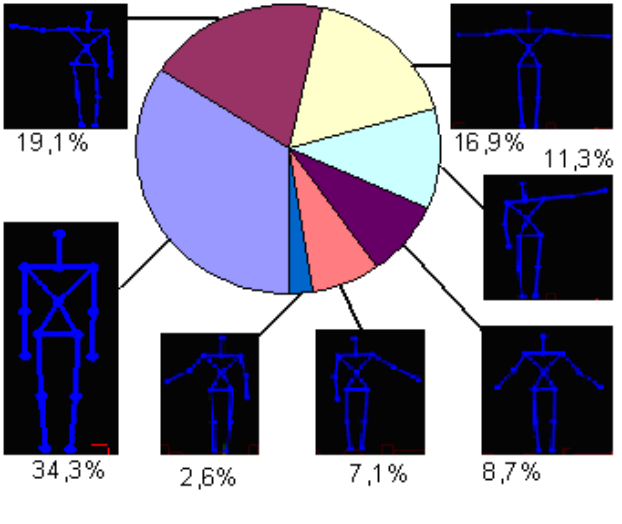
Figure 5. Standing positions, front viewFigure 6. Graphs of some calculated joint degrees The TWOSTEP CLUSTER analysis including all the independent variables resulted seven clusters. Four clusters referred the expected four standing position (Fig. 7), and emerged three additional postures with half raised hands (Fig. 6.). These three postures were understood by the playback of the video synchronized with the graph representing the cluster membership (see the upper graph on Fig. 3).Figure 7. Additional standing positions, with half raised arms, front view Next step all the captured frames and joint degrees were included in The Nearest Neighbor Analysis the analysis. Using the 16 joint angles as feature space and 20 percent of the 1063 captured frames as training cases resulted a 93 % correct prediction. It was found that the number of the intended postures (Fig. 5.) are higher, and are presented better in the training set, leading to good prediction rates. The occurrence of unintended postures (Fig. 7) does not allow the algorithm to learn, especially in the case of the 7th posture which was in the transient at the very beginning of the recording.
The predicted posture by the Nearest Neighbor Analysis was saved and visualized in the lover graph on Fig. 4. The distribution of the posture is shown on Figure 8.
Figure 8. Distribution of postures
CONCLUSIONS
This research confirmed that both the cluster analysis and Nearest Neighbor Analysis can identify different standing postures in given circumstances. It was found that with even one single 3D camera, and with a short training session standing positions can be discriminated applying Nearest Neighbor Analysis.
Due to incompliance to the requirements of an ergonomics capture systems mentioning above the applicability of the system in the long time laboratory and in field scenarios has not been confirmed. However the human capture based technology already can be used to
train users to a special, some second long, precision movement, for example to insert a pin,
help ergonomics professional in the risk assessment in special circumstances,
give on-line feedback to users in special circumstances, e.g. to improve sitting behavior.
It seems that due to the technical advance a breakthrough seems to emerge in the field of the ergonomic risk assessment methodology. In the new approach is expected to rethink the direct and indirect risk factors of work- related Musculoskeletal Disorders. The currently used technologies in the closed laboratories will be usable in industrial environments as well they will allow solutions as calibrated rating for individuals.
REFERENCES
Aminian, K. and Najafi, B. (2004), Capturing human motion using body-fixed sensors: outdoor measurement and clinical applications. Comp. Anim. Virtual Worlds, 15: 79–94. doi: 10.1002/cav.2 Diego-Mas, J.A., Alcaide-Marzal, J. (2013), Using Kinect sensor in observational methods for assessing postures at
work, Applied Ergonomics, http://dx.doi.org/10.1016/j.apergo.2013.12.001 Dutta, Tilak, (2012) Evaluation of the Kinect sensor for 3-D kinematic measurement in the workplace, Applied Ergonomics 43 645e649 Haggag, H., Hossny, M., Nahavandi, S., Creighton, D. (2013), Real time ergonomic assessment for assembly
operations using kinect Proceedings - UKSim 15th International Conference on Computer Modelling and Simulation, UKSim 2013, art. no. 6527468, pp. 495-500.
Kocsis, László Rita M. Kiss, Lászlóné, Kocsi and Zsolt Knoll, (2004) Biomechanical Models And Measuring Techniques For Ultrasound-Based Measuring System During Gait, Periodica Polytechnica SER. MECH. ENG. VOL. 48, NO. 1, PP. 1–14 Martin, C.C.; Burkert, D.C.; Choi, K.R.; Wieczorek, N.B.; McGregor, P.M.; Herrmann, R.A.; Beling, P.A., (2012)
"A real-time ergonomic monitoring system using the Microsoft Kinect," Systems and Information Design Symposium (SIEDS), 2012 IEEE , vol., no., pp.50,55, 27-27 doi: 10.1109/SIEDS.2012.6215130 Moeslund, Thomas B. and Erik Granum, (2001) A Survey of Computer Vision-Based Human Motion Capture Computer Vision and Image Understanding 81, 231–268, doi:10.1006/cviu.2000.0897 Pimentel do Rosário, José Luís, (2013), Biomechanical assessment of human posture: A literature review, Journal of
Bodywork and Movement Therapies, Available online 27 November 2013, ISSN 1360-8592, http://dx.doi.org/10.1016/j.jbmt.2013.11.018. Ross, A. Clark, Yong-Hao Pua, Karine Fortin, Callan Ritchie, Kate E. Webster, Linda Denehy, Adam L. Bryant, (2012),Validity of the Microsoft Kinect for assessment of postural control, Gait & Posture, Volume 36, Issue 3, Pages 372-377, ISSN 0966-6362, http://dx.doi.org/10.1016/j.gaitpost.2012.03.033. Ruth, E. Mayagoitia, Anand V. Nene, Peter H. Veltink, (2002) Accelerometer and rate gyroscope measurement of
kinematics: an inexpensive alternative to optical motion analysis systems, Journal of Biomechanics, Volume 35, Issue 4, Pages 537-542, ISSN 0021-9290, http://dx.doi.org/10.1016/S0021-9290(01)00231-7. Szabó, G. (2011), “Identification of Sitting Positions with Artificial Neural Networks”, in: First International Scientific Practical conference of the Latvian Ergonomics Society, Zenija Roja, Henrijs Kalkis, Valdis Kalkis (eds), Riga, University of Latvia, pp. 85-90. Szabó, G. (2012), “Evaluation and prevention of work-related musculoskeletal disorders in Hungary”, in: Advances
in Physical Ergonomics and Safety, Ahran T Z, K Waldemar (eds.), Orlando, CRC Press - Taylor and Frances Group,. pp. 195-202. Vieira, Edgar Ramos, and Shrawan Kumar, (2004), Working Postures: A Literature Review, Journal of Occupational Rehabilitation, Vol. 14, No. 2. Wai Yin Wong and Man Sang Wong, (2008) Smart garment for trunk posture monitoring: A preliminary study,
Scoliosis 2008, 3:7 doi:10.1186/1748-7161-3-7
LISTED IN THE AHFE DIGITAL BOOKSTORE CATALOGUE
Explore the complete digital volume
Advances in Physical Ergonomics and Human Factors: Part II
Read this individual research paper free through the original publisher, or explore the full digital proceedings book.
ISBN 978-1-4951-2105-0
Explore this ISBN in the AHFE Bookstore ↗Listed in the July 2026 bookstore catalogue; search by ISBN to confirm current availability · Digital book purchase optional