Reginaldo Schiavini (2022). The Influence of the Scenario on Intention to Comply with Warnings. In: Advances in Ergonomics In Design, Usability & Special Populations: Part I. AHFE Open Access, vol. 18. https://doi.org/10.54941/ahfe100808
The aim of this pilot study was to compare the influence of scenarios in the perceptions of participants. Were manipulated factors such as the danger and risk that led to the obtention of two scenarios called selfish and unselfish. The importance of using scenarios for doing this research on behavior consonant with warnings is very large, especially when you need to model/select virtual involvements. Such scenarios can support reasoning about situations of use, even before these situations are created. In this pilot study, the scenarios were developed to assess behavioral intentions to comply with security warnings, as well as the perception of risk and danger. The aim was to find a scenario that is sufficiently negative to dynamic warning technology-based, ie, they tend to produce low rates of behavioral intentions. For this, we measured behavioral intentions through a questionnaire. The sample consisted of 60 volunteer college students. The main results showed no significant differences between the two scenarios and both can be used.
Knowing the potential of the application of technology in the design of safety warnings, but rather the lack of empirical data on dynamic prompts, a team of researchers from ErgoVR, the FMH/UL proposes to study the effectiveness of technology-based alerts using the Virtual Reality (VR). In this research, the term VR is used to designate a dip system that uses interactive digital worlds.
Given this particular interest of study, this article presents a pilot study, whose purpose was to test two experimental conditions, where were manipulated scenario factors, such as the danger, the risk, and perceived cost-benefit behavioral intention with the warning. In this research, the meaning of scenario corresponds to a description (narrative) that contains the role of actors, information about the objectives and targets to be achieved, as well as sequences of actions that must comply in a given situation, the defined context. In the development and choice of the two scenarios used, we sought to test which psychological factors most influenced the decision of the user. We decided to use two different types of scenarios, namely: selfish and unselfish as divergent behaviors, or even opposite, that can influence the behavioral intention of the user. To support this two written narratives were developed to simulate a situation of danger and the use of images with warnings to provide a greater understanding and involvement of the people. To make more reliable the degree of accuracy of the scenarios that best represent the psychological factors (e.g. characteristics of selfish and unselfish behavior, perception of risk and urgency) we sought to create situations that were as similar as possible to the real world. Although it is difficult to find literature on scenarios directly related to the subject and there are no empirical studies that have evaluated warnings about the influence of the scenarios, only are known studies of contexts and cases review of warnings understanding. The scenarios have been used nowadays in a variety of areas. As an example Carroll (2000) uses scenarios in the design of human-computer interaction to discern and document typical and significant activities in the development of Ergonomics In Design, Usability & Special Populations I (2022) software and graphic interfaces. These scenarios can support reasoning about situations of use, even before these situations are created. According to this same author, scenarios have to have a narrative, which include sequences of actions and events, things that actors do, things that happen to them, changes in circumstances and setting, and so on. The use of scenarios for the decision in complex environments is discussed by Cook et al. (2007). An example of the usage of this scenarios in these conditions is the simulation for cardiac surgery as seen by Feltovich et al. (2001). Therefore, with the use of two different scenarios consisting of different narratives, we aim to assess behavioral intentions in two scenarios that use a static warning. As a result, we want to know whether behavioral intentions are different for the two scenarios and the static warning is effective for these scenarios, considering the behavioral intentions of users.
In this context, researchers are faced with the need to decide which virtual involvement to use and, above all, which context to create. The context that researchers seek for their study should contain graphic-visual features (visual features by means the properties that replicate the real visual world such as: colors, textures, shadows, details, depth, etc.), which allow the creation of an environment that provides the user a level of concentration and a strong feeling presence so that it can be influenced in their decision making before a static warning. The evaluated variables were declared as behavioral intentions and perceived danger. As a result, it was expected to find a scenario that is sufficiently negative to a dynamic warning. The research question was: Which of the scenarios (selfish or unselfish) is more effective in influencing the behavioral intention of participating in non-compliance with the information security of a static warning? The answer to this question will allow choosing the most appropriate one, which can be used to check the success rate of dynamic warnings, with differentiated levels of explicitness of the consequences of non-compliance with the warning. In this study, the warnings are security communications used for the purpose of informing people about the possible dangers that are susceptible. Duarte (2011) notes that warnings are one of several methods of risk control to avoid injuries. As an example, they can warn of latent hazards in a workplace, promote safe behavior and also reduce or prevent a number of problems related to health. Warnings can be used in several ways (e.g. signs, labels, booklets, labels, etc.). They can be static or dynamic. The static prompts using a method of passive communication. In contrast, dynamic warnings or technological basis, as they are also are called, use a more advanced technology to inform and alert a particular hazard. As a feature, the dynamic warnings can be multimodal, allowing customization and be resistant to habituation. These factors make these warnings more effective than the static (Smith-Jackson and Wogalter, 2004; Wogalter and Conzola, 2002; Wogalter and Mayhorn, 2005; Rebelo and Duarte, 2008; Duarte et al, 2013).
METHODOLOGY
Design of the Study The experiment uses independent samples distributed randomly in two experimental conditions:
Unselfish scenario
Selfish scenario For this study were collected as dependent variables: a) declared behavioral intention, b) perceived risk and danger. Both variables were measured with questionnaires, according to item 2.4.
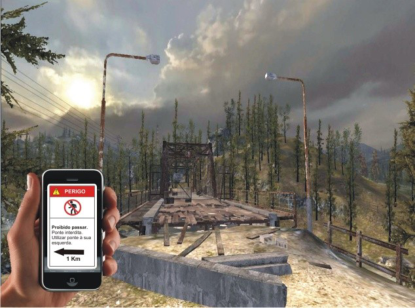
Description and Characterization of Scenarios Were developed two different scenarios (ie, unselfish and selfish), from meetings with specialists. We used the same virtual environment for both a land characterized by open and hilly countryside, filled with trees, rocks and built elements, such as houses, quarry, a river and a bridge. For this we tried to create an extreme situation in which the individual was taken to disobey the warning (inserted into a mobile phone which is in a virtual environment). This warning is dynamic and basic technology. To operationalize this, it was thought at risk of life which are, of course, those whose ends justify the means. So we tried to use different or even opposite behaviors that could influence the behavioral intention of the user. It was agreed therefore call "unselfish" situation where there are risks to third Ergonomics In Design, Usability & Special Populations I (2022) parties. We used an image with a bridge and a fire across the border, and a narrative composed of the following: "Imagine that today is the first day of work of John as ranger in the Arrabida ridge. The area of his work comprises a large forest that spans a river, bridges, a small village and a quarry. It is beside a bridge forbidden, crossing a dangerous river. To avoid drowning, access to the river is fenced by impassable barriers. At this time John sees the focus of a small fire that broke out in the woods on the other side and can spread. His task is to move there immediately to extinguish the fire before he assumes uncontrolled proportions and endangers the lives of people who live in the next village."
We chose to call "selfish" the situation of risk to yourself. For this we used an image of a bridge and the following narrative: " Imagine that today is the first day of work of John as ranger in the Arrabida ridge. The area of his work comprises a large forest that spans a river, bridges, a small village and a quarry. It is beside a bridge forbidden, crossing a dangerous river. To avoid drowning, access to the river is fenced by impassable barriers. At this time John sees and hears very strong, around and along the river bank where explosions from a quarry very close. The vibrations of explosions shake the ground where you are and there fragments of rock in the air around you, which can kill you if you keep on this side of the border. " It was felt that it would be expected that had different weights between the two scenarios and thus being noticed in a different way by the people the people. Following each narrative two distinct images from the game called by Unity3D Bootcamp ® Technologies were used. We opted for this solution because we believe that it served our needs, because in the future, we intend to use this same virtual involvement in studies with the use of VR. Images according to the characteristics of the narrative of each scenario (images 1 and 2) were adapted. For this adaptation, we used Adobe Photoshop ® software CC. Consistent with the warnings proposed matching ANSI-ISO and adapted with the use of Corel Draw ® (image 3) software were used.
(1) (2)
Figure 01. Images with warnings, representing, respectively, the selfish(1) and unselfish(2) scenarios used in the final questionnaire for data collection.
Ergonomics In Design, Usability & Special Populations I (2022)
(3)
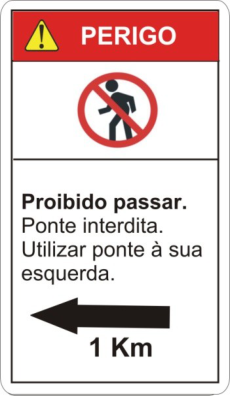
Figure 02. (3) Danger - No passing. Interdicted bridge. Use bridge on your left 1km.
Although the aim of this study was not to evaluate the warnings, we believe it is important to use the warnings and images of the virtual involvement by Unity3D game Bootcamp ®, (1) and (2) with an assembly, to provide a more efficient context. The importance of this context with images is due to the need to illustrate the engagement chosen for the virtual narrative unfold.
Participants Was collected data from 75 participants but, due to bad padding and inconsistency in the data, 15 participants were eliminated. Thus, the final sample consisted of 60 volunteer university students (50% men and 50% women), aged between 18 and 30 years (M = 21.07, SD = 1.83) and distributed equitably for each experimental condition.
Materials and Instruments for Data Collection For each condition were developed two questionnaires containing images (as seen in item 2.2) and a written narrative that describes a dangerous situation and assesses the behavioral intention through the decision making before a static warning with the use of questionnaires (as will be seen in section 2.4.1). The questionnaire was divided into two parts. The first time for training the participant and clarify questions about the task and the second instrument for collecting data. For the process of data collection, initially we developed a test compound followed by two narratives (considering the scenario training) of an image on a sheet of paper and two questionnaires. The first (of training) had 5 questions and the second had 10 questions. We used a Likert scale of 9 points (with 0 being "no probability" and 8 "extremely likely") for both cases. Even at this stage, several preliminary tests were applied to 25 college students. We understand that there was no need as many points on the scale to give an opinion. We opted for a scale, so as to force a choice in either direction. This makes sense because we expect the individual to do something, ie complies with the warning or not. Because of this we decided to change the scale of Likert 9 points for a 6-point scale (as will be seen in section 2.4.1 below). The justifications given by them in relation to behavioural intentions, led us to conclude that the responses were" socially adequate " or "socially desirable behaviour " occur and therefore decided to change the narrative to the third person to try to solve this problem. On this issue, Park and Kim (2013) identify that Davison (1983) was the first who coined the hypothesis third-person effect, as the tendency to assume that others will be more susceptible to the negative effects of the public than they. People tend to expect that the public exposure produces a greater effect on others than on themselves. Concerning socially appropriate responses, Pitesa et al. (2013) demonstrated in a study that people's behaviour tends to be socially desirable, with the impact of a salient or important interpersonal action. Boerger (2013) carries out extensive research into the understanding and development of a tool for data collection where he studies the motivations for responding to the " socially desirable " has as origin the need to keep up appearances. Thus, after this initial phase of enhancement tool
Ergonomics In Design, Usability & Special Populations I (2022) for collecting data, we define the model that would be used, as described in section 2.4.1 below.
Questionnaire The questionnaire was divided into two sections, the first to evaluate variables are as declared behavioural intention, degree of hazard and perceived risk in consonance with a static warning. We used a Likert scale of 6 points (1 being equivalent to "extremely low" and 6 "extremely high"). The questions were the same for the two experimental conditions, with the exception of question number 4 which differs for each experimental condition (4a to 4e for Unselfish and Selfish), as follows:
(Q.1) How do you rate the level of urgency to cross to the other shore? (Q.2) What is the probability of John obey the warning displayed? (Q.3) What is the perception of danger to the interdicted bridge? (Q.4a) What is the perception of danger about the fire? (Q.4b) What is the perception of danger about explosions? (Q.5) What is the probability of an injury occur while crossing the interdicted bridge? (Q.6) What is the probability of crossing the bridge safe 1 km?
The second section of the questionnaire involved the collection of demographic data (age, gender, educational level) and a question about the experience/training in first aid or safety. This question was formulated to prevent this experience/training influence on behavioural intention.
Procedures The researcher and an assistant went to a university, specifically in a design course, and collected data (using questionnaires), in classrooms, as the availability of participants. There was a personal goal and then the importance of this research presentation. Some instructions of the composition of the study, the phases and their characteristics were reported. Was communicated to the participants that they were not being assessed and that there were no right or wrong answers. Students who agreed to participate in the study, were given a consent form, which was completed before the start of practice. From the accepted student's research and signing the consent form, the document was distributed to the narrative and questionnaire for training. At this stage students were asked if there was any kind of doubt. After that it was delivered the second and final set of documents (narrative and final questionnaire), this time, they were no longer allowed to ask questions. The questionnaires were gathered together and were asked to remain silent while someone was still it. Both questionnaires were administered in a classroom with many students, individually, and it has not been established for the particular task completion time. The complete study, including the contents of all the warnings and all instructions were communicated in the Portuguese language. The English translations are given in this article.
RESULTS OBTAINED Statistical analysis was performed using the IBM ® SPSS ® Statistics v22, was conducted at a significance level of 5%.
To verify the formulated research question and due to the type of data collected, the Mann-Whitney test was used to compare the two experimental conditions (ie, unselfish and selfish) with respect to the six questions applied to participants, related to the variables dependent (ie, declared behavioral intention, perceived risk and danger), (see Table 1).
Unselfish Selfish M SD M SD U Z (Q.1) Level of urgency to cross to the other shore. 5.1 0.7 5.0 1.25 428.5 -,341
Ergonomics In Design, Usability & Special Populations I (2022)
(Q.2) Probability to obey the warning displayed. 3.5 1.1 3.9 1.2 379.5 -1.075 (Q.3) Perception of danger of the interdicted bridge. 4.1 0.9 4.4 1.0 381.5 -1.056 (Q.4a, e) Perception of danger to fire / explosion. 4.9 0.8 5.1 0.7 391.5 -,923 (Q.5) Probability of a personal injury occurs when crossing the interdicted bridge. 4.8 0.8 4.9 1.0 420.5 -.463
(Q.6) Probability of crossing the bridge safe 1Km. 3.5 1.4 3.7 1.2 404.0 -.699 Note: p> 0.05
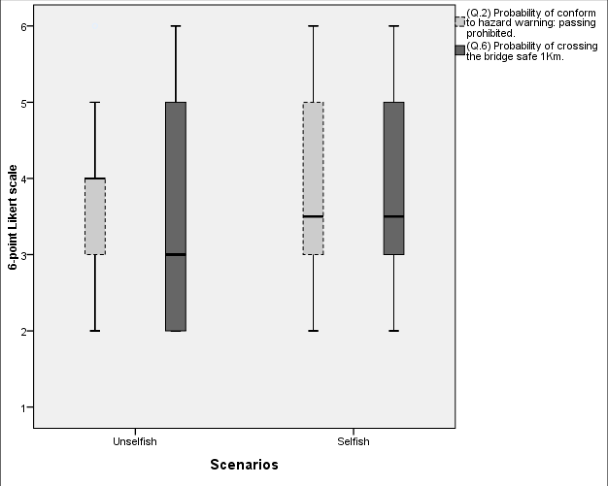
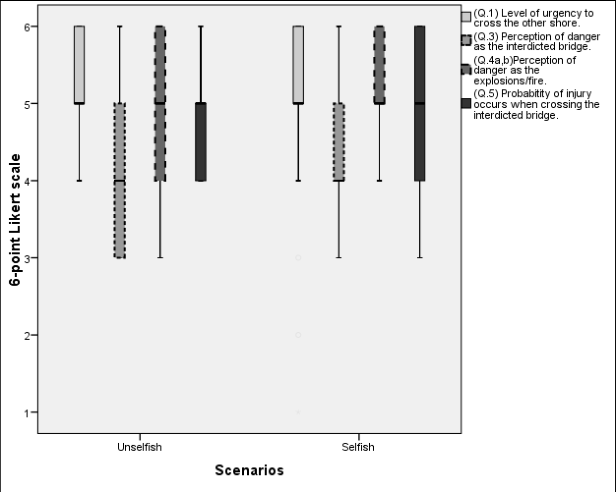
According to the results of the Mann-Whitney test, no statistically significant differences were observed between the two experimental conditions, unselfish and selfish scenario (see figure 04 and 05).
Figure 04. Distribution of the degree of declared behavioral intention for the two experimental conditions, with 6-point Likert scale, using boxplot.
Ergonomics In Design, Usability & Special Populations I (2022)
Figure 05. Distribution of the degree of perceived risk and danger for the two experimental conditions, with 6-point Likert scale, using boxplot.
DISCUSSION
The main objective of this research was to compare the influence of the scenarios in the perceptions of participants (unselfish and selfish scenarios). For this is created through narratives and images, the perception of danger and urgency to accomplish the task.
The results obtained by the Mann - Whitney test showed a statistical equality in relation to its purpose. Ie , it has not been possible to demonstrate that one was significantly more favorable than the other because the results show that both scenarios are fairly unfavorable, thus can be used.
Figure 4 shows in variable “declared behavioural intention "that the selfish scenario for questions 2 and 6 there is an even distribution of data, which shows that the participants adopted the same behavioural intention declared to the two issues under consideration. This is positive because it shows that there is a consistency between both issues. Unselfish scenario there is a different distribution, ie, there is greater dispersion throughout the scale, and it can show that there is a higher level of uncertainty about the decision to be made.
In question 2 the selfish scenario, we can see a wider distribution of data in the third quartile (Q 3 = 5) in relation to unselfish scenario, may demonstrate a greater tendency to obey the warning. It is observed that the distribution of the data in question 6 for unselfish scenario, may indicate some doubt take the safe bridge. This may indicate that the influence of the setting is strong so that there is a predisposition to obedience not to warning.
Regarding the variable "perceived risk and danger" (Figure 05) is observed in the median values equal respective issues in both scenarios. The data are more concentrated in the higher ranges, which indicates that the risk factors and danger have a good perception for participants in both scenarios. Thus, the risk factors and perceived danger may have positively affected behavioral intentions to reduce doubts in decision making.
The results show that respondents classified as urgent move to the other side, and that both scenarios were able to convey this sense of "urgency". Most respondents perceived danger and can also injury occurs when crossing the bridge interdicted. By analyzing the responses to Questions 2 and 6 perceives an equality between both responses to Ergonomics In Design, Usability & Special Populations I (2022) the two scenarios. However, how to explain why only 50% of respondents chose the safe path? Taking into consideration that 50 % of people decided to cross the bridge forbidden and therefore disobeying the warning, how far away from the bridge did not influence people's decision? In a real situation, an intention would be expected to obey the warning, however, this research sought precisely to find a scenario that would lead people to disobey the warning.
One possible explanation for the contradiction and similarity between the data obtained, may be the occurrence of a socially appropriate or desirable behaviour. Gervais and Norenzayan (2012), in their third experiment, confirm the existence of a socially desirable behavior "in the responses when people feel that their behaviour is being monitored. So they tend to use a positive attitude. During pre-test of this research, we realized the occurrence of this phenomenon by using verbalization after the completion of the questionnaires, as was seen in section 2.4 of this article and referenced by (eg Park and Kim, 2013; Pitesa et al, 2013; Boerger, 2013), and also exposed by Wogalter (2006).
CONCLUSIONS
One of the reasons may be the cause of non-compliance with the warning may be that the dangers are not obvious (open hazard) for participant. In this case, the dangers (of explosions and fire and/or bridge in ruins) shown in the image and narrative, may not have been sufficiently explicit. We have to consider that the participants did not know the engagement, had no way to explore and, as such, may not have had the capacity to imagine alternatives that had to be kept safe. To what extent the stated behavioural intentions reflect the behaviour of individuals and the extent to which the use of the image of the bridge was positive or negative? Perhaps the use of the narrative was just enough. Another reason to explain the results can be related attitudes and beliefs. Individuals may have had some previous experience, positive, giving it reason to believe they would be able to cross the bridge in ruins successfully. In this case, the perception of risk is fundamental. The warning would have to be strong enough to counter this perception, and it did not. Therefore this result can be considered positive, because it was expected exactly a scenario that would produce the same result. Another issue in results is motivation. We know that people always do an analysis of cost- effectiveness. In this case, this relationship seems to have been favorable to the objective of this research, because although the results show that participants perceive high risk in the bridge, the cost of travel 1 km, in a way that ignorant, may have been considered high.
Thus, following this research, we intend to use the RV in another experiment with the use of any of the scenarios. The RV is best suited for evaluating the behavioral compliance in addition to its characteristics of immersion provides greater user involvement and also the use of some features typically found in emergencies, such as noise and fire. It is expected that in future study the effect occurring "socially desired behavior" is small or zero. This will allow a better assessment with dynamic security warnings in critical situations, we intend to study the effect of outlining the consequences of these behaviours.
ACKNOWLEDGMENTS
This work was supported by grants BEX 6210-10-4 to Reginaldo Schiavini from CAPES Foundation, Ministry of Education of Brazil. I also thank the students design, from UBI, who kindly participated in the survey.
REFERENCES
Burdea, G.C., Coiffet, P. (2003), "Virtual Reality Technology", York, NY, USA: John Wiley & Sons, Inc. pp. 451.
Ergonomics In Design, Usability & Special Populations I (2022)
Börger, T. (2013), "Keeping up appearances: motivations for socially desirable responding in contingent valuation interviews", Ecological Economics, Volume 87, pp. 155–165. Carroll, J.M. (2000), " Making Use: scenario-based design of human-computer interactions", USA: MIT Press Cambridge.
pp.368. Cook, M. Noyes, J., Masakowski, Y. (2007), “Decision making in complex environments”, USA: Ashgate Publishing Company. Davison, W.P. (1983), "The third-person effect in communication", Public Opinion Quarterly, Volume 47 No. 1, pp. 3–15. Duarte, M.E.C. (2011), "Using Virtual Reality to Assess Behavioral Compliance with Warnings". Dissertação de Doutoramento não publicada. Universidade Técnica de Lisboa, Lisboa. Duarte, E. Rebelo, F., Teles, J., Wogalter, M.S. (2013), "Behavioral compliance for dynamic versus static signs in an immersive
virtual environment", Applied Ergonomics, pp. 1–9. Duarte, E. Rebelo, F., Wogalter, M.S. (2010), "Virtual Reality and its potential for evaluating warning compliance", Human Factors and Ergonomics in Manufacturing & Service Industries, Volume 20 No. 6, pp. 526–537. Feltovich, P.J. Coulson, R.L., Spiro, R.J. (2001), “Learners’ (mis)understanding of important and difficult concepts: A challenge
to smart machines in education”, in: Smart machines in education, Forbus, K.D., Feltovich, P.J. (Ed.), Menlo Park, CA: AAAI/MIT Press. Gervais, W.M., Norenzayan, A. (2012), "Like a camera in the sky? Thinking about God increases public self-awareness and socially desirable responding", Journal of Experimental Social Psychology, Volume 48 No. 1, pp. 298–302. Gutierrez, M. Vexo, F., Thalmann, D. (2008) "Stepping into Virtual Reality", Santa Clara, CA: Springer-Verlag Telos. pp. 214. Park, S., Kim, J. (2013), "Social categorization and cross-cultural exploration of the third-person effect: Perceived impact of
North Korea’s nuclear test on the self and comparison targets", Studies in Communication Sciences, Volume 13 No.1, pp. 50–57. Pitesa, M. Thau, S., Pillutla, M.M. (2013), "Cognitive control and socially desirable behavior: The role of interpersonal impact", Organizational Behavior and Human Decision Processes, Volume 122 No. 2, pp. 232–243. Smith-Jackson, T.L., Wogalter, M.S. (2004), "Potential uses of technology to communicate risk in manufacturing", Hum. Factors
Ergon. Manufacturing, Volume 14, pp. 1-14. Wogalter, M.S. (Ed.) (2006), “Handbook of Warnings”. Mahwah, NJ: Lawrence Erlbaum Associates, Inc. Wogalter, M.S., Conzola, V.C. (2002), “Using technology to facilitate the design and delivery of warnings”, International Journal of Systems Science, Volume 33, pp. 461-466. Wogalter, M.S. David, D. M., Laughery, K. R. (Eds.). (1999), "Organizing theoretical framework: A consolidated
Communication-Human information processing (C-HIP) Model", in: Warnings and risk communication. London: Taylor & Francis. Wogalter, M.S., Mayhorn, C.B. (2005), “Providing cognitive support with technology-based warning systems”, Ergonomics, Volume 48, pp. 522-533.
Ergonomics In Design, Usability & Special Populations I (2022)
LISTED IN THE AHFE DIGITAL BOOKSTORE CATALOGUE
Explore the complete digital volume
Advances in Ergonomics In Design, Usability & Special Populations: Part I
Read this individual research paper free through the original publisher, or explore the full digital proceedings book.
ISBN 978-1-4951-2106-7
Explore this ISBN in the AHFE Bookstore ↗Listed in the July 2026 bookstore catalogue; search by ISBN to confirm current availability · Digital book purchase optional