Emilio Cadavid, Luz M. Sáenz (2022). “Prepare For Work” Intervention Model in a Group of Operators MSD High Prevalence of Shoulder and Cervical Spine. In: Advances in Ergonomics In Design, Usability & Special Populations: Part III. AHFE Open Access, vol. 20. https://doi.org/10.54941/ahfe1001293
This paper presents an intervention proposal for a group of workers, known as power line workers, who are responsible for mounting, operating and maintaining energy power lines for a company that provides public utility services in Medellin, Colombia. Power line workers have been characterized by high levels of disability and the adverse effects of MSDs, in particular tendonitis that affects the rotator cuff muscles in the shoulder; a condition that has, in the past, led to high levels of work relocation. Following an analysis of the workplace and the implementation of an instrument for the assessment and perception of musculoskeletal discomfort and the affected joint areas, a proposal known as "PREPARE FOR WORK" was developed. This proposal included: awareness in looking after those body parts to be targeted, a physical exercise program, and a monitoring program that would provide ongoing feedback from the group of workers based on their perceptions of the exercises carried out prior to work. This will lead to the second application of the questionnaire known as Profile of Muscle-Joint MSD Prevention Program, a strategy to measure impact and improve intervention if necessary.
Empresas Públicas de Medellín has been providing public utility services for 59 years. Initially, the company only served the residents of Medellín, but it has expanded quickly and is now positioned at the forefront of the sector. Organized as a “state-owned, industrial and commercial enterprise”, and owned by the municipality of Medellin, the Company provides electricity, gas, water and sanitation services that meet the very highest international standards of quality. The company’s reach extends to 125 municipalities in the department of Antioquia, and serves 3.6 million residents in Medellin and the Metropolitan area of Valle de Aburrá.
The Company has a prominent role in Colombia’s electricity sector, meeting 21.11% of the country’s total demand, while over the course of more than five decades it has succeeded in building the backbone of Colombia’s hydroelectric system. With years of experience in the development of utility projects, the Company is now focusing on the development of alternative sources of energy that will contribute to the environmental sustainability of the planet and present further opportunities for domestic and international growth (Empresas Públicas de Medellín, 2013). Ergonomics In Design, Usability & Special Populations III
Due to the size of the company, the system comprises different areas of service provision: electricity (known as ENERGY), gas, water supply and sewerage (known as “Water”).
The Company’s Electricity Division is regarded as a large subsystem, and includes: Energy generation Hydroelectric stations: 25
This project is focused on the section of the subsystem that deals with energy transmission and distribution, and specifically, where operational, mounting and maintenance work is carried out on utility poles.
The Company’s Risk Management Unit works alongside the Labor Risk Administrator (ARL), in accordance with Law 1562 (Ministerio del Trabajo, 2012), to coordinate the Occupational Health Program for the health and safety management system in the workplace.
The Company also has an Epidemiological Surveillance System for Musculoskeletal Risk Factors. An ARL representative maintains contact with the energy transmission and distribution workers.
Activities carried out through this program include:
- Medical evaluation for working at heights (assesses the aptitude of applicants and workers for this kind of work).
- Ongoing training in the area.
A Guide for Working at Heights is currently being implemented (Resolución 1409, 23 July 2012).
In this analysis, power line crews are seen as a small subsystem of the larger Energy system.
Subsystem: The power line crew In Colombia, energy is generated mainly through hydraulics (dams and waterfalls). Energy is transported through large towers to distribution substations that service the cities. To finally reach the end consumer, an entire network of overhead and underground cables is required. In Medellín, electricity is distributed through an overhead network that depends on an entire support system (utility posts) manned by a sizeable group of operatives called power line workers.
Power line workers are responsible for mounting, operating and maintaining power lines. In terms of training, it is the experience, as well as the length of time performing a particular job, that determines their position within this process.
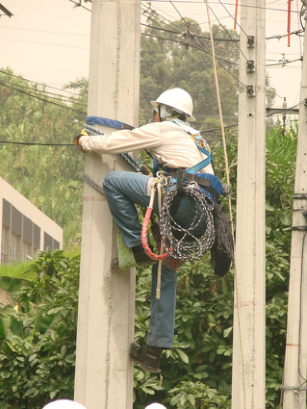
Power line “crews” (a team of three workers), who are trained to climb utility poles, carry out duties at heights and at ground level. Crew members are aware of the tools that are required by their colleagues higher up the utility posts, and are in a position to supply those tools. See figures 1 and 2. Crews check through a telescopic pole if the power Ergonomics In Design, Usability & Special Populations III line is active, ensuring that safety procedures are being carried out in an appropriate manner.
Figure 1. Climbing to utility post Figure 2. Equipment required Crew members are employed directly, and on a full time basis, by the Company. Their salaries are not paid on a piecework basis, while work can either be scheduled or unscheduled, depending whether it’s planned maintenance to the city’s network or repair to damages. The crew must always complete a particular job to ensure the system continues to operate.
The power line worker is exposed to certain risk factors that can affect their safety: electric shocks, falling from heights and musculoskeletal disorders (MSDs) caused by repetitive work, prolonged static postures and over- exertion.
The work carried out by power line workers has been chosen for analysis due to the high occurrence of disabilities and the effects of MSDs, in particular tendonitis that affects the rotator cuff muscles in the shoulder. In the past, this problem has led to high levels of work relocation. The objective is to propose a program of physical activity that prepares members for work, which in turn contributes to risk control.
Overall Objective
To evaluate, using ergonomic criteria, the work carried out by a team of power line workers charged with the operation and maintenance of street lighting in the city of Medellín.
Specific Objectives
To establish the operational risks associated with a team of power line workers charged with the operation and maintenance of street lighting in Medellín.
To assess the epidemiological data and the prevalence of musculoskeletal disorders in order to identify the different groups of joints that are affected.
To propose actions aimed at managing the musculoskeletal disorders identified.
Ergonomics In Design, Usability & Special Populations III
MATERIALS AND METHODS
The Sample The study sample consisted of 88 workers. All members of the group are male, and all are employed directly by the company. The average age of the group was 45. The maximum length of service as a power line worker was 40 years, the minimum length of service was 3 years, with an average of 19 years and 2 months. The average working week is 55 hours.
In order to analyze the work carried out by power line workers, information was gathered and processed in two ways: Individual and group interviews and photographic records were carried out in a biannual meeting known as “El Rodeo”. The following criteria were covered: procedures required to carry out work; a description of the moments (stages) of work; technology: items required to carry out work (equipment and tools); factors relating to workplace (physical space); demands of work; and the response from workers.
For the identification of risk factors that lead to musculoskeletal disorders: The design and implementation of a questionnaire called Profile of Muscle-Joint MSD Prevention Program. A review was also carried out to assess the resources available in the Company that enabled risk factors to be identified, and accompanying strategies for the power line workers.
RESULTS AND DISCUSSION
Procedures required to carry out work Various kinds of utility posts exist in the energy distribution system. The functioning components (hardware) are mounted at the top of the utility posts, and personnel known as power line workers are required to climb the posts, using personal safety kits, with equipment and tools to carry out mounting, operational and/or maintenance work.
The type of system used to climb the utility posts is determined by the kind of support structure used to hold up the electrical network (utility posts, towers, rails, etc.), as well as location features and surrounding space. The utility posts can be climbed by cars with caskets, which require large spaces, by steps, and by the skill and physical exertion of the power line worker using a rope system and harness to protect against risk factors, such as falling from height.
The crews are able to change the particular system according to the features of the land or zone where they are working. This analysis focuses on the system of physical exertion, as all power line workers use this method at some point whilst carrying out operational, mounting and maintenance work.
Technology: Items required to carry out work (equipment and tools) The power line workers require the following items to carry out their work: Protective equipment including: hardhats, safety glasses, uniform (clothes and shoes), protective gloves, harnesses, safety ropes, as well as other items such as slings (ropes or straps with snap hooks at the ends to secure the worker).
In addition, belts (made from a resistant material such as fique or nylon to ensure the worker is supported when climbing), poles (telescopic type to take items), steps and, depending on the work, the required tooling.
Ergonomics In Design, Usability & Special Populations III
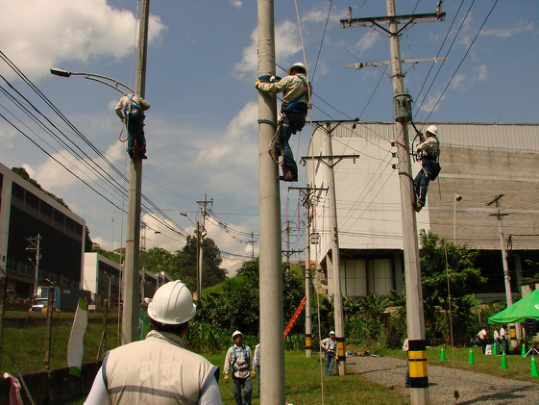
Factors relating to workplace (physical space and environment) Work is carried out in the open, and the method of climbing the utility posts is determined by the available space. The use of a car with casket accounts for approximately 10-20% of the work carried out, while belts and harnesses account for 80-90%. (See figure 3. Physical space and environment).
Figure 3. Physical space and environment
Demands of work and workers response The working day is 8 hours long with 30-minute breaks every four hours.
The crew responds to work orders that are assigned by an operations leader. During the day, a crew will carry out maintenance work on networks that conduct both energized and de-energized energy according to scheduled times, and reconnect energy supply to different clients, which can take from a few minutes up to several hours of the working day.
Workers carry out the jobs that have been planned for each day (according to demand). The nature of their day-to- day work develops physical capabilities. At first, workers complain of high fatigue, followed by signs of regular muscle spasms.
The teams of workers attend a training camp once or twice a year.
Workers consider the job very hard and tiring.
Physical demands The activity of a power line worker is comprised of different tasks, which include: marking the area in which the work is to be carried out and organizing the tools, materials and safety protection items that will be required. These tasks are carried out in the moments before the workers climb the utility posts. For most of this period, workers are maintaining a standing position, while no repetitive movement or over-exertion is required.
On the other hand, the tasks carried out whilst climbing the utility posts, carrying out work and returning to ground level required the adoption of different postures, repetitive movements and significant over-exertion.
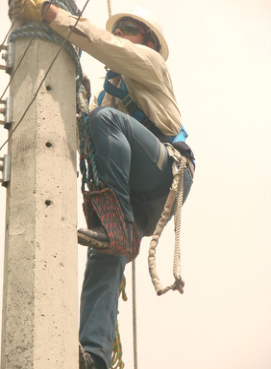
During the climbing period: the worker adopts a dynamic posture when climbing the utility posts. The movements carried out in the lower right leg at this time include a bending of the hip between 80 and 100 degrees, and a bending Ergonomics In Design, Usability & Special Populations III of the knee between 90 and 120 degrees, as well as a slight abduction and rotation of the hip. In the lower right leg, the hip remains in a neutral position with the knee totally extended and support from the feet placed in steps for climbing. See Figure 4.
The worker carries out approximately 5 to 8 combined movements of upper and lower limbs per minute (repetitive movements). The worker has the support of his own body as excess weight whilst raising and moving himself with the belt mechanism along the utility pole. The worker also contends with the weight of tools that he is carrying.
Figure 4. Posture climbing to utility post Figure 5. Receiving work tools Receiving work tools and carrying out repair or maintenance work on the lighting: the worker adopts a standing posture and performs different bending and extension movements of the arms. At certain times, the worker will maintain the shoulder 180 degrees above the horizontal, the bilateral elbow in an extended position with pronation of the forearm, a 60-degree bending of the wrist and a slightly extended neck. In this task, between 8 and 10 combined movements per minute of the upper limbs are carried out. These movements are not considered repetitive movements, nor does the worker experience over-exertion during this activity. For short periods, the worker will carry out this activity when looking over the shoulder. See Figure 5.
Placing and collecting the signaling: the worker will adopt a posture that entails a 15 degree bending of the trunk and a 60 degree bending of the left shoulder, with the right shoulder at 0 degrees. No repetitive movements are carried out during this activity. The worker has the support of his own body as excess weight whilst raising and moving himself through use of the belt mechanism.
Results on the design and application of a questionnaire to investigate the muscle joint profile of a group of power line workers The Risk Management Unit has an epidemiological surveillance program that has shown that the main causes of power line worker absenteeism, and the subsequent relocation to other work duties, are musculoskeletal disorders in the neck and shoulders and, in particular, mechanical neck pain, chronic tendinitis and tears in the rotator cuff muscles in the shoulder. For this reason, the drafting of a questionnaire was proposed that would examine musculoskeletal discomfort in a group of 88 workers with an average age of 46 (+/- 9 years).
A questionnaire known as the Profile of Muscle-Joint Prevention Program MSD was designed (see Annex 1), and included basic information about length of time in the job, level of seniority within the company, weekly hours, painful symptoms, previous osteomuscular problems in the upper limbs and the practice of physical exercise. Key to the initiative was a Nordic Questionnaire that graphically defined the neck, shoulder and lumbar regions so that those responding to the questions are able to recognize clearly the prevalence of discomfort in the different groups Ergonomics In Design, Usability & Special Populations III of muscle joints. (Kuorinka et al., 1987)
The report shows that 54.4% (48) of the group suffered some form of musculoskeletal disorder (MSD) during the last twelve months, while 17% (15) suffered MSD in the last month. For this specific group, 15% (13) have specific recommendations limiting the work they carry out (for example, work above shoulder level, work with particular weights, work involving impact, long journeys, etc.).
Of the current group of 88 workers, 17% are being treated for shoulder and neck pathologies.
79.5% of the group carry out some type of physical exercise, the most common of which is soccer at the weekend.
CONCLUSIONS AND RECOMMENDATIONS On the Description of Work
Based on the interviews, the photographic register and a description of the activity provided by the company, it could be concluded that:
Procedures that are entailed in the power line worker’s daily activity encompass over-exertion, posture and repetitiveness. These three factors are linked to work conditions in the multifactorial framework of the etiology of MSDs according (Ayoub and Wittels, 1989) to the Guide to Comprehensive Care in Occupational Health Based on Evidence for Musculoskeletal Disorders (MSD) (Ministerio de la Protecciòn Social & Pontificia U Javeriana, 2007). In general, four large risk groups should be taken into consideration:
- Individual factors: functional capacity of the worker, habits, background, etc.
- Factors connected to work conditions: strength, posture, and movement.
- Organizational factors: organization of work, days, hours, breaks, rhythm and workload.
- Factors associated with the environmental conditions of the workplace and systems: temperature, vibration, etc.
The activity includes a number of tasks – each one expressed as a percentage according to the length of time the task takes to complete. To climb the utility post, secure the body and maintain the required position to carry out, either with or without a belt, takes up approximately 70% of the working day.
Whilst these tasks are being carried out, high demands relating to posture and over-exertion are evident, due to the necessity of supporting body weight, carrying tools and the range of movement, all of which require a high level of physical effort.
On the identification of risk factors for musculoskeletal disorders The results of the questionnaire applied to the current group of workers confirm the historical trends shown by the Epidemiological Surveillance System.
The way that work is carried out confirms that musculoskeletal disorders are an operational risk.
A physical activity program is created to prepare for work, before the working day begins, and based on the following approaches:
Ergonomics In Design, Usability & Special Populations III
“Physical activity as a strategy for prevention and health promotion, in line with the objectives of ergonomics, creates within an employment context (and applied to people’s daily lives) habits for healthy lives, builds self- esteem, develops an ability to overcome obstacles and increases motivation to achieve good academic performance and social standing.
The National Physical Activity Program: An Active and Healthy Colombia is a program aimed at creating and implementing public policy to reduce inactive lifestyles in Colombia (Instituto Nacional del Deporte). The program also defines certain scenarios, including within the work environment, whereby companies and public entities are incorporating actions connected to physical activity and healthy lifestyle habits. These actions lead to improvements in personal wellbeing (flexibility, strength, better health, body awareness, etc.), as well as transcending and generating positive work dynamics and group habits. (Cadavid & Sáenz, 2010) The majority of public health professionals see stretching exercises as an indispensible practice for an individual’s health. The majority of those who hold this view emphasize that stretching is an important part of training, and not just an exercise to be carried out before physical activity. (Tavares de Almeida, 2007)
(It is important to continue developing joint actions with the Occupational Health Unit, ensuring the implementation of ergonomic criteria, so that the activity of the power line workers is analyzed with a systemic perspective. It’s important to remember that the team is interdisciplinary – this will enrich future analysis and intervention proposals.
The impact of a physical activity program designed for a group of power line workers must be measured through certain indicators.
In the review of available Company resources geared towards the identification of risk factors and follow-up strategies for the group of workers, Colombia’s Ministry for Social Protection also proposed a series of tools (República de Colombia & Pontificia, 2010). This series of tools is based on the definition of psychosocial factors, outlined in Resolution 2646 (2008) of the Republic of Colombia and is defined as: “(The) psychosocial factors are understood as features relating to work, outside of the work environment or external to the organization, and the individual conditions and characteristics intrinsic to the worker, that interact in dynamic way, through perceptions and experiences, influencing people’s health and performance.”
In-work conditions are understood as those characteristics relating to work and its organization, and which influence an individual’s health and wellbeing. Conditions outside of the work environment relate to the worker’s family, social and economic environment. They also include living conditions, which may affect the health and wellbeing of the individual.
Individual conditions allude to a series of characteristics particular to each worker, or social demographics such as sex, age, marital status, educational level, occupation (profession or job) the city or place of residence, socio- economic background, living conditions and the number of dependents. These social demographics can shape the perception and outcome of risk factors either in or out of the work environment.
Taking into consideration the multifactorial etiology of the aforementioned musculoskeletal disorders, the results of the application of a series of tools could also be developed into support material to examine the incidence of other factors in the appearance of musculoskeletal disorders, but this would be the objective of a different analysis.
Proposal for the “Prepare for Work Program” From an operational point of view, an intervention proposal called PREPARE FOR WORK has been developed and includes:
Awareness in the management of those body parts to be targeted (process of raising awareness of body movement, why it is done and factors involved) through participatory meetings with those groups of workers taking part in 2014.
Awareness includes a presentation with slides that addresses such topics as: Ergonomics In Design, Usability & Special Populations III
The person as a living being.
The basic biomechanical components of the human being (man/machine analogy).
Basic physiology of the joints system.
Potential acute or chronic injuries.
The concepts of body heating and maintenance.
The exercise program that will be carried out during the year.
A physical exercise program This program is based on a progressive system centering on motor skills, and which include flexibility, strength and balance as integral to the muscle-joint system. Figure 6. Progressive system in the approach to the practice of physical activity (Cadavid, Physical Activity, The Corporate Commitment, 2011)
- Flexibility is the ability to make movements through a maximum possible extension of a particular joint.
- Strength: the degree of tension that muscles develop during exercise to overcome or oppose resistance.
- Balance: the ability to maintain a body in a stable position by counteracting the laws of gravity whilst moving and staying still
- Resistance that trains the cardiopulmonary system is not included in this program.
Cardiopulmonary
Muscle joint system
System
Resistance Balance
Strength Flexibility
Figure 6. Progressive system in the approach to physical activity
Figure available in the original PDF paper.
The objective in this phase is the generation of “body awareness” through joint mobility and physical flexibility.
The Program is geared towards the Crew of Power Line Workers working in the energy transmission and distribution subsystem. It was shown that this group was more susceptible to risk factors relating to over-exertion, posture and repetitive movement of the upper body and neck.
Program Objectives: To physically and mentally prepare staff working in the area of energy distribution with an aim to prevent discomfort in the upper body and neck.
Ergonomics In Design, Usability & Special Populations III
To help generate postural hygiene habits as factors for quality of life in later life.
Intensity: activities should be carried out 10-15 minutes before the start of each job, and once or twice per week in each of the locations where the program is implemented.
Methodology: Physical education and physiotherapy professionals will oversee the program, and direct the activity in the following way:
General joint movement will be carried out that will focus on the arms and include movement of wrists, elbows, shoulders and neck.
Flexibility work will then be carried out targeting the different muscle groups around the abovementioned joints, such as the trapezius, deltoids (shoulder muscles), biceps, triceps and forearms.
Please note: In specific cases where a worker has been diagnosed with a muscle joint injury, muscle strengthening exercises will be carried out using elastic material (Theraband).
Initially, flexibility exercises will be carried out gently i.e. muscle joint mobility exercises will be performed in the company of a professional, and with or without gravitational force. Active stretching consisting of muscle joint mobility exercises will then be carried out with help from a colleague or supervision by a professional.
If necessary, the worker can use their own body weight and/or elastic material (Theraband) and other types of support (dumbbells). Strengthening exercises can also be carried out with help from colleagues.
It must be clear that no exercise should induce pain or discomfort, and if this occurs then the exercise must be stooped and immediate medical advice should be sought.
A follow-up program The follow-up program includes:
- Ongoing feedback from the group of workers based on their perceptions of the exercises carried out prior to work. A format will be designed to record any new developments, and will include the following criteria:
- A second evaluation of application of the questionnaire known as Profile of Muscle-Joint Prevention Program TME (See annex 1) Questionnaire Profile of Muscle-Joint Prevention Program
REFERENCES
Cadavid, E., & Sáenz, L. (2010). Ergonomics in The Prevention Context Reality and Educational Proposals in Colombia En . En Advances in Occupational, Social and Organizational Ergonomics (págs. 383-392). Boca Ratón, Florida, USA: CRC Press Kuorinka, I., Jonsson, B., Kilbom, A., Vinterberg, H., Biering-Sorensen, F., Andersson, G., and Jorgensen, K. (1987,
septiembre), Standardised Nordic questionnaires for the analysis of musculoskeletal symptoms. Applied Ergonomics , 18, 3, 907-916. Website http://www.sciencedirect.com.consultaremota.upb.edu.co/science/article/pii/000368708790010X Ministerio de Cultura, I. C. (2010). Programa Nacional de Actividad Fïsica, Colombia Activa y Saludable. Colombia. Website: http://www.coldeportes.gov.co/coldeportes/recursos_user/documentos/normatividad/Normas/programa_colactivaysaludable.pdf Ministerio de la Protección Social, & Pontificia, Universida Javeriana (2007). Guía de Atención Integrla de Salud Ocupacional Basada en la Evidencia para Desórdenes Musculo Esqueléticos(DME) Relacionados con Movimientos Repeetitivos de Miembors Superiores(Síndrome de Túnel Carpiano, Epidcondilitis y Enfermedad de De Quervain)..Santafé de Bogotá: Imprenta Nacional. Ministerio de la Protección Social, República de Colombia, y Pontificia, Universidad Javeriana (2010). Batería de Instrumentos
para la Evaluación de Factores de Riesgo Psicosocial. Bogotá: Imprenta Nacional, Colombia. Ergonomics In Design, Usability & Special Populations III
Ministerio del Trabajo, R. d. (11 de Julio de 2012). Ley 1562.D. Recuperado el 8 de Febrero de 2013, http://www.mintrabajo.gov.co/normatividad/leyes.html República de Colombia, M., & Pontificia, Universidad Javeriana. (2010). Batería de Instrumentos para la Evaluación de Factores
de Riesgo Psicosocial. Bogotá, Colombia: Imprenta Nacional de Colombia. TavaresdeAlmeida, T. &. (2007). Mitos e verdades sobre flexibilidade: reflexões sobre o treinamento de flexibilidade na saúde dos seres humanos. Motricidade. 3(1), 337-344
ANNEX 1. QUESTIONNAIRE: PROFILE OF MUSCLE-JOINT
MSD PREVENTION PROGRAM IN EPM
Server ______________________________Centre of Activity__________________________________________ Age: _____ Sex: _____ ID: _____________ Educational level: __________________________________________
Profession____________________ ¿How long have you been in this position? ____ years ____months
¿On average, how many hours a week do you work? _______ You are: Right-handed _____ Left-handed _____ Ambidextrous _____
Neck Shoulder Dorsal spine
Elbow Wrist or Hand Lumbar spine
Have you had painful symptoms in: Joint or Body Part No Mild Moderate Severe Neck
Those symptoms have occurred in: The last year ____ The last month ____ Did you seek medical advice for these symptoms: yes_____, no_____
Do you have any special recommendations for carrying out your job: Yes____, No____ Previous osteomuscular experience in upper limbs:
Physical Exercise: Type of exercise: _______________________________________________________________________________
Frequency: ____ times/week.
Duration: _____ minutes/session.
Observations:__________________________________________________________________________ ____________________________________________________________________________________ ____________________________________________________________________________________ __________________________________________________________________________________ Ergonomics In Design, Usability & Special Populations III
Ergonomics In Design, Usability & Special Populations III
LISTED IN THE AHFE DIGITAL BOOKSTORE CATALOGUE
Explore the complete digital volume
Advances in Ergonomics In Design, Usability & Special Populations: Part III
Read this individual research paper free through the original publisher, or explore the full digital proceedings book.
ISBN 978-1-4951-2108-1
Explore this ISBN in the AHFE Bookstore ↗Listed in the July 2026 bookstore catalogue; search by ISBN to confirm current availability · Digital book purchase optional