Pallavi Murarka, Manjit Chauhan (2022). Ergonomic Intervention in Pharmaceutical Distribution Work in India using the Principles of Anthropometry. In: Social and Occupational Ergonomics. AHFE Open Access, vol. 65, pp. 204–212. https://doi.org/10.54941/ahfe1002677
Background:Workplace ergonomics deals in fitting workplace conditions and job demands to the capabilities of its user population. Ergonomic interventions are the measures taken to create a more user-friendly workplace following the ergonomic principles. Anthropometry, the study of statistical variation of human body dimensions and its implications on design, needs to be considered while designing equipment and workplaces and doing the ergonomic intervention. Objective:This study aimed to conduct an ergonomic intervention for workers in a pharmaceutical distribution unit to reduce the frequency of bending and kneeling postures. Method:The ergonomic intervention was done in three stages. In stage one, an assessment of work was done to understand work postures, work pattern, and duration of work. In stage two, a workstation was designed using ergonomics and anthropometry. In stage three, the workstation was introduced to workers. Intervention design:Using the principles of ergonomics, anthropometry, and guidelines for standing work, a standing workstation was designed. Standing measurements for elbow height, eye height, and length and height of arm reach front and arm reach side were considered. 5th, 95th, or 50th percentile of anthropometric measurements for the male population were utilized based on the anthropometric guidelines for reach, clearance, and range of motion and guidelines for designing a standing workstation.Result: The ergonomically designed worktable consisted of two primary components: an elevated worksurface and two side tables attached to it. The elevated horizontal platform or main worktable helped in eliminating excessive back and legs bending, twisting, and squatting on the floor. Two side tables provided space to keep packed goods. Other components of the worktable were footrests and storage space. Footrests were provided to support the body while working in a standing position. Drawers and shelves helped in storage and organizing the workplace. Nylon bushes were given to stabilize the workstation on uneven floors. Foldable side tables and removable overhead shelf provided flexibility in shifting and maintaining the workstation.
Ergonomics focuses on the interaction between man-machine and the inter- face between the two (Bridger, 2018). Workplace ergonomics aims at desi- gning the workplace, keeping the capabilities and limitations of the worker in mind as poor workplace design leads to fatigue and lower productivity due to the three main workplace ergonomic risk factors: repetitions, forceful exertions, and sustained awkward postures (ErgoPlus, n.d.).
Ergonomic interventions seek to reduce the ergonomic risk factors: physi- cal strain on the musculoskeletal system by improving the equipment, layout, and work environment to suit users (Hoe et al., 2018; Mulimani et al., 2018). Murarka & Chauhan (2022) reported the prevalence of musculo- skeletal disorders (MSD) among pharmaceutical distribution workers and
Ergonomic Intervention in Pharmaceutical Distribution Work 205
found no significant association between pain and demographic factors. In 9 hospital laboratories, when the ergonomic risks were found to be associated with poor workstation design, Haile et al. (2012) stated that workstations should match human anthropometric measurements to minimize extreme postures, improve task efficiency, and provide a safe working environment. Anthropometry is a branch of ergonomics that deals with body measure- ments (Pheasant, 2006). It is the study of statistical variation of human body dimensions and its implications on design (Berlin & Adams, 2017). A study at the Cranfield Technology Institute highlighted the consequences of not considering human dimensions while designing a lathe (Singleton, 1964). Poor workstation designs were found hazardous for operators in assembly production lines, and the need for anthropometric workstations was identi- fied (Realyvásquez-Vargas et al., 2020). A possibility of fatal human errors was attributed to the mismatch between the console specifications and the operator’s body size (Lee et al., 2020).
The objectives of this study are to
1. Do a physical intervention: design a workstation that reduces the risk of musculoskeletal injury for pharmaceutical distribution workers. 2. Identify the relevant anthropometric variables corresponding to the work- station components. 3. Identify the percentile values of the anthropometric measurements for various workstation components to make the workstation comfortable for the majority. 4. Construct a workstation using measurements identified using principles of anthropometry.
REVIEW OF LITERATURE Human beings vary in size; therefore, it is not practically possible to design a workplace that suits everyone. Anthropometric is considered while creating a workstation that fits the majority of workers. Designing for average excludes too many users, so a commonly accepted rule is to eliminate extreme sizes: Designing based on measurements from the 5th to the 95th percentile. Howe- ver, choosing which percentile for which dimension depends on the specifics of each design case. A workplace should provide sufficient space to move around and work comfortably. Using the 95th percentile of the relevant anth- ropometric variable allows the maximum number of people to move around. On the other hand, when it comes to reaching parts on the work surface and work surface heights, the 5th percentile should be used (Pheasant, 2006; Berlin & Adams, 2017).
Steps for using anthropometry in workstation design (Lee et al., 2020; Openshaw & Taylor, 2006):
- Understand the work pattern of the target users. - Anticipate possible actions: movements and postures adopted to do the work. Identify the critical user/ target population. - Identify whether static and dynamic measurements need to be considered.
206 Murarka and Chauhan
- Identify the necessary body dimensions corresponding to each element of the workstation design. - Determine suitable percentile ranges for each measurement. - Find a suitable anthropometric database with relevant measurements. - Make a model of the proposed design based on the selected data. - Evaluate whether one fixed design will be adequate, or if adjustable equi- pment needs to be added to accommodate the whole working population.
Common postures adopted in the workplace environment such as stan- ding, sitting, reaching, and moving need to be considered when designing workplace products, space, and parts of the workstation such as overhead storage and pedestals. The workplace should allow maximum movement of the user’s body joints within healthy and natural range of motion and reduce repetitive movements (Openshaw & Taylor, 2006; Chakrabarti, 1997). An ergonomically appropriate working environment designed keeping workers into account minimizes the user exertion (Kalınkara et al., 2011). Dimensi- ons considered to design furniture for students in India were bench surface height, bench depth and width, backrest width and height, backrest angle, desk height, desk depth, width, and desk angle (Taifa & Desai, 2017). For heavy processes like ironing, the height of the working surface should be 200 mm lower than the elbow height. Worksurface for light work, such as assembly-line or mechanical jobs should be about 5-10 cm below elbow height (CCOSH). Working at a standing desk is a popular strategy to help reduce low back pain due to prolonged work (Cregg et al., 2020). However, insufficient foot clearance at a standing desk may cause the workers to stand farther away from the workspace and lean forward in an unhealthy, awkw- ard posture; therefore, sufficient foot clearance is required while working in a standing position (Konz & Johnson, 2007). Provision of footrest: built-in or portable allows the worker to shift body weight from one leg to the other while working in a standing position.
METHODOLOGY
Ergonomic intervention was done in three stages.
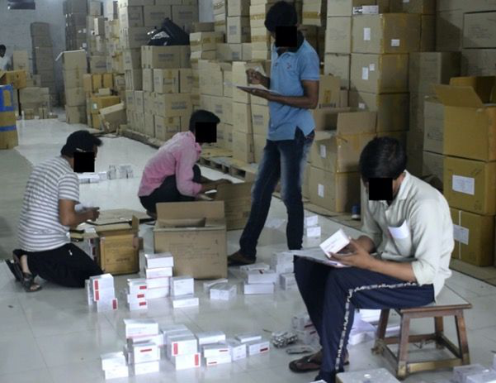
Stage 1: Description of Work and Workstation This stage consisted of obtaining information on the current status of the work pattern, workplace layout, job demands, and work hours as prelimi- nary analysis. Distribution units are responsible for the storage, packing, and distribution of medicines. The job of packing workers or pickers typically includes: picking, checking, packing, and carrying. Pickers lay the goods in specified quantities on the floor and pack them. Packed boxes are moved to be dispatched (Murarka & Chauhan, 2021). Currently, the work is perfor- med on the floor, which requires workers to bend and twist their back and legs several times. As shown in Figure 1, they sit on the floor in a squatting and kneeling position. Stage 2: Designing of Workstation
A workstation was designed to reduce ergonomic risk factors considering:
Ergonomic Intervention in Pharmaceutical Distribution Work 207
Figure 1: Existing workstation.
Work pattern/ job demands of the workers involved in pharmaceutical distribution
Anthropometric principles and measurements of workers
Guidelines for standing work Components of New Workstation
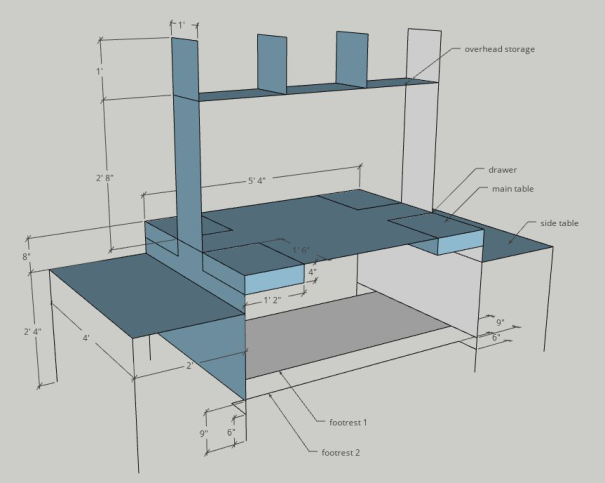
The new workstation design consists of an elevated horizontal platform on which four people can work (Figure 2). The two main components of this workstation are one main table and two side tables. Other appendages in the workstation are four drawers, one overhead storage shelf, one storage cum footrest (footrest 1), and footrest 2.
Advantages of the new workplace over the existing one:
Avoids squatting kneeling on the floor
Avoids back bending and twisting of back and legs in standing or sitting position
Avoids bending to lift the load once
Anthropometric Variables Considered for Designing New Workstation 5th, 95th, or 50th percentile of the below given anthropometric measurements for male population are considered for designing workstation:
1. Eye height 2. Elbow height 3. Arm reach front i. Lower position arm reach length ii. Lower position arm reach height iii. Upper position arm reach length iv. Upper position arm reach height
208 Murarka and Chauhan
Figure 2: Workstation components and measurements.Table 1. Reference table for anthropometric measurements. Source: Chakrabarti, 1997.
Table available in the original PDF paper.
Minimum 5th
95th
Mean 50th Maximum
Anthropometric Variable
percentile percentile
percentile Inch Feet Inch Feet Inch Feet Inch Feet Inch Feet
i. Lower position arm reach length ii. Lower position arm reach height
Table 1 displays all the descriptive and percentile values of the rele- vant anthropometric dimensions that are considered while designing the workstation.
Ergonomic Intervention in Pharmaceutical Distribution Work 209
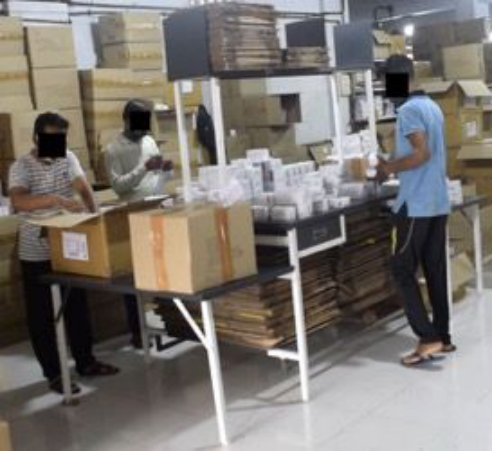
Figure 3: New workstation.
Stage 3: Implementation of Intervention The new workstation was introduced to workers as shown in Figure 3.
RESULTS
Table 2 explains the components, measurement of each component, and the basis (guidelines) for selecting each measurement.
DISCUSSION
18 anthropometric measures, 9 sitting and 9 standing, were collected to design sitting and standing textile workstations (Kalınkara et al., 2011). Anthropometric measurements of workers were used to design work tables and chairs for manual packing to minimize work posture related risks (Rejeki et al., 2020). Work standardization and anthropometric worksta- tion for the manual and mechanical box assembly operators decreased inefficient movements and body postures in operators from 230 to 78 (Realyvásquez-Vargas et al., 2020). The seat height, seat width, seat depth, upper edge of backrest, and worktable height were selected as the target design variables for deriving console specifications suitable for the body size of Korean users (Lee et al., 2020). Using a footrest in the height range of 10–30 cm during standing computer work was suggested to support bet- ter posture (Cregg et al., 2020). Recommended foot clearance space was found to be 150 mm deep, 150 mm high, and 500 mm wide (Konz & Johnson, 2007).
210 Murarka and Chauhan
Table 2. Workstation components, measurements, and rationale for deciding size criteria.
Table available in the original PDF paper.
Component Measurements Feet
Criteria to decide size Rationale (Inch)
Main table Length 5’4" (64")
Equations and mathematical formulas are available in the original paper PDF.
Gives clearance for work to two large size workers working next to each other. Width 4’ (48")
Small size workers can reach without stretching their arms. Also, the allowance for space in the center is there. Height from the floor
3’ (36")
Tall workers can work comfortably. Short workers can use an elevated platform or stool to stand. Side tables Length 2’4" (28”)
The average size of cardboard box is 24”.
Width 4’ (48”) Height from the floor 2’4" (28”)
Avoids working above elbow level. (Chakrabarti, 1997) Drawers with handle
Length 1’2" (14”)
Approximate size Clearance and easy to grab, push and pull Width 1’6" (18”)
Same as above Same as above
Approximate size Clearance and easy to grab, push and pull Depth 4" Approximate size Clearance and easy to grab, push and pull Overhead shelf Length 5’4" (64”)
Width of main table -5th
Width 1’ (12”)
Small size workers can reach without stretching their arms.
percentile of upper front length *2 (from both front and back side) 48”-18” *2 = 12” Anthropometric Criteria: Reach 2’8" (32”)
Height from the main work surface
Short workers can reach without stre- tching their arms. Tall workers get visual clearance.
5th percentile of upper front height and 95th percentile of eye height + 2” for clearance 5th percentile of upper front ht. = 2’6” 95th percentile of eye height = 2’6” 2’6” + 2” = 32” Anthropometric Criteria: Reach and Clearance
Ergonomic Intervention in Pharmaceutical Distribution Work 211
Table 2. Continued.
Table available in the original PDF paper.
Component Measurements Feet
Criteria to decide size Rationale (Inch)
Height of the shelf
1’ (12”)
Size of the folded cardboard boxes
Footrest cum storage shelf
Length 5’4" (64”) Width 2’6" (30”)
9” foot clearance is given from both sides
Height from the floor
9" Foot clearance 9” foot clearance from the floor level Additional footrest
Depth 6” Foot clearance 6” foot clearance from both sides Height from the floor
6” Foot clearance 6” foot clearance from the floor level
CONCLUSION
The ergonomically designed workstation considering anthropometric mea- sures in this study is found to be useful for the pharmaceutical distribution workers by decreasing inefficient movements and awkward postures. The workstation dimensions considered 5th and 95th percentile of the user size, which excludes extreme 5% of the users on the both smaller and larger side. An adjustable workstation can be designed to accommodate the remaining population, but that would be costly. A cost effective and flexible way to cover the shorter users is to provide non-slippery platform to stand.
REFERENCES
Berlin, C., & Adams, C. (2017). Production ergonomics: Designing work system to support optimal human performance. Ubiquity Press. Bridger, R. S. (2018). Introduction to Human Factors and Ergonomics, 4th Edition.
Boca Raton, FL, USA. CRC Press. Chakrabarti, D. (1997). Indian Anthropometric Dimensions for Ergonomic Design Practices. National Institute of Design. Cregg, A., Foley, R., Livingston, L., & La Delfa, N. (2020). A biomechanical eva-
luation of different footrest heights during standing computer work. Ergonomics, 64(3),ErgoPlus. (n.d.) Workplace ergonomics. ErgoPlus. https://ergo-plus.com/wo rkplace-ergonomics/ Haile, E., Taye, B., & Hussen, F. (2012). Ergonomic Workstations and Work- Related Musculoskeletal Disorders in the Clinical Laboratory. Laboratory Medicine, 43(Suppl 2), E11-E19. Hoe, V., Urquhart, D., Kelsall, H., Zamri, E., & Sim, M. (2018). Ergonomic inte-
rventions for preventing work-related musculoskeletal disorders of the upper limb and neck among office workers. Cochrane Database Of Systematic Reviews. https://doi.org/10.1002/14651858.cd008570.pub3
212 Murarka and Chauhan
Kalınkara,V., Çekal,N., Akdogan, I.,& Kacar,N. (2011). Anthropometric measurements related to the workplace design for female workers employed in the textiles sector in Denizli, Turkey. Eurasian Journal Of Anthropology, 2(2), 102–111. In-text: (Lee et al., 2020) Konz, S., & Johnson, S. (2007). Work Design. CRC Press LLC. Lee, J., Cho, N., Yun, M., & Lee, Y. (2020). Data-Driven Design Solution of a
Mismatch Problem between the Specifications of the Multi-Function Console in a Jangbogo Class Submarine and the Anthropometric Dimensions of South Koreans Users. Applied Sciences, 10(1), 415. https://doi.org/10.3390/app10010415 Mulimani, P., Hoe, V., Hayes, M., Idiculla, J., Abas, A., & Karanth, L. (2018).
Ergonomic interventions for preventing musculoskeletal disorders in dental care practitioners. Cochrane Database Of Systematic Reviews, 2018(10). https://doi. org/10.1002/14651858.cd011261.pub2 Murarka, P., & Chauhan, M. (2022). Relationship of Pain in the Lower Back and Knee with Gender, Age, and BMI of the Pharmaceutical Supply Chain Workers. Technology Enabled Ergonomic Design, Design Science and Innovation. Select Proceedings of HWWE 2020. 459–467. https://doi.org/10. 1007/978-981-16- 6982-8_41 Murarka, P., & Chauhan, M. (2021). Assessment of work posture of CFA wor-
kers and designing a new workstation. AHFE 2021, LNNS 260, pp. 108–115. https://doi.org/10.1007/978-3-030-80829-7_14 Openshaw, S., & Taylor, E. (2006). Ergonomics and Design A Reference Guide.
Allsteel. Pheasant, S. (2006). Bodyspace: Anthropometry, Ergonomics And The Design Of Work; Ed. By Christine M. Haslegrave. Taylor & Francis. Realyvásquez-Vargas, A., Arredondo-Soto, K., Blanco-Fernandez, J., Sandoval-
Quintanilla, J., Jiménez-Macías, E., & García-Alcaraz, J. (2020). Work Stan- dardization and Anthropometric Workstation Design as an Integrated Approach to Sustainable Workplaces in the Manufacturing Industry. Sustainability, 12(9), 3728. https://doi.org/10.3390/su12093728 Rejeki, Y., Achiraeniwati, E., As’ad, N., & Hadiid, N. (2020). The design of manual packaging work station based on workers’ dimension in beverage indu- stry. IOP Conference Series: Materials Science And Engineering, 830, 042014. https://doi.org/10.1088/1757-899x/830/4/042014 Singleton, W. T. (1964). A Preliminary Study of a Capstan Lathe. International
Journal of Production Research, 3(3): 213. Taifa, I., & Desai, D. (2017). Anthropometric measurements for ergonomic design of students’ furniture in India. Engineering Science And Technology, An International Journal, 20(1), 232–239. https://doi.org/10.1016/j.jestch.2016.08.004 Working in a Standing Position : OSH Answers. Ccohs.ca. Retrieved 17 July 2021,
from https://www.ccohs.ca/oshanswers/ergonomics/standing/. 342–353. https:// doi.org/10.1080/00140139.2020.1832261
LISTED IN THE AHFE DIGITAL BOOKSTORE CATALOGUE
Explore the complete digital volume
Social and Occupational Ergonomics
Read this individual research paper free through the original publisher, or explore the full digital proceedings book.
ISBN 978-1-958651-41-4
Explore this ISBN in the AHFE Bookstore ↗Listed in the July 2026 bookstore catalogue; search by ISBN to confirm current availability · Digital book purchase optional