Dongbin Tobin Cho, Jongwoo Jung, Insik Myung, Hyewon Lee, Patrick W. Jordan (2021). How to Design Great Emotional Experience for Mobile User Interface?. In: Advances in Affective and Pleasurable Design. AHFE Open Access, vol. 14. https://doi.org/10.54941/ahfe100585
SAMSUNG ELECTRONICS Co., Ltd., 11, Seocho-daero 74-gil, Seocho-gu, Seoul 137-965, Korea b Royal Society of Medicine, Candlesby House, Butleigh, Somerset BA6 8TH, UK ↗
Emotion is easily recognized but difficult to define. For example, emotion has been a famous topic for a long time in user experience (UX) design. However, it has been a question of long standing how to systematically evaluate and design emotion, while maintaining qualitative aspects of emotion (e.g., not-measurable aspects). We developed the systematic tool for emotional UX design, while leaving some room for designer’s creativity. To develop the tool, participants performed various tasks using smartphone, generating both positive and negative emotions. Once people’s emotions were identified, ideal emotional journey, consisting emotional solutions, were created. In order to create ideal emotions, general design principles were proposed. Finally, more specific UX solutions were developed based on general design principles. Some of our UX solutions were applied to design new messenger for smartphone, emotionally augmenting communicating experiences.
Emotions are a combination of mental and physical states. The mental side of emotion involves a psychological judgment about an experience, while the physical side comes from physiological reactions in the body caused in part by these psychological judgments and in part because of subconscious physiological reactions (Carlson and Hatfield, 1992).
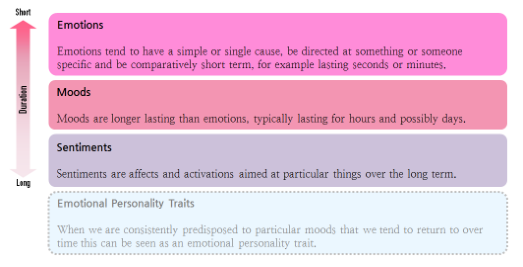
Emotions are not the only states that involve affect and activation. Desmet (2002) identified four other types. The states are differentiated from each other based on the length of time for which the affect and activation are experienced, on the complexity of the causes and whether they are directed at a specific situation or felt more generally. Emotions are compared and contrasted with the other four states, which are moods, sentiments, and personal traits (see Figure 1).
Emotions tend to have a simple or single cause, be directed at something or someone specific and be comparatively short term, for example lasting seconds or minutes. For example, being annoyed with a friend because they were late for a meeting would be an example of an emotion.
Moods are longer lasting than emotions, typically lasting for hours and possibly days. They often have combined causes and are felt generally rather than being directed only at the things that caused them. For instance, if our alarm clock does not go off we are late getting up, then our partner is rude to us and then we get stuck in traffic we may be in a bad mood by the time we arrive at work.
Sentiments are affects and activations aimed at particular things over the long term. They reflect our likes, dislikes, attitudes and standards. While they are likely to influence our emotions, they are not the same thing. For example, someone might have the sentiment of being scared of snakes but will not actually feel the emotion of fear unless they see a snake (Frijda, 1994).
When we are consistently predisposed to particular moods that we tend to return to over time this can be seen as an emotional personality trait. For example, if someone tends to be in a cheerful mood a lot we might characterize them as a cheerful person, while if someone is often in an angry mood we might describe them as an angry person.
Figure 1. What emotions are and are not This paper mainly involves the study on the emotional experiences (less on the moods, sentiments, or emotional personality traits), which tend to have simple or single cause of using smartphones. For instance, user might be emotionally satisfied because of clear feedback from the interface.
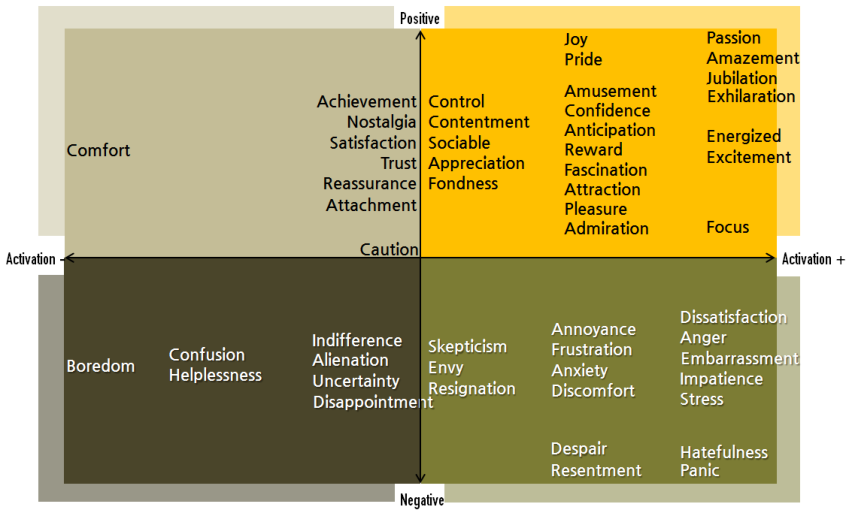
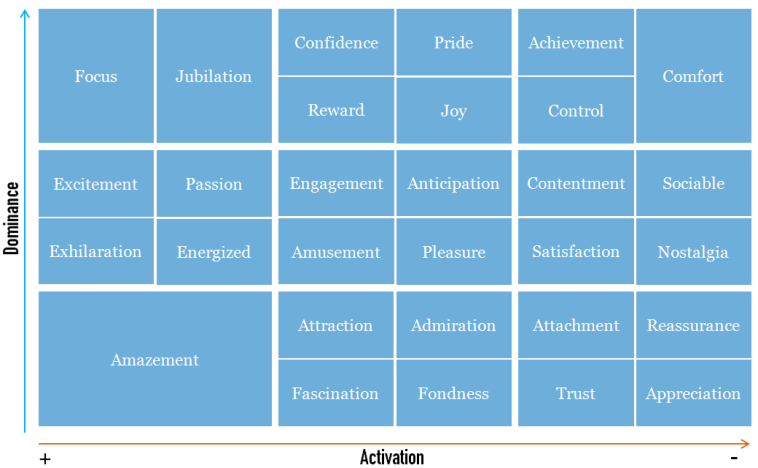
Dimensions of Emotions Two basic dimensions of emotions are affect and activation. Nearly all models of emotion include these dimensions (e.g., Bales, 2001; Desmet, 2002; Mehrabian, 1981; Russell, 1980; Van Gorp, 2006). Affect, or positivity, refers to whether the emotion is positive or negative. Examples of emotions with positive affect are: excitement, happiness and being relaxed; examples of emotions with negative affect are irritation, disappointment and boredom. Some emotions are neutral in affect (neither positive nor negative). Examples of these include caution and focus. Activation refers to how much energy or stimulation the emotion causes. For example, excitement and focus have quite high levels of activation, caution has a neutral level and relaxation and boredom low levels. One extra dimension that has been proposed is dominance (Mehrabian, 1980). This three dimensional model includes this in addition to affect and activation – they refer to these as ‘pleasure’ and ‘arousal’ and call their model the Pleasure, Arousal, Dominance (PAD) Model. For example, fear and anger are both emotions that are negative in affect and high in activation, but they are different in terms of dominance. Fear is an emotion resulting from a low dominance and a sense of not being in control or having any power, whereas anger is experienced when the person feels more dominant and powerful. (see Figure 4 for affect and activation, and Figure 5 for activation and dominance). These three dimensions were used to select final lists of 30 postive and 24 negative distinct emotions among many other similar emotions (see also RESULTS for developing emotion sets).
Our Design Approach to Apply Emotion In order to optimize people’s user experience with products it is important to ensure that they are not only useful and usable but also that they are emotionally engaging. Our emotions influence how we plan to use a product, how we interact with it and our perceptions surrounding the product before, during and after use (Forlizzi and Battarbee, 2004).
Aside from strategic factors such as pricing, advertising and retail channels, emotional reactions to a product are probably the single biggest factor affecting its success in the marketplace (Van Gorp and Adams, 2012). Likewise, emotion has been important and well-known topic for a long time in user experience (UX) design. However, it has been a question how to systematically design the emotion, while maintaining qualitative aspects of emotion such as designer’s creativity and flexibility.
Therefore, the main aim of the project was to create both systematic and flexible tools for emotional UX design and to show how this tool can be applied to mobile interface such as gallery and messenger. To achieve our goal, we followed several steps;
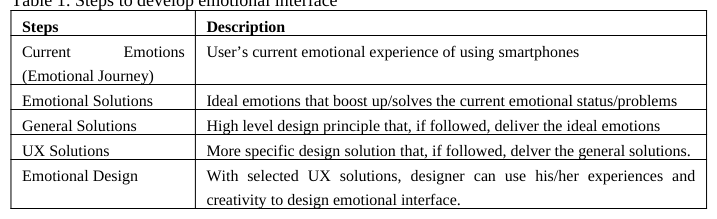
1. Identified emotions associated with smartphone use 2. Converted current emotions to ideal emotions 3. Delivered positive emotional experience using general solutions. 4. Delivered general solution using more specific UX design solution 5. Applied UX solutions to mobile interface with designer’s creativity and flexibility (see Table 1).
Table 1: Steps to develop emotional interface Steps Description
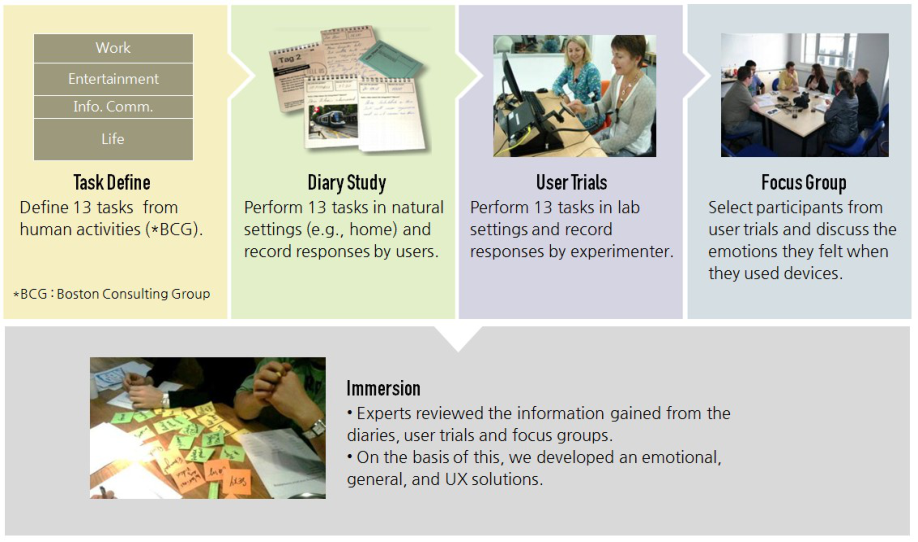
METHOD Three empirical studies (user diaries, user trials, focus groups), plus a workshop and a subsequent series of work- sessions were carried out (immersion stage) (see Figure 2).
Figure 2. Overall research procedures
32 participants took part in the studies: 16 users of Android smartphones, 8 users iOS smartphones (Apple iPhone), and 8 users of other smartphones (Blackberry and Nokia). The participants were evenly balanced for age and gender and were also evenly distributed according to age and socioeconomic status. All participants took part in both the diary studies and the user trials, with 18—6 of each type of OS users—taking part in the focus groups.
User Diary Study In user diary study, participants were asked to complete a series of smartphone tasks over the course of a week. They were asked to complete each task twice, once in the first half of the week and once in the second half. The task set included 13 tasks, such as make a telephone call, add someone’s contact details to the phone, and send a text by SMS or Instant Messenger, and etc. (see Table 2, for complete task lists). They completed the task ‘naturally’ (e.g., at home) as part of their smartphone usage, they were simply asked to record their experience of this (see Table 3, for complete questions)
Table 2. Task set during diary study & user trials
Table available in the original PDF paper.
Table 3. Items that participants were asked during diary study
Table available in the original PDF paper.
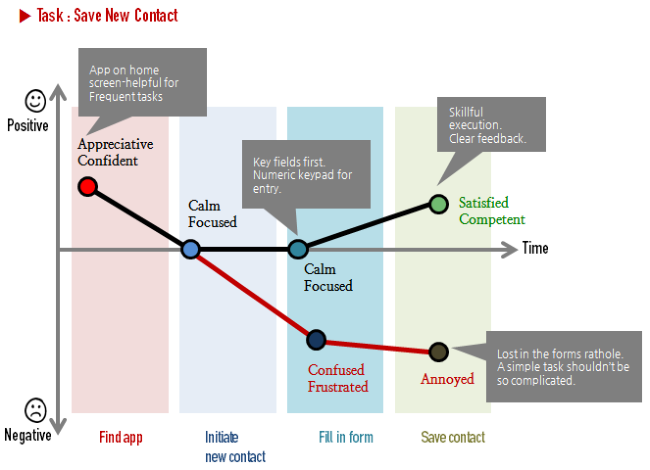
User Trials In user trials, participants attended a usability lab in order to use a smartphone—the Samsung Galaxy S3—under controlled condition. They were given a selection of tasks from the same 13 that were done in the diary study (see Table 2). The order in which they were asked to do these was randomized and the number of tasks they did was dependent on how quickly they managed to complete them. The session lasted for 90 minutes. Users completed each task that they were set in silence, but were videoed as they did it. The video was then played back to them and they were asked to comment on how they were feeling at each stage of task, which technique is known as retrospective protocol. It has the advantage of enabling participants to complete the tasks without the intrusion of having to verbalize their emotions at the time and removes the risk that the effort of having to do this would make the tasks harder. Experimenter recorded the reactions such as participants’ positive and negative emotions as they went through the tasks (see Figure 3, for example). At the end of the trials participants were asked to provide more opinions about the best and worst aspects of the smartphone and the tasks that they found most and least enjoyable (see Table 4).
Table 4. Information recorded during the user trials
Table available in the original PDF paper.
Figure 3. Example of user’s emotional journey (task: add someone’s contact details to the phone) Focus Groups
The focus groups were held involving 18 of the 32 people who had already participated in the diary and user trials studies. Each group contained six people who all used the same category of operating system (i.e., Android, iOS or ‘other’). Each group started with participants discussing the emotions associated with their favorite products. This was to give us an insight into whether there might be additional positive emotions that can be experienced in product use outside of those associated with smartphones. In the analysis this could be used as a check on the generalizability of the study outcomes to other product areas. They then discussed the emotions they felt when using their own smartphones and the Samsung Galaxy S3 that they had used in the user trials. They also discussed characteristics of the phones that were associated with these emotions. After the discussions, participants were asked to record their own views with respect to each of the issues discussed (see Table 5)
Table 5. Information recorded during the focus groups
Table available in the original PDF paper.
Immersion In immersion stage, after completion of the empirical studies, some of the expert used the Samsung Galaxy S3 for a period of three weeks and reviewed the information gained from diary study, user trials, and focus groups. The aim was to give the project team real-life experience of using the smartphones which would generate insights to inform the analysis of the current emotions, the emotional solutions, general solutions, and UX solutions. An initial workshop, including the whole of the core project team, reviewed the information gained from the diaries, user trials, and focus groups and, on the basis of this, made an initial pass at identifying emotional and general solutions. In a series of subsequent work-sessions, the experts developed these further, to move towards the final set of emotional, general, UX solutions, and the relationships between UX and general solutions and between general and emotional solutions.
RESULTS
Emotion Sets Based on the empirical tests and experts’ insight, 30 emotional solutions, 14 general solutions, and 23 UX solutions were developed. The emotion sets were produced in three stages. First, we listed all the separate emotional descriptors in users’ responses across the user diaries, user trials, and focus groups. This meant including all the emotions described at any stage during a task or when reflecting on a product. Second, we judged that some of the items that participants listed were not actually emotions. For example if, when asked about their emotions, someone had put ‘phone looks good’ or ‘difficult to use’ we would remove these items as they do not describe how the person is feeling, but rather are their assessments of the phone. After the first two stages, we found 67 of negative emotions and 87 of positive emotions. Third, experts grouped items together in instances where, in the context of product use, we judged them to be essentially the same. For example, although amazement and admiration have qualitative similarities—they are both about being impressed with the product—amazement is significantly greater than admiration in terms of positivity and activation and is lower on dominance (see Figure 5). Similarly, although anger and annoyance are both about the perception that some aspect of a product is unacceptably poor, anger is significantly greater in terms of negativity, activation and dominance. This led to our final lists of 24 distinct negative emotions and 30 distinct positive emotions (see Figure 4).
Figure 4. Emotions on activation and affect (positivity) dimensions Emotional solutions are particular positive emotions that we aim to elicit in order to help improve user experience during an emotional journey with a product. And the set of potential emotional solutions for smartphones is the same as the set of positive emotions that we identified during the studies (see Figure 5).Figure 5. Emotional solutions (positive emotions) on activation and dominance dimensions General Solutions
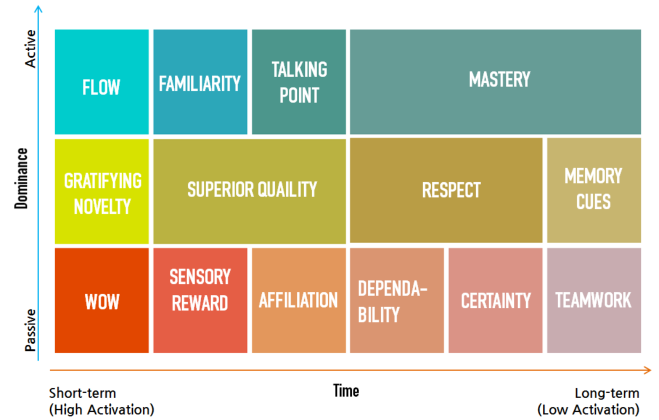
General solutions are high-level design principles for delivering the emotional solutions. They were based on linking the positive and negative emotions that had occurred in the studies to qualities and behaviors of the product and then generalizing from these to form the general solutions. In total there are 14 general solutions. Between them they can deliver all of the proposed emotional solutions as well as eliminating all of the potential negative emotions. They are listed in Table 6 with their subcomponents. To understand better with emotions, they are also plotted in the same dimension as emotions. For example, general solution of FLOW can give people feeling focused (compare
Figure 6 with Figure 5).
Table 6. Lists of general solutions and their subcomponents
Table available in the original PDF paper.
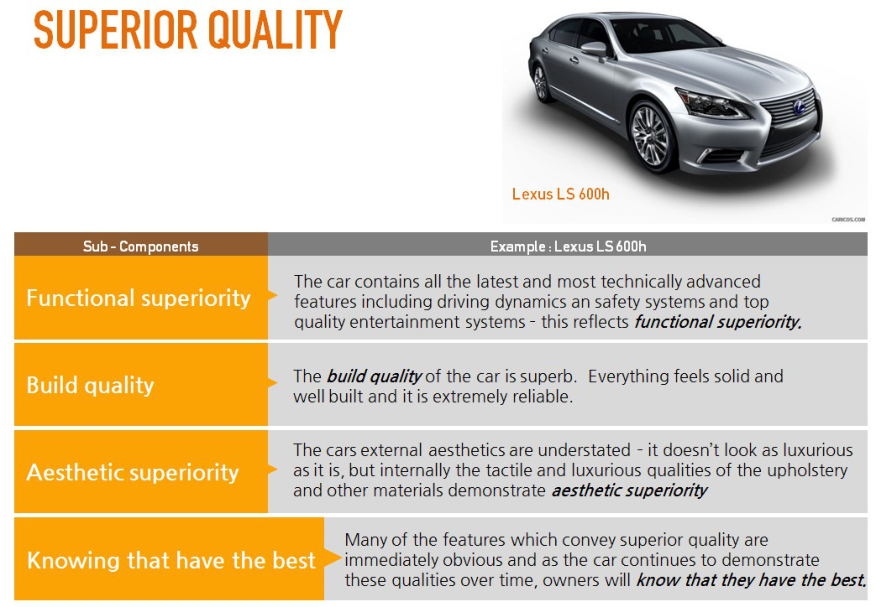
Figure 6. General solutions plotted on emotional dimensions (compare with Figure 5; e.g., FLOW gives feeling of focus) One of our general solutions is SUPERIOR QUALITY, which has several subcomponents. Since it is a general principle, it applies to both IT and non IT product, such as Lexus (see Figure 7). And the general solutions will form the basis for developing more specific UX solutions.Figure 7. An example of general solution, SUPERIOR QUALITY UX Solution
UX solutions represent design directions that embody principles behind a general solution. Based on general solutions, we developed 23 UX solutions which categorizes into ten groups (see Table 7).
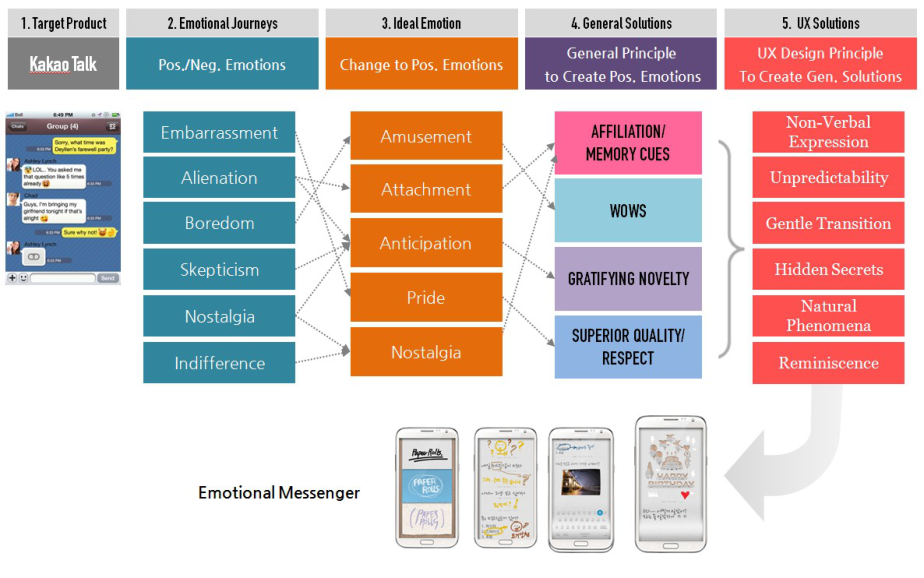
In sum, based on ideal emotions, general solutions were developed. And based on general solutions, UX solutions were developed. As shown in Figure 9 it describes the links between the UX solutions, general solutions, and the emotions experienced, showing systematically how UX solutions can enable the positive emotions and eliminate the negative.
Table 7. Lists of UX solutions and their general solution link
Table available in the original PDF paper.
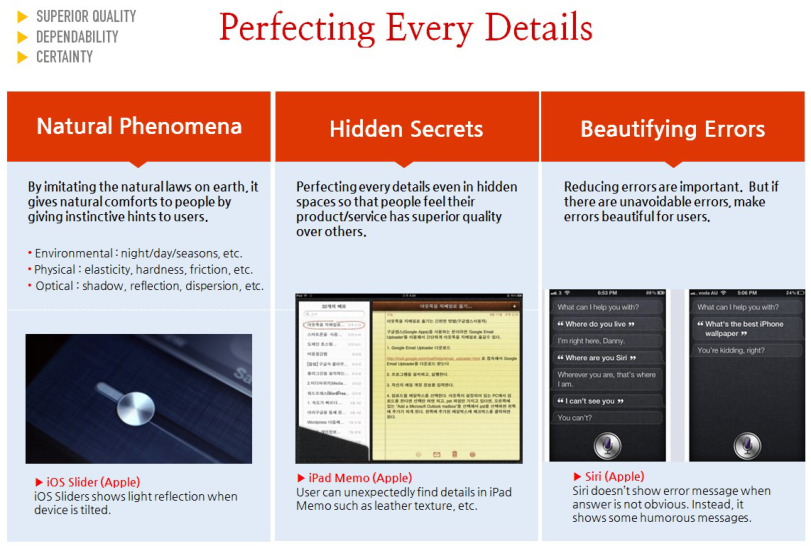
For example, one of our UX solution group is Perfecting Every Details, which has UX solutions of Natural Phenomena, Hidden Secrets and Beautifying Errors. These UX Solutions were developed from general solutions of SUPERIOR QUALITY, DEPENDABILITY, and CERTAINTY (see Figure 8).
Figure 8. Example of UX solutions which are based on general solution of SUPERIOR QUALITY (compare with Figure 7)
Messenger Design Example It is possible to apply emotional solutions, general solutions, and UX solutions to communication apps, such as messenger. As shown in Figure 9, for example, to develop “emotional messenger” for smartphone, we need to identify the emotions that user experience when using existing messenger (e.g., embarrassment, alienation, boredom, skepticism, nostalgia, indifference, etc., see Table 8).
Table 8. Possible reasons for current emotions toward existing messenger
Table available in the original PDF paper.
When current emotions are identified, ideal emotions are selected, which are already linked with negative or positive emotions (e.g. embarrassment[Equation or mathematical symbol available in the original paper PDF]pride, skepticism[Equation or mathematical symbol available in the original paper PDF]anticipation). Then certain general solutions are selected to deliver the emotional solutions (e.g., general solution of SUPERIOR QUALITY gives feeling of pride; general solution of GRATIFYING NOVELTY gives feeling of anticipation). Finally, sets of UX solutions can be selected to deliver the general solution (e.g., UX solution of Natural Phenomena can generate the feeling of SUPERIOR QUALITY; UX solution of Unpredictability can generate GRATIFYING NOVELTY). When UX solutions of Natural Phenomena and Unpredictability are selected for new messenger design, designers can use their own creativity and experiences based on the suggested UX solutions. For instance, by using UX solution of Natural Phenomena, the space where communication is occurring can be transformed into real paper (e.g., real paper has natural quality of ink spreading, folding, air buffer, resilience, etc.). The resilient nature of paper sometimes creates pleasant Unpredictability for users such as applying pop-up-card effect to the messenger.
Figure 9. Possible steps to develop “emotional messenger”
CONCLUSION The main aim of this paper was to deliver a set of design process and principles for delivering a positive emotional experience with product and services. It also describes the systematic links between solutions and the emotions experienced, while maximizing designer’s creativity, flexibility, and previous experiences. Some of our concept design and prototypes were submitted as Grade-A patents, receiving certification of originality and creativity. Moreover, one of patents was directly applied to “Pen Window,” Samsung Galaxy Note 3. All of our outcomes were transferred to Mobile Communication Division, Samsung Electronics, which implies that our outcomes have great impact on mobile product.
REFERENCES Bales, R. F. (2001). “Social Interaction Systems: Theory and Measurement”, Transaction Publishers. Carlson, J. G., & Hatifield, E. (1992). “Psychology of Emotion”, Harcourt, Brace, Jovanovich. Desmet, P. R. (2002). “Designing Emotions”, Delft University of Technology, Department of Industrial Design. Forlizzi, J. & Battarbee, K. Understanding experience in interactive systems. Human-Computer Interaction Institute. Paper 46.
http://repository.cmu.edu/hcii/46. Frijda, N. H. (1994). Varieties of affect: Emotions and episodes, moods and sentiments. In Ekam, P. and Davidson, R. J.(eds), “The Nature of Emotion, Fundamental Questions”, Oxford University Press. Mehrabian, A. (1980). “Basic Dimensions for a General Psychological Theory of Emotion”, Wadsworth Publishing Company. Mehrabian, A. (1981). “Silent Messages: Implicit Communication of Emotions and Attitudes”, Wadsworth Publishing Company. Russell, J.A. (1980). A circumplex model of affect. Journal of Personality and Social Psychology, 39, 1168-1178. Van Gorp, T. J. (2006). “Emotion, Arousal, Attention and Flow: Chaining Emotional States to Improve Human-Computer
Interaction”, University of Calgary Master’s Degree Project. Van Gorp, T. & Adams, E. (2012). “Design for Emotion”, Morgan Kaufmann; Elsevier Science.
LISTED IN THE AHFE DIGITAL BOOKSTORE CATALOGUE
Explore the complete digital volume
Advances in Affective and Pleasurable Design
Read this individual research paper free through the original publisher, or explore the full digital proceedings book.
ISBN 978-1-4951-2109-8
Explore this ISBN in the AHFE Bookstore ↗Listed in the July 2026 bookstore catalogue; search by ISBN to confirm current availability · Digital book purchase optional