Joanna Bartnicka (2020). E-learning Methods in the Knowledge Transfer Between Surgical Tools Manufacturers and Hospital. A Case Study from Laparoscopy. In: Advances in Science, Technology, Higher Education and Society in the Conceptual Age: STHESCA. AHFE Open Access, vol. 10. https://doi.org/10.54941/ahfe100389
Institute of Production Engineering, Faculty of Management and Organization, Silesian University of Technology, Zabrze, 26-28 Roosevelta, 41-800, Poland ↗
Laparoscopy is one of the rapidly developing domains in surgery. Together with this development it can be observed the systematic growth of tools and equipment complexity as well as changes in surgical procedures and the modes of using surgical instruments. Particularly the development and complexity of surgical tools is related to their shape, fields of using them, tendency to integration functions of several tools and creating multifunctional tools. Such direction of surgical tools development is positive, especially for patients, because of better efficiency and effectiveness of surgery or lower risk of infections, but it could cause certain problems for medical staff both for surgeons and scrub nurses. These problems concern (1) ergonomic failures what `can be lead to fatigue or even musculoskeletal disorders of surgeons and (2) knowledge advantage for medical staff who have to absorb difficult and multidisciplinary knowledge of how to use the surgical laparoscopic instruments in proper and efficiently way.The reason of mentioned problems are on the one hand the gaps in ergonomic knowledge among designers and manufacturers, on the other hand the poor knowledge transfer between manufacturers and end-users in hospitals.Taking into account these problematic aspect of designing and using laparoscopic tools, the solutions based on e-learning methods for better communication and knowledge transfer between manufacturers and hospitals are proposed and described on the example of case study. Particularly e-learning methods enable understanding the ergonomic needs and the expectations of end-users as well as are the opportunity to include surgeons in tools designing process.
Surgical instrument manufacturing develops together with the progress of up-to-date surgical techniques. In this range one of the most dynamic area is minimally invasive surgery (MIS), to which laparoscopy is included.
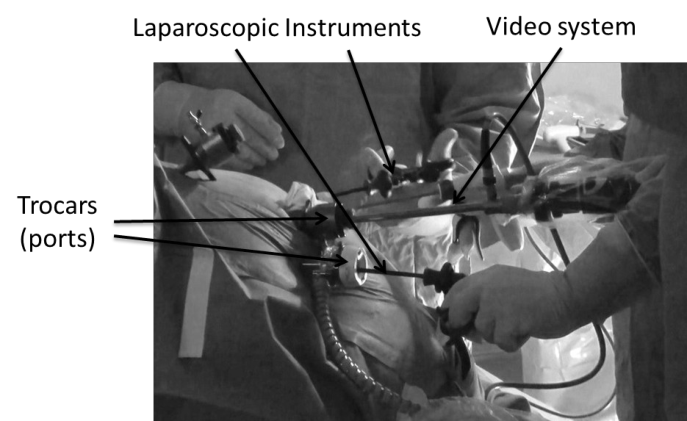
Laparoscopy is used to examine the interior of the abdominal or pelvic cavities for diagnosis and treatment different kind of diseases. The most common laparoscopic surgeries are: cholecystectomy, appendectomy, nissen fundoplication, obturator hernia or bariatric surgeries. The laparoscopic technique requires a few small skin incisions (the number depends on the type of surgery and laparoscopic method) through which are inserted the slender tube with a video system, which transmits image of operative field on the monitor, and different kind of laparoscopic tools. The tools are long and narrow, and have small jaws that allow for the introduction of them through narrow ports (trocars) embedded into incisions and use according to certain laparoscopic procedure. The Figure 1 presents the example of common surgical tools used during laparoscopic surgeries.
Figure 1. The sample of laparoscopic tools using during cholecystectomy (own elaboration, photo: A. Ziętkiewicz)
Because of the fact that the whole surgery is performed by the limited maneuvering ability of surgeons, the important role is played by multifunctional surgical instruments. Such approach to the accomplishment of surgical tasks is on the one hand positive because of profits for patients. Among them are [Trejo et al. 2007; Trejo et al. 2006]: [Equation or mathematical symbol available in the original paper PDF] reduced post-operative complications, such as fever or infection, [Equation or mathematical symbol available in the original paper PDF] less pain, [Equation or mathematical symbol available in the original paper PDF] shortness hospitalization, [Equation or mathematical symbol available in the original paper PDF] faster recovery time, [Equation or mathematical symbol available in the original paper PDF] faster and less problematic healing of surgical wounds, better cosmetic results.
On the other hand, using laparoscopic instruments brings certain negative consequences. The increased technological complexity of instruments and sometimes poorly adapted equipment for the laparoscopic theatre environment encouraged surgeons to adopt incorrect posture and consequently suffering from physical and mental burdens [Gofrit et al., 2008].The inadequate instruments grip design and other aspects of instruments construction like stiffness, shape, length etc. as well as the way of using them determine the unusual positions of arms, hands and fingers. There are available different types of handles for use in minimally invasive surgery indeed. However, the principle of using them is similar, based on the positioning tools maneuvering hands and fingers which may lead to the local pressure and the injuries or nerve irritation [Cutner et al., 2013; Matern et al., 1999]. There was noticed a problem of adverse effects of using surgical instruments like: direct tissue damage, malfunction related damage such as critical bleeding, and retained pieces of broken instruments [Yasuhara et al., 2012]. Apart from physical discomfort, using laparoscopic instruments causes mental burden by surgeons. The technical complexity of instruments makes the laparoscopic procedures more complicated and requires the necessity of keeping intensified concentration during whole surgery, leading to the severity of pain complaints and fatigue [Berguer et al., 2003;
Berguer et al., 1999; Berguer et al., 2001].
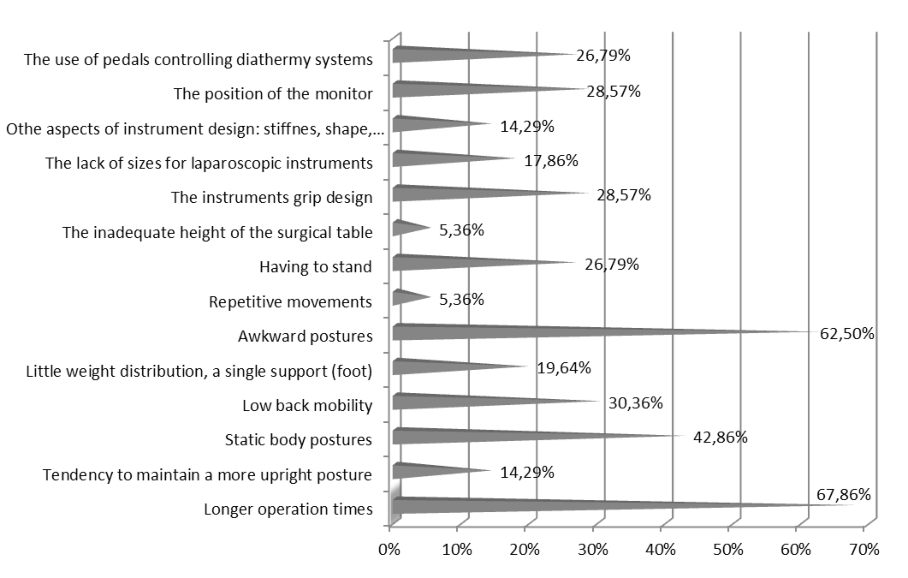
There were indicated the problems of using laparoscopic instruments among polish surgeons in frame of the international project titled “Online Vocational Training course on laparoscopy's ergonomics for surgeons and laparoscopic instruments' designers” within the Lifelong Learning Programme: Leonardo da Vinci Multilaternal Projects for Development of Innovation, Agreement number: 2012-3649/001-001, financed by National Agency for Lifelong Learning Programme Organismo Autónomo Programas Educativos Europeos (OAPEE). According to the survey conducted within 56 surgeons from 6 hospitals, the most important effects of using unergonomic instruments are numbness in the fingers and loss sensitivity as well as fatigue in the muscles of the back, neck and shoulders. The surgeons emphasized the factors which can cause physical discomfort. They are awkward postures, the instrument grip design or the lack of sizes for laparoscopic instruments. The Figure 2 presents the surgeons answers the question about the factors which causes the major physical discomfort.
Figure 2. The factors resulting the major physical discomfort according to polish surgeons (own elaboration based on the questionnaire developing in frame of international project titled “Online Vocational Training course on laparoscopy's ergonomics for surgeons and laparoscopic instruments' designers”
Taking into account the above description, in this paper the discussion about the problem of what is the reason of ergonomic failure and how to improve the ergonomics in laparoscopic instruments is presented. The background of the considerations will be the knowledge transfer between manufacturers - treated as the entity responsible for instruments designing - and hospitals as representatives of surgeons who are the direct recipients and end-users of laparoscopic tools. There is proposed the way of improving the knowledge transfer based on e-trainings for designers and surgeons.
THE ROLE OF KNOWLEDGE TRANSFER IN ERGONOMIC DESIGN OF SURGICAL TOOLS The knowledge transfer is defined as a process by which knowledge is transmitted to, and absorbed by, a user
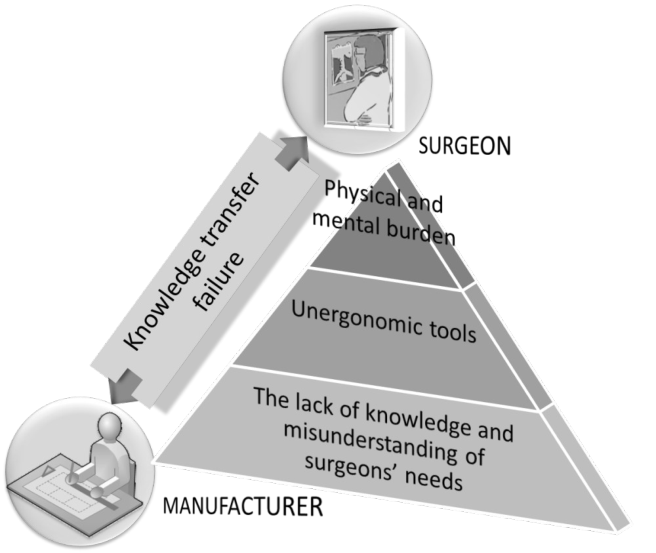
[Garavelli et al., 2002]. The attribute, by which knowledge cannot be transferred is communication [Spring Schomaker and Zaheer, 2014]. It should be emphasized that apart from the communication and consequently the information exchange, the most important aspect of successful knowledge transfer is knowledge identification and assimilation [Cohen and Levinthal, 1990]. These characteristics allow for proper knowledge interpretation and hence for meeting its essential function which is an effective knowledge using in certain task and context. Because of the fact that knowledge is socially embedded and highly context-specific, the transfer of it could be difficult [Nonaka and Nishiguchi, 2001]. Specifically these difficulties are strong related to the lack of mutual understanding of the sender and receiver coming from different professional backgrounds and hence with different professional experiences, competences, aspirations, goals and even personal and organizational culture. Based on this, the reason of the mentioned negative consequences of using laparoscopic tools can be considered on the background of the “pyramid of causes” presented in the Figure 3, where the main pivot of the pyramid is knowledge transfer failure in the area of ergonomics.
The pyramid and its analysis was created based on the interviews with the manufactures (n=2), sales representatives of surgical instruments (n=2) and with hospitals representatives (n=2): head of the general surgery department, head of scrub nurses; as well as free interviews conducted with sales representatives participated as exhibitors in two video-surgery conferences in Poland (IX Conference “Advanced laparoscopic surgeries”, 2013 June 5-7 Torun; 13th Sympozium of Miniinvasive Surgery, 2013 October 14-15 Istebna).
Figure 3. The pyramid of causes (own elaboration)
The base of the pyramid is the lack of knowledge and misunderstanding the ergonomic needs of surgeons by manufacturers. The manufacturers focus rather on technical and financial aspects during surgical tools designing process then on ergonomic needs of future users. Despite the fact that on both sides (manufacturers and surgeons) there is the willingness to make improvements to existing products and the manufacturers establish permanent cooperation with hospital units or individual doctors creating informal research and development departments, the common activities are usually not oriented on ergonomic issues but on improving the tools in terms of their clinical functionality.
The reason of missing the ergonomic approach to surgical tools designing within the knowledge transfer is first of Technology, Higher Education and Society (2020) all the lack of knowledge in the area of ergonomics and the lack of ergonomic awareness on both sides: manufacturers and surgeons. This fact leads to the second level of the pyramid which is unergonomic laparoscopic tools and consequently to physical and mental burden of laparoscopic surgeons.
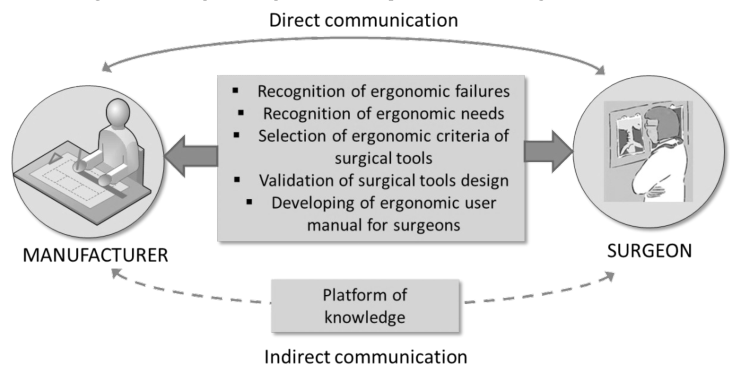
Taking into account the above descripted considerations about physical and mental burdens of surgeons caused by maladjusted laparoscopic tools, it is proposed to enhance the role of knowledge transfer between manufacturers and surgeons in certain domain which is ergonomics. The detailed areas of knowledge transfer subjects in the context of knowledge transfer in ergonomic design of surgical tools are presented in the Figure 4.
Figure 4. The subjects of knowledge transfer between manufacturer and surgeon for designing process of surgical tools (own elaboration)
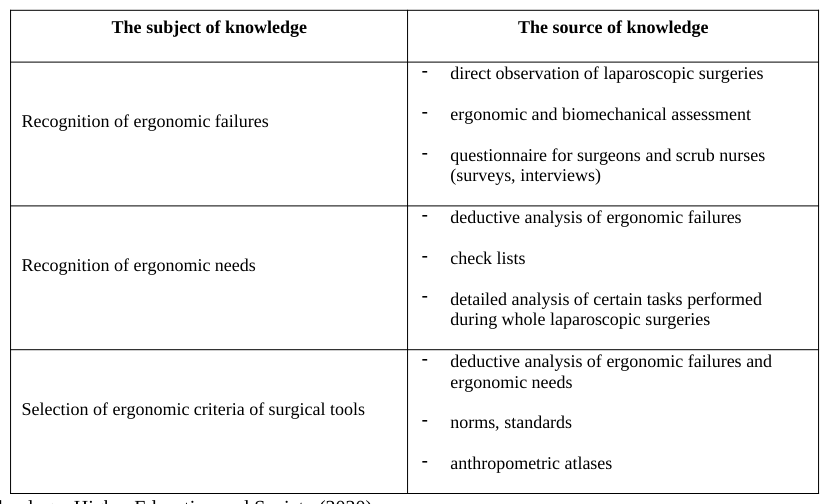
Taking into account the attribute of knowledge transfer which is knowledge identification there is presented the knowledge sources for all of the subjects in Table 1.
Table 1: Knowledge sources in improving knowledge transfer between manufacturer and surgeon for surgical tools designing process (own elaboration)
Information about the subjects which are derived from hospital within the tools design process means that surgeons are included with the process and that the process is based on participatory approach. This approach is relevant new in technical science and emphasizes the importance of collaborative “designing of products, services, spaces, or systems that includes the range of stakeholders. Practitioners of participatory design believe that an approach based on collaboration between producers, designers, and end-users will inherently lead to results that are more effective, more appropriate, and more desirable” [Erlhoff and Marshall, 2008]. As far as surgical tools design is concerned the participation can be realized by two types of knowledge transfer:
1) directly transfer of knowledge where the communication is based on direct relationships between manufacturer and surgeon realized by meetings, expert panels, participation of manufacturer as an observer in surgical procedures etc.,
2) indirectly transfer of knowledge, where the communication is based on additional channels between manufacturer and surgeon an example of which is e-platform of knowledge.
The first type highlights the role of manufacturers who acquire the knowledge about mentioned subjects based on sources indicated in Table 1 by themselves.
The second type takes into account the additional element between manufacturers and surgeons and provides certain, pre-defined knowledge which is disseminated by widespread media like Internet. This kind of knowledge transfer is particularly important when there are barriers like spatial barrier or language barrier etc. making the direct transfer difficult or impossible.
The two approaches to knowledge transfer, however, require the certain skills and competencies from the area of ergonomics by both manufacturers and surgeons. It is the condition for achieving a consensus between them giving simultaneously a sense of fulfillment of expectations by each side of knowledge transfer.
Meeting the concept of improving knowledge transfer in ergonomics-based design process there is proposed to build an e-learning platform for both manufacturers and surgeons which includes the identified subjects of knowledge.
A CASE STUDY OF USING E-LEARNING FOR IMPROVING KNOWLEDGE TRANSFER IN ERGONOMICS-BASED DESIGN OF LAPAROSCOPIC TOOLS E-learning has become very popular in nowadays education as an alternative to traditional training methods. The term e-learning was developed in 1998 by Jay Cross, the founder of the Internet Time Group [Matei and Vrabie, 2013]. The popularity of e-learning is related to the opportunity for reaching certain knowledge independently of student location and learning time. There are two different kind of e-learning methods [Matei and Vrabie, 2013]: e- learning based on CD (without online access to learning platform) and online e-learning based on networks, which is more popular. The new web technologies makes the e-learning methods more flexibility and adjusted to the needs of students. For example online learning in virtual learning environments has grown in recent years [Xu et al., 2014]. The idea of this learning technology is to personalize the learning materials according to the individual predispositions, learning styles or cognitive capabilities of particular student or group of students.
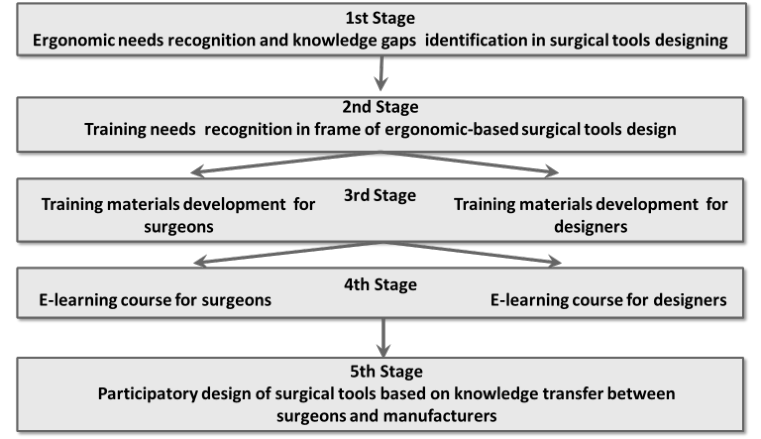
Taking into account the objectives of the article it can be stated that the knowledge transfer between manufacturers and surgeon is proposed to be improved based on e-learning system adjusted to the individual needs of certain groups of professionals (which are described in previous points). The path of improving knowledge transfer based on e-learning technology (Figure 5) is developed taking into account the recognized subjects and knowledge sources (see Table 1).
Figure 5. The path of improving knowledge transfer between surgeons and designers based on e-learning technology (own elaboration)
The first stage of the path, the outcome of which is partly described in previous part of the article, can be the basis for preparation of diagnosing surveys for surgeons and designers in range of the training individual preferences. In this case the questions were located in such areas as: [Equation or mathematical symbol available in the original paper PDF] expected technical features of e-learning course, like proportion between theoretical and practical issues of training content or duration of the course, [Equation or mathematical symbol available in the original paper PDF] the motivations to take e-learning course, [Equation or mathematical symbol available in the original paper PDF] training requirements particularly important for future student.
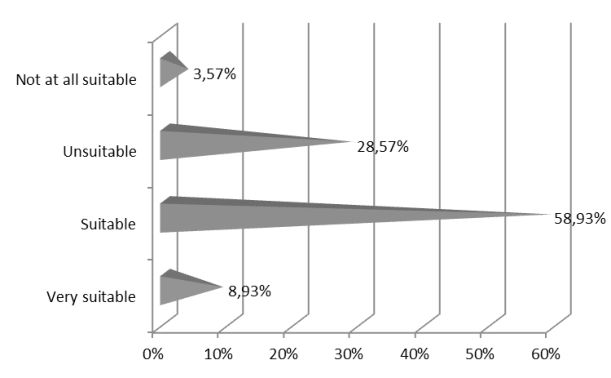
The chosen outcomes concerning laparoscopic surgeons (see the metrics in the Introduction) preferences are described below. In the Figure 6 there is presented the surgeons opinion about appropriateness of e-learning technology as a training channel in frame of ergonomics. The vast majority of respondent confirmed this kind of training path as correct.
Figure 6. Surgeons opinion about appropriateness of e-learning technology (own elaboration based on the questionnaire developing in frame of international project titled “Online Vocational Training course on laparoscopy's ergonomics for surgeons and laparoscopic instruments' designers”)
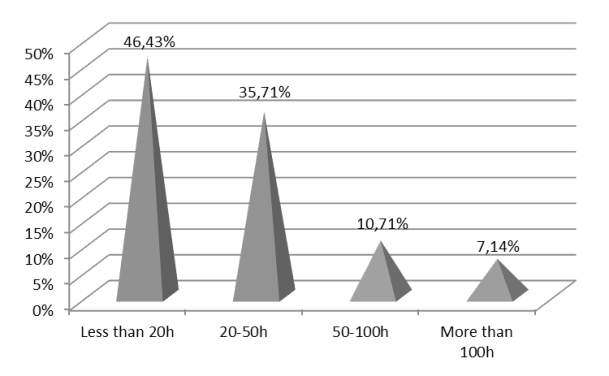
The important feature for surgeons is time of training. The less time is consumed for e-learning the better (Figure 7). The reason is related to numerous professional duties.
Figure 7. Surgeons opinion of expected duration of e-learning course (own elaboration based on the questionnaire developing in frame of international project titled “Online Vocational Training course on laparoscopy's ergonomics for surgeons and laparoscopic instruments' designers”)
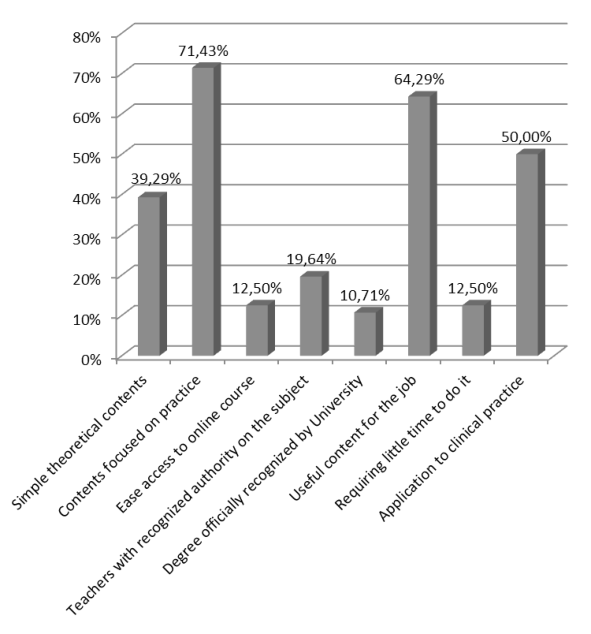
The most expected characteristics of training content are content focused on practice, utility for the job, application to clinical practice as well as simple language (Figure 8).
Figure 8. Surgeons general preferences about training content (own elaboration based on the questionnaire developing in frame of international project titled “Online Vocational Training course on laparoscopy's ergonomics for surgeons and laparoscopic instruments' designers”)
In range of the survey it was possible to indicate the preferred topics by surgeons and designers. They could also propose the topics they wanted to learn.
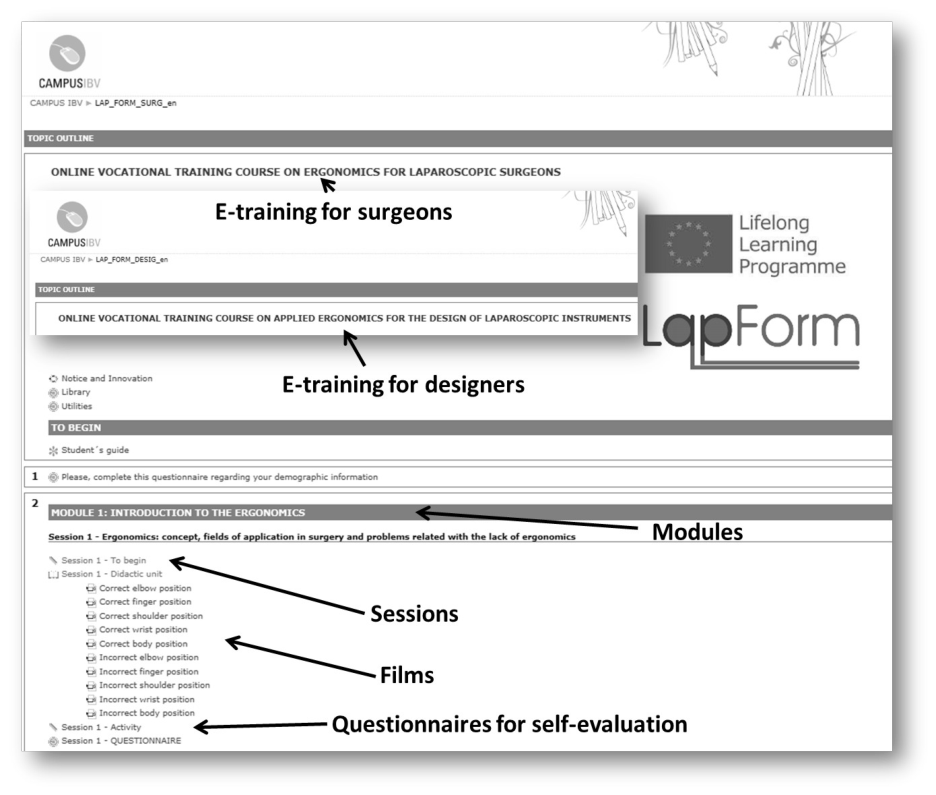
According to the surgeons and designers preferences there was developed the training materials separately for both groups of professionals (see 4th Stage). The training content takes into account the students’ abilities of knowledge absorption, so the knowledge objects are represents by such readable form like: drawings, movies, animations, diagrams, text highlights in the frames, key points, coloring, etc. Thanks to such differentiated presentation the training content should be correctly interpretable by the users without any previous knowledge in this range. The whole content is ordered by dividing it in topic modules and sections (lessons). The Figure 9 presents one of the e- learning course website with the clear division of training materials.
Figure 9. The example website with e-learning course (http://campus.ibv.org/course/view.php?id=398 – the page is available only for registered users)
The knowledge about ergonomics in laparoscopic procedures absorbed by both surgeons and manufacturers gives the opportunity to change the traditional approach to instruments design from technical to human-centered based on participation of its future users (5th Stage).
The e-learning content are the common platform, the basis of which should be realized the cooperation between the both groups of professionals. In the same time the knowledge transfer via Internet prepares to direct exchange of information within surgical tools design.
CONCLUSIONS
The presented approach to building the e-learning platform in range of ergonomics in laparoscopic surgeries is intended to allow the students for an efficient and effective training mode, resulting the creation of a common space of knowledge transfer between manufactures and surgeons. E-learning platform, in its premise, can play the role of intermediary in the process of the knowledge exchange between the mentioned stakeholders. In addition the e- learning course will be translated in four languages: Polish, English, German and Spanish, so the knowledge transfer can have an international dimension.
ACKNOWLEDGMENT
This study was supported in part by (1) the LapForm project (527985-LLP-1-2012-ES-LEONARDO-LMP). This project has been funded with support of the Lifelong Learning Programme of the European Commission. This publication reflects the views only of the author, and the Commission cannot be held responsible for any use which may be made of the information contained therein; (2) statutory work: Knowledge transfer within product life cycle; work symbol BK-203/ROZ3/2013.
REFERENCES
Berguer R., Chen J., Smith W. D. (2003), “A comparison of the physical effort required for laparoscopic and open surgical techniques”, Archives of Surgery, 138, pp. 967-970 Berguer R., Forkey D. L., Smith W. D. (1999), “Ergonomic problems associated with laparoscopic surgery”, Surgical
Endoscopy, 13, pp. 466-468 Berguer R., Smith W. D., Chung Y. H. (2001), “Performing laparoscopic surgery is significantly more stressful for the surgeon than open surgery”, Surgical Endoscopy, 15, pp. 1204-1207 Cohen W. M., Levinthal D. A. (1990), “Absorptive capacity: A new perspective on learning and innovation”, Administrative
Science Quarterly, 35, pp. 128 Cutner A., Stavroulis A., Zolfaghari N. (2013), “Risk assessment of the ergonomic aspects of laparoscopic theatre”, Gynecol Surg, 10, pp. 99-102 Erlhoff M., Marshall T. (Eds.) (2008), “Design Dictionary. Perspectives on Design Terminology”, Birkhäuser Verlag AG, Basel
Boston
Berlin Garavelli A.C., Gorgoglione M., Scozzi B. (2002), “Managing knowledge transfer by knowledge technologies”, Technovation, 22, pp. 269-279 Gofrit O. N., Mikahail A. A., Zorn K. C., Zagaja G. P., Steinberg G. D., Shalhav A. L. (2008), “Surgeons’ Perceptions and
Injuries During and After Urologic Laparoscopic Surgery”, Urology, 71 (3), 404-407 Matei A., Vrabie C. (2013), “E-learning platforms supporting the educational effectiveness of distance learning programmes: a comparative study in administrative sciences”, 3rd World Conference on Learning, Teaching and Educational Leadership - WCLTA 2012, Procedia - Social and Behavioral Sciences 20013, 93, pp. 526-530 Matern U., Eichenlaub M., Waller P., Ruckauer K. (1999) „MIS instruments. An experimental comparison of various ergonomic
handles and their design”, Surgical Endoscopy, 13, pp. 756-762 Nonaka I., Nishiguchi T. (2001), “Knowledge Emergence: Social, Technical, and Evolutionary Dimensions of Knowledge Creation”, Oxford University Press, New York Spring Schomaker M., Zaheer S. (2014), “The Role of Language in Knowledge Transfer to Geographically Dispersed
Manufacturing Operation”, Journal of International Management, 20, pp. 55-72 Trejo A. E., Doné K. N., DiMartino A. A., Oleynikov D., Hallbeck M. S. (2006), “Articulating vs. conventional laparoscopic grasping tools – surgeons’ opinions”, International Journal of Industrial Ergonomics, 36 (1), pp. 25-35 Trejo A. E., Jung M.-Ch., Oleynikov D., Hallbeck M. S. (2007), “Effect of handle design and target location on insertion and aim
with a laparoscopic surgical tool”, Applied Ergonomics, 38, pp. 745-753 Xu D., Huang W.W., Wang H., Heales J. (2014), “Enhancing e-Learning Effectiveness Using an Intelligent Agent-Supported Personalized Virtual Learning Environment: An Empirical Investigation”, http://dx.doi.org/10.1016/j.im.2014.02.009 Yasuhara H., Fukatsu K., Komatsu T., Obayashi T., Saito Y., Uetera Y. (2012), “Prevention of medical accidents caused by
defective surgical instruments”, Surgery, 151, pp. 153-161
LISTED IN THE AHFE DIGITAL BOOKSTORE CATALOGUE
Explore the complete digital volume
Advances in Science, Technology, Higher Education and Society in the Conceptual Age: STHESCA
Read this individual research paper free through the original publisher, or explore the full digital proceedings book.
ISBN 978-1-4951-2110-4
Explore this ISBN in the AHFE Bookstore ↗Listed in the July 2026 bookstore catalogue; search by ISBN to confirm current availability · Digital book purchase optional