Jarno Einolander, Hannu Vanharanta (2020). Degree of Commitment Among Students at a Technological University – Testing a New Research Instrument. In: Advances in Science, Technology, Higher Education and Society in the Conceptual Age: STHESCA. AHFE Open Access, vol. 10. https://doi.org/10.54941/ahfe100379
Just as commitment in organizations is very important for long-term success, commitment to one’s educational institute is important, too. Higher education provides the foundation for the social, economic and political growth of a country. Therefore, improving student retention by successfully delivering quality education, leading to student graduation and integration in the workforce, is crucial. It has been argued that students stay in their higher education institutes for similar reasons to those that make employees committed and engaged in organizations.In our previous studies we have created a literature-based generic model of organizational commitment and engagement that could be used in conjunction with an Internet-based application to evaluate their various components and primary correlate constructs. In this study we took this evaluation model to the context of a higher educational institute to try to evaluate students’ commitment to their university.As a result, we identified several development needs in order to evaluate students’ commitment with our application. Because the statements in our original instrument were aimed for use in the organizational domain, some of them were not suited to studies on commitment in an educational institute. Looking at the results of our study, we decided that the overall construct of our model and the wording of applicable statements should be modified in order to create an appropriate instrument for use in an academic institution. This was done based on Bean’s Student Attrition Model. However, collective analysis of the test results clearly identified that even with the preliminary model it is possible to find where students see the needs for greatest development and how they view their current state of engagement.
Employee commitment is argued to be critical to contemporary organizational success. One of the main sources of competitive advantage for today’s organizations is the ability to retain talented employees. In other words, long-term sustained success and growth can be achieved by attracting and retaining the best talent (Heinen and O’Neill, 2004). Similarly, commitment to one’s educational institute is important as well. Education is considered to be a critical contributor to economic competitiveness, growth, as well as social inclusion, among others. Student satisfaction and commitment to their studies is a significant issue for academic institutions. Therefore, improving student retention by successfully delivering quality education leading to student graduation and integration in the workforce is imperative.
It has been argued that students stay in their higher education institutes for similar reasons to those of employees in organizations (Bean, 1980). Based on Bean (1980), student withdrawal can be regarded as being similar to employee turnover. Bean (1980) developed his model of student attrition based on organizational commitment literature focusing on turnover in work organizations. The presumed roles of organizational variables, personal variables, and environmental variables in shaping both attitudes and intents are largely supported by many studies. Focusing differently, Tinto (1982) argues that retention involves two different commitments from a student. The first one, known as goal commitment, is the students’ commitment to obtain a degree, and the second one, institutional commitment, is their decision to obtain that degree at a particular institution. These commitments together are what affect students’ commitment to a particular institution (DeShields et al. 2005). In addition, many studies have identified that students’ overall satisfaction has a positive correlation to student retention (Cleary, 2001; DeShields et al. 2005). Therefore, DeShields et al. (2005) argued that the linkage between satisfaction and retention for students in higher education should be studied and carefully led and managed.
Measuring these kinds of concepts requires support from theory and methodology, so that the communication can be objective and the actions taken can be effective. In our previous research we created a literature-based generic online application to evaluate different concepts related to organizational commitment and engagement, to gain insights how employees see their membership in their organizations currently and what kind of proactive vision they have for the future. Organizational commitment refers to the extent to which an individual regards him or herself as an organizational person. In particular, organizational commitment refers to “the relative strength of an individual's identification with and involvement in a particular organization” (Porter et al. 1974).
In the fall of 2013, we tested our organizational commitment instrument with 40 Master’s students at Tampere University of Technology in Finland. This study was a part of larger instrument development process. However, in this study we decided to test our instrument’s usability in assessing students’ commitment to their studies. Before evaluation, the participating students were asked to think of their university as their employing organization. Based on the results of our student research, we concluded that the instrument as a whole is not at its best in assessing student commitment. More specifically, the wording of applicable statements and the overall structure of our ontology model should be modified in order to create an appropriate instrument for use in an educational institution. To tackle the structure problem, we took variables from Bean’s (1980; 1985) Student Attrition Model as the framework for building a new modified instrument. Statements for our new model were extracted from the existing statements in our organizational commitment model. They were chosen based on their suitability for assessing student commitment.
This paper is constructed as follows. After the introduction, the theoretical background on organizational and educational commitment is presented. The following section introduces the methodology, including the research instrument and research setting. After the methodology, a sample of the analysis and results of the research are presented. The last chapter concludes and summarizes our paper.
THEORETICAL BACKGROUND Organizational Commitment
Organizational commitment refers to the extent to which an individual regards him or herself as an organizational person. In particular, organizational commitment refers to “the relative strength of an individual's identification with and involvement in a particular organization” (Porter et al. 1974). Reichers (1985) defines organizational commitment as a process of identification with the goals of an organization's multiple constituencies (1985), such as organization, occupation, job, supervisor, workgroup, or organizational goals. For more than 20 years the leading approach to organizational commitment research has been Meyer and Allen’s (1984; 1997) three-component conceptualization of organizational commitment. They describe them as distinguishable components, rather than types of attitudinal commitment and denominate them as affective, continuance, and normative commitment. They argue that these components reflect distinct psychological states and employees can experience each of these states to varying degrees. According to this model, the affective component refers to employees’ emotional attachment to, identification with, and involvement in the organization. It refers to how strongly the employee identifies with, is involved in, and enjoys being a member of an organization. This dimension is closely related to the definition of
Porter et al. (1974). Second, continuance commitment (Allen and Meyer, 1990; Meyer and Allen, 1991) is the cost- related aspect of commitment. This refers to the commitment accumulated based on sacrifices and investments made by an employee which would be lost if the activity were discontinued (e.g. pay, pension, seniority). This view draws upon Becker’s (1960) early thoughts about the reasons leading to commitment. Lastly, the normative component refers to employees’ feeling of obligation to remain with the organization (Meyer and Allen, 1997). Normative commitment sees commitment developing based on internalized loyalty norms, i.e. the feeling of obligation to remain with an organization (Allen and Meyer, 1990; Meyer and Allen, 1991). They argued that each type of commitment ties the individual to the organization in different ways and will differently affect his/her behavior in the workplace.
Organizational commitment has been considered as a mediator variable in several causal models of employee behavior. Often it has been included as a mediator focusing on predicting other employee reactions or behaviors (Mathieu and Zajac, 1990). As a consequence, organizational commitment has been linked to several personal variables, role states, and aspects of the work environment, such as job characteristics or organizational structures. From an antecedent point of view, it has been related to employees’ absenteeism, performance, turnover, and other behaviors. In addition, several other variables have been found to correlate with organizational commitment, such as job involvement and job satisfaction behaviors (Mathieu and Zajac, 1990). Additionally, DeCotiis and Summers (1987) found that commitment had a direct positive influence on employees’ work motivation and objective measures of job performance, as well as a direct negative influence on their intention to leave and actual turnover (Mathieu and Zajac, 1990). In other words, employees who identify with and are involved in their organization are committed, and presumably want to maintain membership in their organization and exert effort on its behalf (Mowday, Steers and Porter, 1979). Many extensive studies support this prediction (c.f. Mathieu and Zajac, 1990; Cohen, 2000). Meyer and Allen (1997) emphasized the positive correlation between affective commitment and work attendance. A committed workforce will be more dedicated to their jobs and more motivated to give their time and effort to accomplish the required tasks.
Academic Commitment Earlier studies on student retention focused on students’ academic abilities in predicting their retention. However, research indicates that academic goals, self-confidence, institutional commitment, social support, and particular contextual influences like institutional selectivity and financial support, in addition to social involvement, all have a positive relationship to student retention. Students who cannot develop these factors are more inclined to drop out. Previous research has indicated that the strongest factors seem to be academic-related skills, academic self- confidence, and academic goals (Lotkowski et al. 2004). However, studies have shown that academic performance can only account for half of the variance in dropout rates (DeShields et al. 2005). In addition, a great deal of research has suggested that the social integration of students may be an important factor in predicting persistence. These studies argue that integration into the social environment plays a major role in commitment to a particular academic institution (Tinto 1975; DeShields et al. 2005).
Probably the two most dominant theories of student persistence and retention are Tinto’s (1975, 1987) Student Integration Model and Bean’s (1980, 1982) Student Attrition Model. Tinto’s (1975) model emphasizes integration and commitment. Both of these models agree that commitment is a key factor in explaining persistence in educational institutes. Based on Tinto (1975), persistence occurs when a student successfully integrates into the institution academically and socially. A student’s background characteristics (family background, individual attributes, and previous education experiences) influence their initial level of goal commitment and initial commitment to their educational institute. These commitments have an influence on academic integration. Goal and institutional commitment are also influenced by peer group and faculty interactions, and out-of-class room factors which contribute to social integration (Grossett, J. M. 1991). Habley (2004) argued that one of the main factors affecting academic retention is the quality of interaction a student has with other people on campus. This increased integration, both academically and socially, leads to greater goal commitment and institutional commitment, which leads to lower dropout rates and higher graduation rates. Based on Tinto’s model, students who fail to successfully integrate academically or socially are likely to leave the educational institute. In his more recent paper, Tinto (2003) identified five conditions that promote student persistence: expectations, support, feedback, involvement, and learning. Based on Tinto, students are more likely to persist and graduate in a setting (1) that expects them to succeed, (2) that provides academic, social, and personal support, (3) that provides frequent and early feedback about their performance as they are trying to learn and persist, (4) that involves them as valued members of the institution (e.g. frequent and quality interaction with staff and other students), and (5) most importantly, students are more likely to persist and graduate in settings that foster learning. Students who are actively involved in learning, i.e. who spend more time on task especially with others, are more likely to learn and, in turn, more likely to stay
(Tinto 2003).
Bean’s Student Attrition Model (1980, 1985) sees student withdrawal as being like employee turnover. He developed a model of student attrition based on organizational commitment literature focusing on turnover in work organizations. He defined student attrition as the cessation of individual membership in a particular higher educational institute. He argued that students stay in their higher educational institutes for similar reasons to employees in organizations, hence it is an analogue of organizational commitment. Based on the results of many studies of the Student Attrition Model, the presumed roles of organizational variables, personal variables, and environmental variables in shaping both attitudes and intents are largely supported. To further advance their research, Bean and Metzner (1985) attempted to create a conceptual model of the dropout process for non-traditional students. They argued that the main difference in the attrition process between traditional and non-traditional students is that non-traditional students are more affected by the external environment than by the social integration variables affecting traditional student attrition.
Non-traditional students are distinguished by the lessened intensity and duration of their interaction with the primary agents of socialization (e.g. faculty, peers) at the educational institute they are attending (Bean and Metzner, 1985). Typically, non-traditional students have to balance studies with employment. Usually, students are either full-time students, working part-time; or they are part-time students who are in full-time employment (Fleming 2009). In many cases, non-traditional students live quite far away from their educational institute, they attend only part time, for example, because of work, and have family responsibilities. Most have to balance their working lives and their academic studies. In addition, such students’ participation in extracurricular activities is relatively minor compared to traditional students, as are the impacts of other social integration variables that are seen to have major influence on traditional students (Bean and Metzner, 1985). This pattern of participation characterizes higher education students in Europe now more and more (Fleming 2009).
As can be observed, the theoretical background has the same basic content. The problem is, however, gathering information so that it could easily produce general and specific information on the levels of commitment and engagement at collective and individual levels and show whether there are needs for significant improvement. We believe that this is a major management and leadership problem in universities. Therefore, there is a need to create simple tools so that academic organizations can collect information directly from the students. Our target is to create an Internet-based student commitment measurement system, using self-evaluation. Once self-evaluation has been conducted, students and academic staff will be more aware of possible development gaps and can base their objectives for improvement on concrete bottom-up results. The methods within the methodology are described in the next chapter.
METHODOLOGY
Evolute application environment The evaluation method utilized in this study was developed on the generic, Internet-based, computer application environment called Evolute. Evolute is an online system that supports specific-purpose fuzzy logic applications (Kantola, 2005; Kantola, Vanharanta, Karwowski 2006). Fuzzy logic is a conceptual system of reasoning, deduction, and computation that makes it possible to reason precisely with imperfect information. Imperfect information is information which in one or more respects is imprecise, uncertain, incomplete, unreliable, vague, or partially true (Zadeh 2009). The Evolute system allows researchers to develop a specific domain ontology and present it online to the target group (Kantola., Vanharanta, Karwowski 2006). The application involves the use of self-evaluation in the assessment of different concepts in work role through semantic entities, such as statements (Kantola. Vanharanta, Karwowski 2006). The Evolute platform has been used in various studies in different countries, for example, in Finland (e.g. Kantola, Vanharanta, & Karwowski 2006; Kantola, Karwowski, & Vanharanta, 2011), in Poland, in the U.K. (e.g. Makatsoris, 2009), in South Korea (e.g. Chang, Kantola, & Vanharanta, 2007; Chang et al., 2009), and in Spain (e.g. Bikfalvi et al., 2007).
Research Instrument Ontology
The disciplines needed to manage complex concepts like organizational commitment require a vast understanding of factors affecting it in many ways, as well as sound knowledge and mastery of actions that can assist its development. In order to classify and understand the concepts relating to this field of organizational study, we created an ontology. An ontology is a formal representation of a set of concepts within a domain and the relationships between those concepts. It is used to reason the properties of that domain and may be used to define the domain. According to Gruber (1993), an ontology is a “formal, explicit specification of a shared conceptualization” (Gruber 1993, p. 199). An ontology provides a shared vocabulary which can be used to model a domain – that is, the type of objects and/or concepts that exist, and their properties and relations (Arvidsson and Flycht-Eriksson, 2008). Therefore, an ontology is a way to explicitly define the concepts affecting commitment to organizational domain. In this context, the ontology is a classification of qualitative knowledge relating to personal feeling of attachment to organization. In other words, the ontology is a list of attributes that describe the meta-data (features affecting organizational commitment).
In our previous studies, we created a literature-based generic ontology model of organizational commitment (see e.g. Einolander and Vanharanta 2013). This model is intended to be used in conjunction with the Evolute (Kantola 2009) system to evaluate the various components of organizational commitment and their primary correlate constructs. The ontology is structured by three widely recognized psychological states affecting commitment to three categories: (1) Affect-related aspects, (2) Norm-related aspects, and (3) Cost-related aspects. This division, more specifically, affective, normative and continuance commitment was introduced by Meyer and Allen (e.g., Meyer and Allen 1984). It has been argued that one of these categories partially overlap with other ones (e.g. Angle and M. B. Lawson 1994; Brown 1996) but still have a distinct effect on employee behavior and consequently on an organization.
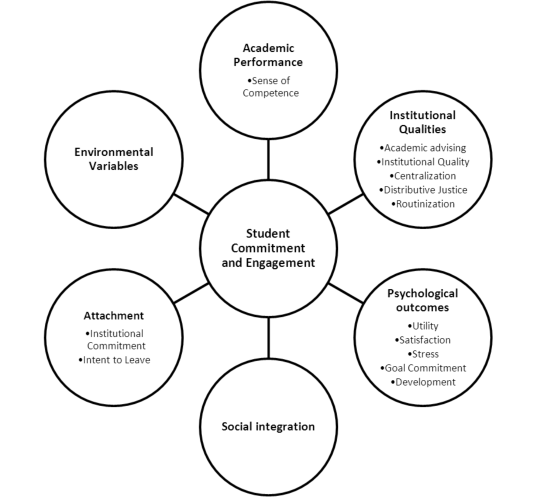
The Research Instrument in an Academic Context Because the statements in our instrument are aimed at organizational commitment, some of them are not suited to commitment studies in an educational institute. Adapting the instrument for the academic context of the current research required a new grouping of concepts and their features. This was done in order to grasp the commitment and satisfaction better in a specific domain, i.e. students’ commitment and satisfaction with their academic institution. We used variables from Bean’s (1975) and Bean and Metzner’s (1985) Student Attrition Model as a framework to do this. As a result, 15 concepts were identified along with 107 applicable statements or ‘features’ describing them. Figure 1 illustrates the concepts.
Figure 1. Evaluated concepts in our application
On a practical level, respondents are asked to evaluate the current state of the statement, how they feel about things at that moment in their organization. Also, the desired target or future state, how they want or see the situation to be in the future, is evaluated. This evaluation results in the creation of a proactive vision, i.e. the gap between the current reality and future vision. The gap between the actual and the desired states, often called creative tension or proactive vision, shows possible fields of improvement and intervention. The reasoning from the indicative statement evaluation to the visualized proactive vision is made with fuzzy logic; the statements are semantic entities and the ontology is the information resident in a knowledge base (c.f. Zadeh 2009; 1973).
Along with the statements, linguistic scale values are utilized. The scales vary according to the statements, for example, from “not at all” to “completely”, or “highly unsatisfied” to “satisfied”. The respondents provide their answers, both to current and desirable (target) states, by clicking on the two bars beside the scale. With this method, the respondent can choose from over 100 different values for each statement since the graphic bar offered a continuous scale of values. Responses to each statement are then transformed into a numerical form, a real value between 0 and 1. By using the continuous scale, the aim is to overcome some of the disadvantages that the conventionally used Likert-scale type measures may possess (c.f. Russell & Bobko 1992). Russell & Bobko (1992) speculated that the Likert-scale requires subjects to somehow compress or otherwise reduce their latent response. They suggest that information loss due to the coarseness of the scale can cause false increases or decreases in moderated regression effect sizes, and propose that it could result in an unknown systematic error, which could have a major effect on the ability to detect true interaction effects. Also, Blalock and Hubert argued that the advantage of continuous scale compared to, for example, the bi-polar Likert Scale (Blalock and Hubert, 1968) composed of five different values, is the better accuracy of answers.
Data Collection and Test Subject Characteristics Evaluation took place in the fall of 2013 with Finnish M.Sc. program students with various backgrounds during a purchasing and supply chain management course. All of the students had a prior bachelor level degree in some field of engineering or business administration and had been in working life before attending their master’s level studies. Before evaluation all participants were provided with written instructions describing the objective of the evaluation and a step-by-step guide for taking the evaluation.
Respondents were given a three-week time window to take the self-assessment at a time that suited them best. Once all the statements had been answered, the participants were asked to give feedback on the usability of the instrument and their initial views of overall accuracy of the report that was automatically provided. This report consisted of graphs on the whole instrument assessing organizational commitment.
Altogether, 60 individuals were asked to participate in this research study. Students were asked to consider their university as their organization, and relate their responses to that. Students were encouraged to participate in this study by rewarding them with extra credit points. In the end, 40 useable results were obtained. The sample consisted of 24 males and 16 females. The average age of the participants was 34 years old with an average of 10 years in working life. Several demographic characteristics were included in the study as descriptive statistical variables. We included age, gender, highest education level attained, job type, experience in current job, and overall tenure in the current organization. Nationality and total tenure in working life were also included.
ANALYSIS AND RESULTS As a result, we identified 108 applicable statements for assessing student commitment from the overall ontology. Data based on these 108 statements were analyzed using Cronbach’s Alpha Reliability Analysis. The coefficients for 19 identified subscales ranged from .89 to .59 and their average was .75. Nunnally (1978) offered a rule of thumb of 0.7 for an acceptable alpha. In most of the subscales, the coefficient alphas exceed the conventional minimum value. However, because the sample size was relatively limited, more testing is required before any conclusions can be made about the scale’s reliability. Nevertheless, comments given by the sample students seem to validate the results to some extent.
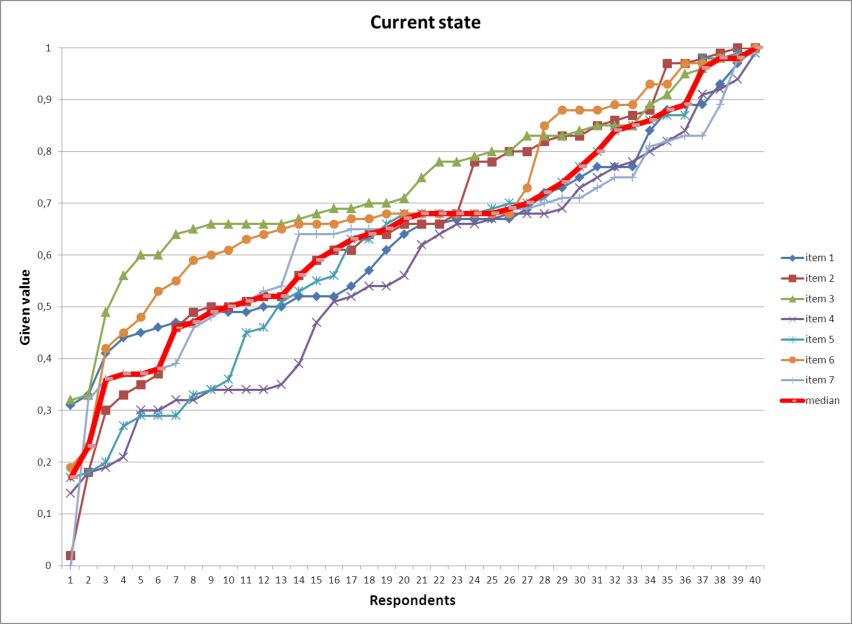
In the following figures the data obtained in our study were treated as in quantitative research. A large amount of data was visually analyzed in different types of graphs. Figure 2 shows the current state of academic advising as the respondents see it. This figure was made by drawing an ascending trend line from a single statement, where each respondent's answer was a single plot. By drawing them into a single graph, their difference becomes immediately visible. However, this sort of analysis makes it impossible to track a single respondent’s answers. The vertical axis indicates the qualitative linguistic value converted to the numeric scale from 0 to 1. For example, for statement number 1, the linguistic value ‘never’ has been assigned to the numerical value of 0 and ‘always’ has been assigned to the numerical value of 1. Between the values of 0 to 1, there is a continuous sliding scale of responses. The horizontal axis indicates all 40 respondents.
Figure 2. Current state of academic advising.
In Figure 2, there is a median curve. A median is statistically valid method for an average when the data is of ordinal scale. All respondents have given current and target state values for each of the seven statements. The median separates the data into two groups: above the median and below the median. The median value shows the significance of the curve. If the curve goes constantly over the median, it has been valued more by the respondents than the curve that goes partly or totally under the median.
In Figure 2, the following statements are constantly over the median curve:
Senior management is good at communicating with the rest of the organization;
My manager shares information adequately;
My organization or manager provides support when needed.
This graph shows that the respondents value information sharing very highly in academic advising. Item 3 (My manager shares information adequately) and Item 4 (I receive useful and constructive feedback that helps to improve my performance) are the two statements that have the most different views about their current state. About 30 percent of the respondents see the biggest gap between the current states in these statements. This shows that most of the respondents feel that information is shared adequately but this information lacks concrete feedback that helps to improve their performance. This figure also shows that about as many respondents, i.e. a significant portion of the whole group, stay constantly below 0.65 in their answers, which signifies that they do not consider academic advising as being top quality.
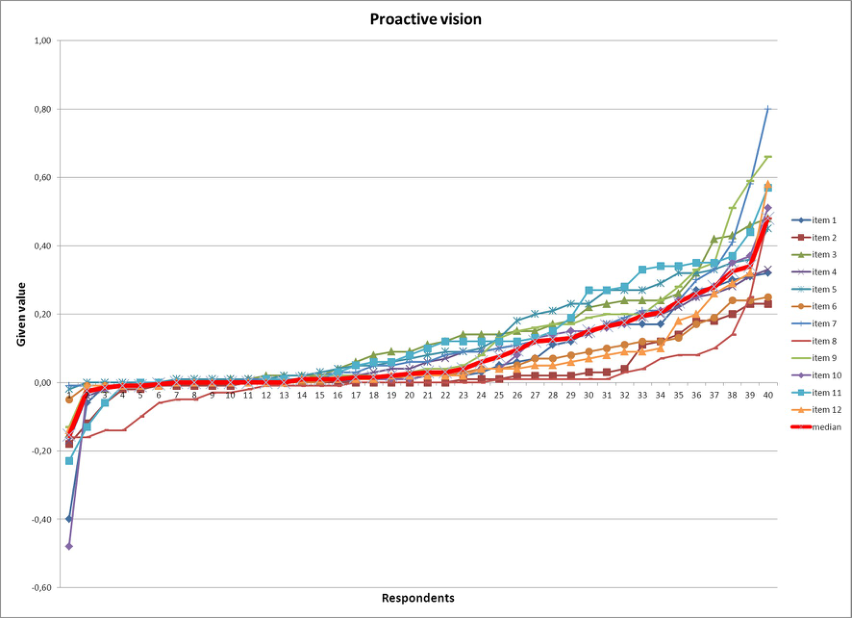
In order to assess social integration, 12 statements were extracted from the whole ontology model, such as (1) I am satisfied with the way I get to know other people while at work, (2) I like the people I talk to and work with at work (3) This organization respects its employees, and (4) I would not like to lose the friends or work group I have at work. Figure 3 is an example of a proactive vision, i.e. the tension between the current and target states of respondents. These curves illustrate the collective view of the direction in which respondents wish these factors to evolve.
Figure 3. Proactive vision of social integration
This figure shows that most of the respondents feel that the statements concerning social integration are on the level they feel they should be in the future or the level should improve relatively slightly (value near zero). However, there are a small number of respondents that answered at opposite ends of the scale. This shows that there are also respondents who see a great gap between current and future, both negative and positive. There are only one to three respondents who have a negative proactive vision, which could result from misinterpretation of the statements or some other unknown reason.
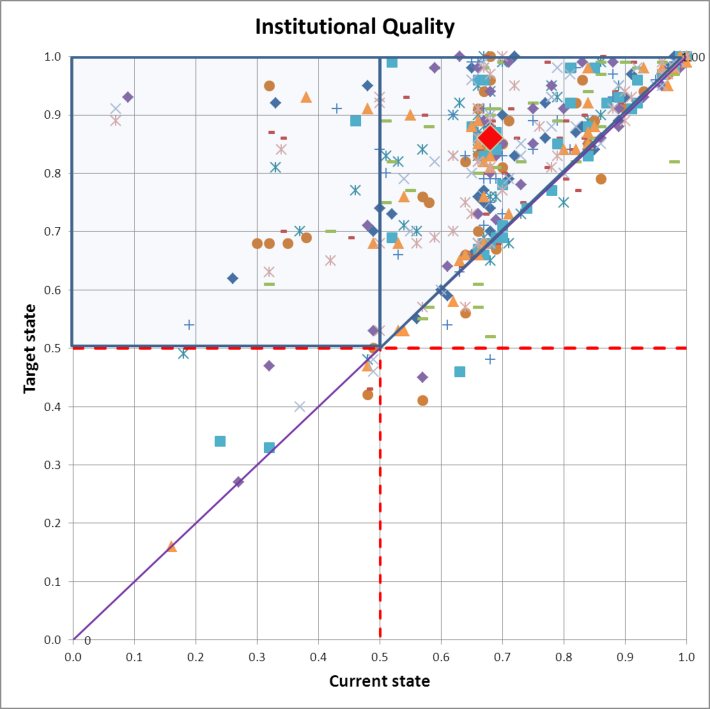
Figure 4 represents each respondent’s answers to statements assessing the institutional quality of their organization, which in this case is the university where they are studying. The horizontal axis shows their answer to the current state and vertical axis their target (or future) state concerning each statement. Each data point in the chart represents one individual’s answer to one particular statement. The bigger data point marker represents the median of all the statements of all respondents.
The upper left part of the figure shows that there are single respondents that consider the quality of their institution to be relatively low and at the same time they see there is a significant need for improvement. However, as it can be seen from the top right part of the figure, most of the respondents consider the quality of their institution high and wish that it would stay that way or show a little more improvement. An interesting group of respondents are those who wish the target state to be lower than the current state. This might be because they had not really understood the statement or they had not completely been able to think of their university as their organization. The median of all the statements shows the collective view of all the respondents on the matter in hand. This figure shows that within the research group there is a very high congruent view and feeling about the statements measuring the quality characteristics of their institution.
Figure 4. Current and target state responses to institutional quality.
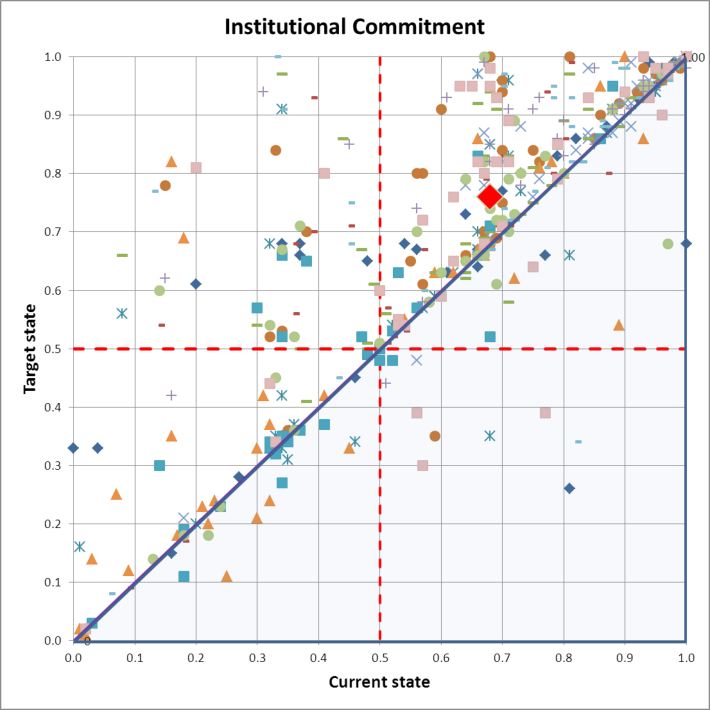
Figure 5 on the other hand shows a very different result to Figure 4. In Figure 5 answers are plotted for the statements concerning institutional commitment. These include statements such as (1) Deciding to work for this organization was a definite mistake, (2) I am proud to tell others who I work for, (3) I do not feel a strong sense of belonging to my organization, and (4) I am personally committed to this organization. Again the median value indicates that collectively people would like these characteristics to be enhanced.
Figure 5. Current and target state responses to institutional commitment.
However, in this figure it can be seen quite clearly that the answers are very scattered across the whole response scale. This indicates that there is a lot of disagreement among the survey respondents. This high level of disagreement may indicate that it is necessary to dig deeper into the results of these items, or they may simply indicate inconclusive findings. In this case, the respondents have different views on whether they would like to see themselves more committed to their university. However, again most respondents see that the current state is adequate or that they would like it to be slightly better. This figure also shows that there are many respondents who grade these statements very low, both the current and future, and also the future lower than the current state. This may indicate that these people do not want to consider themselves committed to that particular educational institute.
With the methods presented, it is quite easy to analyze a large amount of data in a visual form. This kind of visual analysis is easy to use and informative for management and leadership purposes, especially for people who are not very familiar with different statistical analysis methods. Collective data gathered with a statistically sufficient sample size are able to provide insights to the reasons behind academic dropout. It also provides knowledge on how academic dropout can be managed so that it becomes a downward trend in the future.
CONCLUSIONS AND LIMITATIONS The aim of this study was to test our organizational commitment and engagement instrument for investigating university students. It should be emphasized that this study was also used as a pilot test for our organizational commitment instrument and served as one step towards finalizing the instrument for a large-scale business study. Hence, the sample size was relatively limited and its suitability for this study was somewhat questionable.
The overall ontology was created to be a generic model of organizational commitment and engagement. This implies that the ontology and self-evaluation created based on it can be used to evaluate these constructs in multiple domains. In this research, we proposed to make the evaluation of organizational commitment to academic educational institutes. However, in different domains or case settings, different characteristics may or should be emphasized. In addition, evaluating a specific characteristic or a statement relating to a characteristic may prove to be unsuitable for one domain although it is suitable in other domains. This was clearly the case in this research, as a great deal of the statements designed for use in an organizational setting could not be seen as relevant or even suitable when assessing commitment and engagement related to educational institutes and individual studies.
Both the overall instrument and the extracted version contain over one hundred unique statements to assess factors related to commitment and engagement. It has to be acknowledged that longer questionnaires may lead to lower completion rates and frustration and fatigue from respondents. This may lower the quality of the responses as respondents become tired of thinking carefully and answering statements. However, at this point we anticipate the concept in hand to be so multidimensional and complex that significantly fewer statements could not cover it completely. Therefore, the Evolute system utilized in this study was developed in such a way that a respondent’s evaluation could be left unfinished and continued at another time, which hopefully reduced possible fatigue.
Looking at the results of our sample group, we extracted applicable statements and created a completely new hierarchical ontology model for them based on previous theoretical findings in this field of research. It can be clearly seen from the answers that the respondents could not perceive their university as their “employing” organization. To correct this problem, all the statements have to be modified in relation to the educational domain. In addition, more specific statements have to be added that cover different specific aspects of studying. In so doing, we would be able to produce a more suitable instrument to be used in educational institutes. However, the results and feedback from respondents indicate that a self-evaluation based on linguistic variables is challenging but also rewarding for the individuals that performed the evaluation.
REFERENCES
Allen N. J., Meyer J. P., (1990), “The measurement and antecedents of affective, continuance and normative commitment to the organization”. Journal of Occupational Psychology, Vol. 63, Iss. 1, 1990, pp. 1–18. Angle H. L., Lawson M. B., (1994), “Organizational commitment and employees’ performance ratings: Both type of
commitment and type of performance count”. Psychological Reports, Vol. 75, 1994, pp. 1539–1551. Arvidsson, F., Flycht-Eriksson, A. (2008), “Ontologies I”. website: http://www.ida.liu.se/~janma/SemWeb/Slides/ontologies1.pdf. Bean, J. P. (1980), “Dropouts and turnover: The synthesis and test of a causal model of student attrition”. Research in Higher Education, 12(2). Bean, J. P. (1982), “Student attrition, intentions, and confidence: Interaction effects in a path model”. Research in Higher
Education, 17(4), pp. 291-320. Bean, J. P. (1985), “Interaction effects based on class level in an exploratory model of college student dropout syndrome”.
American Educational Research Journal,22(l), pp. 35-64. Bean, J. P., Metzner, B. S. (1985), “A conceptual model of nontraditional undergraduate student attrition”. Review of Educational Research. 55(4), pp. 485-540. Becker H. S., (1960), “Notes on the Concept of Commitment”, The American Journal of Sociology, Vol. 66, No. 1, 1960, pp. 32-
40. Bikfalvi, A., Llach, J., Kantola, J., Marques, P., & Mancebo, N. (2007), “Complementing education with competence development: An ICT-based application”. International Journal of Management in Education, 1(3), pp. 231–250. Blalock A., Hubert M. J., (1968), “Methodology in social research”, McGraw-Hill, New York. Brown R. B., (1996), “Organizational commitment: Clarifying the concept and simplifying the existing construct typology”.
Journal of Vocational Behavior, Vol. 49, Iss. 3, 1996, pp. 230–251. Chang, Y., Kantola, J., & Vanharanta, H. (2007), ”A study of creative tension of engineering students in Korea”. Human Factors and Ergonomics in Manufacturing & Service Industries, 17(6), pp. 511–520. Cohen A., (2000), “The Relationship between commitment forms and work outcomes: A comparison of three models”. Human
Relations. Vol. 53, Iss. 3, 2000, pp. 387–417. DeCotiis T. A., Summers T. P., (1987), “A path-analysis of a model of the antecedents and consequences of organizational commitment”. Human Relations, Vol. 40, Iss. 7, 1987, pp. 445–470. DeShields, O. W., Kara, A., & Kaynak, E. (2005), "Determinants of business student satisfaction and retention in higher
education: Applying Herzberg’s two-factor theory". International Journal of Educational Management, 19(2), pp. 128-139. Einolander, J., Vanharanta, H. (2013), “Organizational Commitment among Purchasing and Supply Chain Personnel - Testing Research Instrument”, International Journal of Digital Information and Wireless Communications (IJDIWC) 3(4), pp. 43- 50. Fleming, Ted. (2009), “Access and Retention Experiences of Non-traditional Learners in HE”. European Lifelong Learning
Project 2008-10. Grossett, J. M. (1991). “Patterns of integration, commitment, and student characteristics and retention among younger and older students”. Research in Higher Education, 32(2), pp. 159-178. Gruber, T. (1993), “A translation approach to portable ontology specifications”, Knowledge Acquisition, 1993, 5(2), pp. 199–
220. Habley, W. R. (Ed.). (2004), “The status of academic advising: Findings from the ACT sixth national survey (Monograph No.
10)”. Manhattan, KS: National Academic Advising Association. Heinen, J. S., O’Neill C., (2004), “Managing Talent to Maximize Performance”, Employment Relations Today, Vol. 31, Iss. 2, pp. 67–83. Kantola, J. (2005), “Ingenious Management”, Doctoral thesis, Pori, Finland: Tampere University of Technology, 2005. Kantola, J., Karwowski, W., Vanharanta, H. (2011), ”Managing managerial mosaic: The Evolute methodology”. In Electronic
globalized business and sustainable development through IT management: Strategies and perspectives (pp. 77–89). Hershey, PA: IGI Global. Kantola, J., Vanharanta H., Karwowski, W. (2006), “The evolute system: a co-evolutionary human resource development methodology”, in International Encyclopedia of Ergonomics and Human Factors, 2nd ed., 2006. Lotkowski V., Robbins S., Noeth, R. (2004), “The role of academic and nonacademic factors in improving college retention”.
ACT Policy Report, pp. 1-41. Makatsoris, C. (2009), “An information and communication technologies based framework for enhancing project management education through competence assessment and development”. Human Factors and Ergonomics in Manufacturing & Service Industries, 19(6), pp. 544–567. Mathieu J. E., Zajac D. M., (1990), “A review and meta-analysis of the antecedents, correlates, and consequences or
organizational commitment”. Psychological Bulletin, Vol. 108, Iss. 2, 1990, pp. 171 - 194. Meyer J. P., Allen N. J., (1991), “A three-component conceptualization of organizational commitment”. Human Resource Management Review, Vol. 1, Iss. 1, 1991, pp. 61–89. Meyer J. P., Allen N. J, (1984), “Testing the side-bet theory of organizational commitment: Some methodological
considerations”. Journal of Applied Psychology, 69, pp. 372−378. Meyer J.P. and Allen N.J., (1997), “Commitment in the workplace: theory, research, and application”, Sage Publications, Inc.
1997, 160p. Mowday R.T, Steers R.M., Porter L.W. (1979), “The measurement of organizational commitment”. Journal of Vocational Behavior, Vol. 14, Iss, 2, 1979, pp. 224–247. Nunnally, J. C. (1978), “Psychometric theory” (2nd ed.). New York: McGraw-Hill. 701p. Porter, L. W. Steers R. M., Mowday R. T., Boulian, P. V, (1974), “Organizational commitment, job satisfaction and turnover
among psychiatric technician”, Journal of Applied Psychology, Vol. 59, Iss. 5, 1974, pp. 603–609. Reichers, A. E., (1985), “A Review and Reconceptualization of Organizational Commitment”. Academy of Management Review, Vol. 10, Iss. 3, pp. 465-476. Russell C. J., Bobko, P. (1992), “Moderated Regression Analysis and Likert Scales: Too Coarse for Comfort”. Journal of Applied
Psychology, Jun92, Vol. 77, Iss. 3, 1992, pp. 336–342. Tinto, V. (1975), “Dropouts from higher education: A theoretical synthesis of the recent literature”. A Review of Educational Research, 45, pp. 89-125. Tinto, V. (1987), “Leaving college: Rethinking the causes and cures of student attrition”. Chicago: The University of Chicago
Press. Tinto, V. (1982), “Limits of theory and practice in student attrition”. Journal of Higher Education, Vol. 53, No.6 pp. 687-700. Tinto, V. (2003), “Promoting Student Retention Through Classroom Practice”. Presented at Enhancing Student Retention: Using International Policy and Practice. An international conference sponsored by the European Access Network and the Institute for Access Studies at Staffordshire University. Amsterdam, November 5-7, 2003. Zadeh, L. (1973), “Outline of a new approach to the analysis of complex systems and decision processes”, IEEE Transactions on
systems, Man, and Cybernetics, Vol. 1, Iss. 1, 1973, pp. 28–44. Zadeh, L. (2009), “Toward extended fuzzy logic - a first step”, Fuzzy Sets and Systems, 160, Iss. 21, 2009, pp. 3175–3181.
LISTED IN THE AHFE DIGITAL BOOKSTORE CATALOGUE
Explore the complete digital volume
Advances in Science, Technology, Higher Education and Society in the Conceptual Age: STHESCA
Read this individual research paper free through the original publisher, or explore the full digital proceedings book.
ISBN 978-1-4951-2110-4
Explore this ISBN in the AHFE Bookstore ↗Listed in the July 2026 bookstore catalogue; search by ISBN to confirm current availability · Digital book purchase optional