Wen Wang (2021). Sustainable Design of Biomaterials. In: Human Systems Engineering and Design (IHSED2021): Future Trends and Applications. AHFE Open Access, vol. 21. https://doi.org/10.54941/ahfe1001212
A study is being carried out of sustainable design of biomaterials for future life. Plentiful examples from many different fields, such as products, architecture, installations as well as fashion were collected. This paper introduces several newly design works that can enlighten us for future sustainable design in this fields. At the same time, the materials and related processing methods of sustainable design were summarized and a research scheme towards sustainable design by using Biomaterials for fashion was established as well.
Human Systems Engineering and Design (IHSED 2021) https://openaccess.cms-conferences.org/#/publications/book/978-1-7923-8987-0
INTRODUCTION
The garment industry is one of the most water-intensive industries in the world. The pollution and waste generated in the whole processing and production is a great challenge to environmental protection. Therefore, a solution is urgently needed. As designer and researcher, we have responsibility to explore and design new techniques and materials as potential solutions for a sustainable future. At present, bio design, as an innovative and sustainable design movement, has attracted more and more attention. It involves the collaboration of professionals from different fields, such as designers, material scientists and biological scientists, etc., who integrate organic processes and materials into design (Green, 2015; Yang et al. 2019). A study has been carried out of sustainable design of biomaterials for future life. Some examples from different fields, such as product, architecture, installation as well as fashion were collected. At the same time, the materials and related processing methods were summarized and a research scheme by using Biomaterials for fashion was established as well. This paper analyzed the main problems and challenges in the design of biomaterials. Some suggestions and solutions were proposed.
CASE STUDY At present, many designers and researchers focused on renewable resources, especially the green, natural and sustainable materials in nature. Therefore, a large number of research for the development of sustainable materials and technologies in this field has emerged. In this paper, the current relatively new cases were sorted out and analyzed.
Victimless Leather Jacket Australian biological artist Oron Catts collaborated with Ionat Zurr to grow a leather coat in an incubator, named "Victimless Leather Jacket". By extracting animal cells as growth tissue and human osteocytes as growth support structures. This method of using natural biological growth ability to directly create a "living product". It is also a new possibility of production mode in the clothing industry (Catts and Zurr, 2006).
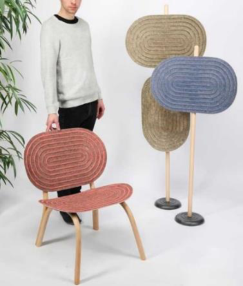
Halo chair The Organic project, designed by Phillip Hainke. The project explored the development of new materials from renewable resources. The designed “Halo chair” was made from hemp and casein, which demonstrated the strength and possibilities of lightweight materials. A binder consisting of calcium hydroxide and casein was used to press hemp fibers and wood chips into a solid shape. Through extensive preliminary research, the optimal composition and structure were found to obtain a sandwich material covered with hemp fiber felt and hemp slice core, which was stable and light (see Figure 1).
Human Systems Engineering and Design (IHSED 2021) https://openaccess.cms-conferences.org/#/publications/book/978-1-7923-8987-0
Figure 1. Halo chair Figure 2. Hem panels soundproof panel
Hem panel The HEM PANEL project was designed by Belgian designer Romy di Donato. Designer worked with cannabis and made a set of soundproof panels made from hemp fibers. This special natural bio-based material was a good noise barrier. It is an ideal sound insulation board material (see Figure 2).
The soundproof panels made from natural hemp were blended perfectly with the surroundings. Hemp fiber has natural antibacterial properties and the ability to repel ultraviolet light, and is very easy to grow. It has broad prospects in various industries, and will be bring a lot of economic and environmental opportunities.
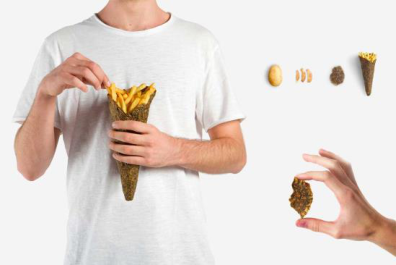
Peel Saver The project was to design a fully biodegradable potato wrapper made from potato skins (see Figure 3). Potato skins were made of starch and fiber, which were impregnated and naturally dried to gain the ability to adhere for molding. After they were used up, they can be fertilizer for plants (Li and Yong, 2014; Hanani et al. 2014).
The use time of traditional packaging is very short, towards unrecyclable garbage when used up (Van der Ryn and Stuart, 2013; Davis et al. 2006). “Peel Saver” can be as a sustainable solution to replace plasticized paper packaging. It presented a different perspective for new materials of packaging, which were made from production waste. The project solved the problem of discarded street food packaging by turning bio-waste into a resource.
Human Systems Engineering and Design (IHSED 2021) https://openaccess.cms-conferences.org/#/publications/book/978-1-7923-8987-0
Figure 3. Peel Saver packaging
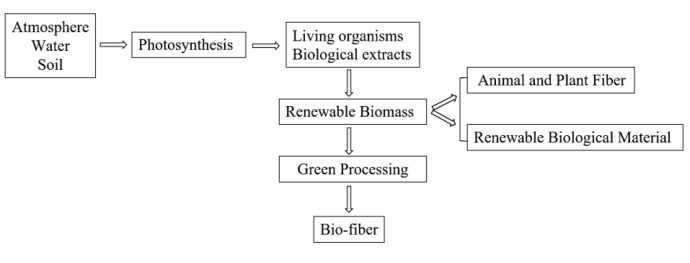
MATERIALS AND PROCESSING METHODS Biomass mainly refers to lignocellulosic waste, such as straw, and the environmentally friendly chemical products and green energy produced from it (Yinon et al. 2018; Clark, 2005). The bio-fiber refers to the fiber made of living organisms or biological extracts, which is a kind of fiber derived from the renewable biomass produced through photosynthesis by using the atmosphere, water and soil (Murugan et al. 2018; Getme et al.2020). Bio-fiber can be divided into two categories, one is the direct use of animal and plant fiber, the other is renewable biological material. The monomer can be used for fiber processing, and then through synthetic processing into various fibers. Figure 4. shows the generating and processing of Bio- fiber. In the study of processing methods, the green processing methods of cellulose fiber are more concerned at present. Including pulp preparation and solvent preparation of cellulose fiber (Singh et al. 2020; Hameed and Qipeng, 2010; Sun et al. 2015) (see Figure 4).
Figure 4. Generating and processing of Bio-fiber
Human Systems Engineering and Design (IHSED 2021) https://openaccess.cms-conferences.org/#/publications/book/978-1-7923-8987-0
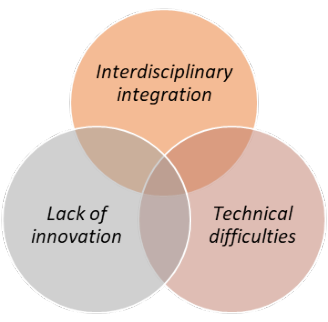
PROBLEMS AND SOLUTIONS The use of biological materials and technology to develop clothing is still in the basic research stage. From research and development to industrialization, it involves gene technology, microorganism, biochemical technology and other cross complex. At present, there are the following problems (see Figure 5).
Figure 5. Problems facing the design of biomaterials
Interdisciplinary integration Biological clothing engineering requires the cooperation and reference of interdisciplinary personnel, such as material experts, biochemists, sociologists, artists and designers, to accelerate the results.
Technical difficulties It is still in the basic research stage, involving many key links, long process and great difficulty, including gene technology, industrial microbiology, biochemical technology, etc.
Lack of innovation Textile fiber technology for clothing production has been stuck in the range of cotton, linen and traditional bio-based fiber for a long time. It lacks the invention and innovation of the new biomaterial for fashion.
In order to realize the large-scale application of biological materials in clothing, it is
Human Systems Engineering and Design (IHSED 2021) https://openaccess.cms-conferences.org/#/publications/book/978-1-7923-8987-0 necessary to construct the ecological environment for the development of biomaterial clothing, to solve the problems such as the technical shortage of new products, quality control and the defects of product design. Some suggestions and approaches are as follows:
Combine with bio-technology, energy conservation and environmental protection, waste utilization, functional improvement and application.
Emphasis on the development of safety and standardization technology.
Increase the cooperation of the government, enterprises, schools and scientific research institutions in the biomaterials and textile industry chain.
Strengthen international exchanges and cooperation, and Implement training and innovation platforms.
Nowadays, interdisciplinary integration was regarded as a technical characteristic of the development of the industry. The redesign of conventional materials would be an important idea for the development of bio-clothing. Biomaterial clothing requires a multidisciplinary collaboration of material experts, biochemists, artists and designers to accelerate results. Product innovation is an urgent problem in the garment industry. It should be combined with bio-technology, energy conservation and environmental protection, waste utilization, functional improvement and application. It should carry out replacement innovation of materials, processes and products as well.
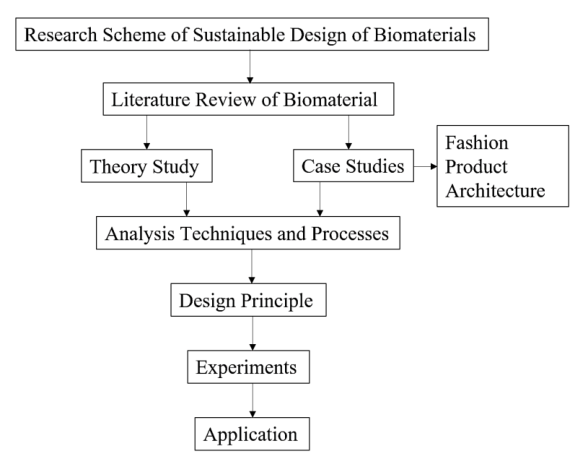
RESEARCH SCHEME On the basis of analysis of the examples, a theoretical framework towards the research of biomaterial fashion design is established, which provides a theoretical and practical basis for further research. Figure 6 shows the study scheme below.
Human Systems Engineering and Design (IHSED 2021) https://openaccess.cms-conferences.org/#/publications/book/978-1-7923-8987-0
Figure 6. Research Scheme of biomaterial fashion design
CONCLUSIONS
The whole processing and production of making clothing were big challenge to environmental protection. Therefore, solutions are urgently needed. A study has been carried out of sustainable design of biomaterials for future life. Some examples from different fields, such as product, architecture, installation as well as fashion were collected. At the same time, the materials and related processing methods were summarized and a research scheme by using Biomaterials for fashion was established as well. This paper analyzed the main problems and challenges in the design of biomaterials. Some suggestions and solutions were proposed.
REFERENCES
Green, J. (2015). Designed for the future : 80 practical ideas for a sustainable world (First ed.). New York, New York: Princeton Architectural Press. Yang, Xiaohan, et al. (2019). Biodesign research to advance the principles and
applications of biosystems design. Catts, O., Zurr, I. (2006). Towards a new class of being-The Extended Body.
Artnodes, 6(2), 1-9. LI, J., Yong W. (2014). Application of the Green Ecological Design in Packaging Design. Packaging Engineering 35.4: 5-8.
Human Systems Engineering and Design (IHSED 2021) https://openaccess.cms-conferences.org/#/publications/book/978-1-7923-8987-0
Hanani, ZA., Nur, Y. H. Roos, J. P. (2014). Use and application of gelatin as potential biodegradable packaging materials for food products. International journal of biological macromolecules 71: 94-102. Van der Ryn, S, Stuart C. (2013). Ecological design. Island press, Davis, Georgina., J. H. Song. (2006). Biodegradable packaging based on raw
materials from crops and their impact on waste management. Industrial crops and products 23.2: 147-161. Bar-On, Yinon M., Rob P, Ron M. (2018). The biomass distribution on Earth. Proceedings of the National Academy of Sciences 115.25: 6506-6511. Clark, James H. (2005). Green chemistry and environmentally friendly
technologies. Green separation processes: 3-18. Rajesh, Murugan, et al. (2018). Dynamic behaviour of woven bio fiber composite. BioResources 13.1: 1951-1960. Getme, Abhijit Sudamrao., Brijesh P. (2020). A review: bio-fiber’s as reinforcement
in composites of polylactic acid (PLA). Materials Today: Proceedings 26: 2116-2122. Singh, Anshu A., et al. (2020). Green processing route for polylactic acid–cellulose fiber biocomposites. ACS Sustainable Chemistry & Engineering 8.10: 4128- 4136. Hameed, N., Qipeng G. (2010). Blend films of natural wool and cellulose prepared
from an ionic liquid. Cellulose 17.4: 803-813. Sun, Haibo, et al. (2015). Dissolution of cellulose with a novel solvent and formation of regenerated cellulose fiber. Applied Physics A 119.2: 539-546.
Human Systems Engineering and Design (IHSED 2021) https://openaccess.cms-conferences.org/#/publications/book/978-1-7923-8987-0
LISTED IN THE AHFE DIGITAL BOOKSTORE CATALOGUE
Explore the complete digital volume
Human Systems Engineering and Design (IHSED2021): Future Trends and Applications
Read this individual research paper free through the original publisher, or explore the full digital proceedings book.
ISBN 978-1-7923-8987-0
Explore this ISBN in the AHFE Bookstore ↗Listed in the July 2026 bookstore catalogue; search by ISBN to confirm current availability · Digital book purchase optional