Akane Matsumae, Sei Hadano (2021). How an Incorrect Decision Caused by Peer Pressure and Personality Affects Regret. In: Human Systems Engineering and Design (IHSED2021): Future Trends and Applications. AHFE Open Access, vol. 21. https://doi.org/10.54941/ahfe1001115
The authors conducted experimental research using two examinee groups, one with peer pressure and one without, to compare the intensity of regret for an incorrect decision. The results show statistically significant differences between the two groups, depending on whether they submitted to peer pressure. Those who changed their decision due to peer pressure showed significantly greater regret for their decision than those who did not change their answer, while there was no significant difference between those who changed and those who did not change where no peer pressure was involved. The authors also analyzed the results from the perspective of each examinee’s Big Five personality characteristics, and the results suggested a negative correlation between an extraverted personality and the intensity of regret among those who did not change their decision despite peer pressure to do so.
How is regret affected by an incorrect decision when that decision is made because of peer pressure? Regret is defined as the negative, cognitively based emotion that we experience when realizing or imagining that our present situation would have been better had we acted differently (Zeelenberg, 1999). In relation to the decision making, it is the typical emotion we may feel for incorrect decisions. Ueichi et al. examined whether regret is greater when retaining or when changing a decision (Ueichi & Kusumi, 2004). Dohke et al. designed a scenario where people retained or changed a decision with or without a justified reason, and asked examinees to guess the intensity of regret of the person in the scenario who made an incorrect decision (Dohke & Murata, 2007). The results showed that a decision made with a justifiable reason lessened regret, while a decision lacking such a reason increased regret, regardless of whether the decision was retained or changed. Nakanishi et al. asked examinees to decide whether to retain or to change a decision, and then told them that their final decision was incorrect, after which they asked them to indicate the intensity of their regret (Nakanishi et al., 2015). As seen in these previous studies, the intensity of regret can vary, depending on the situation in which the decision was made and on whether the original decision was retained or changed. However, the impact of peer pressure on the intensity of regret after making incorrect decisions has been under-researched, although people often experience its impact. The purpose of this study is to experimentally understand the effect of peer pressure on the intensity of regret for an incorrect decision.
METHODOLOGY
Overview The authors conducted comparative experimental research using two examinee groups, one with peer pressure and one without, to compare the intensity of regret provoked by an incorrect decision during designed experimental tasks, as described below. Forty- seven university students between the ages of nineteen and twenty-five in Japan participated in this experiment. They were assigned two independent questions, with ninety-four questions answered in all, and took the Big Five personality test to factor in the effect of their personality on this experiment.
Experimental Procedure Experimental Task. The experimental tasks used in Asch’s experiment were referred in order to generate peer pressure in examinees (Asch, 1955). Examinees were individually asked two independent questions each regarding an experimental task.
Human Systems Engineering and Design (IHSED 2021) https://openaccess.cms-conferences.org/#/publications/book/978-1-7923-8987-0
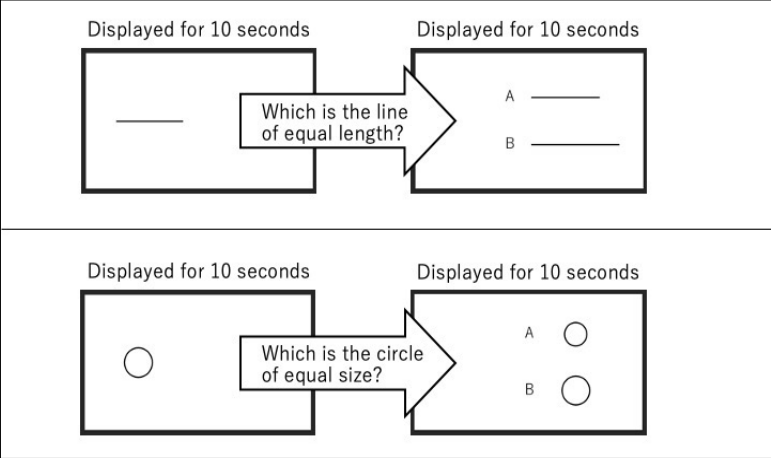
The questions could be answered by A or B, and both answers were incorrect. The experiment was conducted online, one-on-one, be-tween the examiner and the examinee. Two images were presented to the examinee for 10 seconds each using a screen-sharing function, and the examinee was asked to select a line of equal length, A or B, though both were incorrect answers. In the same way, the second question prompted examinees to choose a circle of equal size (Figure 1).
Figure 1. Questions assigned to each examinee: both A and B are incorrect answers.
The examiner assigned each examinee conditions both with peer pressure and without throughout the experimental task, alternating with the two consecutive questions above. The images shown to examinees for the final decision were slightly changed to induce them to change their answer, as they tended to retain the same answer otherwise. Since whether a decision was retained or changed is also known to be a major factor affecting regret, the experiment needed a balanced number of responses between them to compare. The order of these two questions was equally balanced among examinees, and the length or size of A/B were also balanced in advance to maintain equal conditions for the choice. To better observe the effect of peer pressure on regret, the experiment was care-fully designed to eliminate other major factors suggested in previous studies that may otherwise have affected the examinees’ regret. For instance, the experimental task above limited each image display to ten seconds, and excluded cues and factors to avoid the known effect of pursuit on regret: the deeper the pursuit, considering as
Human Systems Engineering and Design (IHSED 2021) https://openaccess.cms-conferences.org/#/publications/book/978-1-7923-8987-0 many factors as possible for the best result, the greater the regret evoked (Isobe et al., 2008).
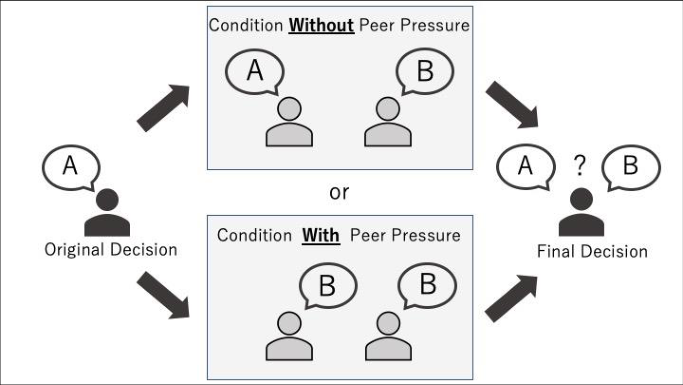
Peer Pressure. After answering the first question, the examinee was informed of two other examinees’ “answers” (which were actually prepared by an examiner in response to the examinee’s own answers). If the examinee originally answered A to the questions, he/she was told either that the others had also answered “A and B” (to eliminate peer pressure) or had answered “B and B” (to create peer pressure). The examinee was then asked the same questions again, and given the opportunity to change their answer (Figure 2).
Figure 2. Designed experimental conditions when the examinee first answered “A” Regret Evoking. Regret is defined as an emotion that arises when the outcome of a choice differs from one's expectations or hopes in a negative way (Ueichi & Kusumi, 2004). In this experiment, regret is evoked by lost profits, not by damages such as penalties given to examinees. The examiner told examinees that gifts would be prepared for those who answered correctly. After the examinee chose an incorrect answer (by design), the examinee was asked to evaluate how much regret they felt on a four-point scale: 1) I don't regret my decision, 2) I don’t regret my decision much, 3) I regret my decision a bit, and 4) I regret my decision. Gifts were still given to all examinees after the experiment.
Follow-Up Questionnaire. Although the experiment made efforts to eliminate
Human Systems Engineering and Design (IHSED 2021) https://openaccess.cms-conferences.org/#/publications/book/978-1-7923-8987-0 factors other than peer pressure that may affect regret as described above, the examinees were monitored on a subjective four-point scale as to how well they actually recognized these factors known in previous studies: sincereness (Dohke & Murata, 2007), confidence (Nakanishi et al., 2015) and pursuit (Isobe et al., 2008)toward the decision. The authors also asked examinees 1) why they retained or changed their decisions, and 2) why they regret or do not regret their decisions.
Personality Test Each examinee was assigned a TIPI-J test to examine the effect of the examinee’s personality on his/her regret. TIPI-J is the Japanese version of the TIPI (Oshio et al., 2014), Ten Item Personality Inventory, widely used as a rough measure of the Big Five personality dimensions: extraversion, agreeableness, conscientiousness, neuroticism and openness(Gosling et al., 2003).
RESULTS AND DISCUSSION
Eighty-six datasets from the forty-three examinees were examined as valid data. Four out of the forty-seven examinees who noticed that the examiner controlled either other examinees’ “answers” or the length/size of the line/circle displayed the second time were excluded from the dataset to be analyzed below.
The Effect of Peer Pressure on Regret
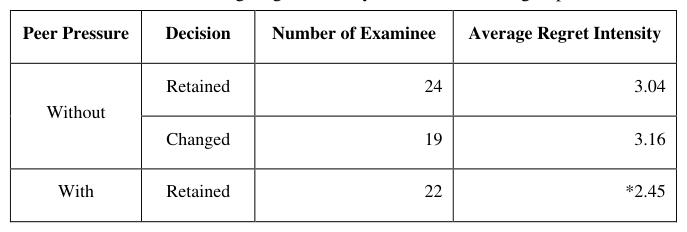
Table 1 shows the average regret intensity of four examinee groups who retained or changed their decision with or without peer pressure. A t-test (two-tailed) was applied to examine whether the difference in averages of regret intensity between two specific groups was statistically significant.
Table 1: Average regret intensity for each examinee group Peer Pressure Decision Number of Examinee Average Regret Intensity
Human Systems Engineering and Design (IHSED 2021) https://openaccess.cms-conferences.org/#/publications/book/978-1-7923-8987-0
The results show significant differences between regret intensity averages for the retained and changed decisions made with peer pressure (t(34) = 3.58, p = 0.001), as those who changed their decision under peer pressure indicated greater regret for their incorrect decision. No statistically significant difference was found between regret intensity averages of retained and changed decisions made without peer pressure (t(33) = 0.36, p = 0.723). The results above suggest that peer pressure leads to greater regret for incorrect decisions among those who changed their decision.
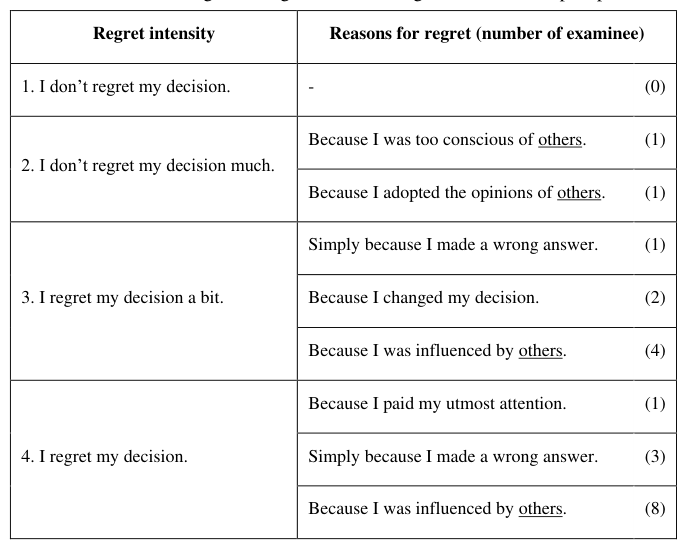
Table 2 highlight the comments of those who changed their decision with peer pressure and may help elucidate the feelings of the group that significantly shows greater regret. The underlined words in Table 2 suggests, peer pressure was a major cause of regret. This follow-up questionnaire also supports the results indicating that incorrect decisions that were influenced by the decisions of others (peer pressure) resulted in greater regret, while those who stuck with their own decisions experienced less regret. The authors examined the influence of other potential factors suggested by existing studies (pursuit, confidence and sincereness toward the decision) and confirmed that those influences were not significant in this experiment.
Table 2: Reasons for regret among those who changed decisions with peer pressure Regret intensity Reasons for regret (number of examinee)
Human Systems Engineering and Design (IHSED 2021) https://openaccess.cms-conferences.org/#/publications/book/978-1-7923-8987-0
The Effect of Personality
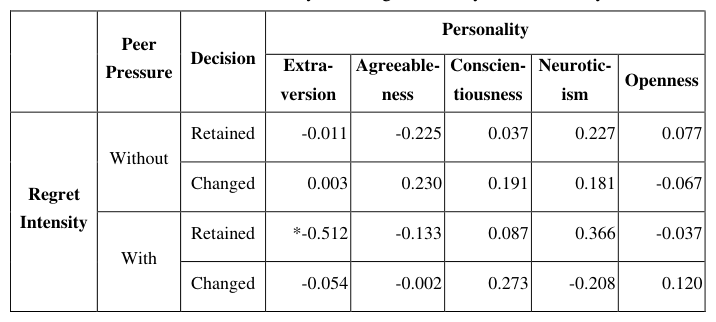
Table 3 shows the results of the correlation analysis of the association between personality and regret intensity of the four examinee groups who retained or changed their decision with or without peer pressure. Almost no statistically significant results were found, though there was a significant moderate negative correlation between regret intensity and an extravert personality for those who retained their decision even with peer pressure (r= - 0.512, p=0.015).
The results of these analyses show that regret is greater/lesser when those with low/high extraversion retained their incorrect decision against peer pressure.
Table 3: Correlation Analysis of Regret Intensity and Personality Personality Peer
CONCLUSIONS
The results show statistically significant differences between the two examinee groups, depending on whether they submitted to peer pressure. Those who changed their decision due to peer pressure showed significantly greater regret for their decision than those who did not change their answer, while there was no significant difference between those who changed and those who did not change where no peer pressure was involved. Interviews revealed that incorrect decisions that were influenced by others’ decisions (peer pressure) resulted in greater feelings of regret, while those who stuck with their own decisions had less regret. The one effect of personality on regret that was observed was where low extraversion was correlated with greater regret and high extraversion was correlated with less regret when the incorrect decision was retained even in the presence of peer pressure to change it. The knowledge obtained from this study can be applied to experience design for decision
Human Systems Engineering and Design (IHSED 2021) https://openaccess.cms-conferences.org/#/publications/book/978-1-7923-8987-0 making.
ACKNOWLEDGMENTS
This study was supported by JSPS KAKENHI (JP20K20119).
ETHIC STATEMENT This study was approved by the ethical review board, and written informed consent was obtained from participants.
REFERENCES
Asch, S. E. (1955). Opinions and Social Pressure. Scientific American, 193(5), pp.31–35. Dohke, R., & Murata, K. (2007). Regret in decision-making: When maintaining the
status quo leads us to regret. The Japanese Journal of Psychology, 23(1), pp.104–110. Gosling, S. D., Rentfrow, P. J., & Swann, W. B., J. (2003). A very brief measure of the Big-Five personality domains. Journal of Research in Personality, 37(6), pp.504–528. Isobe, A., Hisatomi, T., Matsui, Y., Ui, M., Takahashi, N., Oba, K., & Takemura, K.
(2008). Construction of a Japanese version of the “Regret and Maximization Scale” in decision making. The Japanese Journal of Psychology, 79(5), pp.453–458. Nakanishi, D., Igawa, J., & Shiwa, S. (2015). The effect of confidence in decision making on feelings of regret. Japanese Journal of Research on Emotions, 22(3), pp.118–127. Oshio, A., Abe, S., Cutrone, P., & Gosling, S. D. (2014). Further validity of the
japanese version of the ten item personality inventory (TIPI-J): Cross- language evidence for content validity. Journal of Individual Differences, 35(4), pp.236–244. Ueichi, H., & Kusumi, T. (2004). Change in feelings of regret over time: Relation to decision-making style, behavior, and coping methods. The Japanese Journal of Psychology, 74(6), pp.487–495. Zeelenberg, M. (1999). The use of crying over spilled milk: A note on the
rationality and functionality of regret. Philosophical Psychology, 12(3), pp.325–340.
Human Systems Engineering and Design (IHSED 2021) https://openaccess.cms-conferences.org/#/publications/book/978-1-7923-8987-0
LISTED IN THE AHFE DIGITAL BOOKSTORE CATALOGUE
Explore the complete digital volume
Human Systems Engineering and Design (IHSED2021): Future Trends and Applications
Read this individual research paper free through the original publisher, or explore the full digital proceedings book.
ISBN 978-1-7923-8987-0
Explore this ISBN in the AHFE Bookstore ↗Listed in the July 2026 bookstore catalogue; search by ISBN to confirm current availability · Digital book purchase optional