Mireya Zapata Rodríguez, Silvia Cajamarca (2021). Gamification in the Teaching-Learning Process for Initial Education Children. In: Human Systems Engineering and Design (IHSED2021): Future Trends and Applications. AHFE Open Access, vol. 21. https://doi.org/10.54941/ahfe1001137
The main objective of this research is to carry out an analysis of the impact of this didactic strategy in the teaching-learning process through a quasi-experimental study and a comparative analysis in initial education students, aimed at generating an innovative proposal for the educational field The present investigation began with the application of a pretest, to determine the knowledge before the intervention with the gamification tool designed for mobile devices. After the intervention, a post-test was applied to both control and experimental groups. The result was that the experimental group achieved better results compared to the control group. Finally, it is concluded that the learning obtained when working with a technological tool is significant, as part of a didactic strategy.
This article focuses on the educational field of initial education, which, supported by technology, aims to contribute to the teaching-learning process of human body in children from 3 to 4 years old, through an interactive application that complies with characteristics of a gamification game.
In the teaching-learning process, it is recommended to develop activities and pedagogical strategies that promote an innovative education. Always contributing to the development of skills, aimed at the interaction, selection and transformation of the knowledge acquired into wisdom, so that they can apply it in their daily context (Ausubel, 1983). Technological applications aimed at improving educational processes are shown in (Polo-Mantuano, Pillajo-Yugcha, Zapata, 2021), where it is evidenced that the insertion of technology improves the quality of education.
In this context, children learn by playing, and it is not considered a waste of time because while playing they learn to respect rules, take turns, solve obstacles and learn from mistakes, which they no longer make on a second attempt. With this game mechanic the aim is to achieve three objectives: first to create a link between the students and the contents of the subjects, second to look for technological tools to counteract boredom and motivate the teaching-learning process. And third, optimize and reward students in those tasks in which there is no incentive but learning (Gaitán, 2016).
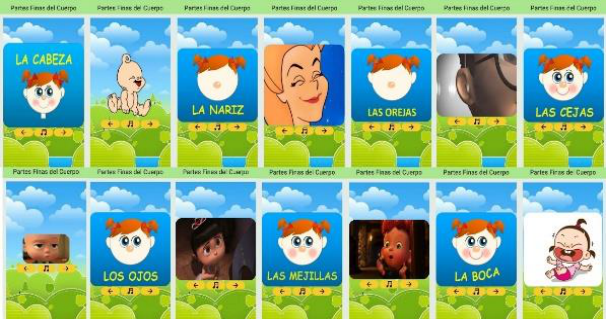
In this article a tool is also offered, aimed at the first levels of teaching-learning, particularly at the initial level I. The research consists on implementing gamification in the teaching-learning of human body by means of an app designed for Android mobile devices (see Figure. 1). Children learned to differentiate each of their body parts through some games in which images of each of the body parts are presented, starting with their thick parts such as: head, trunk, upper and lower extremities, to finish identifying in their body and in the rest of children. With this, boys and girls achieve the skill acquired, because they learn not only by listening, but also by playing (Ackerman, 2017 and Ortiz, 2018).
Human Systems Engineering and Design (IHSED 2021) https://openaccess.cms-conferences.org/#/publications/book/978-1-7923-8987-0
Figure 1. Main screen and application window METHODOLOGICAL DESIGN
The focus of this research was mixed, quantitative and qualitative data were collected and analyzed from children participating in this study. Likewise, a comparative study with a quasi-experimental design is presented, generating an innovative proposal for this educational field.
Human Systems Engineering and Design (IHSED 2021) https://openaccess.cms-conferences.org/#/publications/book/978-1-7923-8987-0
In this research, the following hypothesis was raised: “the application of gamification as an educative strategy has a positive impact on the teaching-learning process of the human body in initial education children”. In order to test this hypothesis, variables of the research related to virtual objects and the teaching- learning process were defined, and later quantitative and qualitative data collection instruments were applied (Hernandez et al. 2016).
Objetives The sample consisted on 22 boys and girls of the initial level of 3 years, divided into two groups: control and experimental of 11 children each. We only worked with a parallel that was already established in the intervention institution. A pre-test evaluation was applied to both groups to establish the baseline regarding their mastery of knowledge of the parts of human body.
The learning process with the control group was carried out in a traditional way, and an observation record was used for evaluation. With the participants of the experimental group, the learning of the same subject was carried out, but with the help of a mobile device or a computer with the installed app of the designed gamification game with the parts of the human body, which includes the registration of the activities of each participant in the same application, these data were used for the evaluation of the post-test. Finally, the data obtained from the investigation was compared in both, the control and the experimental group.
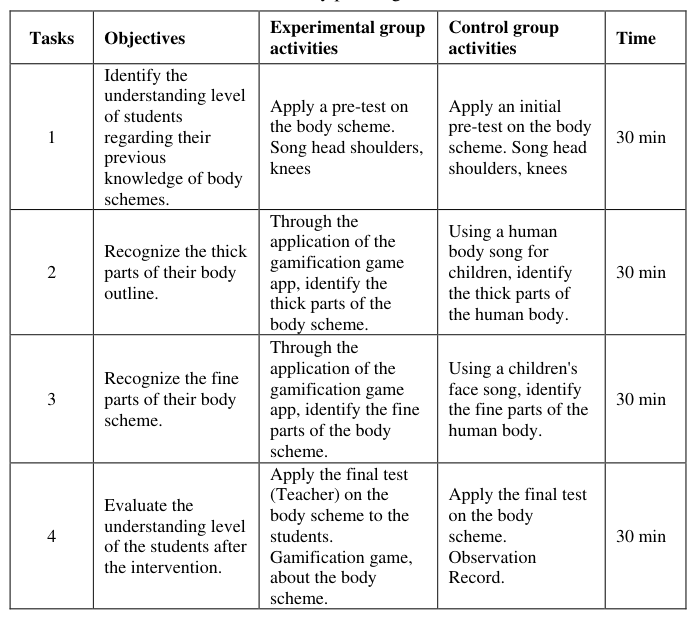
Learning sections The learning sections proposed for the intervention with the participating chil-dren in this study can be seen in Table 1. Almost similar for the two groups with the difference that the control group was worked through the Zoom platform, with a traditional methodology and the experimental group with the gamification game developed. The fundamental basis of this study consists of 4 sections made with the game app about the body scheme.
Results
Next, the analysis of the descriptive statistics obtained from the application of the pre- test and post-test to the research groups is presented, as well as the t-test, to verify its statistical significance.
Human Systems Engineering and Design (IHSED 2021) https://openaccess.cms-conferences.org/#/publications/book/978-1-7923-8987-0
Table 1. Activity planning for children Tasks Objectives Experimental group activities Control group activities Time
The total sample studied was 22 boys and girls, with an average age of the participants of 3.40 years. Regarding gender, we worked with 10 boys and 12 girls. Both, experimental and control intervention groups consisted of 11 children. Pre-test results
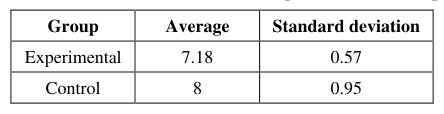
Table 2 shows the results of the pre-test evaluation for the experimental and control groups. As can be seen, the average in both groups is very similar, which indicates that there is a homogeneity of knowledge regarding the topic evaluated in the entire sample.
Table 2. Pre-test statistical data in the sample on a total of 12 points Group Average Standard deviation
Human Systems Engineering and Design (IHSED 2021) https://openaccess.cms-conferences.org/#/publications/book/978-1-7923-8987-0
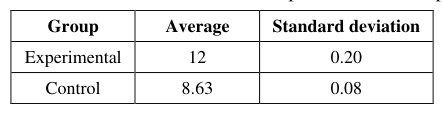
Post-test results In the final stage, a post-test evaluation was applied with the results shown in Table 3 for the experimental and control groups. As can be seen in the results, the experimental group obtained an academic performance with an average of 12, surpassing the control group that obtained 8.63 points.
The values obtained show that the experimental group presents a difference of 3.37 points over the control group. The difference illustrated in Figure. 2 is attributed to the use of the gamification application designed for the children participating in this study to learn the parts of the human body. The present study shows that using this type of educative strategy helps children to improve their learning process through a technological tool, focus on to the game, that is striking and entertaining and can be used at any time without the need of a teacher (Manotas, 2020).
Table 3. Post-test statistical data in the sample on a total of 12 points Group Average Standard deviation
Evaluation Results
9
8
7
Score Ge, Gc
6
5
4
3
Pre-test Post-Test Control group Experimental group
Figure 2. Pre-test and post-test average of evaluation for control and experimental groups The results of average evaluation values were subjected to the t-test for the respective analysis. We found a significant relation between academic performance and the
Figure available in the original PDF paper.
Human Systems Engineering and Design (IHSED 2021) https://openaccess.cms-conferences.org/#/publications/book/978-1-7923-8987-0 designed gamification app, with t(22)=0.008, p < 0.05, demonstrating the fulfillment of the proposed hypothesis, which confirms that students who work with a technological tool as part of their methodological strategy have better results in the teaching-learning process.
CONCLUSIONS
For this research, an application for children of the parts of the human body was developed. It was designed for easily accessible Android systems, so that it was friendly and dynamic for 3-year-old initial education children, as an innovative educative resource in the teaching and learning of the human body, which had positive results evidenced by performance the greater part of the group of participants who used the gamification resource. The experimental group used the gamification application, obtaining as a result a better academic performance compared to the control group. Similarly, referring to the level of knowledge about the human body, the learn-ing level was better in the students that made up the experimental group, which shows a positive impact, as well as the benefit of working with a gamification application that contributes to the teaching-learning process as an educative strategy.
REFERENCES
Ausubel, D. (1983). Significado y aprendizaje significativo. Psicología Educativa. Un punto de vista cognoscitivo, 23-37, Trillas, México. Polo-Mantuano J., Zapata M. (2021) Active Methodologies for Physics Teaching
Through Virtual Learning Environments. In: Russo D., Ahram T., Karwowski W., Di Bucchianico G., Taiar R. (eds) Intelligent Human Systems Integration 2021. IHSI 2021. Advances in Intelligent Systems and Computing, vol 1322. Springer, Cham. https://doi.org/10.1007/978-3-030-68017-6_39 Pillajo-Yugcha M., Zapata M. (2021) Virtual Environments in the Mathematics Teaching-Learning Processes in High School. In: Ahram T.Z., Falcão C.S. (eds) Advances in Usability, User Experience, Wearable and Assistive Technology. AHFE 2021. Lecture Notes in Networks and Systems, vol 275. Springer, Cham. https://doi.org/10.1007/978-3-030-80091-8_39 Zapata M., Gordón J., Caicedo A., Alvarez-Tello J. (2021) Social Robotic Platform
to Strengthen Literacy Skills. In: Zallio M., Raymundo Ibañez C., Hernandez J.H. (eds) Advances in Human Factors in Robots, Unmanned Systems and Cybersecurity. AHFE 2021. Lecture Notes in Networks and Systems, vol 268. Springer, Cham. https://doi.org/10.1007/978-3-030-79997-7_18 Gaitán, V. (2016). Blog, “Gamificación: el aprendizaje divertido”, [On-line] http://www.educativa.com/blog-artículos/gamificación-el aprendizaje- divertido/ Ackermann, E. (2017). Constructing Knowledge and transforming the world. En M.
y. Tokoro, A learning zone of one´s own: Sharing representations and curriculum reform (pp.236-243)-Amsterdam
Human Systems Engineering and Design (IHSED 2021) https://openaccess.cms-conferences.org/#/publications/book/978-1-7923-8987-0
Ortiz, A, Jordán, J, y Agredal, M. (2018). Gamificación en educación: una panorámica sobre el estado de la cuestión”, Educ. Pesqui Hernández, R., Fernández, C., y Baptista,p. (2016). Metodología de la investigación.
México: Mc Graw Hill Manotas, A. L. (2020). Reflexión sobre la implementación de las TIC como estrategias y medios para el proceso de enseñanza aprendizaje” Alfabetización digital REDEM.
Human Systems Engineering and Design (IHSED 2021) https://openaccess.cms-conferences.org/#/publications/book/978-1-7923-8987-0
LISTED IN THE AHFE DIGITAL BOOKSTORE CATALOGUE
Explore the complete digital volume
Human Systems Engineering and Design (IHSED2021): Future Trends and Applications
Read this individual research paper free through the original publisher, or explore the full digital proceedings book.
ISBN 978-1-7923-8987-0
Explore this ISBN in the AHFE Bookstore ↗Listed in the July 2026 bookstore catalogue; search by ISBN to confirm current availability · Digital book purchase optional