Ana Alvarez, Mireya Zapata Rodríguez, Raquel Ango, Eric Martínez Tocoronte (2021). Postural hygiene in the workplace for making masapan crafts. In: Human Systems Engineering and Design (IHSED2021): Future Trends and Applications. AHFE Open Access, vol. 21. https://doi.org/10.54941/ahfe1001153
A worker may suffer muscle aches or numbness in the legs and fatigue after an eight-hour workday in which they occupy a permanent position for a long time. Considering minimum requirements of postural hygiene and ergonomics, we managed to avoid these discomforts without suffering health problems in the medium and long term. This study is part of a population of fifteen artisans who make marzipan handicrafts in the town of Calderón in Ecuador. The process arises from a transformation of the bread dough into an artisan dough more than 80 years ago, consisting of an ancestral art that needs quality from the obtaining of the dough to the artistic details of the figures, where the artisan makes his creations without realizing that they are taking poor posture in their workplace. The study analyzes the operation of the Manufacture of the Glue that is carried out standing up, mixing the ingredients to obtain the dough, and it is cooked until it obtains a homogeneous consistency. It is a repetitive activity in each of the production cycles. The OWAS and RULA methods were applied to assess the risks produced by physical loads derived from the activities carried out and the postures' global characterization, which were observed and classified in various possible combinations. The process is at level 3. That is, it requires the redesign of the task and increasing the active pauses. As a result, it was obtained that the risk category is level 2. The analyzed posture has the potential to cause damage to the musculoskeletal system.
The purpose of promoting a genuine preventive culture involves society as a whole, protecting workers from occupational hazards involves planning prevention from the design of the business project, the initial assessment of the risks inherent in the work and its periodic updating as circumstances change (Garcìa Laureano, 2019). Quality of life involves creating, maintaining and improving the working environment, whether it be its physical conditions (hygiene and safety) or its psychological and social conditions (Tejada Betancourt, 2020). El Throughout history, man has faced accidents under various forms and circumstances, from activities that are carried out on a daily basis to the most complex ones. The case of production is a clear example, here the risk due to the activities carried out in organizations may, in certain cases, imply an attack on the health and well-being of the person (Salgado, 2020). At world level, occupational health is considered a pillar in the development of each country, this discipline focuses on the protection of workers' health, prevention of work accidents, professional and occupational risks in economic activities (Heredia, 2021). In this context, hygiene in industry makes possible to preserve the health of workers in their labor, where prevention plays an important role in avoiding accidents or occupational diseases (S. Meza Sánchez, 2020). The definition of health established by the WHO presents the term as the state of complete physical, mental and social well-being and not merely the absence of harm or disease (Robledo, 2020) The International Labor Organization (ILO) estimates that, in developing countries, the percentage of annual occupational accidents and diseases is between 2% and 11% of the Gross Domestic Product (GDP) (Heredia, 2021). This, in addition to affect the quality of life of workers, also means a social and economic cost. In Latin American countries the rate of work accidents and occupational diseases continues rising over the years, where only large corporations have occupational health programs (Medina, 2017), resulting in several companies that do not belong to this circle, their productivity is affected (S. Asensio Cuesta, 2020). The quantity of accidents and occupational diseases are alarming. These are caused by various risk factors regarding occupational hygiene such as: mechanical, physical, chemical, biological, electrical, psychosocial, locative and ergonomic (Trujillo, 2015) (Heredia F. Á., 2018) In Ecuador, according to the data of the most recent study of the Work Risks Directorate of the Social Security Ecuadorian Institute (SSEI), the most reported affections were those of the musculoskeletal system (Comercio, 2018), a large part of occupational diseases are related to the design of the workplace and the bad postures that workers take. In this sense, ergonomics seeks to improve the life of the user in designs and ergonomic developments (Sánchez, 2016) ,that is, this discipline deals
Human Systems Engineering and Design (IHSED 2021) https://openaccess.cms-conferences.org/#/publications/book/978-1-7923-8987-0 with the understanding of human interactions and the elements of a system, in order to optimize human well-being (Morales, 2021) (Muñoz, 2016). Ecuador is a country diverse in cultures and traditions, masapan crafts are a tradition of the residents of Calderón-Ecuador parish, which were declared as an intangible national heritage of Ecuador by the National Assembly in 2018 (Telegrafo, 2018). Its origins date back to pre-Columbian times, when the ancestors of this region made food for their agricultural and death rituals. The tradition continued for years until in 1938 it went from being an edible bread to a decorative craft; using white glue to protect colors and give them shine, thus with the passage of time the technique, procedures and materials have changed (Hora, 2019) (Telegrafo, 2018). In this context, the craftsmen in charge of their manufacture are mostly part of the masapan craftsmen association (MASARTE), where it has been reported that repetitive common movements in the manufacturing process have affected their health (Rivas, 2018). In this sense, the application of ergonomic methods such as Ovako Working Analysis System (OWAS) and Rapid Upper Limb Assessment (RULA) that allow evaluating jobs, providing reliable information to be analyzed and as a result proposing strategies for solution for a continuous improvement of their working conditions in order to avoid health problems (Sánchez, 2016) MATERIALS AND METHODS The ergonomic study was carried out at the Progressive Masapan Craftsmen Association (MASARTE). The organization works with a tradition of more than 80 years that passes from generation to generation, most craftsmen are elderly people who are exposed to repetitive movements that require the production of handicrafts, causing musculoskeletal disorders that are the main causes of absenteeism and premature retirement (C. Muñoz Poblete, 2012) The use of ergonomic evaluation methods allows knowing the workplace status and working conditions, it should be emphasized that the type of evaluation must be appropriate to the type of work (Ortiz, 2019). For this research, the RULA method was applied, which is used to determine the postural load in a repetitive and individual way (Diego, 2015), the other method used is OWAS, which, unlike the previous one, assesses globally all the postures adopted by a worker during the labors (Diego, 2015). PRINCIPLE
In order to carry out the study, three artisans who carry out the process of cooking the ingredients to obtain the dough were evaluated, where one of the most critical activities found is the repetitive movement of the spoon to achieve the desired mixture, the masapist with his experience defines when it is homogeneous. The RULA Method is applied to group A, which is obtained from the study of each of the members that compose it: Arm, Forearm and Wrist. Group B is composed of: Neck, Trunk and Legs. In both of them, the scores for the postural load of the task are defined. For the following ergonomic study, the OWAS method is used, which assesses the physical load derived from the postures adopted by the worker during the development of an activity. In this case, the posture of the standing craftsman is evaluated while carrying out the activity of kneading the dough.
Human Systems Engineering and Design (IHSED 2021) https://openaccess.cms-conferences.org/#/publications/book/978-1-7923-8987-0
DEVELOPMENT For the evaluation of group, A and B with the RULA method, the craftsman's
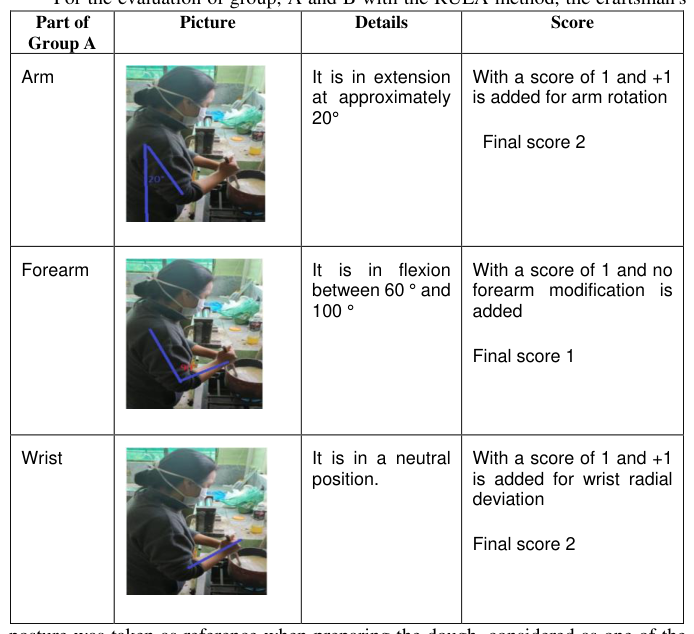
posture was taken as reference when preparing the dough, considered as one of the most critical activities. This static posture is evaluated due to repetitive movements that implies the activity and the conditions that it can cause to health. Group A evaluation by RULA method The measurements that are made in the posture to be evaluated are of the angles formed by the parts of the body respect to certain references, using the tables associated with the method shown in (Diego, 2015) (Arm, forearm and wrist scoring table), a score is assigned to that area of the body.
Table 1: Matrix of the data collected for group A In Table 1. Matrix of the data collected for group A (arm, forearm and wrist) of the RULA method determines the angle, details the condition and scores the part of the group. Once the assessment of the three parts of group A has been completed, the turn of the wrist is independently assessed with the help of the wrist turn table documented in (Diego, 2015). In this case, the position is one of medium pronation or supination, so a score of 1 is added. With the values obtained from each part of the group, the global score of group
Human Systems Engineering and Design (IHSED 2021) https://openaccess.cms-conferences.org/#/publications/book/978-1-7923-8987-0
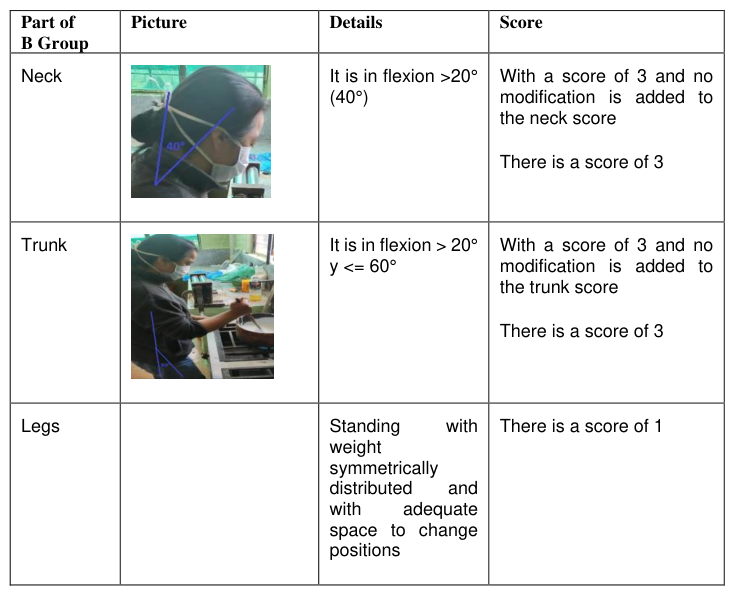
A is calculated obtaining 3, taking as reference the scales presented in (Diego, 2015). Group B evaluation by RULA method As in group A evaluation, the measurements are angular and are scored according to the tables associated with the method shown in (Diego, 2015). (Neck, trunk and legs scoring table), where the score is assigned to each area of the body.
Table 2: Data matrix collected for group B (neck, trunk and legs) of the RULA method, where the angle is determined, the state is detailed and the part of the group is scored.
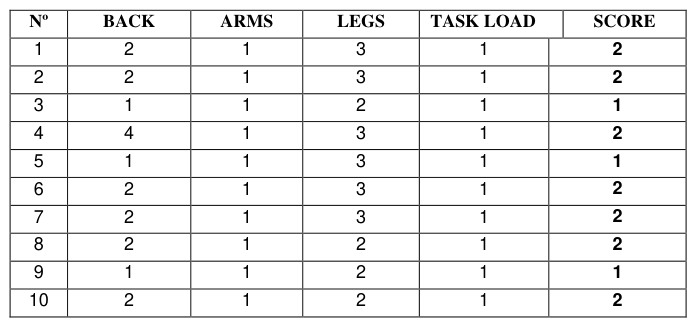
Human Systems Engineering and Design (IHSED 2021) https://openaccess.cms-conferences.org/#/publications/book/978-1-7923-8987-0 repeats it again. The score shows that the work cycle has 7 out of 10 observations (70%) where the postures have a risk level 2 equivalent to postures with the possibility of causing damage to the musculoskeletal system, while 30% of the other postures have a risk level 1 which is a normal and natural posture without harmful effects on the musculoskeletal system (Diego, 2015)
Table 3: Data and values matrix collection of OWAS method, where back, arms, legs and the task load evaluation are shown.
To obtain the global risk level of the back, arms and legs, the Risk Categories table of the body positions according to their relative frequency is used, which is found in [20], the relative frequency is determined and the percentages are obtained of the observations taken and their respective level of risk. For back; right back 30% (risk level 1), back bent 60% (risk level 2), back bent with twist 10% (risk level 1). For arms; both arms down 100% (risk level 1). For legs; standing 40% (risk level 1), on a straight leg 60% (risk level 2). The measurements that are made in the posture to be evaluated are of the angles formed by the parts of the body respect to certain references, using the tables associated with the method shown in (Diego, Evaluación postural mediante el método RULA, 2015)(Arm, forearm and wrist scoring table), a score is assigned to that area of the body. RESULTS Given the final score of 5 obtained with the RULA method, the process is at level 3, that is, the redesign of the task is required. With the study of the OWAS method, we determined that there are two critical postures, the back bent and on a straight leg with the risk category at level 2 in both cases, so the postures have the potential to cause damage to the musculoskeletal system, therefore, corrective actions are required in a near future (Diego, Evaluación Postural Mediante El Método OWAS. Ergonautas, 2015)
Human Systems Engineering and Design (IHSED 2021) https://openaccess.cms-conferences.org/#/publications/book/978-1-7923-8987-0
According to the results, it is determined that the postural risk is centered in the kneading activity, where repetitive movements are carried out and require a considerable force application. CONCLUSIONS The results of the execution of the RULA method in the activity of mixing ingredients for the dough show that the task needs to be redesigned because it maintains high possibilities of causing harm in the short or long term to the artisans who are frequently exposed to this activity. The risks present in the activities imply a problem for the occupational health and postural hygiene of those affected. The measures to be taken are postural changes, avoiding sudden and repetitive movements, which help to prevent disorders of the upper limbs of the body. With the help of the OWAS method, it is ruled out that the whole process of making masapan handicrafts causes occupational diseases related to the musculoskeletal system. However, these require corrective actions in the near future, on the contrary, it is evident that the dough baking and kneading processes are the tasks that affect the artisans, with the RULA method it is evident that the affections are centred in the upper extremities, arm, forearm and wrist, this is due to the nature of the ingredients to elaborate the dough, as they require constant movement and application of force to homogeneously integrate the ingredients. Design and build appropriate technologies in the short term as a preventive measure to eliminate dough handling, repetitive movements or incorrect and prolonged postures in the preparation tasks, and then analyze other risks such as noise generated by the equipment derived from electrical contact. ACKNOWLEDGEMENTS We must thank the MASARTE Association where women and men artisans from Calderon in Quito - Ecuador give us thousands of colorful figures made of marzipan and that with our researchers and the support of the authorities of the Universidad Tecnológica Indoamérica have allowed us to carry out this research. REFERENCES
C. Muñoz Poblete, J. V. (2012). Factores de riesgo ergonómico y su relación con dolor musculoesquelético de columna vertebral: basado en la primera encuesta nacional de condiciones de empleo, equidad, trabajo, salud y calidad de vida de los trabajadores y trabajadoras en Chile (ENETS) 2. 194- 204. Comercio, E. (07 de 06 de 2018). Cinco enfermedades más comunes en el trabajo . Diego, M. D. (2015). Evaluación Postural Mediante El Método OWAS. Ergonautas.
Ergonautas, https://www.ergonautas.upv.es/metodos/owas/owas- ayuda.php. Diego, M. D. (2015). Evaluación postural mediante el método RULA. Ergonautas, https://www.ergonautas.upv.es/metodos/rula/rula-ayuda.php. Garcìa Laureano, R. (2019). Seguridad y salud MF0075. Obtenido de Editorial Tutor
Formaciòn:
Human Systems Engineering and Design (IHSED 2021) https://openaccess.cms-conferences.org/#/publications/book/978-1-7923-8987-0 https://play.google.com/store/books/details/Seguridad_y_salud_MF0075?i d=aCaUDwAAQBAJ&gl=US Heredia, F. Á. (2018). Salud ocupacional y prevención: guía práctica. Bogotá:
Ediciones de la U. Heredia, F. Á. (2018). Salud ocupacional y prevención: guía práctica. Bogotá: Ediciones de la U. Heredia, F. Á. (2021). Salud ocupacional. Bogotá: Ecoe Ediciones. Hora, L. (28 de 01 de 2019). págs. https://lahora.com.ec/noticia/1102218296/calderon-cuna-de-artesanos-del- mazapan. Medina, E. G. (2017). Manual de salud ocupacional. Bogotá: El Manual Moderno
Colombia. Morales, G. G. (2021). La ergonomía como estructura de innovación en la ingeniería de proyectos de organizaciones productivas. Universidad Nacional de Colombia. Muñoz, J. E. (2016). Ergonomía básica . Bogotá: Ediciones de la U. Ortiz, J. R. (2019). Relación entre posturas ergonómicas inadecuadas y la aparición
de trastornos musculo esqueléticos en los trabajadores de las áreas administrativas que utilizan pantalla de visualización de datos en una empresa de la ciudad de quito . Ciencias de Seguridad y Defensa, 158-181. Rivas, R. R. (2018). Ingeniería humana: aspectos ergonómicos en el diseño industrial y en la producción. Tomo I. Buenos Aires: Nobuko. Robledo, F. H. (2020). Salud ocupacional: conceptos básicos. Bogotá: Ecoe
Ediciones. S. Asensio Cuesta, M. J. (2020). Evaluación ergonómica de puestos de trabajo.
Madrid: Paraninfo. S. Meza Sánchez. (2020). Higiene y seguridad industriaL. Instituto Politécnico Nacional. Salgado, J. B. (2020). Higiene y seguridad industrial. Instituto Politécnico Nacional. Sánchez, M. O. (2016). Fundamentos de ergonomía. Patria. Tejada Betancourt, L. (. (2020). Seguridad laboral y salud ocupacional. Universidad
abierta para Adultos(UAPA). Telegrafo, E. (17 de 05 de 2018). págs. https://www.eltelegrafo.com.ec/noticias/cultura/1/mazapan-patrimonio- cultural. Telegrafo, E. (29 de 05 de 2018). págs. https://www.eltelegrafo.com.ec/noticias/quito/1/figuras-mazapan- tradicion-calderon-quito. Trujillo, R. F. ( 2015). Seguridad ocupacional . Bogotá: Ecoe Ediciones.
Human Systems Engineering and Design (IHSED 2021) https://openaccess.cms-conferences.org/#/publications/book/978-1-7923-8987-0
LISTED IN THE AHFE DIGITAL BOOKSTORE CATALOGUE
Explore the complete digital volume
Human Systems Engineering and Design (IHSED2021): Future Trends and Applications
Read this individual research paper free through the original publisher, or explore the full digital proceedings book.
ISBN 978-1-7923-8987-0
Explore this ISBN in the AHFE Bookstore ↗Listed in the July 2026 bookstore catalogue; search by ISBN to confirm current availability · Digital book purchase optional