Ana Alvarez, Andres Navarrete, Mireya Zapata Rodríguez (2021). Semi-automatic kneading Machine for the Prevention of Occupational Diseases in Marzipan Artisans. In: Human Systems Engineering and Design (IHSED2021): Future Trends and Applications. AHFE Open Access, vol. 21. https://doi.org/10.54941/ahfe1001158
Elderly people are a very vulnerable group to perform any work; as the years go by, the individual progressively loses body functions and for this reason profes-sional diseases are increasingly recurrent when we are in advanced age. The study population consisted of fourteen artisans, ninety-six percent of whom were in the age range of 65 to 80 years who live in the Association of artisans in the parish of Calderón in Quito, Ecuador; the work sampling method was applied where 20 minutes were obtained as standard time for the Kneading operation, which is per-formed in a manually operated machine, processing 5 kg of marzipan in each pro-duction cycle, during which time the workers remain standing and performing re-petitive movements; the objective of the research is to design an appropriate tech-nology used in the Kneading operation. With the previous study of modern man-ual kneading equipment, information was obtained on concepts such as shear force, bending moment, and tensile strength, used to proceed with the sketch and then simulate in SolidWorks Software for Windows. At the end of the data col-lection, we proceeded to design a dough mixer with AISI 1050 steel rollers, with HR processing; which allowed to reduce the repetitive movements of the right and left hand in 25000 TMU when processing the dough, reducing the current risk of contracting occupational diseases by repetitive movements such as Bursi-tis, which some people present nowadays because they are kneading manually. The bursas that are present in the joints of the human body become inflamed, an-other disease that was avoided is the Syndrome of the metacarpal tunnel that inca-pacitates the functionality of the hand. In the psychological area, these artisans are demotivated by the impossibility of developing activities when they were young-er. With the present research it is foreseen to give them a better quality in the han-dling of the operations, because in the design special attention was paid to the er-gonomic aspects and to the principle of the least effort.
Human Systems Engineering and Design (IHSED 2021) https://openaccess.cms-conferences.org/#/publications/book/978-1-7923-8987-0 group, the same ones that mostly correspond to people over 65 years of age.
MATERIALS AND METHODS
The material of the semi-automatic kneading machine guarantees an adequate level of pressure and resistance for the type of work required, and works under international standard specifications, the type of steel is AISI 150 (Cuenca, 2017) and to determine the 20 minutes of standard time of the kneading operation, the method of sampling of the work is used.
DESIGN PROCESSES In phase one, several alternatives are sought with respect to the restrictions imposed to solve the identified problem of the need to prevent occupational diseases to marzipan artisans specifically due to repetitive movements and standing posture during the operation of the manual kneading machine; without obtaining solution structures in the second phase, the semi-automatic kneading machine is specified as an organized set of parts: two rollers, a structure, a 1 Hp single-phase motor, two axes, a pulley, etc., with assembly drawings and general dimensions, In the third phase the design is detailed, corresponding to generate a machine that allows to adopt the standing posture for less than 20 minutes, safety aspects of the operation and at the same time allows to reduce the repetitive movements of the right and left hand in 25000 TMU, Fig.1 shows the phases of the design.
Final design: Semiautomati c Kneading machine.
Phase 3. Detailed design: Reaffirming the consideration s of what is desired from the mechanism..
Phase 2. Preliminary design: Converting requirements into product specifications .
Phase 1. Conceptual design: Concretizatio n of the semi- automatic mixer.
Identification of the need for occupational disease prevention for artisans
Figure1: Descriptive model of the design phases PRINCIPLE The semi-automatic dough mixer works by means of two kneading rollers, exerting pressure until the dough is flat (see Fig. 2). It is designed for a power of 1
Figure available in the original PDF paper.
Human Systems Engineering and Design (IHSED 2021) https://openaccess.cms-conferences.org/#/publications/book/978-1-7923-8987-0
HP (0.746 Kw), and is supported on a composite body base, using a single-phase motor (110V) with band dynamism whose characteristics cover the needs that the work demands according to the most used standards for this type of work (BUN-CA, 2011) (Arroba Benitez Darwin Orlando, 2014)
Figure 2: Prototype of a semi-automatic kneading machine The problems associated with manual hand kneading work fall under the category of repetitive movements as indicated in the literature (Gama, 2018) (Mora, 2017), and constitute the main reason for this research. In relation to these affectations, can be understood that the joints that present the most problems are hands, wrists and shoulder (Fabian Celín, 2018); a reality that becomes more acute if it is taken into consideration that a large part of the population studied is made up of adults over 65 years of age as observed, something that is not alien to the national and Latin American reality, also representing a need for improvement of working conditions in adult ages (Alejandra Vives, 2016) Subsistence, as well as dignified work for the elderly, has become a latent need that should be prioritized both in the socioeconomic perspective and in the field of health (M. Teresa Abusleme, 2018). The proposal aims to improve the proper exercise of craftsmen's work and the repercussions emphatically on the hand and wrist to avoid acute and later chronic injuries
Figure available in the original PDF paper.
PROTOTYPE The mixer has been designed for this type of manual work, developed in a resistant steel alloy with AISI 1050 characteristics, it uses two external gears which
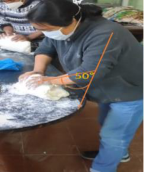
Human Systems Engineering and Design (IHSED 2021) https://openaccess.cms-conferences.org/#/publications/book/978-1-7923-8987-0 allow the advance of the work motor, which at the opposite end of the roller are anchored through two supports extended through each roller, the dimensions of the machine; and is fixed to its base by means of 4 fixing and mounting bolts, two on each side. This proposal seeks to reduce occupational diseases of a musculoskeletal nature in inappropriate postures and of repetitive origin, as we can see in the images. Fig. 3 shows the identified places of pressure in upper joints, with risk of affectation.
Shoulder Forearm Wrist
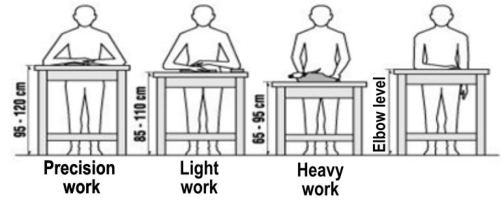
Figure 3: Places of pressure in upper joints, with risk of affectations.Figure 4: Appropriate height of work tables according to their intensity The following parameters were considered as design criteria for the laminator:
The height of the working plane should be between 0.95 m. and 1.20 m. from the floor level, i.e., what is required for precision work (Turiño, 2020) to avoid bad posture (see Fig. 4).
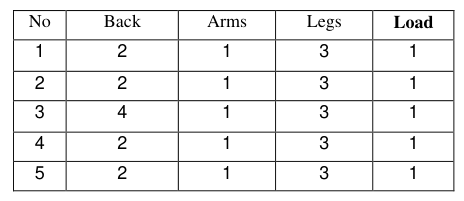
According to the information gathered, the thickness of the laminated dough needs to be between 2 mm and 15 mm depending on the work to be done. Therefore, the machine must offer a kneading that allows to obtain a dough that provides ease of handling and operation. Experiments and Results The experimentation is based on using the OWAS (Ovako Working Analysis System Method), which allows to evaluate the physical loads coming from the postures during the development of the work (Cortez, 2017), the position analyzed in Table 1 is that of the manual process performed when kneading the dough, and the result obtained shows a risk level of category 2, which means that the postures
Human Systems Engineering and Design (IHSED 2021) https://openaccess.cms-conferences.org/#/publications/book/978-1-7923-8987-0 required for the parameters of back, arms, legs and load, maintain possibilities of causing damage to the musculoskeletal system of the artisans, most of whom in the case study are over 65 years of age, making this risk even greater.
Risk Rating Checklist OWAS Method
Table 1: Categorization of risks on postures No Back Arms Legs LoadTable 2: Risk category scale
Table available in the original PDF paper.
It requires no action.
Risk Category Posture effect Required action
1
Normal and natural posture without harmful effects on the musculoskeletal system.
2
Corrective actions are required in a near future.
Positions with the possibility of causing damage to the musculoskeletal system.
3
Posture with harmful effects on the musculoskeletal system.
4
Corrective actions are required as soon as possible.
Corrective actions are required immediately.
The load caused by this posture has extremely damaging effects on the musculoskeletal system.
In the same way, another fundamental result for the research was obtained from the OCRA (Occupational Repetitive Actions) check-list method, which allows us to better observe the risk generated by repetitive work, the repetitive movements analyzed in Table 2 were those performed in the kneading process and whose information reveals that there are very high-risk levels, above 25 points and unacceptable according to the rating scale. Similarly, another of the fundamental results for the research was obtained from the OCRA The Occupational Repetitive Actions check-list method, which allows us to better observe the risk generated by repetitive work, the repetitive movements that were analyzed in Table 2, were those performed in the kneading process and whose information reveals that there are very high-risk levels, above 25 points and unacceptable according to the rating scale.
Human Systems Engineering and Design (IHSED 2021) https://openaccess.cms-conferences.org/#/publications/book/978-1-7923-8987-0
Tabla3: Check-list OCRA Risk factors in repetitive work Right Left
Insufficient recovery time 4 4 Movement’s frequency 4.5 4.5 Force application 16 16
Risk Scale Risk level Checklist Very mild or uncertain 7.6 – 11
2
Not acceptable. Mild level 11.1 – 14
3
4
Not acceptable. High level ≥ 22.5 5
Not acceptable. Medium level 14.1 – 22.5
CONCLUSIONS The main concepts and trends of the man-machine interaction were identified, taking into account the considerations of the design of the semi-automatic mixer as an appropriate technology due to the special attention in its specifications combined with the specificities of the artisans regarding the characteristics of the machine, leading to a reduction of the standard time from 20 minutes to 10 minutes, greater precision in the characteristics of the marzipan, and less effort on the part of the operator avoiding muscle fatigue. This proposal seeks to minimize the possible physical damage that may arise from the daily routine of this work, and in a very special way in the group that maintains the greatest vulnerability represented by the elderly, who find in these tasks a sense of usefulness and contribution based on their experience and thus be able to rescue this ancestral activity ACKNOWLEDGEMENTS
Human Systems Engineering and Design (IHSED 2021) https://openaccess.cms-conferences.org/#/publications/book/978-1-7923-8987-0
The authors would like to thank the members of the MASARTE Association composed of artisans who gave us the opportunity to carry out the community service internship project: "PROPER TECHNOLOGICAL INNOVATION IN PRODUCTIVE PROCESSES IN THE MANUFACTURE OF HANDICRAFTS: CASE SECTOR CALDERÓN, QUITO-ECUADOR", with the results and support of the authorities of the Universidad Tecnológica Indoamérica this research has been carried out. REFERENCES Alejandra Vives, A. M. ( 2016). Envejecimiento y trabajo en Chile: Propuesta para monitoreo de salud laboral. Santiago, Chile: https://politicaspublicas.uc.cl/wp- content/uploads/2017/04/CAP.-1.pdf. Retrieved from https://politicaspublicas.uc.cl/wp-content/uploads/2017/04/CAP.-1.pdf Arroba Benitez Darwin Orlando, L. M. (2014, Febrero). Diseño y construcción de una
máquina pulidora de tubos cuadrados de hasta 2-1/2. Repositorio Universidad Politécnica Salesiana., p. https://dspace.ups.edu.ec/handle/123456789/6311. BUN-CA, F. R. (2011). Manual Técnico de Motores Eléctricos . San José.http://www.bun- ca.org/publicaciones/manuales/UltimaVersion/Motores30Junio11.pdf: Diseño Editorial S.A. Retrieved from http://www.bun- ca.org/publicaciones/manuales/UltimaVersion/Motores30Junio11.pdf Chancusi, S. [. (2018, Agosto 27). Políticas de prevención de la seguridad y salud
ocupacional en el Ecuador. Retrieved from DIALNET: https://dialnet.unirioja.es/servlet/articulo?codigo=7144007 Cortez, A. M. (2017). Evaluación de los factoresde riesgos asociados a las posturas físicas en el proceso de elaboración de ladrillo artesanal en la Mype Mi Ladrillera en Cajamarca. Retrieved from Repositorio Universidad Peruana Unión: http://repositorio.upeu.edu.pe/handle/UPEU/961 Cuenca, N. H. (2017). (Simulación Bidimensional del Corte del Acero AISI 1050. .
Retrieved from http://hdl.handle.net/10016/27891 Fabian Celín, R. C. (2018, pp 63-65 ). Intervención ergonómica para reducir la prevalencia de trastornos musculoesqueléticos por movimientos repetitivos de mano-muñeca, en trabajadores de la línea de producción de una fábrica de perfumes. Retrieved from Investigación e Innovaciòn, I conferencia Internacional sobre Seguridad y Saluid en el trabajo: http://repositorio.uisek.edu.ec/handle/123456789/3584 Gama, A. Y. (2018). Sintomatologia musculo esquelética de miembros superiores y su
relación con los movimientos repetitivos y posturas mantenidas en trabajadores de la empresa alameda colombia. Retrieved from Repositorio Institucional Universidad Distrital - RIUD: https://repository.udistrital.edu.co/bitstream/handle/11349/13598/GuerreroMurcia AngelaJuliana2018.pdf?se Humanos, U. d. (n.d.). Declaración Universal de Derechos Humanos. Retrieved from https://www.ohchr.org/EN/UDHR/Documents/UDHR_Translations/spn.pdf Larrea, M. Y. (2018). Determinación de la cadena de valor en la comercialización de la
Human Systems Engineering and Design (IHSED 2021) https://openaccess.cms-conferences.org/#/publications/book/978-1-7923-8987-0 producción de artesanías de la asociación de adultos mayores del gad municipal del cantón Sucúa. Repositorio Universidad Católica de Cuenca. Retrieved from https://dspace.ucacue.edu.ec/bitstream/ucacue/5548/1/MARTA%20YOMARA%2 0VALLEJO.pdf M. Teresa Abusleme, e. a. (2018). Trabajo y Personas Mayores en Chile.Salesianos
Impresores . Santiago: https://sociologia.uc.cl/wp- content/uploads/2018/03/trabajo-y-psms-en-chile-web.pdf. Mina, M. A. (2017, Diciembre 29). Discriminación laboral en Ecuador. Retrieved from https://www.revistaespacios.com/a18v39n23/a18v39n23p32.pdf Mora, A. P. (2017, Abril ). Estudio de caso de los artesanos de mazapán en la parroquia
de Calderón. Retrieved from Repositorio Digital Universidad Central del Ecuador: http://www.dspace.uce.edu.ec/bitstream/25000/10806/1/T-UCE-0009- 709.pdf Turiño, E. E. (2020, Febrero 13). Evaluación ergonómica de una línea de producción de masas de pizza en una empresa ubicada en la ciudad de Quito. Retrieved from Repositorio Digital Universidad Internacional SEK Ecuador: http://repositorio.uisek.edu.ec/handle/123456789/3676
Human Systems Engineering and Design (IHSED 2021) https://openaccess.cms-conferences.org/#/publications/book/978-1-7923-8987-0
LISTED IN THE AHFE DIGITAL BOOKSTORE CATALOGUE
Explore the complete digital volume
Human Systems Engineering and Design (IHSED2021): Future Trends and Applications
Read this individual research paper free through the original publisher, or explore the full digital proceedings book.
ISBN 978-1-7923-8987-0
Explore this ISBN in the AHFE Bookstore ↗Listed in the July 2026 bookstore catalogue; search by ISBN to confirm current availability · Digital book purchase optional