Estefani Mau-Dongo, Erick Merino-Zavaleta, Juan Peñafiel, Gino Viacava-Campos (2021). Design of a new plant to optimize the production capacity of a MYPE, based on the principles of Systematic Layout Planning, 5s and Project Management. In: Human Systems Engineering and Design (IHSED2021): Future Trends and Applications. AHFE Open Access, vol. 21. https://doi.org/10.54941/ahfe1001191
The case study presented analyzes the operations of a Peruvian MYPE in the plastics sector. Based on a diagnosis, a deficit in its production capacity was identified with representative costs equivalent to 9% of its annual turnover, derived from the lack of machines and inefficiencies, which even being solved would not allow to satisfy the demand, so confirmed that the company's decision was correct. In this way, a project was proposed that would allow the design of the new facilities of the company in a larger premises, with the aim of optimizing its production capacity and preventing the bad practices detected at present from being repeated, validating their viability through a virtual prototype. Likewise, based on the calculations, it would be possible to increase the installed capacity by 53.5%, exceeding the projected demand within three years by 24.90%, which would allow greater organizational growth in the future.
At present, Micro and Small Enterprises (MSEs) are the engine of growth and development in different economies of the world (CEOE, 2018). Above all, in Latin America, and specifically in Peru, where they constitute one of the largest sources of employment and income (ComexPeru, 2018). This business segment has acquired a greater presence in the country's economy, making up 99.5% of all Peruvian formal companies (Ministerio de la Producción del Perú, 2017). How-ever, their actions are frequently affected by factors that condition their performance, one of the main ones being the lack of projection into the future (Comex-Peru, 2018).
In the long term, the MYPES usually perceive the consequences of the absence of such planning, since they can be developed, but to a certain extent, that is, when the capacity they possess is no longer sufficient to meet the demand. Faced with this situation, any company would focus on short-term plans such as optimizing its resources: the size of the workforce, overtime budgets, inventories, etc. And if an improvement is not possible, more transcendental decisions would be made, such as investment in new facilities and / or equipment (Abu Jadayil, Khraisat and Shakoor, 2017). However, for the MYPES it is not easy to have these last measures, because they can be harmed in this attempt.
For this reason, this research is carried out mainly with the objective of optimizing production capacity, by designing a new plant that takes into account the inefficiencies and bad practices that are currently present so that these do not occur again in the new facility. For which the main components are project management, with which the different steps of the proposal are planned and monitored; the Systematic Layout Planning (SLP) methodology, with which the most appropriate distribution was determined and which, according to numerous authors (Gómez, Tascón and Ayuga, 2018; Suhardi, Juwita and Astuti, 2019; Kovács, 2020; Qamar, Meanazel, Alalawin and Almomani, 2020) is a fairly versatile tool with a wide range of application from different approaches, which unlike our contribution are based on redesigning the same operating space, while in our research it would be adapted for a transfer space.
Human Systems Engineering and Design (IHSED 2021) https://openaccess.cms-conferences.org/#/publications/book/978-1-7923-8987-0
STATE OF THE ART Management for project planning
The Project Management or project management covers both the planning, organization, monitoring and control of all aspects of the project, and its purpose is to achieve the project objectives within the agreed criteria of time, cost and quality. For this reason, emphasis is placed on the success factors of the projects, which may be based on the competence of the Project Manager, the organization or the methods and tools used throughout the project. However, it is mentioned that one of the most important factors corresponds to the project scheduling, which is key so that the people involved can understand the multitude of activities present and their relationships (Radujković and Sjekavica, 2017; Zareei, 2018).
Systematic Layout Planning for the design of the new plant For the development of the proposal, a literature review was carried out regarding the Systematic Layout Planning (SLP) tool, since this will be the basis for the design of the new plant and the selection of an optimal layout. Its implementation is carried out in three main stages: the first consists of the analysis of the company's reality, the current work area and the requirements between areas. In the second stage, the previous analysis is used from the outset, distribution alternatives are created taking into account the physical limitations and in the last stage the alternatives are evaluated in order to find the optimal design (Benitez, Fogliatto, Cardoso, Torres, Faccin and Dora, 2018).
Good production practices through 5S and Autonomous Maintenance This philosophy has been adopted by different manufacturing industries follow-ing a methodology that consists of 5 pillars: Seiri (Classify), Seiton (Order), Seiso (Clean), Seiketsu (Standardize) and Shitsuke (Discipline), with some differences in its implementation. In a small or medium-scale company, simple measures are applied but that can generate major transformations in the performance of the organization, while in larger companies, changes are made from the highest management positions to the lowest. Despite this, the same positive results are obtained in both cases (Hussain, Pavan, Sandeep, Bhaskar and Prasad, 2017; Karthis and Silksonjohn, 2019).
Human Systems Engineering and Design (IHSED 2021) https://openaccess.cms-conferences.org/#/publications/book/978-1-7923-8987-0
INPUT General view
The project was carried out considering the detailed engineering and the preservation of good practices, divided into three phases: the first of planning, which includes the identification of the requirements that will act as input data for the second design phase, in which shows the distribution proposals, and their selection; and finally, the implementation phase, where it is about managing other aspects of the project.
Detail view PHASE I: Planning. In this phase, the data was determined taking into account the projected demand for three years, being that of the year 2023, 60,398 bags.
Requirements. It was identified that of all the company's equipment it will only be necessary to change the metallizer, the furnace and one of the injectors, since its percentage of use was higher or very close to 80%, according to the analysis carried out on the time of life of machines. Subsequently, a search for new machinery in the market was carried out. Once chosen, two scenarios were compared based on a machine requirement calculation to meet the projected demand, one in which the equipment is conserved and the other in which a complete change is carried out. In accordance with the above and the life time analysis, it was decided to change the equipment with more time of use At the same time, it was determined that only the injectors with less time of use and the stamping machine would be kept, being two old injectors and a new. Similarly, at the request of the company, a semi-automatic painting machine would be acquired, since they want to make changes in their process. On the other hand, to previously define the furniture to be moved, a classification will be made through the Red Tag System, and for this, the operators will receive training. This classification would allow the removal of only the furniture necessary for the process and would prevent clutter from remaining in the work areas in the new plant.
New capacity. Based on the machinery requirements, the calculation of the installed capacity in the new plant was carried out, for this an average standard time was estimated based on the characteristics of the new machines and the standard time data of the current machinery, obtaining a installed capacity of 80 432 bags per year which is higher than the capacity by 53.5%.
PHASE II: Design.
Analysis of the space of the premises. Taking into account the conditions mentioned above and with the help of the Guerchet method, the area required to carry out the company's operations was determined. It is worth mentioning that an adjustment of the dimensions of the productive areas was made based on the possible increase in
Human Systems Engineering and Design (IHSED 2021) https://openaccess.cms-conferences.org/#/publications/book/978-1-7923-8987-0 bottleneck machinery, and the same criterion was used for the factor of the conversion method with which the measurement of the warehouses was calculated. , so that these are adapted to the size of the premises and can contain properly marked shelves, to facilitate the handling of the products, and the tool board, in the case of the mold and spare parts warehouse, which will keep the implements used in order. , which is a huge difference from how it is currently handled.
Distribution proposals. Two proposals were made, the first based on the relational table, in such a way that it sought to bring the areas of greater correlation closer together and increase the distance between areas that must be separated and the second proposals based on the multiproduct diagram, which seeks to improve the flow of the product most representative, in this case, unstamped varnished plastics, with a 79.50% share.
Analysis of the proposals. First, a qualitative analysis was carried out between both alternatives based on a ranking of factors, which were: non-optimal flow between areas (19%), long routes between areas (15%), not recommended proximity between areas (4%) , lack of space for new machines (15%), clutter in workspaces (4%) and lack of security (19%). In this analysis, the second proposal had a better result with a score of 12.69, compared to the 12.31 points of the first alternative. Subsequently, a quantitative comparison was made by means of matrix tables for both the effort and the cost of material handling, in both cases the second proposal obtained better results.
Table 1. Quantitative Comparison
Table available in the original PDF paper.
ANNUAL EFFORT (Kg x m) COST OF MATERIAL FLOW (S/.) PROPOSAL 1 27,732,837.30 1689.82 PROPOSAL 2 21,620,161.42 1246.79 Selection of optimal proposal. Both quantitatively and qualitatively, the second proposal is the most appropriate for what would be the optimal distribution. As can be seen, this distribution prioritizes the flow of the standard product and also takes into account qualitative criteria, respecting the two-meter corridor to avoid unproductive times due to inadequate flow. It should be noted that the proposals considered separators between the areas to avoid clutter in the workspaces and to maintain proper production practices.
PHASE III: Implementation. In the last phase, both purchasing and inventory management are considered, as well as other relevant aspects.
Inventory required prior to moving. Moving the old equipment and furniture to the new plant would take approximately fourteen days. Therefore, the company must have a sufficient inventory of finished products before transporting the machine to be able to meet the demand and not be affected economically, which is why it is considered that the plant will be finished in the month July, as it has the least demand. These 14 days lead to 1624 bags of unstamped plastic products, this inventory would have to be produced for 22 days in a third shift, so that July production is not
Human Systems Engineering and Design (IHSED 2021) https://openaccess.cms-conferences.org/#/publications/book/978-1-7923-8987-0 interrupted and working in the most orderly way possible to avoid an increase in inefficiencies.
Good practices. The new facility will seek to maintain good practices. For this, certain measures were considered within the design of the plant, such as: the previous classification to determine the furniture that would be moved to the new plant, the internal order of the areas, the boundaries between the areas, the use of shelves and labels. to organize warehouses. Likewise, as part of the project, various trainings related to order and cleanliness were planned, as well as formats to maintain standardization and discipline, in order to counteract the generalized disorder that exists in the work areas and corridors. In addition, to reinforce the training of the new machinery, instructions would be implemented to follow, so that the operators get used to the new equipment more easily and errors in the process are avoided. In the same way, check-lists will be used to promote good machinery care habits prior to production, in this way it can be achieved that operators feel greater responsibility in the use of their equipment and that technical personnel focus in more complex problems. Since currently the company does not have any previous care activity for the machines and therefore a state of deterioration is observed in them.
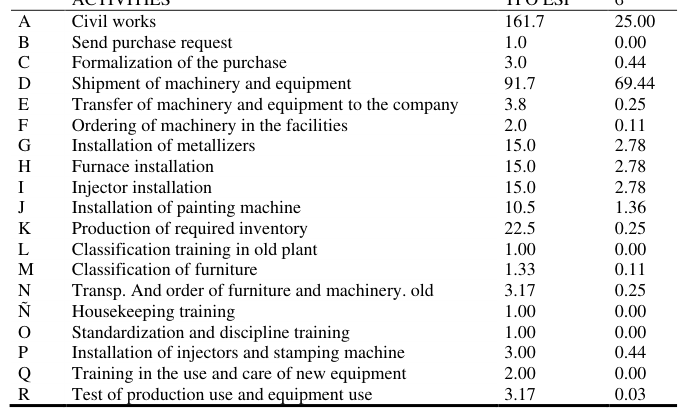
Process view Each of the activities mentioned in the previous paragraph, and that are part of the project, are summarized below:
Table 2. Project Activities ACTIVITIES TPO ESP σ2 A Civil works 161.7 25.00 B Send purchase request 1.0 0.00 C Formalization of the purchase 3.0 0.44 D Shipment of machinery and equipment 91.7 69.44 E Transfer of machinery and equipment to the company 3.8 0.25 F Ordering of machinery in the facilities 2.0 0.11 G Installation of metallizers 15.0 2.78 H Furnace installation 15.0 2.78 I Injector installation 15.0 2.78 J Installation of painting machine 10.5 1.36 K Production of required inventory 22.5 0.25 L Classification training in old plant 1.00 0.00 M Classification of furniture 1.33 0.11 N Transp. And order of furniture and machinery. old 3.17 0.25 Ñ Housekeeping training 1.00 0.00 O Standardization and discipline training 1.00 0.00 P Installation of injectors and stamping machine 3.00 0.44 Q Training in the use and care of new equipment 2.00 0.00 R Test of production use and equipment use 3.17 0.03 In addition, the different relationships that exist between the project activities are reflected in Table 2. Where the critical path of the project was established, which, as
Human Systems Engineering and Design (IHSED 2021) https://openaccess.cms-conferences.org/#/publications/book/978-1-7923-8987-0 can be seen, has a total time of approximately 222 days and comprises: A, E, F , G or H, I, J, N, Ñ, O, P, Q, R.
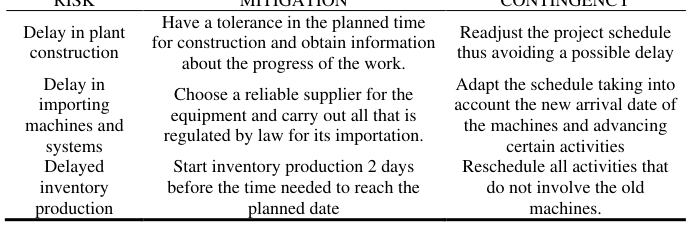
From this, it was identified that A and D are the external activities with the greatest variance, that is, whose changes could change the duration of the project; and K, the most important internal activity for the move to take place without delay. And based on these, mitigation and contingency actions were established to avoid their possible risks, which are presented in the following table:
Table 3. Mitigation and Contingency Actions RISK MITIGATION CONTINGENCY
machines. Indicators view The achievement of the objective of this case study is measured through an indicator, which evaluates the improvement with respect to production capacity, and its components are shown in greater detail in Table 4.
Table 4. Achievement Indicator Percentage of exceeding demand Greater than 0% 𝑃𝑟𝑜𝑑. 𝑐𝑎𝑝. −𝑃𝑟𝑜𝑦 𝑑𝑒𝑚𝑛
VALIDATION Process view
Prototype. Each of the areas was designed with the requirements specified in the second phase of the project, adjusting its internal layout to allow optimal flow. Once the work areas were finished, he set about locating the corresponding security and signaling systems. (Functional video: https://youtu.be/08dhjZwb2nw)
Human Systems Engineering and Design (IHSED 2021) https://openaccess.cms-conferences.org/#/publications/book/978-1-7923-8987-0
Results
Prototype. Based on the prototype, it was possible to determine the functionality of the new plant in terms of its dimensions as well as in the proposed distribution, the improvements made to preserve order and cleanliness within the areas, and the signage that is included in order to maintain good security practices. Likewise, in relation to the design and the proposed improvements, the indicator proposed in item III.E was calculated taking into account that the projected demand for the year 2023 is 60,398 bags / year and that obtained, 80,432 bags / year, achieving a percentage of improvement of 24.9%, which is optimal Success stories. To validate the actions proposed with respect to the conservation of good practices, success stories were used that corroborate the positive results obtained with the 5s, in terms of order and cleanliness; and autonomous maintenance, linked to the correct use and prior care of the equipment.
Table 5. 5S Success Stories No. Ref. Results
Table available in the original PDF paper.
1 Karthis and Silksonjohn
(2019) A time saving of 39.60% was achieved 2 Hussain, et al. (2017) Turning set up time was reduced by 28.3% and by 23.2% in grinding, and OEE was increased by 7%
3 Guillen, Umasi, Quispe,
and Raymundo (2018) Reprocesses decreased by up to 3%
Process OEE increased from 55.45% to 68.04% (an increase of 12.59%) (2018)
2 Bataineh, Al-Hawari, Alshraideh and Dalalah
An improvement of 22.15% was obtained in the OEE (from 35.27% to 57.42%).
(2019).
3 Morales Méndez and
Rodriguez (2017)
Mean Time Between Failure (MTBF) had an improvement of 108% and Mean Time to Repair (MTTR) was reduced by 43%. Tables 5 and 6 show the achievements that can be obtained both from the implementation of the 5s philosophy and from autonomous maintenance. Therefore, it can be assumed that its application in the research proposal for the improvement and preservation of good labor practices would generate a good result.
CONCLUSIONS
With the design of the proposed plant, the existing gap between current production
Human Systems Engineering and Design (IHSED 2021) https://openaccess.cms-conferences.org/#/publications/book/978-1-7923-8987-0 capacity and demand would be closed, since with the new changes it would be possible to manufacture up to 80,432 bags / year, a value that is largely greater than current demand in 53.5%, and which would also exceed the demand for the next three years by 24.9%.
The selected design is based on the multi-product diagram, which tries to give priority to the areas with the greatest use. This option was evaluated both qualitatively and quantitatively, being the most appropriate, since it satisfactorily meets relevant criteria in solving the current problem, such as optimal flow, distances between areas, etc. In addition, to generate a lower effort and cost of material flow. This proposal was functionally validated by means of a virtual prototype, where it can be seen that the dimensions and the arrangement of areas are adequate.
In order to achieve the planned capacity in the new plant, it will be necessary to maintain good labor practices that mitigate the inefficiencies identified in the organization. Therefore, integrated measures should be considered in the design, training to educate staff, and formats for proper management and monitoring, which is very effective according to various success stories, where improvements in time of processes, of the set are appreciated. -up, decrease in reprocessing and in the OEE variables.
It is important to take into account the risks of the activities according to their criticality and variance, identifying and integrating mitigation and contingency measures to the proposal, in such a way that a project of this magnitude is successful considering that it is an MSE.
REFERENCES
Abu Jadayil, W, Khraisat, W. and Shakoor, M. (2017) “Different strategies to improve the production to reach the optimum capacity in plastic company,” Cogent Eng., vol. 4, no. 1, pp. 1–18. Bataineh, O., Al-Hawari, T., Alshraideh, H. and Dalalah, D. (2019). “A sequential
TPM-based scheme for improving production effectiveness presented with a case study,” J. Qual. Maint. Eng., vol. 25, no. 1, pp. 144–161. Benitez, G. B., Fogliatto, F. S., Cardoso, R. B., Torres, F. S., Faccin, C. S. and Dora, J. M. (2018). “Systematic Layout Planning of a Radiology Reporting Area to Optimize Ra-diologists’ Performance,” J. Digit. Imaging, vol. 31, no. 2, pp. 193–200. Confederación Española de Organizaciones Empresariales (CEOE). (2018, Mar 06).
"Las MIPYMES generan el 28% del PIB en Latinoamérica pero carecen aún del impulso nece-sario", 2018. [Online]. Available: https://www.ceoe.es/es/contenido/actualidad/noticias/las-mipymes-generan-el- 28-del-pib-en-latinoamerica-pero-carecen-aun-del-impulso-necesario Gómez, J., Tascón, A. and Ayuga, F. (2018). “Systematic layout planning of wineries: The case of Rioja region (Spain),” J. Agric. Eng., vol. 49, no. 1, pp. 34–41.
Human Systems Engineering and Design (IHSED 2021) https://openaccess.cms-conferences.org/#/publications/book/978-1-7923-8987-0
Guillen, K., Umasi, K., Quispe, G. and Raymundo, C. (2018). “LEAN model for optimizing plastic bag production in small and medium sized companies in the plastics sector,” Int. J. Eng. Res. Technol., vol. 11, no. 11, pp. 1713–1734. Hussain, S. A., Pavan, M. S., Sandeep, A. D., Bhaskar, C. U. and Prasad, P. R. (2017)
“Economic justification for implementation of 5S in MSMES: A case study on M/S. un-nathi CNC Technologies Pvt Ltd,” Int. J. Mech. Eng. Technol., vol. 8, no. 5, pp. 306–319. Karthik, S. and Silksonjohn, J. (2019). “A case study of 5S implementation in inspection process,” Int. J. of Mech. And Pro. Eng, Rea. and Dev., vol. 9, no.3, pp. 1469–1476. Kovács, G. (2020). “Combination of Lean value-oriented conception and facility
layout design for even more significant efficiency improvement and cost reduction,” Int. J. Prod. Res., vol. 0, no. 0, pp. 1–21. Ministerio de la Producción del Perú. (2017) “Estadística MIPYME”. [Online].
Available: http://ogeiee.produce.gob.pe/index.php/shortcode/estadistica- oee/estadisticas-mipyme Morales Méndez, J. D. and Rodriguez, R. S. (2017) “Total productive maintenance (TPM) as a tool for improving productivity: a case study of application in the bottleneck of an auto-parts machining line,” Int. J. Adv. Manuf. Technol., vol. 92, no. 1–4, pp. 1013–1026. Nallusamy, S., Kumar, V., Yadav, V., Prasad, U. K. and Suman, S. K. (2018).
“Enhance the Overall Equipment Effectiveness,” Int. J. Mech. Prod., vol. 8, no. 1, pp. 1027–1038. Qamar, A. M., Meanazel, O. T., Alalawin, A. H. and Almomani, H. A. (2020).
“Optimi-zation of Plant Layout in Jordan Light Vehicle Manufacturing Company,” J. Inst. Eng. Ser. C, vol. 101, no. 4, pp. 721–728. Radujković, M. and Sjekavica, M. (2017). “Project Management Success Factors,” Pro-cedia Eng., vol. 196, no. June, pp. 607–615. Sociedad de Comercio Exterior del Perú (ComexPeru). (2018, Aug 03). “Situación
de las MYPE en 2017: muchos retos en el camino”, 2018. [Online]. Disponible en: https://www.comexperu.org.pe/articulo/situacion-de-las-mype-en-2017- muchos-retos-en-el-camino Suhardi, B., Juwita, E. and Astuti, R. D. (2019). “Facility layout improvement in sewing department with Systematic Layout planning and ergonomics approach,” Cogent Eng., vol. 6, no. 1. Zareei, S. (2018). “Project scheduling for constructing biogas plant using critical path
method,” Renew. Sustain. Energy Rev., vol. 81, no. May 2017, pp. 756–759.
Human Systems Engineering and Design (IHSED 2021) https://openaccess.cms-conferences.org/#/publications/book/978-1-7923-8987-0
LISTED IN THE AHFE DIGITAL BOOKSTORE CATALOGUE
Explore the complete digital volume
Human Systems Engineering and Design (IHSED2021): Future Trends and Applications
Read this individual research paper free through the original publisher, or explore the full digital proceedings book.
ISBN 978-1-7923-8987-0
Explore this ISBN in the AHFE Bookstore ↗Listed in the July 2026 bookstore catalogue; search by ISBN to confirm current availability · Digital book purchase optional