Shuang Liang, Min Zhou, Peian Yao, Francesca Tosi (2022). Smart healthcare service system for elderly based on AIoMT. In: Intelligent Human Systems Integration (IHSI 2022): Integrating People and Intelligent Systems. AHFE Open Access, vol. 22. https://doi.org/10.54941/ahfe1001047
In the age of digitalization, digital technologies offer incredible opportunities to the healthcare sector. No matter where elderly people are, they have to interact with various digital devices in the real world. By using digital sensors, smart devices, Internet of Medical Things, big data, cloud/edge computing, Artificial Intelligence and other advanced technologies, the smart system can observe and analyze the lives of the elderly, dynamically access their information and data, connect people, materials and institutions, and then actively manages and responds to their demands in an intelligent manner. The system can promote interaction and cooperation among social institutions and all stakeholders, help organizations and individuals make informed decisions through information sharing, facilitate the rational allocation of resources, and finally ensure that elderly people can get the services they need. The smart system can integrate and coordinate social systems to realize the dynamic and refined management of the elderly.
Intelligent Human Systems Integration (IHSI 2022): Integrating People and Intelligent Systems https://openaccess.cms-conferences.org/#/publications/book/978-1-7923-8988-7
INTRODUCTION
With the development of society and the digital transformation of industries, digital innovations are reshaping our society and the relationships between people. Digital applications have penetrated all aspects of people's lives, so no matter where elderly people are, they cannot avoid interacting with digital devices. Now, older people not only live in the real world, but they need to live in a digital society. In the digital age, traditional healthcare models have been difficult to meet the various needs of the elderly, and in some cases, it may pose a threat to their happiness and health. The application and development of digital technologies provide new directions for healthcare services. In the context of digital transformation, traditional healthcare service systems are required to make changes and needs to be reconsidered and planned for improving older people's lives.
SYSTEM DESIGN The smart healthcare service system has been applied in various fields, for example, the electronic medical record (Shaikh, Parvati, and Biradar, 2018), digital services for citizens (reservation, queue elimination ...) (Tian et al., 2019), early detection of diseases (Jeong, Han, and You, 2016; Tuli et al., 2020), health service platforms (Jiang, Wang, and Xu, 2021), and telemedicine systems (teleconsultation, telemonitoring and telesurgery) (Abugabah and Nizamuddin, 2020). Many studies focus on technology development and the application of a smart healthcare system in a specific industry. There is little research on the smart healthcare service system for the elderly.
The smart healthcare service system based on AIoMT (AI+IoMT) can help seniors turn into digital seniors. It does not simply integrate digital technology with traditional healthcare services but establishes a connection between the elderly and digital products, and introduces smart devices into homes, industries and the social environment. This system can obtain data about daily activities, physical and mental conditions of the elderly through seniors and smart devices at the perception layer, and then predict the services needed by the elderly with AI technology. In general, this smart system can supplement and improve existing healthcare services and create a new experience that can improve the living quality of the elderly.
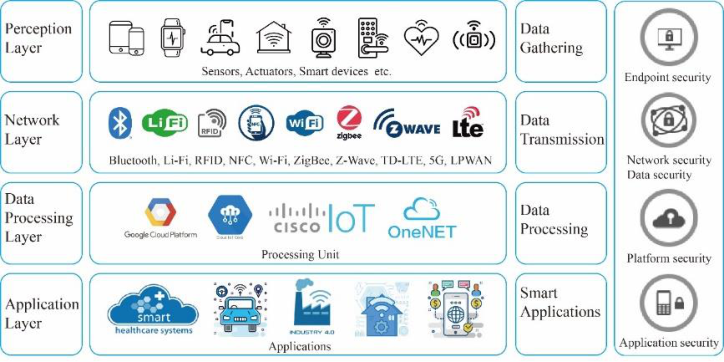
The system architecture is based on the Internet of Things (IoT) and can be divided into 4 layers: the perception layer, network layer, data processing layer, and application layer (see Figure 1).
Intelligent Human Systems Integration (IHSI 2022): Integrating People and Intelligent Systems https://openaccess.cms-conferences.org/#/publications/book/978-1-7923-8988-7
Figure 1. The system architecture
The first layer is the perception layer. As the basis of data collection and information processing, the perception layer is the key for turning seniors into digital seniors. Cameras, sensors, actuators, smart devices, IoT terminals belong to this layer. These sensors and devices can obtain an Internet address through the IPv6 protocol and be connected to the Internet. They monitor physiological and environmental parameters and then send data through the Internet. Core technologies are Computer Vision, Automatic Identification and Data Capture (AIDC), Natural Language Processing (NLP), Context Awareness and Sensor Technology. Computer vision can extract information from the scene at which older people are located by simulating the human visual function, and then send data to the data center for processing. AIDC can use computers, cameras, scanners or other devices to identify older people and collect their data automatically. NLP can realize effective communication between people and computers. Context awareness is the ability of a system to make a response and action based on the collected data and the current situation. Sensor technology can sense the surrounding and special substances such as brightness, temperature, humidity, sound, gas, etc. By using these technologies, health conditions and the current situation of older people, and environmental information can be obtained. This is the first step in turning seniors into digital seniors (Sui and Liu, 2020).
The second layer is the network layer which is responsible for data organization, storage, transmission, and security. There are two modes of Internet connection: wired and wireless. Wireless technology, due to the difference in effective transmission distance, can be divided into short-range wireless (Bluetooth, Li-Fi, RFID, NFC, Wi-Fi, ZigBee, Z-Wave), medium-range wireless (LTE-Advanced and 5G), long-distance wireless (LPWAN, VSAT and other technologies). For different requirements, there are various modes to choose from. According to different data types, stakeholders use MySQL, HBase or Elastic Search to store and search data collected by the first layers, and then create databases, such as healthcare service
Intelligent Human Systems Integration (IHSI 2022): Integrating People and Intelligent Systems https://openaccess.cms-conferences.org/#/publications/book/978-1-7923-8988-7 databases, GIS databases, Financial & Economic databases, etc. These databases can form a large data platform. The network layer can summarize, exchange, and transfer information (data, feedback, instructions…) by wired and wireless networks. During storage and transmission, it is necessary to guarantee data security and avoid security risks such as data loss, accidental exposure, etc.
The third layer is the data processing layer. In the IoT ecosystem, it is a processing unit where data is pre-processed and then sent to data centers. Various software applications can be connected to data centers and prepare for further operations. This layer is the interface between the application service layer and the network layer, supporting various software applications. Big data, blockchain, software-defined networking, storage, data centers, secure communications, anti-virus software, and artificial intelligence can be grouped into this layer. Through AI and big data analytics, the system can show some successful medical cases to assist doctors in making better decisions and giving the best therapeutic option.
The fourth layer is the application layer, including all service providers, service platforms, Apps and other stakeholders. Service providers and stakeholders can transfer the data collected by their devices to their own data center. According to these high value data, they can improve efficiency and provide smart services. Based on the smart system, some applications, such as smart medical care, smart home, smart transportation, community services, can provide service for the elderly. Security is the most important for this system and endpoint security, network security, data security, platform security, and application security need to be guaranteed.
ORGANIZATIONAL STRUCTURE This smart healthcare service system contains many stakeholders and social institutions. Due to the system's complexity, it is difficult for a single organization or institution to complete the construction of such a system. The construction requires the support of technologies, human resources, and medical resources. Therefore, this system requires multiple key organizers to work together. Key Resources
The key or core resources can help identify who are the key organizers. First, this system targets at the elderly, and healthcare services are the most important core resources. In addition, technology, as an essential tool, is also a key resource for the whole system. Medical equipment and smart devices are the basis of data collection, and therefore important. This system includes many stakeholders, which requires a key coordinator with the ability to organize and coordinate all stakeholders. Moreover, the system also involves a large amount of healthcare data and private information which is an essential resource for a government and must be kept confidential.
Intelligent Human Systems Integration (IHSI 2022): Integrating People and Intelligent Systems https://openaccess.cms-conferences.org/#/publications/book/978-1-7923-8988-7
Main Organizers The key resources of this system have healthcare services, technology, medical equipment and smart devices, healthcare data, and coordinators. Therefore, the main organizers of the smart healthcare service system should include the healthcare sector, technology companies with Internet-related services and products, manufacturers of medical supplies, and the government with abilities to help break down industry barriers and coordinate stakeholders. Through working together, these main organizers can build and maintain the smart healthcare service system. They can set up a department or a joint-stock company to be responsible for this service system. Stakeholders
Stakeholders are composed of data collectors and service providers, including hospitals, pharmacies, nursing homes, banks, insurance companies, oil and gas companies (Eni...), telecommunications companies, transportation sector, catering industry, entertainment industry, social organizations, welfare agencies, home care agencies, Bar, Tabacchi, supermarkets, post offices, government departments, shops, technology companies, regulatory agencies etc. All organizations or institutions that interact with the elderly belong to stakeholders. Target Users The target users of this system are older adults who live at home and can take care of themselves. Elderly people with intellectual disabilities and the disabled elderly can also join this system, but it may be difficult to use these services and functions by themselves. Their caregivers can use related healthcare services. Key Activities
This system can monitor the health condition of the elderly in real time. By comparing the monitoring data with the results based on big data-based algorithms, the system can provide targeted prevention services, and help elderly people reduce the risk for diseases. Based on the data and information from stakeholders and institutions, this system can track daily activities of the elderly and provide suggestions. When older people encounter an emergency (fall, sudden illness...) and their physiological parameters change too much, this system can also provide help and emergency medical services. There are still many possibilities that can be explored.
SERVICE PROCESS Registration
Intelligent Human Systems Integration (IHSI 2022): Integrating People and Intelligent Systems https://openaccess.cms-conferences.org/#/publications/book/978-1-7923-8988-7
The elderly need to register before they can receive services provided by this system. They can make an appointment on an official digital platform, and then the information platform will ask staff to visit elderly people for helping them register. Registration information includes name, gender, age, family members, allergies, emergency contacts, medical card number, medical history, etc. After the information is uploaded to the information platform, The platform checks this information with the government, medical institutions and other organizations. Once the verification is completed, the platform sends a successful registration message to the elderly, and a service provider makes an appointment with them for installing the smart home kit. Installation of Smart Home Devices The smart home kit includes a central control system (the brain of the smart home), whole-home WiFi, the wireless Programmable Logic Controller (PLC), smart speaker, screen (8.3", 10.2", 11", 12.9"), wearable devices (smartphones, smartwatch, smart glasses), intelligent control systems (environment, lighting, water, safety protection, entertainment, shade curtains…), and sensors (fall detection devices, human body infrared sensor, water leak detectors, propane/natural gas detectors, smoke detectors, temperature and humidity sensors…). According to the humidity, temperature, oxygen concentration and other indicators in the indoor environment, this system can provide a comfortable environment where temperature and humidity are relatively constant by turning on/off humidifiers, air conditioners, and other household appliances. Based on the life patterns of the elderly, this system can also provide an ideal sleep environment for them.
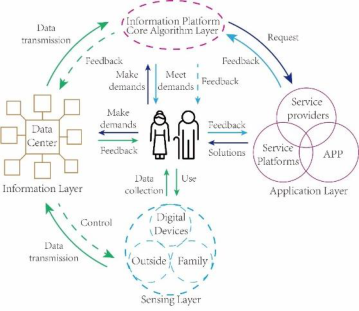
Older adults can choose smart devices and sensors they need to install. After the installation, the staff will connect all the devices and sensors to the home network and test whether each one works. The staff will also teach the elderly how to use and leave the learning materials in their home. Application In the service process (see Figure 2), various digital devices and sensors can collect raw data by activity recognition. All raw data are transmitted to data centres of each industry where raw data is filtered, and the features are extracted. Then, the pre- processing data is transmitted to the national information platform with the smart AI system. If there are any problems, the system will give feedback to the corresponding data centre. Based on AI, the system can analyse daily activities of each older person and make predictions.
Intelligent Human Systems Integration (IHSI 2022): Integrating People and Intelligent Systems https://openaccess.cms-conferences.org/#/publications/book/978-1-7923-8988-7
Figure 2. The service processes
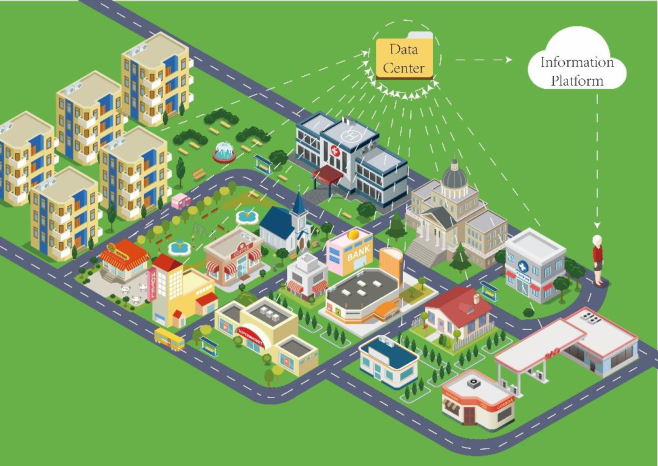
The smart healthcare service system connects to the data platform of the smart city. Cloud-based localization and IoT-aware techniques can be used to track and monitor older people to provide necessary services for their well-being (Piniewski et al., 2010). Wherever elderly people are, the system can obtain their location and track their health parameters. If an older adult is in an emergency or their physiological data changes too much, the system immediately obtains the location and calls up surrounding digital cameras and devices to see the status of the older person. By AI and big data analytics, if the system determines that the older person is at a risk, it will send a message to emergency contacts,family doctors or hospitals (see Figure 3).
Figure 3. The smart healthcare service system in the digital society
Intelligent Human Systems Integration (IHSI 2022): Integrating People and Intelligent Systems https://openaccess.cms-conferences.org/#/publications/book/978-1-7923-8988-7
In this system, the government-led information platform is the core, and each stakeholder (social institutions, public organizations, etc.) also forms their own data center. These data centers need to upload and exchange data with national information platforms, and then receive feedback from the national platform. Since the national information platform can receive data and information on medical expenses, the allocation of medical resource, medical capabilities from stakeholders in different regions. The collected information and data can help the country formulate relevant policies to redistribute economic and welfare to ensure social equity. From a global perspective, countries can also exchange information and complement each other's advantages, thereby promoting social inclusion and sustainable development.
CONCLUSIONS
The smart healthcare service system is to build a digital world parallel to the traditional physical world (Metaverse in healthcare). It can integrate and coordinate social systems to realize the dynamic and refined management of the elderly. By using digital sensors, smart devices, Internet of Medical Things, big data, cloud/edge computing, artificial intelligence and other advanced technologies, the system can observe and analyze the lives of the elderly, dynamically access their information and data, connect people, materials, and institutions, and then actively manages and responds to their demands in an intelligent manner. It can also promote interaction and cooperation among social institutions and all stakeholders, help organizations and individuals make informed decisions. The smart system can improve the imbalanced distribution of medical resources and ensures that older people have equal access to medical information and healthcare services.
ACKNOWLEDGMENTS
The research is funded by China Scholarship Council (201907820006). The authors would like to express their gratitude to the China Scholarship Council.
REFERENCES
Shaikh, Y., Parvati, V. K., and Biradar, S. R. (2018), “Survey of smart healthcare systems using inter-net of things (IoT).” In 2018 International Conference on Communication, Computing and Internet of Things (IC3IoT), pp. 508--513. IEEE Press, New York. Tian, S., Yang, W., Le Grange, J. M. M. et al. (2019), “Smart healthcare: making
medical care more intelligent.” Global Health Journal, 3(3), 62-65. Jeong, J. S., Han, O., You, Y. Y. (2016), “A design characteristics of smart healthcare system as the IoT application.” Indian Journal of Science and Technology, 9(37), 52.
Intelligent Human Systems Integration (IHSI 2022): Integrating People and Intelligent Systems https://openaccess.cms-conferences.org/#/publications/book/978-1-7923-8988-7
Tuli, S., Basumatary, N., Gill, S. S., Kahani. et al. (2020). “An ensemble deep learning based Smart Healthcare System for Automatic Diagnosis of Heart Diseases in integrated IoT and fog computing environments.” Future Generation Computer Systems, 104, 187-200. Jiang, N., Wang, L., Xu, X. (2021). “Research on Smart Healthcare Services: Based
on the Design of APP Health Service Platform.” Healthcare Engineering Journal, 2021, 9922389. Abugabah, A., Nizamuddin, N. (2020). “Smart healthcare ecosystem for elderly patient care.” In 2020 43rd International Convention on Information, Communication and Electronic Technology (MIPRO), pp. 365-370. IEEE Press, New York. Sui, D, C., Liu, X, C. (2020). “Artificial Intelligence Home Care Service Model
Construction.” Chongqing Social Science, 07, 6-19+2. Piniewski, B., Muskens, J., Estevez, L., Carroll, R., and Cnossen, R. (2020).
“Empowering healthcare patients with smart technology.” Computer, 43(7), 27-34.
Intelligent Human Systems Integration (IHSI 2022): Integrating People and Intelligent Systems https://openaccess.cms-conferences.org/#/publications/book/978-1-7923-8988-7
LISTED IN THE AHFE DIGITAL BOOKSTORE CATALOGUE
Explore the complete digital volume
Intelligent Human Systems Integration (IHSI 2022): Integrating People and Intelligent Systems
Read this individual research paper free through the original publisher, or explore the full digital proceedings book.
ISBN 978-1-7923-8988-7
Explore this ISBN in the AHFE Bookstore ↗Listed in the July 2026 bookstore catalogue; search by ISBN to confirm current availability · Digital book purchase optional