Shuang Liang, Min Zhou, Stefano Follesa, Peian Yao (2022). A shared service model for the elderly based on the concept of distributed economies (DE). In: Human Interaction & Emerging Technologies (IHIET 2022): Artificial Intelligence & Future Applications. AHFE Open Access, vol. 68, pp. 323–329. https://doi.org/10.54941/ahfe1002749
Population ageing and urbanisation are two major global trends. With ongoing rapid urbanisation and the global population's shift toward an older age structure, older people need to be given significant consideration in community building. Community home-based care has become the choice of most elderly people. The elderly can be regarded as a valuable community resource. According to the current problems faced by the elderly and community residents, this paper proposes a new shared service model based on the theory of service design and distributed economy. In this model, elderly people can open up free space in their homes as a club, mini library, etc., where community residents can share resources, experiences or interests with others. The aim is to help the elderly participate in community activities and create value for the community. This model helps improve the well-being of older people and the sense of belonging of community residents.
Population ageing and urbanization are two major global trends. According to the report from WHO, the share of the global population aged 60 years or over would increase from 12% to 22% between 2015 and 2050 (World Health Organization, 2021). Furthermore, with the global rise of urbani- zation, the proportion of the world’s urban population is also predicted to grow from 55% in 2018 to 68% by 2050 (United Nations, 2018). This indi- cates that the number of elderly people in the city will continue to increase. In the book, Ageing in Cities, the Organization for Economic Co-operation and Development (2015) states that the proportion of the elderly population over 60 years in its member countries is expected to climb to 25.1% by 2050, and cities are home to 43.2% of the elderly population. Population ageing and urbanization pose challenges for all types of communities in cities. The trend will likely lead to social transformations and drive changes in com- munities and social systems. The global ageing of urban populations requires the implementation of more age-friendly practices in communities (Van Hoof et al., 2018).
and services (Van Hoof et al., 2018). WHO also argues that the key to heal- thy ageing is to ensure elderly people be able to live in environments that support and maintain their intrinsic capacity and functional ability (World Health Organization, 2020). In fact, there are many challenges. Therefore, an innovative service model is required to help tackle this problem and encou- rage the elderly to make a contribution to their community in the process of re-entering society.
THE THEORETICAL FRAMEWORK For this purpose, some studies provide crucial ideas for a reasonable solution.
The Rise of Sharing: Fourth-Stage Consumer Society A Japanese scholar, Atsushi Miura, describes four stages that Japan’s consu- mer society has experienced. In the fourth-stage consumer society, with the declining birth rate and negative population growth, the proportion of the elderly continues to increase. Elderly people generally have more resources, better housing conditions, and a more stable financial income than youn- ger people (Miura, 2014). They live independently and frequently feel lonely because their adult children do not live with them. They would like to have more opportunities to interact with young people or community members and engage in community events. Many countries are now in the fourth stage of consumer society. When society develops to this stage, compared with a society that is too personal and isolated, people hope to build a society where they can naturally connect. People’s consciousness gradually changed from focusing on themselves to focusing on society. Individualism is giving way to collectivism, and values are shifting from egoism to altruism. People increasingly embrace shared items and live in a shared culture as the sharing economy is becoming popular. People’s awareness has shifted from focusing on products to focusing on services. Their material wants are decreasing, and they place great emphasis on need fulfilment and emotional pleasure (Lovell, 2018). People are more inclined to establish a connection with others as a source of happiness. These are distinctive features of the fourth-stage consu- mer society. The modern lifestyles (car-sharing, bike-sharing, house-sharing, etc.) demonstrate that people are living in the age of sharing. Elderly people have also been willing to share their resources and experiences and contri- bute to the community. They can rent out their residence to young people and use their personal connections to assist young people in finding a job. Young people can also help older people buy food and teach them how to use digital devices. This can help improve their social participation and create opportunities that enable older people to be and do what they value.
Shared Spaces In 2012, Akira Asada wrote a book titled Opening Home to Others. The author claims that homeowners just need to share a part of the space in their homes with others, and this model would create small groups. Peo- ple in the groups could naturally share their work and interests with others.
A Shared Service Model for the Elderly Based on the Concept 325
This kind of fate does not come from corporate partnership or kinship but the affection between people (Miura, 2014). For example, “the open garden” in Kodaira City (Japan) started in 2007. The activity encourages local resi- dents to open or share their private gardens as public community spaces. A lot of people could gather at here to enjoy the beauty of nature and communi- cate through nature. They can chat about these flowers and plants, and then exchange ideas. In addition to private gardens, interior spaces might be sha- red. These activities can encourage creativity among communities and foster a stronger sense of belonging. If community residents are willing to share a space in their own homes with other residents, the community will become a shared community. With more and more communities like this, a sharing city will be developed, and a “sharing society” may emerge gradually.
Distributed Economies (DE) The concept of distributed economies (DE) has been developed as a response to the current industrial production systems (Johansson, Kisch and Mirata, 2005). It has been defined as “Small-scale production units, located by or nearby the end-users, whether individuals, entrepreneurs and/or organisa- tions/institutions” (Vezzoli and Cenk 2018). In a community, both elderly people and residents can be considered as production units. The difference is that they do not manufacture products but rather supply services. Depen- ding on their resources, they can provide a variety of services or venues for the community members. The distributed system’s production unit is closer to users and more open, which can encourage users to actively participate, develop customized solutions, and effectively meet individual needs. In an ideal model, all residents can receive resources, information, and knowledge fairly and share them with their neighbors (Johansson, Kisch and Mirata, 2005). Because the distributed economy network is localized and decentra- lized, and consists of small-scale production units, it has many sustainable properties and will become one of the most promising models in the future. Based on this concept, a shared service model can be created.
A SHARED SERVICE MODEL As people get older, it is difficult for them to understand some new concepts, which can make them feel separated from society and abandoned. In addition, adult children usually do not live with their parents after marriage. The daily life of the elderly is relatively monotonous and boring. They often feel lonely, want to have more communication with others, and travel to different places. However, due to the decline in physical functioning, their health condition may not allow them to travel long distances. They need to re-engage in social activities to maintain their physical vitality.
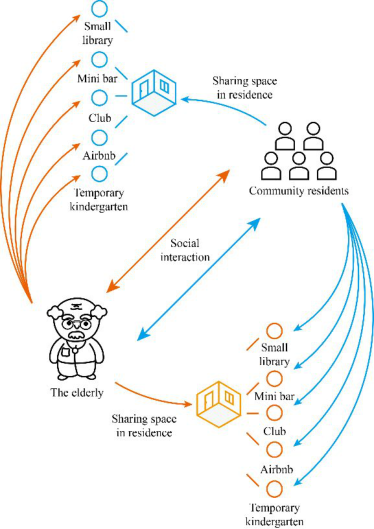
Construction of Service Model Based on previous theoretical research, a shared service model can be develo- ped to facilitate interaction between the elderly and community members and help the elderly overcome loneliness. In this mode, elderly people can share some spaces in their homes as a small library, temporary kindergarten, mini
Figure 1: Service module construction.
bar, club, Airbnb, etc., as shown in Figure 1. For example, elderly people can convert a room into a small playground where children from the commu- nity can come and play every day after school. This not only adds happiness to the elderly, but also creates an entertainment area for the children. The elderly can also transform a room into a mini-library. Residents can donate and borrow books or come here to talk with the elderly and learn from their working and life experiences.
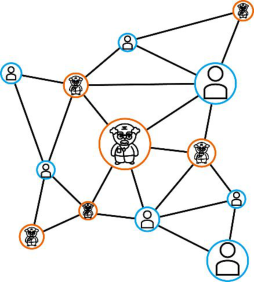
Similarly, other residents can also open some spaces to hold different acti- vities. For example, they can host small parties in their homes on weekends, providing opportunities for those community residents from different back- grounds, countries and cultures to interact. When elderly people are invited to join, they will feel cared for, and these activities can enrich their life while decreasing their sense of isolation. As the number of participants grows, this distributed service network is established (see Figure 2). Because reti- red seniors have more free time, they are the primary service providers and participants in this model. They are encouraged to share their rooms and take part in other community activities organized by others. The elderly can also meet more people and make new friends with common interests. Their lives could become more colorful and meaningful. This model can make better use of the existing vacant rooms and provide higher returns with less expendi- ture. It offers additional opportunities for the sustainable development of a community.
If elderly people can stay healthy and live in an environment that allows them to remain productive members of society, they may be viewed as an
A Shared Service Model for the Elderly Based on the Concept 327
Figure 2: Distributed service network.
underutilized social resource (Beard and Petitot, 2010). They transform con- sumption into self-enrichment through planning and engaging in community activities. In this model, people will pursue a service that can satisfy both the giver and the receiver, rather than consuming services as commodities. What matters is not only the services that community residents have access to, but also who they receive services from, and how they get along with service providers. This model aims to foster a sense of community belonging betw- een elderly people and residents and promote social connectedness within community environments (Van Hoof and Kazak, 2018).
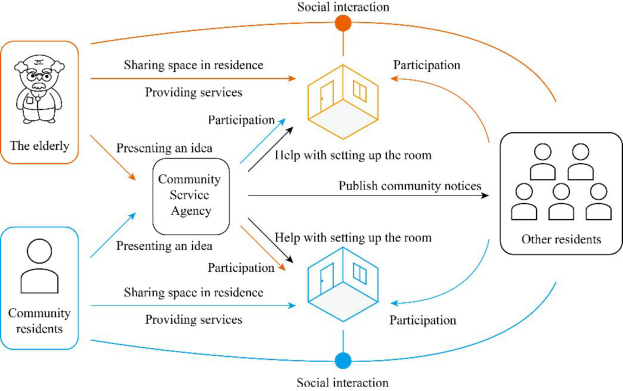
Service Process When elderly people or community residents want to join the model, they can present their ideas to the community services agency. They can choose to participate in events organized by other community members, or if they also want to share the space in their home to provide services, the agency will record their request. For example, what type of space can they offer? What services do they intend to provide? When will they be able to provide the service? Etc. The agency can then assist them in setting up the room and creating a shared area based on their needs. When everything is ready, community residents will see the notification issued by this agency through the official website, community notice board, or text message. Residents can attend these events based on the time, location, activity content, and other information provided in the notification (see Figure 3).
The elderly can also recruit tenants through this community service age- ncy. They can rent out their rooms to young people at a lower price, and they can provide young people with some services. Because the elderly have more social experience, they can also contribute helpful information and experi- ence to the young. When they help young people, they can feel a sense of accomplishment and find self-worth. Due to the low cost, young people have the responsibility to help elderly people solve some problems in daily life as much as possible. For example, they can help the elderly buy food, repair some small household appliances, and teach them how to use digital products. Both of them can benefit from this shared service model.
Figure 3: A shared service model for the elderly.
CONCLUSION
Urban ageing is an emerging domain. As the number of elderly people living in cities continues to rise, age-friendly approaches need to be implemented. Furthermore, many countries around the world are building a sharing soci- ety. In this context, healthy seniors should not be regarded as a disadvantaged group, and they should be regarded as a significant social resource. They can participate in community activities and create value for their communities. This shared service model provides seniors with many opportunities to inte- ract with community members, which can help seniors get emotional support and overcome loneliness. Community residents can also benefit from these activities organized by elderly people. The service model can improve resi- dents’ sense of community belonging and can be seen as a way to build for the future.
ACKNOWLEDGMENT
The research is funded by China Scholarship Council (201907820006). The authors would like to express their gratitude to the China Scholarship Council.
REFERENCES
Beard, J.R., Petitot, C. (2010). Ageing and Urbanization: Can Cities be Designed to Foster Active Ageing? Public Health Reviews, 32, pp. 427–450. Johansson, A., Kisch, P., Mirata, M. (2005). Distributed Economies – A new engine
for innovation. Journal of Cleaner Production, 13(10-11), pp. 971–979. Lovell, S.A. (2018). “Ageing communities”, in: Geographical Gerontology. Perspectives, Concepts, Approaches. Skinner M.W., Andrews G.J., Cutchin M.P (ed.). pp. 149–161.
A Shared Service Model for the Elderly Based on the Concept 329
Miura, A. (2014). The rise of sharing: Fourth-stage consumer society in Japan. Japan: International House of Japan. Organisation for Economic Co-operation and Development (OECD). (2015). Ageing
in cities. Paris: OECD Publishing. Plouffe L., Kalache A. (2010). Towards global age-friendly cities: Determining urban features that promote active aging. Journal of urban health, 87(5), pp. 733–739. United Nations (UN). (May 16, 2018). 68% of the world population proje-
cted to live in urban areas by 2050, says UN. The United Nations Web- site: https://www.un.org/development/desa/en/news/population/2018-revision-of- world-urbanization-prospects.html Van Hoof, J., Kazak, J. K., Perek-Białas, J. M., & Peek, S. (2018). The Challenges of Urban Ageing: Making Cities Age-Friendly in Europe. International journal of environmental research and public health, 15(11), pp. 2473. van Hoof, J., & Kazak, J. K. (2018). Urban ageing. Indoor and Built Environment,
27(5), pp. 583–586. Vezzoli, Carlo, and Cenk Basbolat. (2018). “System design for sustainability for all: S. PSS design applied to distributed economies”. proceedings of RSD7, Relating Systems Thinking and Design, Turin, Italy. pp. 585–601. World Health Organization (WHO). (October 26, 2020). Healthy ageing and functi-
onal ability. The World Health Organization Website: https://www.who.int/news- room/questions-and-answers/item/healthy-ageing-and-functional-ability World Health Organization (WHO). (October 4, 2021). Ageing and health.
The World Health Organization Website: https://www.who.int/news-room/fact- sheets/detail/ageing-and-health
Read this individual research paper free through the original publisher, or explore the full digital proceedings book.
ISBN 978-1-958651-44-5
Explore this ISBN in the AHFE Bookstore ↗Listed in the July 2026 bookstore catalogue; search by ISBN to confirm current availability · Digital book purchase optional