Lloyd Morris, Olga Jasmin Salazar De Morris, Hernán Espejo Viñán (2022). Directive Management In Complex Systems to Promote the Level of Use of Techniques In Operations. In: Intelligent Human Systems Integration (IHSI 2022): Integrating People and Intelligent Systems. AHFE Open Access, vol. 22. https://doi.org/10.54941/ahfe100973
Many organizations have fragmented processes that make it difficult for managers to do their jobs, and a similar situation supports academics, among other things, struggling to describe the static functionality of the processes that support research (Garvin 1998). An alternative to address this problem is the use of socio-technical methods to achieve changes in product-service systems (Qiang and others 2020) together with the concept of trans-complex organizations that are addressed in management science as objects of study. (Bravo et al 2020), which provides a viable option to address the objective of this study: Understand the limitations of the interdisciplinary directive management of the academy and the manufacturing sector, in complex systems, to promote the level of use of techniques in operations.The initial hypothesis is that there is a low level of use of operational techniques in manufacturing companies, due to weaknesses in academic-business operational processes, which hinder research and business management. The current study is an ethnographic research, based on the socio-technical system (Bostrom and Heinen 1977), applied, when carrying out the unfolding of the organizational direction, to favor the implementation and development of operational managerial techniques in Venezuelan cement manufacturing processes , through the interdisciplinary academic-business effort, under an open systems approach, facing three important socio-technical categories: the unfolding of the organizational structure, the technological support supports to the management and the individual human context, in the which includes interdisciplinary work through surveys of expert personnel in the field of operations, both in academia and in companies.From the interpretive proposal and the interview scripts applied, the content analysis, the code mapping and the ethnographic triangulation are obtained, the latter is obtained by comparing the aforementioned categories. The results show the need to adjust the policies, procedures and standards of Venezuelan cement companies to facilitate the use of managerial techniques as a guideline to improve organizational competitiveness; in addition, the option of counseling should be incorporated and, at the same time, take up the past experiences regarding training plans, good practices and exchange of indicators. Regarding universities, it is suggested to deepen research teaching, since the greatest evidence of a link to the business context is in the internship or internship programs.Finally, the research has two aspects of management support that cannot be separated: the first is the integration approach between both organizations and the second is associated with the incorporation of technology. Therefore, the hypothesis, at the end of the study, is valid regarding the situation regarding the low level of use of operational techniques and can be reversed when considering the proposals, generating opportunities for improvement in the Venezuelan business context to higher levels of competitiveness organizational.
Many organizations have fragmented processes that make it difficult for managers to do their jobs, and a similar situation supports academics, among other things, who struggle to describe the static functionality of the processes that support research, [1]. An alternative to face this problem is the use of socio-technical methods to achieve changes in product-service systems, [2], coupled with the concept of transcomplex organizations that are addressed in management science as objects of study, [3]. These contributions provide a viable option to undertake the objective of this study: Understand the limitations of the directive management of the academy and the manufacturing sector, in complex systems, to promote the level of use of techniques in operations.
The directive management (DM) within the current state of general administration theory (GTA), finds its foundations in classical, neoclassical and scientific management theories, [4], that can address the complex systems (CS).
[5], indicate, that the theory is commonly associated with the study of systems is the theory of systems complex, in where the CS are composed of many elements and these elements interact with each other through one or more interactions types, relations no static that changes over time.
For comprehensively address DM in CS, we selected the technical social system proposed by [6], since according to [7] and [8], it incorporates sufficient elements to describe the context of organizational studies. In complement, [9], considers the ethnographic method as an ideal alternative for the construction and interpretation of experiential stories that can be incorporated to study the organizational management in complex systems.
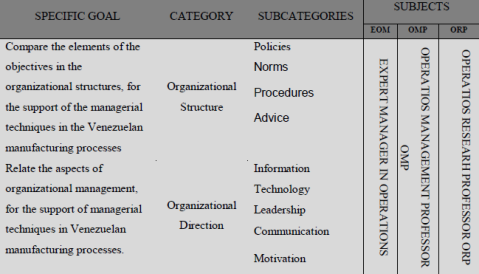
To achieve the objective of present study, the authors established two specific objectives in relation to the categories identified within of theories mentioned as organizational structure and organizational direction in complex manufacturing systems. This identification with a methodological approach, where the subdivision of specific objectives into categories, subcategories and research subjects are see in Figure 1:
Intelligent Human Systems Integration (IHSI 2022): Integrating People and Intelligent Systems https://openaccess.cms-conferences.org/#/publications/book/978-1-7923-8988-7
Figure 1. Specific goals, categories and subcategories The results that the work built, is on the triangulation of these two categories with approaches that are associated for the development of DimCos, taking the reality mentioned by [10], the performance management systems are nothing more than the combination of key elements and aspects to minimize the distance from the supposed reality.
DEVELOPMENT
Methods
The initial hypothesis is that there is a low level of use of operational techniques in manufacturing companies, due to weaknesses in academic-business operational processes, which hinder research and business management.
The current study is an ethnographic research, based on the socio-technical system applied in engineering, [11], for obtain a model in manufacture companies, [12], when carrying out the unfolding of the organizational direction, to favor the implementation and development of operational managerial techniques in Venezuelan cement manufacturing processes.
For the analysis of the information triangulation is proposed, [13] mentions that triangulation in qualitative research for the comprehensive development of the phenomenon under study, where four types of triangulation can be used: between methods, researchers, theories and data. This research performs triangulation between categories, which implies triangulation between methods, theories, and data.
Data collection.
Work through surveys of expert personnel in the field of operations, both in academia and in company. Therefore, the study population made up of three experts: One expert in operation manager cements, one expert in operation management professor and one expert in operation research professor.
Intelligent Human Systems Integration (IHSI 2022): Integrating People and Intelligent Systems https://openaccess.cms-conferences.org/#/publications/book/978-1-7923-8988-7
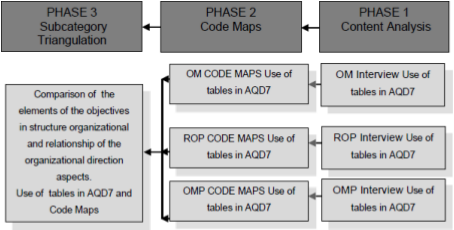
In Figure 02, it is indicated how the triangulation of the qualitative results was arrived at, through the execution of three phases, where the population or the subjects are experts in operations both from academic and Venezuelan cement manufacturing processes spheres.
Figure 2. Methodology
The first phase contemplates the results of the three interviews processed via AQD7, through content analysis, generating the content division and its content scheme.
The second phase is covered with the elaboration of code maps, grouped by subcategories, obtaining three code maps of the contents, for which subcategory tables were created in AQD7.
Finally, through phase three, objectives two and three of this research are achieved by comparing the elements of the objectives in the structures and relating the aspects of organizational management, through qualitative triangulation.
Phase 1 – Content Analysis The phase 1 incorporates the content analysis of the qualitative data. This phase is obtained from the processing of information from the application of the three qualitative instruments (semi structured interviews): Instrument-1 (Content analysis in AQD7 software: Interview with Operations Manager), Instrument-2 (Content analysis in AQD7 software: Interview with Operations Research Teacher) and Instrument-3 (Content analysis in AQD7 software: Interview with Operations Administration Teacher). Figure 3 is the content analysis sample for a fraction of the information obtained by applying instrument-1:
Intelligent Human Systems Integration (IHSI 2022): Integrating People and Intelligent Systems https://openaccess.cms-conferences.org/#/publications/book/978-1-7923-8988-7
Annex I-1 Content analysis in AQD7 software Interview with Operations Manager {1} E:- What are the organizational policies that support the use of managerial techniques in cement processes? {2} OM:- Currently there are no policies that favor the use of techniques in manufacturing processes. {3} There is still a part of the culture of multinational companies, in which the comparison of indicators between group companies was managed, as a policy to improve competitiveness {4} In fact, comparative studies were mandatory at the international level.
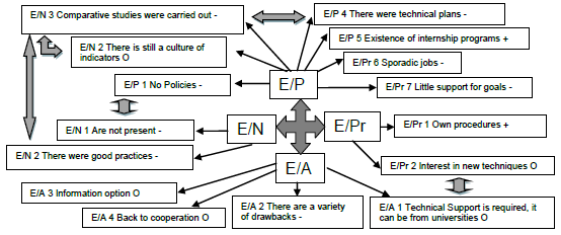
From the content analysis of the interviews using tables for the identification of codes in AQD7, this study constructed code maps for the category of organizational structure (E) with its subcategories of policies (P), norms (N), procedures (Pr) and advice (A). Due to the extensive information, figures 4 provide the operations manager code map.
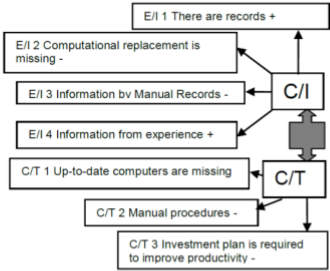
Figure 4. Coding maps sample in organizational structure From the content analysis of the interviews using tables for the identification of codes in AQD7, this study constructed code maps for the category of organizational direction in communications processes (C) with its subcategories of information (L) and technology (T). Due to the extensive information, figures 5 provide the operations manager code map I.
Intelligent Human Systems Integration (IHSI 2022): Integrating People and Intelligent Systems https://openaccess.cms-conferences.org/#/publications/book/978-1-7923-8988-7
Figure 5. Coding maps sample in organizational.
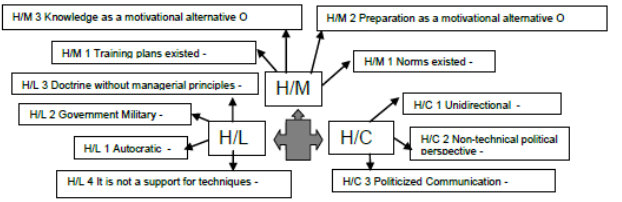
From the content analysis of the interviews using tables for the identification of codes in AQD7, this study constructed code maps for the category of organizational direction in human processes (H) with its subcategories of leadership (L), communication (C) and motivation (M). Due to the extensive information, figures 6 provide the operations manager code map II.
Figure 6. Coding maps sample in organizational.
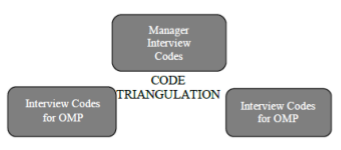
DISCUSSION OF RESULTS (Phase 3) To obtain advantages both in the diversity and in the depth of the information, in this section developed the phase three, referring to triangulation. The triangulation was carried out, according to [14], the observers triangulate, not only with methodology, they can also triangulate with data sources, therefore, performs the triangulation for each category as a data source, view figure 7. To continue are discussed the research categories.
Intelligent Human Systems Integration (IHSI 2022): Integrating People and Intelligent Systems https://openaccess.cms-conferences.org/#/publications/book/978-1-7923-8988-7
Figure 7. Code Triangulation
Organizational Structure Category For this first moment, we observed a coincidence regarding the existence in the cement companies of internship programs immersed in the university environment, which includes policies, procedures and norms of the extension environment of the universities. In this sense, all agree on the existence of extension policies linked to industrial internship programs, yet they are sporadic jobs with little support for industry goals.
There are no defined policies to support management techniques in essential policies under the pragmatic approach; preliminary practices are only achieved for implementation. Although there are procedures in the extension medium of the universities applicable through stages in internships, the lack of cooperation for implementation and / or the view that implementation depends on the business sector are strong barriers to the real development of managerial techniques in the processes cement manufacturers.
Regulations in the university field in relation to innovation, technology, research and extension supported the absence of norms and good practices that favor managerial techniques in the manufacturing context. Academic regulations but not in business represents an opportunity for research, also having the difficulties of specific ignorance of the established standards and the lack of evidence in the implementation of techniques in manufacturing processes.
The need for advice is a reality due to the diversity of inconveniences that the cement company has where it requires technical support from the universities. This advice can be given under various circumstances, namely: In the collection of information under the options of collecting information in the production processes, in the use of software and in the analysis of results or returning to cooperation between organizations. However, further advice or training in mathematics and statistics is required.
Organizational Direction Category The leadership style is autocratic, given the following statements: autocratic, non- participatory, taxing, quite bureaucratic. In the case of the cement sector, it is added that it is a leadership under doctrines without managerial principles with military governmental characteristics and without the use of new tools in solving problems in the academic environment. In any case, it does not represent a support for the techniques, it discourages the advancement of models and has a negative impact on the development of techniques in
Intelligent Human Systems Integration (IHSI 2022): Integrating People and Intelligent Systems https://openaccess.cms-conferences.org/#/publications/book/978-1-7923-8988-7 organizational management.
Communication is politicized, so its perspective is political and not technical, its channels are used to transmit political issues in a unidirectional way, being non-regular for research, extension and teaching activities. It is considered slow and impractical, representing a scenario that is neither reasonable nor helpful to the development of the models.
To motivate workers, teachers and students in the generation of academic or business activities related to the use of managerial techniques, it is possible to resume the norms and business training plans, policies can be designed to encourage applications and encourage research, it is possible to incorporating training plans with models as tools that are translated into improvements in effectiveness and utility, the salaries of university teachers can be adjusted. Finally, take knowledge as a motivational alternative where preparation or training in relation to management techniques is a strategic axis.
It is also observed that for the detection, formulation, monitoring of conditions and development of management techniques, information can be obtained in various ways. Direct information can be given by accessing business records including manual records. There is another alternative to resorting to information by experience and information by instruments. The information through intermediaries can be given after access through internships and through the access of undergraduate or graduate students.
In many opportunities, the lack of integration, the lack of computational replacement or the suspicion that it does not give direct access, are limiting for the collection of information required for the application of the techniques. However, it is possible to process it through software, programs such as Qsb, Tora, Lingo or Lindo that the academic environment has to facilitate the capacity and effectiveness in the formulation, the calculation of algorithms and simulators in obtaining results and development. In addition to the fact that the software is constantly updated, a technology investment plan is required to increase the productivity of the cement industry, since the lack of computers and technology has led to manual calculation procedures in the process manufacturing.
From the interpretive proposal and the interview scripts applied, the content analysis, the code mapping and the ethnographic triangulation are obtained, the latter is obtained by comparing the aforementioned categories. The results show the need to adjust the policies, procedures and standards of Venezuelan cement companies to facilitate the use of managerial techniques as a guideline to improve organizational competitiveness; in addition, the option of counseling should be incorporated and, at the same time, take up the past experiences regarding training plans, good practices and exchange of indicators. Regarding universities, it is suggested to deepen research teaching, since the greatest evidence of a link to the business context is in the internship or internship programs.
CONCLUSIONS
The research has two aspects of management support that cannot be separated: the first is the
Intelligent Human Systems Integration (IHSI 2022): Integrating People and Intelligent Systems https://openaccess.cms-conferences.org/#/publications/book/978-1-7923-8988-7 integration approach between both organizations and the second is associated with the incorporation of technology. Therefore, the hypothesis, at the end of the study, is valid regarding the situation regarding the low level of use of operational techniques and can be reversed when considering the proposals, generating opportunities for improvement in the Venezuelan business context to higher levels of competitiveness organizational.
Through the process of triangulation and analysis of variables of the socio-technical model, it is obtained that both the business organization and the academic one must carry out a review on the incorporation of the use of managerial techniques in the organizational objectives. The motivation drive is the engine of this system, although a positive attitude was found from both managers and teachers, satisfaction is not entirely convincing, the research itself proposes: taking knowledge as an alternative of motivation where the preparation or training in relation to management techniques is a strategic axis.
REFERENCES
Garvin, David A. "The processes of organization and management." Sloan management review 39.4 (1998): 33-51. Li, Ai Qiang, et al. "Exploring product–service systems in the digital era: a socio-technical
systems perspective." The TQM Journal (2020). Bravo, A., et al. "Trans-complexity: a management fad or a mathematical construct." Journal of Physics: Conference Series. Vol. 1671. No. 1. IOP Publishing, 2020. Kitana, Abdelkarim. "Overview of the managerial thoughts and theories from the history:
Classical management theory to modern management theory." Indian Journal of Management Science 6.1 (2016): 16. Thurner, Stefan, Rudolf Hanel, and Peter Klimek. Introduction to the theory of complex systems. Oxford University Press, 2018. Bostrom, Robert P., and J. Stephen Heinen. "MIS problems and failures: A socio-technical
perspective. Part I: The causes." MIS quarterly (1977): 17-32. Ropohl, Günter. "Philosophy of socio-technical systems." Society for Philosophy and Technology Quarterly Electronic Journal 4.3 (1999): 186-194. Monsalve, E. B., Carreño, M. F., Gutiérrez, E. B., Molina, L. M., Garcia, J. F., & Rangel,
H. B. “Theorization on case studies in business intelligence management on intellectual capital” In Journal of Physics: Conference Series (Vol. 1160, No. 1, p. 012011). IOP Publishing. (2019). Schensul, Jean J., and Margaret D. LeCompte. Essential ethnographic methods: A mixed methods approach. Vol. 3. Rowman Altamira, 2012. Franco- Santos, Monica, and David Otley. "Reviewing and theorizing the unintended
consequences of performance management systems." International Journal of Management Reviews 20.3 (2018): 696-730. Baxter, Gordon, and Ian Sommerville. "Socio-technical systems: From design methods to systems engineering." Interacting with computers 23.1 (2011): 4-17. Morris, Evan Harry Lloyd, et al. "Experiencia investigativa en el desarrollo de
modelamiento en empresa de manufactura." Avances en Investigación Científica. Coordinación de investigación de la Corporación Universitaria Autónoma de Nariño, 2020.
Intelligent Human Systems Integration (IHSI 2022): Integrating People and Intelligent Systems https://openaccess.cms-conferences.org/#/publications/book/978-1-7923-8988-7
Triangulation, Data Source. "The use of triangulation in qualitative research." Oncol Nurs Forum. Vol. 41. No. 5. 2014. Arias Valencia, María Mercedes. "La triangulación metodológica: sus principios, alcances
y limitaciones." (2000).
Intelligent Human Systems Integration (IHSI 2022): Integrating People and Intelligent Systems https://openaccess.cms-conferences.org/#/publications/book/978-1-7923-8988-7
LISTED IN THE AHFE DIGITAL BOOKSTORE CATALOGUE
Explore the complete digital volume
Intelligent Human Systems Integration (IHSI 2022): Integrating People and Intelligent Systems
Read this individual research paper free through the original publisher, or explore the full digital proceedings book.
ISBN 978-1-7923-8988-7
Explore this ISBN in the AHFE Bookstore ↗Listed in the July 2026 bookstore catalogue; search by ISBN to confirm current availability · Digital book purchase optional