Hernan Espejo, Lloyd Morris, Carlos Cachimuel, Juan Segura (2022). Lighting applied to textile industries to increase the welfare of personnel and business productivity. In: Human Factors for Apparel and Textile Engineering. AHFE Open Access, vol. 32, pp. 212–223. https://doi.org/10.54941/ahfe1001558
2 SISAu Research Group, Facultad de Ingeniería y Tecnologías de la Información y la Comunicación, Universidad Tecnológica Indoamérica, Ambato, Ecuador ↗
Lighting engineering, the science in charge of determining the necessary lev-els of illumination in the spaces destined to the development of daily activi-ties, considers that in industry, optimal levels of illumination allow activities to develop in an adequate environment, in addition to increasing the well-being of the employees and, consequently, increasing the productivity of the companies; Several studies have been conducted worldwide related to the analysis of lighting in different work activities, showing that it is an aspect to be improved in workplaces, it has also been identified that the lack of light-ing has a substantial impact on the psychophysiological processes of vision, so the objective of this study is to develop a systematic proposal to identify the level of lighting in industries engaged in garment manufacturing and pro-pose a scheme to ensure adequate levels of lighting, for this, the procedures provided in the Mexican Official Standard are applied: NOM-025-STPS-2008, for the luminotechnical study and the results are compared with the Spanish Standard: UNE-EN 12464-1:2022, identifying a 50 52% of non-compliance with the expected standard; from the diagnosis a lighting pro-posal is developed using the software DIALux evo 8. 2 software for design and simulation. From the expected results, it is estimated that with the im-plementation of the proposal, 100% compliance with the required lighting standards will be achieved, energy productivity will be increased by 462% in the application area and, according to other research, the labor welfare of employees will be improved by 40% thanks to adequate levels of brightness in their workstations, as well as the reduction of visual discomfort.
According to The United Nations Environment Programme (UNEP) (Pro- grama de las Naciones Unidas para el Medio Ambiente, 2016), the Global Environment Facility (GEF) (Fondo del Medio Ambiente Mundial, 2021) and United for Efficiency (U4E, United for Efficiency) (U4E United for Efficiency, 2021) in their document: “Accelerating the Global Adoption of Energy Effi- cient Lighting” (International Science Council, 2022), lighting accounts for
15% of global energy consumption and 5% of greenhouse gas emissions, generating environmental impacts contributing to current climate change (Saavedra, et al., 2016). In addition to all this, lighting is a priority part of the ergonomic conditioning (Instituto Nacional de Seguridad e Higiene en el Trabajo, 2015) of all workplaces, even though the human being has the abi- lity to adapt, poor lighting environments can cause increased visual fatigue, reduced efficiency associated with performance, increased non-quality, and even occupational accidents.
According to the digital portal Portafolio (EL TIEMPO Casa Editorial, 2021), in their article called “Lighting and design influence work performa- nce”, they say that the change of light throughout the day depending on the biorhythm of people, collaborates the motivational aspect of their perfor- mance, for example the cold light, which is more intense and blue, at the beginning of the working day, helps in the activation of the organism, For example, cold light, which is more intense and blue, at the beginning of the working day, helps to activate the organism, and at the end of the day, warm light, which is less intense and has a yellowish hue, helps to relax and rest. Philips (2021) affirms that optimal lighting can increase productivity by 10%.
In 2010, the lighting initiative called en. lighten (Programa de las Nacio- nes Unidas para el Medio Ambiente, 2016), with the aim of incorporating new and more efficient lighting technologies worldwide, in the document “Analysis of energy saving in industrial LED lighting: A case study” (Ana Serrano-Tierz, 2015), metal halide luminaires are replaced by LED lumi- naires, achieving energy savings close to 50%, in the same document, it is expected that by 2020 75% of the lighting will be based on LED techno- logy, in accordance with the decision adopted by the European Parliament on June 17, 2010.
DEVELOPMENT Considering the provisions of the Mexican Official Standard NOM-025- STPS-2008, Lighting conditions in workplaces (SECRETARIA DEL TRA- BAJO Y PREVISION SOCIAL, 2008), the lighting level survey is developed with the following steps:
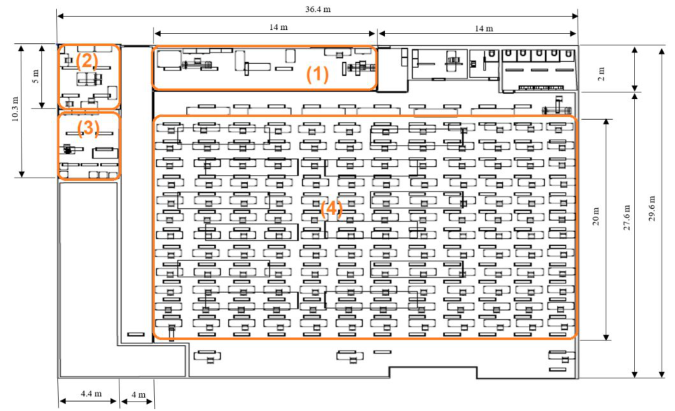
Determination of the Plant Lighting Level Characteristics of the Production Plant The necessary characteristics of the production plant under study are identi- fied in Table 1 as well as the distribution of its areas Figure 1.
Equations and mathematical formulas are available in the original paper PDF.
3(H −h ′) (1)
214 Lighting Applied to Textile Industries
Table 1. Characterization of the production plant under study.
Table available in the original PDF paper.
Characteristics Description Height of the room (H) 3.6 m Height of the working plane (h’) 0.8 m Length (x) 36.4 m Width (y) 29.6 m Wall color Medium gray Ceiling color Old white Activities performed in the work area Garment manufacturing Internal work areas (Figure 1) (1) buttonholes and buttons, (2) embroidery, (3) preventive quality, (4) production
Figure 1: Distribution of internal work areas under analysis.
Where: h
Lighting Applied to Textile Industries 215
Table 2. Characterization of the lighting system.
Table available in the original PDF paper.
Features Description Type of lighting Natural (skylights), artificial (during the day), and localized (located in machines). Number of luminaires and localized (located in machines) Type of lamp 191 luminaires located in the manufacturing area (each luminaire has 2 lamps) Power of each lamp (each luminaire has 2 lamps) Lamp dimensions Fluorescent Luminous flux 59W Number of lamps (1200 × 26) mm Life time 1 870 lm
Table 3. Correlation of the area index and the number of measurement areas.
Table available in the original PDF paper.
Area index Minimum number of zones to be evaluated IC < 1 4 1 ≤IC < 2 9 2 ≤IC < 3 16 3 ≤IC 25
Identification of the Number of Measurements to Be Taken in the Productive Areas For this determination and in accordance with the proposed use standard, the following procedure is defined.
Main Characteristics of the Area Lighting System Under Study, Which is Summarized in Table 2 Location of Measurement Points: Based on the characteristics of the 4 defi- ned areas, the IC area index must be identified to identify the number of measurement zones, considering the equation: Area index IC IC = (x)(y) h (x + y) (3)
Where: IC = area index x,y = dimensions of the area (length and width), in meters h = Height of illumination with respect to the working plane, in meters Considering the resulting CI value, the minimum number of zones to be evaluated is identified in Table 3.
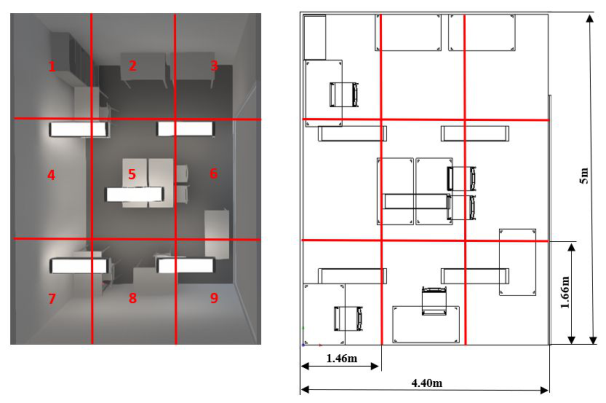
As an example for the area of buttons and eyelets, considering that the CI is 1.1 and the minimum number of zones to be evaluated is 9, the area can be divided as shown in Figure 2.
216 Lighting Applied to Textile Industries
Figure 2: Light measurement points in the study area.Table 4. Example, forecast in the area of Buttonholes and Buttons.
Table available in the original PDF paper.
AREA DATE TIME TYPE OF ILLUMINATION Buttonholes and Buttons Tuesday 08h00-10h00 Artificial y natural Wednesday 10h00-12h00 Artificial y natural Thursday 12h00-14h00 Artificial y natural
Table 5. Example of average illumination measurement.
Table available in the original PDF paper.
Recording of illumination measurements (lux) Sampling points Days of measurement
Measurement of Illumination Levels Based on what is proposed by the standard, the chronogram for taking illu- mination measurements is developed and an example in the buttonhole and button area is shown in Table 4.
Table 5 shows the values resulting from this measurement.
Lighting Applied to Textile Industries 217
Table 6. Summary of lighting levels of the production facility.
Table 7. Percentage of compliance with the illumination level of the plant under study.
Table available in the original PDF paper.
Working section Current average
Minimum recommended Percentage of illumination compliance level (lux) levels (UNE, Asociación Española de Normalización,
2022) (lux)
197.8 750 26.37 %
Buttonholes and buttons
411.5 750 54.87 %
Printing and embroidery
618.7 1000 61.87 %
Preventive quality Production 442.2 750 58.96 %
Table 6 shows the results of the lighting identification procedure of the production plant areas.
Comparison of Lighting Levels of the Plant With Values Proposed in the UNE-EN 12464-1:2022 Standard (UNE, 2022) Table 7 presents the level of compliance of the illumination of the studied area with the appropriate values.
Identification of Conditions Affecting Personnel Working in Low-Light Environments In the document “Health Effects of Changes in Artificial Lighting Conditions on Workers: A Systematic Review” (Avendaño Toloza, 2018), the following is identified.
An illumination level at 150 lux, below the required standards, 84.6% of the subjects analyzed show some visual symptom, 65% defective vision, 85% near vision, 11% astigmatism, color 15% and 45% heterophony.
With the data presented and compared to the initial illumination levels, it is affirmed that more than 80% of the people exposed to this level will present visual symptoms.
IMPROVEMENT PROPOSAL APPLYING LIGHTING TECHNIQUES AND THE USE OF SPECIALIZED SOFT-WARE Design of the Simulation of the Proposal
Calculations are made to determine the parameters involved in this system, such as: utilization coefficient, reflection coefficient, maintenance
218 Lighting Applied to Textile Industries
Table 8. Effective reflectances for certain colors and textures (% values).
Table available in the original PDF paper.
Tone Color Surfaces Construction finishes Very clear New white
Maple Walnut Mahogany Pine Light wood Dark wood
43 16 12 48 30-50 10-25
88 76 76 81 65 76 83 72
Old white Cream blue Cream Blue Honey Grey Green blue
18 27 40 45 25 07 17 13 30-50 15-25
Light-colored quarry Cement Concrete White marble Vegetation Clean asphalt Rock paving stone Gravel Light brick Dark brick
79 55 70 73 METAL FINISHES
Clear Cream Blue Honey Gray
80 75 75 63
Polarized white Polished aluminum Matt aluminum Clear aluminum
54 65 63 61
Medium Blue green Yellow Honey Gray
08 50 10 25 07 03
Dark Blue Yellow Brown Gray Green Black Source: Cálculo del Número de Luminarias para un Espacio Arquitectónico por el Método de Lúme- nes (Coordinación de Universidad Abierta, Innovación Educativa y Educación a Distancia de la UNAM, 2021).
co-efficiency, total luminous flux, number of luminaires, luminaire place- ment height and luminaire placement; finally, with the help of DAILUX evo 8.2 software, the design and simulation of the proposed new lighting system is carried out.
Luminaire Height Calculation The initial values are maintained as there is no change of locality, using equation (1).
Calculation of Room Constant-k The initial values are maintained in the absence of a change of location, using equation (2).
Determination of Reflection Values Starting from the wall and ceiling colors and with the help of Table 8, the effective reflectance measured in percent can be determined.
Lighting Applied to Textile Industries 219
Table 9. Utilization coefficient considering reflectances and room index.
Table available in the original PDF paper.
K p Ceiling 0.80 0.50 0.20 P Wall 0.80 0.40 0.80 0.40 0.80 0.40
Source: Cálculo del Número de Luminarias para un Espacio Arquitectónico por el Método de Lúme- nes (Coordinación de Universidad Abierta, Innovación Educativa y Educación a Distancia de la UNAM, 2021).
Table 10. Maintenance factor values (Fm) by CIE.
Table available in the original PDF paper.
1 2
Frequency of cleaning (years) Ambient conditions P C N D P C N D
On the ceiling We choose a gray color, the closest possible in this case is: Medium gray = 61 = 0.50 On walls It is determined with a wall color, white: Old white = 76 = 0.80 Determination of the Utilization Coefficient Value After having calculated the reflection values and the calculation of the room constant (K), the utilization coefficient is found in Table 9.
Determination of the Maintenance Factor fm It will be done through Table 10 presented by the International Science Council (ISC) (Saavedra et al., 2016), in which it is sufficient to specify the frequency with which maintenance will be performed on the lighting instal- lations, the type of lamp and finally the environmental conditions to which the system is subjected.
220 Lighting Applied to Textile Industries
Em = Average illumination level (Standard 12 464.1) (lux) 8t = Luminous flux that determines room or zone needs (lum) S = Surface to be illuminated (m2) The luminous flux is related to utilization coefficients (Cu) and the maintenance factor (Fm), which are defined below: Cu = It represents the ratio between the luminous flux received by a body and the flux emitted by the light source.
Calculation of the Number of Luminaires The following formula will be used to calculate the number of luminaires:
Nl = 8t n × 8l (5) Donde: NL = number of luminaires; 8t = total luminous flux required in the zone or room; 8l = luminous flux of a luminaire; n = number of lamps in the luminaire;
Displacement of Luminaires Once the number of luminaires required has been calculated, they are distributed on the work plan to achieve uniformity through the following formulas: Number of rows across the width of the room
Lighting Applied to Textile Industries 221
Figure 3: Simulation of the working environment.
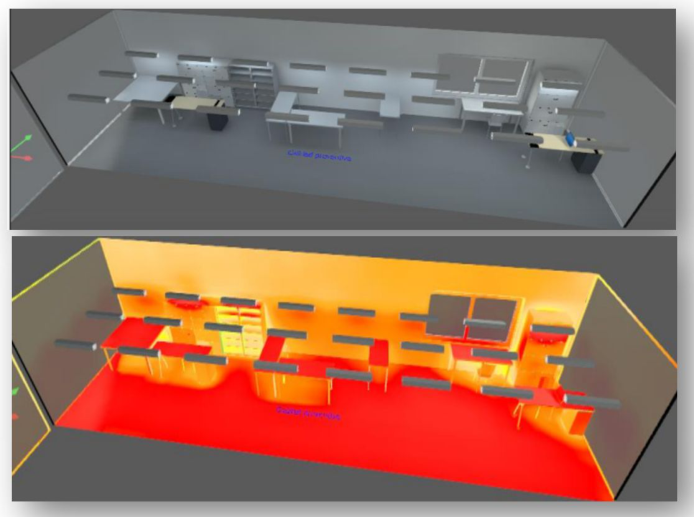
With the data obtained, the simulation of the work area is developed Figure 3, in the DIALux evo 8.2 program, observes the luminous flux that will generate the proposal that includes LED lamps and the distribution at 0.80 meters from the ground as work plane. Estimation of Lighting Levels At the end of the simulation process of the optimal lighting level, Table 11 shows the adequate lighting levels in each of the studied areas in compliance with the European standard on indoor lighting (UNE, 2022). Increased Well-Being of the Collaborators
The proposal will satisfy the lighting requirements for the development of work activities, comparatively with the study “Health effects of changes in artificial lighting conditions in workers” (Avendaño Toloza, 2018), it is expected to improve at least 6 of 15 eye fatigue ratings, i.e. the benefits would be increased by 40%, to all employees of the plant, resulting in an increase in labor welfare.
Calculation of productivity increase. Analogous to what is presented in the document “Process Optimization of Advertising Articles Using an Integrated
222 Lighting Applied to Textile Industries
Table 11. Comparative summary of illumination levels before and after the proposal.
Table available in the original PDF paper.
Section Initial illumination
Initial luminaires
Luminaires required (DIAL
(lux)
Gmbh, 2021)
Required illumination (UNE, 2022)
Proposed illumination (DIAL Gmbh,
2021) (lux)
197.8 5 9 750 915
Buttonholes and buttons
411.5 7 9 750 790
Printing and embroidery
618.7 6 24 1000 1058
Preventive quality Production 442.2 173 151 750 856
Strategy of Production and Environmental Care” (Espejo-Viñán, 2021), the increase in productivity is estimated as follows
Final Productivity
Initial Productivity [Equation or mathematical symbol available in the original paper PDF][Equation or mathematical symbol available in the original paper PDF] Finished product Proposed electrical energy consumption
[Equation or mathematical symbol available in the original paper PDF]−1 (9)
Finished product Initial electrical energy consumption IP = Initial electrical energy consumption Proposed electrical energy consumption = 703.17
125.23
= 5.615 −1 = 462% (10) The proposal foresees an increase in productivity, related to electricity consumption in the order of 462% and a corresponding reduction in environ- mental pollution due to a reduction in energy use, which in the study period is mainly supplied by hydroelectric energy.
CONCLUSION AND FUTURE WORK This research proposes a clear and simple methodology of the application of international norms of illumination compared to its standards, and with the help of the method of lumens and the simulation software DIALux, it is possible to show that it could be passed from an average non-compliance by low illumination of 50% to 0%. 52% to 0%, which affects more than 80% of the people in their labor welfare, related to the visual part, hoping to reduce this affectation by at least 40%, and finally there will be an increase in productivity related to electrical energy of 462%, by optimizing resources by replacing fluorescent lamps by a better distribution with LED luminaires with lower energy consumption.
In the future, lighting and energy expenditure controls should be incorpo- rated after the implementation of the proposal, with the purpose of increasing the monitoring of the visual affections of the employees, as well as the
Lighting Applied to Textile Industries 223
reduction of the energy used in the plant in favor of greater increases in productivity and labor welfare of the collaborators.
REFERENCES
Ana Serrano-Tierz, e. a. (2015). Analysis of energy saving in industrial LED lighting: A case study. Dyna, Universidad Nacional de Colombia. Avendaño Toloza, W. C. (2018). Efectos en la salud derivados de cambios en las
condiciones de iluminación artificial en trabajadores : una revisión sistemática. Rosario: Universidad del Rosario. Coordinación de Universidad Abierta, Innovación Educativa y Educación a Distancia de la UNAM. (2021). Cálculo del Número de Luminarias para un Espacio Arquitectónico por el Método de Lúmenes. (Unidad de apoyo para el aprendizaje) Retrieved 2021, from https://uapa.cuaieed.unam.mx/sites/default/files/minisite/st atic/099ccabb-1893-46cc-a291-897d9bc59078/contenido/index.html DIAL Gmbh. (2021). DIALux evo 8.1. (Dial) Retrieved from https://www.dialux.c
om/en-GB/academy EL TIEMPO Casa Editorial. (2021). Portafolio, Noticias de economía y negocios en Colombia y el mundo. Retrieved from https://www.portafolio.co/ Espejo-Viñán, H. (2021). Process Optimization of Advertising Articles, Using an
Integrated Strategy of Production and Environmental Care. New York: Springer Nature Switzerland. Fondo del Medio Ambiente Mundial. (2021, 10). Fondo para el Medio Ambiente Mundial FMAM - (GEF). Retrieved from https://www.tesoro.es/asuntos-internac ionales/fondo-para-el-medio-ambiente-mundial-fmam-gef International Science Council (ISC). (2022). International Science Council. Retrieved
2022, from https://council.science/es/about-us/ Instituto Nacional de Seguridad e Higiene en el Trabajo (INSHT). (2015).
Iluminación en el puesto de trabajo. Madrid, España. Retrieved from https://www.insst.es/documents/94886/96076/Iluminacion+en+el+puesto+d e+trabajo/9f9299b8-ec3c-449e-81af-2f178848fd0a Machado Miranda, E. N.-L. (2020). Evaluation of interior lighting levels and calculation for lighting facilities. Riobamba: KnE Engineering. Philips. (2021). Philips - United States. Retrieved from https://www.usa.philips.com/ Programa de las Naciones Unidas para el Medio Ambiente. (2016). Aceleración
de la adopción mundial de la iluminación energéticamente eficiente. París: UN Environment United for Efficiency (U4E). Saavedra, E., Luyo, J., & J. Rey, F. (2016, Diciembre 12). Tecnia. Retrieved from http://www.revistas.uni.edu.pe/index.php/tecnia/article/view/57 SECRETARIA DEL TRABAJO Y PREVISION SOCIAL. (2008). NORMA OFI-
CIAL MEXICANA NOM-025-STPS-2008, CONDICIONES DE ILUMINA- CION EN LOS CENTROS DE TRABAJO. U4E United for Efficiency. (2021). United for Efficiency. Retrieved from https://unit ed4efficiency.org/ UNE, Asociación Española de Normalización. (2022). UNE-EN 12464-1:2022
Luz e Iluminación de los lugares de trabajo. Madrid: Asociación Española de normalización.
LISTED IN THE AHFE DIGITAL BOOKSTORE CATALOGUE
Explore the complete digital volume
Human Factors for Apparel and Textile Engineering
Read this individual research paper free through the original publisher, or explore the full digital proceedings book.
ISBN 978-1-958651-08-7
Explore this ISBN in the AHFE Bookstore ↗Listed in the July 2026 bookstore catalogue; search by ISBN to confirm current availability · Digital book purchase optional