Amadeu Martins, Ana Nunes, Andreia Lima, Carlos Ribeiro, Carolina Pedro, Jéssica Oliveira, Monalisa Vieira, Patrícia Monteiro (2022). Strategic Design for “Smellscapes”: Do Smells Get Into Our Decisions?. In: Human Dynamics and Design for the Development of Contemporary Societies. AHFE Open Access, vol. 25, pp. 305–312. https://doi.org/10.54941/ahfe1001402
Most design interventions manipulate the environment to convey sensory information to the public. However, aside from cosmetic industry, research on the olfactory modality has been broadly overlooked. Being one of the most ancient senses, smell provides motivational guidance within the environment, and some evidence has pointed to multisensory influences of smell. Thus, if the olfactory experience could surpass its mere perception and extend to our decisions, it would become a critical topic for design R&D. We assessed the influence of environmental smells on the performance of two distinct decision tasks, namely, a parallel response selection / conflict monitoring task (see Beste et al. 2013) and a cocoa taste-discrimination task, respectively employing an orthonasal (experiment 1) and a retronasal (experiment 2) smell exposure. Three identical laboratory rooms were used in both experiments to expose the participants to control, pleasant (apple fragrance scented room), and unpleasant (faecal / putrid room) smells in a counterbalanced within-subject design. Although participants’ response times were equivalent between conditions in experiment 1, the unpleasant room was associated with a decreased (albeit non-significant) number of errors. Remarkably, experiment 2 revealed that the unpleasant smell condition produced significantly more accurate judgments about the cocoa content of the trials than those obtained under pleasant (p< 0.01) and control (p< 0.05) conditions. Our findings are discussed considering the salience of smells (i.e., motivational value), and task demands (i.e., exposure length and type of cognitive processes engaged). Those factors likely combine to determine the resources (e.g., attention) allocated at each task and consequently, the degree of interference that smells could have on decision-making. We argue that olfactory design interventions might benefit those people in various contexts where sharp decisions are an asset (e.g., operating rooms, court rooms, etc).
It is commonplace that design interventions operate on the consumers’ envi- ronment at some extent, conveying visual, auditory, or haptic information to the public. But aside from cosmetic industry, the olfactory modality has been broadly overlooked possibly because the experimental study of chemosenses
is difficult to implement. Nevertheless, design research has started to integrate olfactory design elements of experience, collectively known as “smellscapes” (see Xiao et al. 2021 for a review).
Smell provides motivational advantage over the environment by optimi- zing feature detection of relevant stimuli for survival, thus promoting hazard avoidance (Mutic et al. 2016, 2017). Over the last decade, the neural pro- cessing steps required for an olfactory stimulus to be perceived have been characterized. Cross-modality influences of smell and other senses have also been identified despite the uncertainty regarding their respective percepti- ons (Auffarth, 2013). Not surprisingly, this would become a “hot” topic for design R&D, should the olfactory experience interact not only with other sen- sory channels but also with high-level cognitive functions, such as decision making.
Orthonasal vs. Retronasal Smell Olfactory stimuli are translated into neural signaling through complex bioch- emical transduction occurring at the nasal epithelium. Psychophysical studies have indicated that olfaction depends on two systems, the orthonasal smell which results from the direct breathing in, and the retronasal smell which requires breathing out, particularly while eating so that the exhaled vapours pass to the nasal cavity (Doty, 2019; Rolls, 2019). The latter is prone to cross-modality interaction between smell and taste, but only recently it has begun to be thoroughly explored. In fact, some studies suggest that retronasal smell has a more powerful impact on behaviour than orthona- sal smell, allegedly by combining emotional / hedonic properties of stimuli (Fondberg et al., 2018; Hannum et al., 2018), and by interfering with cogni- tion, such as episodical memory or language (Fallon et al., 2020; Gottfried et al., 2004; Hannum et al., 2021; Pellegrino et al., 2021). However, the majority of research assessing olfaction tends to quantify / qualify it as an outcome (i.e., dependent variable) in study design. Therefore, little is known about the influences of constant olfactory exposures on high-level cognitive functions.
The Orbitofrontal Cortex Integrates Smell into Higher Cognition In humans, olfaction is the only sensory system with a direct pathway to the orbitofrontal cortex (OFC), a forebrain integrative region that regulates higher cognition such as adaptive decision making or goal-directed behavi- our (Rudebeck and Rich, 2018). Neural signals from both taste and smell converge at the OFC, where they seemingly undergo pattern discrimination and affective attribution (De Araujo et al., 2003; Shanahan, Bhutani and Kahnt, 2021). As the OFC binds the motivational and affective valence of smells whilst coordinating several high cognitive functions, a case can be made for smells to act upon our decision making. Therefore, we explored this possibility with two decision-making paradigms, requiring either an orthona- sal (experiment 1) or a retronasal (experiment 2) constant olfactory exposure. We hypothesized that participants’ decisions would be greatly interfered by
Strategic Design for “Smellscapes”: Do Smells Get Into Our Decisions? 307
the latter, and we also expected that task performance would be facilitated by a “pleasant” constant smell.
METHOD
Experiment 1 Participants. 40 undergraduate students (14 males) with a mean age of 20.7 (SD = 2.4) years volunteered to participate in exchange of a shopping vou- cher raffle entry. Two females were excluded due to transient anosmia (i.e., cold). The local ethical committee study approved the study protocol.
Environmental smell manipulation. Three identical laboratory rooms were used to expose the participants to control (no manipulation), pleasant (apple fragrance scented room), and unpleasant (faecal and putrid room) environ- mental smells in a counterbalanced within-subject design. The ambiance of the rooms began one day before testing. Two “Air Wick Air Freshener Essen- tial Mist” devices delivered a continuous apple fragrance to the “pleasant” room, whereas a conventional 40 cm diameter per 50 cm height bucket con- taining 2 kg of bovine manure produced a continuous putrid smell into the “unpleasant” room. Both the air fresheners and the bucket of manure were out of sight. Each room was kept at a constant temperature of 24 degrees Celsius. Three independent observers who were blind to the study confirmed the pleasantness / unpleasantness of the environmental smell manipulation.
Apparatus. In each room, participants sat 80 cm far from a Full HD 21,5” screen connected to a Dell OptiPlex 3070 (8 GB DDR4 2666 MHz RAM) where the experimental instructions and stimuli were presented. A standard keyboard (Dell KB522) was used for response collection.
Decision task. A Portuguese version of the task introduced by Beste and colleagues (Beste et al., 2013) was employed to assess response decisions under conflicting cues. The task comprised a block of 16 practice trials fol- lowed by two blocks of 32 experimental trials each, with a short break in between. In each trial, one of the following disyllabic colour words was pre- sented at the centre of the screen: “azul” (blue), “verde” (green), “preto” (black), “rosa” (pink). Those colour words were presented inside a rhomb or a square and were printed either in the corresponding colour or in one of the remainders. The geometrical shape served as cue to denote the task rule: participants had to (a) read the word when it was surrounded by a square, or (b) name the print color of the word when a rhombus was present. In any case, participants were instructed to press the initial letter key of their desi- red response as quickly as possible. If performance broke down, participants were told to continue with the next stimulus presented. Inter-stimulus inte- rvals were set to the latency of each response (up to a timeout of 1500 ms). The whole task was controlled by a custom script written in Open Sesame (Mathôt, Schreij and Theeuwes, 2012).
Procedure. Upon arrival at the laboratory, participants provided their informed consent and basic demographic data. Participants were then assi- gned to the decision task at one of the rooms according to the counterbala- ncing plan. Upon task completion, participants would leave the room and rest for 5 minutes in the hallway before entering the next room. Instructions about
the task demands were always given prior to the task. Participants were tested three times in a simple within-subject factor (rooms) design, always supervi- sed by one of the experimenters to prevent them to close their nostrils. All testing was completed before the COVID-19 pandemic outbreak.
Data Reduction and Analysis. Response latencies were averaged to com- pute the overall response time per experimental room. Errors (incorrect or late responses) were averaged out, and the proportion of correct decisions per experimental room was computed (c.f. Quelhas Martins, McIntyre and Ring, 2014). Repeated-measures ANOVA with the Greenhouse-Geisser correction was applied to the data. The standard error of the mean (SEM) is illustra- ted. The statistical significance level was set at p< 0.05 and all analyses were performed with “IBM SPSS” version 20.
Experiment 2 Participants. 30 normosmic undergraduate students (12 males) with a mean age of 19.9 (SD = 1.9) years volunteered to participate in exchange of a shopping voucher raffle entry. The local ethical committee study approved the study protocol.
Environmental smell manipulation. The same as in experiment 1. Decision task. We modified an existing protocol (Reinoso Carvalho et al., 2017). In each trial, three identical chocolate samples with the same dark brown colour and volume (approximately 2.0 cm3) were presented wrapped into coloured cellophane film. Three different colours (respectively, “red”, “green”, and “blue”) of cellophane film were used to tag the proportions of cocoa content (respectively, 40%, 50%, and 60%) of the chocolate sam- ples. The aim of the task was to discriminate the sample with the highest cocoa content. After each sample, the participant was instructed to wash his/her mouth with warm water. Response latency was timed and it was defi- ned as the interval from the third sample being eaten and the decision being issued.
Procedure. The same as in experiment 1, apart from the task being different.
Data Reduction and Analysis. The same as in experiment 1.
RESULTS
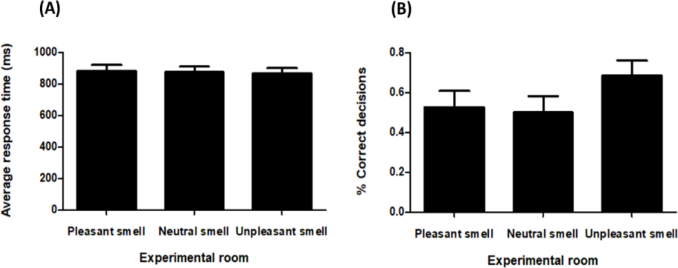
Experiment 1 Parallel action monitoring response times under distinct constant smells. A repeated measures ANOVA indicated that performance latencies were indistinguishable between the three rooms, F(2,74) = 0.13, p = .87 (Figure 1A).
Parallel action monitoring decisions under distinct constant smells. A repe- ated measures ANOVA revealed that the task completed under an unpleasant smell tended to outperform those accomplished under control and pleasant smells, F(2,74) = 2.11, p = .13, η2 = .05 (Figure 1B). Post-hoc tests indicated that such performance was marginally more accurate than those occurring under the control (p= .07) and the pleasant smell (p= .11) conditions.
Strategic Design for “Smellscapes”: Do Smells Get Into Our Decisions? 309
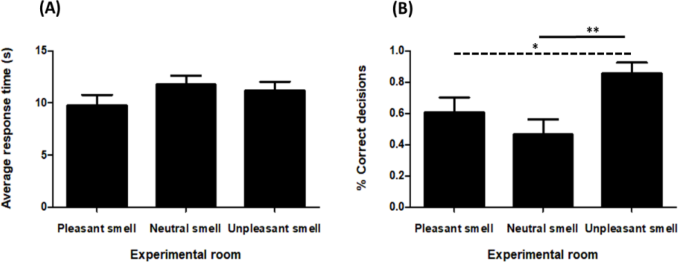
Figure 1: Performance in the “Parallel action monitoring task”. While participants’ response time (A) was similar between rooms, their proportion of correct decisions (B) was slightly improved (albeit not significantly) when the task was running at the room with the unpleasant smell.Figure 2: Performance in the “Cocoa taste-discrimination task”. Again, participants’ response time (A) was similar between rooms. However, the proportion of correct decisions (B) was significantly improved when the task was running at the room with the unpleasant smell. Note: * p< .05; ** p< .01.
Experiment 2 Cocoa taste-discrimination response times under distinct constant smells. A repeated measures ANOVA detected no overall differences in response times between the three rooms, F(2,54) = 1.38, p = .26 (Figure 2A).
Cocoa taste-discrimination decisions under distinct constant smells. A repeated measures ANOVA detected a significant within-subject effect (room) in the accuracy of cocoa taste-discrimination decisions, F(2,54) = 6.11, p< .01, η2 = .19 (Figure 2B). Further, paired samples post-hoc tests confirmed significantly more correct decisions at the unpleasant smell condition than both the control [t(27)=3.67; p< .01] and the pleasant smell [t(27)=2.55; p< .05] conditions.
CONCLUSION
The immediate effects of smells on cognition are usually hard to interpret due to the inherent properties of chemosensory paradigms. Here, we presented
two paradigms requiring decisions concurrent to orthonasal (experiment 1) or retronasal (experiment 2) constant smells. As hypothesized, participants’ decisions revealed the greatest interference when the task implicated a cross- modal taste-smell judgement (i.e., retronasal olfaction). Strikingly though, we found that the constant “unpleasant” smell optimized the performance in both tasks.
Considering these unexpected findings, several aspects are worth discus- sing. First, smells primarily serve motivational drives. Therefore, it is possible that the bitter taste of the chocolate samples with the highest cocoa con- tent has matched the putrid smell at the “unpleasant” room condition to increase arousal and to signal a hazardous environment. In other words, the putrid smell would achieve contextual salience through a sensory congrue- ncy process, just as if the brain would be “primed” by the smell to monitor any noxious (i.e., poisonous) ingestion. On the one hand, this explanation is compatible with evidence that supports the existence of an “episodic buffer” which temporarily stores olfactory information to subserve ongoing tasks (Zelano et al., 2009), and the improvement of working memory performa- nce under conditions of moderate arousal (Quelhas Martins et al., 2013). On the other hand, such prospect could also accommodate the coincident trend of decisions accuracy in both tasks, regardless of their distinct leng- ths. Specifically, the “Parallel action monitoring task” typically lasted for 3-4 minutes in each room whereas the “Cocoa taste-discrimination task” lasted roughly for a mere 20 seconds per room. One could argue that the participants might have habituated to the olfactory exposure by the second block of the former of these tasks, thereby decreasing their levels of arousal. Second, olfactory accuracy also changes as a function of the motivatio- nal drive. Shanahan, Bhutani and Kahnt (2021) have recently shown that individuals are less able to discriminate food-related smells when satiated than during fasting. As such, we cannot rule out the possibility that the “Cocoa taste-discrimination task” might have interfered with participants’ smell. However, it must be acknowledged that this task was very brief and implied that the participant exhaled the vapours of the melted cocoa in each trial. Moreover, any interindividual differences in taste would dissipate due to the counterbalancing. Finally, we should acknowledge the likelihood of disti- nct cognitive processes (“top-down” versus “bottom-up”) being allocated in each task. In particular, the “Parallel action monitoring task” employed here engages several “top-down” cognitive processes like vigilance, conflict moni- toring, among others (Beste et al., 2013). Decisions which implicate such a “cold cognition”might be less permeable to olfactory influences, particularly during lengthy orthonasal exposures. Furthermore, smell interference in deci- sion processes will probably be minimal when olfactory stimuli are unrelated to the task.
In sum, these preliminary data indicate that decision-making processes are susceptible to constant olfactory cues, a complex effect that warrants further studies. Paradigms involving behavioural tasks with distinct exposure types (orthonasal vs. retronasal) and lengths should be expanded with psychophy- siological correlates to unravel the contributing weight of factors determining the impact of smells in our decisions. In the coming years, “smellscape”design
Strategic Design for “Smellscapes”: Do Smells Get Into Our Decisions? 311
could be strategically targeted to contexts where decisions are an asset (e.g., operating rooms, court rooms, etc).
ACKNOWLEDGMENT
This work was supported by a Portuguese Government “Fundação para a Ciência e a Tecnologia (UIDB/DES/00711/2020)” Grant attributed to UNI- DCOM/IADE – Unidade de Investigação em Design e Comunicação, Lisbon, Portugal.
REFERENCES
De Araujo, I. E. et al. (2003) ‘Taste-olfactory convergence, and the representation of the pleasantness of flavour, in the human brain’, European Journal of Neuroscience, 18(7), pp. 2059–2068. doi: 10.1046/j. 1460–9568.2003.02915.x. Auffarth, B. (2013) ‘Understanding smell-The olfactory stimulus problem’, Neu-
roscience and Biobehavioral Reviews. Neurosci Biobehav Rev, pp. 1667–1679. doi: 10.1016/j.neubiorev.2013.06.009. Beste, C. et al. (2013) ‘A novel cognitive-neurophysiological state biomarker in premanifest Huntington’s disease validated on longitudinal data’, Scientific Reports, 3. doi: 10.1038/srep01797. Doty, R. L. (2019) ‘Psychophysical testing of smell and taste function’, in Handbook
of Clinical Neurology. Elsevier B.V., pp. 229–246. doi: 10.1016/B978-0-444- 63855-7. 00015–0. Fallon, N. et al. (2020) ‘A behavioral and electrophysiological investigation of effects of visual congruence on olfactory sensitivity during habituation to prolonged odors’, Chemical Senses, 45(9), pp. 845–854. doi: 10.1093/CHEMSE/BJAA065. Fondberg, R. et al. (2018) ‘Multisensory flavor perception: The relationship between
congruency, pleasantness, and odor referral to the mouth’, Appetite, 125, pp. 244– 252. doi: 10.1016/j.appet.2018.02.012. Gottfried, J. A. et al. (2004) ‘Remembrance of odors past: Human olfactory cortex in cross-modal recognition memory’, Neuron, 42(4), pp. 687–695. doi: 10.1016/S0896-6273(04)00270-3. Hannum, M. et al. (2018) ‘Different olfactory percepts evoked by orthona-
sal and retronasal odorant delivery’, Chemical Senses, 43(7), pp. 515–521. doi: 10.1093/CHEMSE/BJY043. Hannum, M. E., Fryer, J. A. and Simons, C. T. (2021) ‘Non-food odors and the duality of smell: Impact of odorant delivery pathway and labeling convention on olfactory perception’, Physiology and Behavior, 238. doi: 10.1016/j.physbeh.2021.113480. Mathôt, S., Schreij, D. and Theeuwes, J. (2012) ‘OpenSesame: An open-source, gra-
phical experiment builder for the social sciences’, Behavior Research Methods. Behav Res Methods, pp. 314–324. doi: 10.3758/s13428-011-0168-7. Mutic, S. et al. (2016) ‘You smell dangerous: Communicating fight responses through human chemosignals of aggression’, Chemical Senses, 41(1), pp. 35–43. doi: 10.1093/chemse/bjv058. Mutic, S. et al. (2017) ‘Chemosensory danger detection in the human brain: Body
odor communicating aggression modulates limbic system activation’, Neurops- ychologia, 99, pp. 187–198. doi:10.1016/j.neuropsychologia.2017.02.018. Pellegrino, R. et al. (2021) ‘Duality of Smell: Route-Dependent Effects on Olfactory Perception and Language’, Chemical senses, 46. doi: 10.1093/chemse/bjab025.
Quelhas Martins, A. et al. (2013) ‘Moderate intensity exercise facilitates working memory’, Psychology of Sport and Exercise, 14(3), pp. 323–328. doi: 10.1016/j.psychsport.2012.11.010. Quelhas Martins, A., McIntyre, D. and Ring, C. (2014) ‘Effects of baro- receptor stimulation on performance of the Sternberg short-term memory task: A cardiac cycle time study’, Biological Psychology, 103, pp. 262–266. doi: 10.1016/j.biopsycho.2014.10.001. Reinoso Carvalho, F. et al. (2017) “‘Smooth operator”: Music modulates the
perceived creaminess, sweetness, and bitterness of chocolate’, Appetite, 108, pp. 383–390. doi: 10.1016/j.appet.2016.10.026. Rolls, E. T. (2019) ‘Taste and smell processing in the brain’, in Handbook of Clinical Neurology. Elsevier B.V., pp. 97–118. doi: 10.1016/B978-0-444-63855-7. 00007–1. Rudebeck, P. H. and Rich, E. L. (2018) ‘Orbitofrontal cortex’, Current Biology. Curr
Biol, pp. R1083–R1088. doi: 10.1016/j.cub.2018.07.018. Shanahan, L. K., Bhutani, S. and Kahnt, T. (2021) ‘Olfactory perceptual decisionmaking is biased by motivational state’, PLoS Biology, 19(8). doi: 10.1371/jour- nal.pbio.3001374. Xiao, J. et al. (2021) ‘Recent Advances in Smellscape Research for the Built Environ-
ment’, Frontiers in Psychology, 0, p. 2729. doi: 10.3389/FPSYG.2021.700514. Zelano, C. et al. (2009) ‘A specialized odor memory buffer in primary olfactory cortex’, PloS one, 4(3). doi: 10.1371/JOURNAL.PONE.0004965.
LISTED IN THE AHFE DIGITAL BOOKSTORE CATALOGUE
Explore the complete digital volume
Human Dynamics and Design for the Development of Contemporary Societies
Read this individual research paper free through the original publisher, or explore the full digital proceedings book.
ISBN 978-1-958651-01-8
Explore this ISBN in the AHFE Bookstore ↗Listed in the July 2026 bookstore catalogue; search by ISBN to confirm current availability · Digital book purchase optional