Michele Santos, Rita Almendra (2022). The Achievement of a Balanced and Consistent PhD Thesis - Journey Towards the PhD Proposal. In: Human Dynamics and Design for the Development of Contemporary Societies. AHFE Open Access, vol. 25, pp. 432–437. https://doi.org/10.54941/ahfe1001418
CIAUD, Research Centre for Architecture, Urbanism and Design, Lisbon School of Architecture, Universidade de Lisboa, Rua Sa Nogueira, Polo Universitário do Alto da Ajuda, 1349-063 Lisboa, Portugal ↗
The achievement of a balanced and consistent PhD Thesis proposal is a challenge for each PhD student. This paper intends to unfold and reflect on the tactics used by the authors in the course named “Seminário de Projeto de Tese” (Thesis Project Seminar) lectured at the Doctoral Program in Design at the Lisbon School of Architecture, Univ. of Lisbon. The main goal of this reflection is to present and question the key elements of this “kick-off” moment, but mostly, to convey the way they are worked along with the students and later concatenated in a robust proposal that maps the research project. In methodological terms, we will be using literature review to frame the work and we will assess the didactics used in class. As a result of this work, we show a step-by-step didactic process explained and open to be used. These guidelines have proven to be very assertive.
The Doctoral Program in Design at the Lisbon School of Architecture (LSA) from the University of Lisbon consists of 3 years supported by several Cur- ricular Units. These curricular units are intended to stimulate and develop students’ knowledge and skills that will help them to perform in different core areas during their PhD journey.
THESIS PROJECT SEMINAR ROLE IN THE DESIGN PhD PROGRAM AT LSA Thesis Project Seminar (TPS) is a course that allows PhD students during the second semester of their first year of the program, to develop their PhD proposal. After they have worked on the first semester in the Research and Methodologies course on the key elements of the research process.
The TPS Course – Goals, Processes and Structure The TPS course goal is to, through the direct application of the acquired knowledge, endow students with the tools and the necessary confidence to
Class Professors Subject 1 All 3 Synthesis of each one’s proposal 2 MS Thesis Proposal Structure 3 RA Theoretical frameworks 4 RG Lining up Goals, Research Questions and Hypothesis 5 MS Thesis Index and Provisional Index 6 MS Lining up Organogram, Research Drawing and Tasks Timing 7 RG Bibliographic References and Bibliography 8 RA Proposals’ supporting Diagrams 9 RA Critical Selection of Methods 10 RG Presentation of Students’ Diagrams 11 RA Presenting the Proposal – Structure 12 MS Relevant aspects for the Presentation/TPS Defense 13 RG Doubts clarification 14 All 3 Evaluation, Students self-evaluation and CU evaluation
construct a balanced and supported research PhD proposal. The proposal should present different types of research methodologies, chosen from the most adequate, according to their personal defined objectives, as well as, techniques, tools, processes that can best assist them on the construction of the research project and on its presentation and defense before a jury.
The TPS course is structured in lectures that occur in face-to-face lessons, for 1,5 hours/week for 14 weeks. During the pandemic, the classes occurred online and in mixed formats. The sessions were guided by 3 teachers, with individual classes and sometimes jointed ones. Every year the course dire- ctor, selects teachers from different design areas deliberated in order to match the nature of the students and interests that may vary from Product/Indu- strial Design; Fashion Design; Communication/Graphic Design; Interaction Design; Interior design. The course planning is detailed in Table 1, the sub- ject of each class is related to the elements that must be integrate the PhD proposal.
When analyzing briefly Table 1 it is important to underline that a color code is associated with one of the teacher classes, the grey color is used when all the teachers will be in the class. These are introductory and assessment moments that call for broader perspectives.
In terms of contents, the plan predicts that all students present their own research intentions in a first instance and only in a second moment they are confronted with the thesis proposal structure. That allows students to speak freely and for teachers to capture their primary reasoning about the research and its process. From that moment on each class is dedicated to a specific mandatory topic of the research proposal, as it follows:
1. Theoretical Framework – This topic demands on the part of PhD students the definition of the relevant topics to be tackled thru literature review so the research context becomes clear and its pertinence is established; 2. Lining up Research questions, goals and Hypotheses – in this case, students had already addressed each of the elements in the research
434 Santos and Almendra
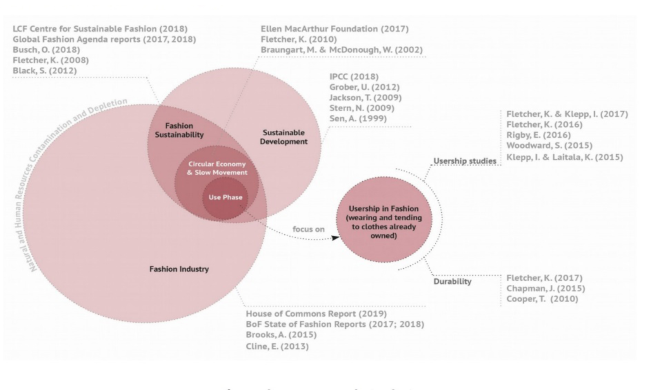
Figure 1: Contextual framework diagram - student Ana Neto, 2019.
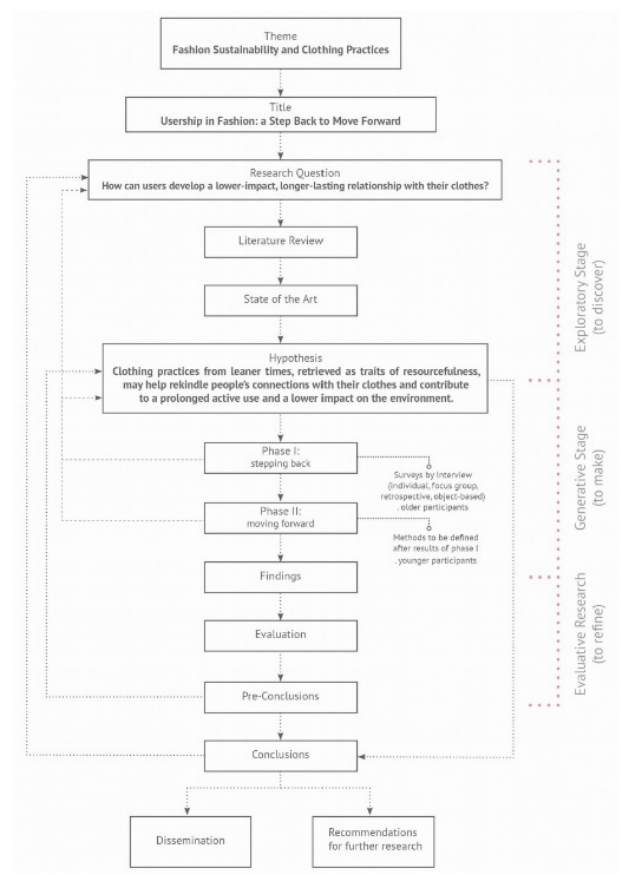
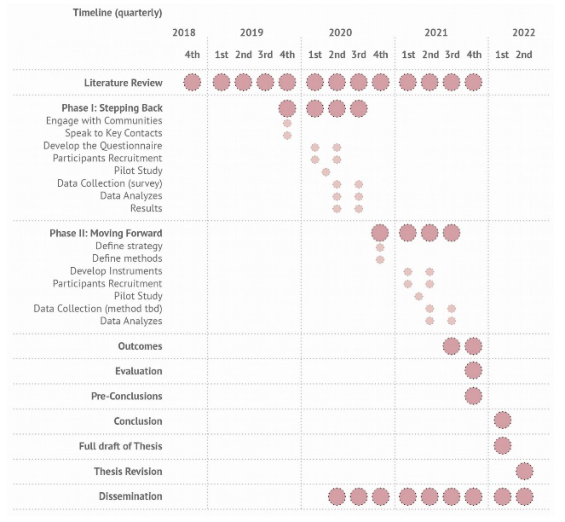
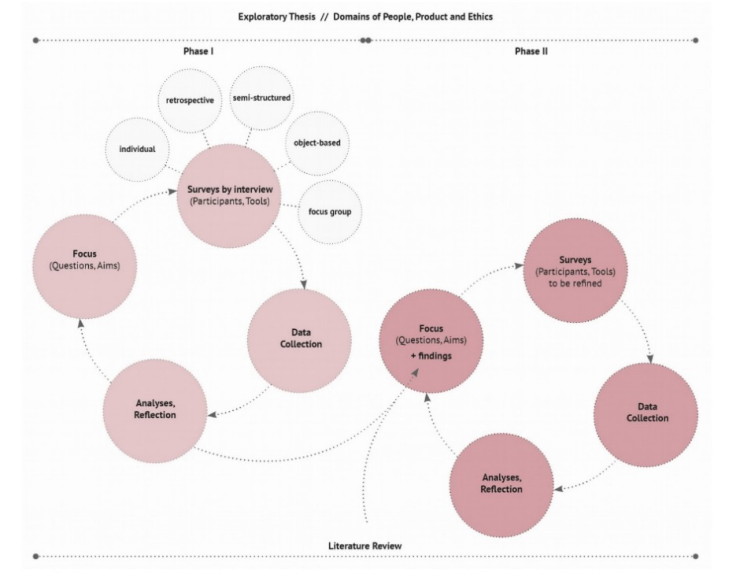
methodologies course. The challenge is to align all the elements questio- ning its relevance and accuracy; 3. Proposal Index and Provisional Thesis Index – in the class dedicated to this topic the pre-textual elements are addressed so students become aware of the organization of all the elements while intending a tentative index of their Thesis; 4. Lining up research context’s diagram, research organogram and pro- visional Calendar – the synthesis promoted by these specific elements make students engage in a challenging task of systematization of the key elements of their thesis proposal. In the case of the research context’s diagram, the goal is to translate visually the foundational research areas and their connections and interdependencies (see Figure 1); concerning the research organogram students face the opportunity to describe gra- phically the entire research process describing the different phases that integrate it (Figure 2); Finally, the provisional calendar permits them to assign to each task a timeframe (Figure 3). 5. Bibliographic references and Bibliography – the awareness and practice of selecting the adequate references and bibliography as well as how to display them in the proposal is worked out in this specific class; 6. The proposal’s supporting diagrams – besides the diagrams/tables men- tioned in point 4 (that are also subject of analysis in this class) other schemes, graphics, infographics are subject of study and analysis so stu- dents can use them as pertinent information pieces of their proposals (see example Figure 4); 7. Critical selection of methods – this specific session recalls some of the knowledge worked in the research methodologies course and calls for the student’s critical reflection about the selection and rationale behind their choices; 8. Presentation of the proposal/Defense moment – in this final class (which is not the final one in terms of schedule since students have one more class
The Achievement of a Balanced and Consistent PhD Thesis 435
Figure 2: Research organogram - student Ana Neto, 2019.
to clarify doubts and another one to discuss evaluation, self-evaluation and peers-evaluation) the aspects of the proposal’s presentation before a jury are tackled in order to support the creation of a clear and meaningful communication object.
RELEVANT LESSONS TO REFLECT UPON The PhD proposal organization and diagrams like we have presented are a combination of written and graphic reflection of each individual PhD proposal intention that reflects the nature of a PhD in Design. This symbiosis speaks a familiar language for designers and gives us the schematic approach that helps the viewer, in particular, the jury to understand these intentions.
436 Santos and Almendra
Figure 3: Provisional calendar - student Ana Neto, 2019.Figure 4: Methodological approach - student Ana Neto, 2019.
The Achievement of a Balanced and Consistent PhD Thesis 437
This procedure is more focus than other widely known like Murray (2010) or Phillips and Pugh (2009).
CONCLUSION
This organization of work, built step by sept in a logical framework used at the LSA in the past years has proved to be an assertive approach. It helps stu- dents and supervisors in the organization of their PhD proposals guaranteeing that they will not miss important reflection steps.
ACKNOWLEDGMENT
This work was supported by CIAUD, Research Centre for Architecture, Urba- nism and Design, Lisbon School of Architecture, Universidade de Lisboa financed by national funds through FCT - Fundação para a Ciência e a Tecno- logia, I.P., under the Strategic Project with the reference UIDB/04008/2020.
REFERENCES
Murray, Rowena, ed. (2010). How to Write a Thesis. Berkshire: Open University Press. Phillips, Estelle M. and Pugh, Derek S. (2009). How to get a PhD. A handbook for
students and their supervisors. Berkshire: Open University Press.
LISTED IN THE AHFE DIGITAL BOOKSTORE CATALOGUE
Explore the complete digital volume
Human Dynamics and Design for the Development of Contemporary Societies
Read this individual research paper free through the original publisher, or explore the full digital proceedings book.
ISBN 978-1-958651-01-8
Explore this ISBN in the AHFE Bookstore ↗Listed in the July 2026 bookstore catalogue; search by ISBN to confirm current availability · Digital book purchase optional