João Martins, Luis Mota, Rui Cavaleiro (2022). Human-Centered Design on the Ways to Santiago de Compostela: New Artefacts for their Sustainability. In: Human Dynamics and Design for the Development of Contemporary Societies. AHFE Open Access, vol. 25, pp. 473–481. https://doi.org/10.54941/ahfe1001423
1 Instituto Politécnico de Viana do Castelo, Rua Escola Industrial e Comercial Nun’Álvares, 34, 4900-347 Viana do Castelo, Portugal; CIAUD, Research Centre for Architecture, Urbanism and Design, Lisbon School of Architecture, Universidade de Lisboa, Rua Sá Nogueira, Polo Universitário do Alto da Ajuda, 1349-063 Lisboa, Portugal ↗
2 Instituto Politécnico de Viana do Castelo, Rua Escola Industrial e Comercial, Nun’Álvares, 34, 4900-347 Viana do Castelo, Portugal ↗
This paper is concerned with how design can add value to the traditional and historical Way of Santiago, identifying design needs and problems that give rise to innovative solutions. The main objective of the research was to develop new products, environments or services that contribute to enhancing the Way of Santiago so that it can be followed with greater safety, comfort, efficiency and pleasure by pilgrims and tourists. The project encouraged master students and designers to build a critical reflection on the knowledge obtained, through a survey, fieldwork, interpersonal contacts and bibliographic review, in order to identify design problems or opportunities for the emergence of new solutions appropriate to the context and user needs. The teaching-learning dynamics was based on the Studio-Based Learning model. The project work resulted in a set of new solutions for the problems identified, to respond to users' functional needs and socio-cultural interactions, the use of artifacts, emotional aspects, habits and behaviors associated with the project context.
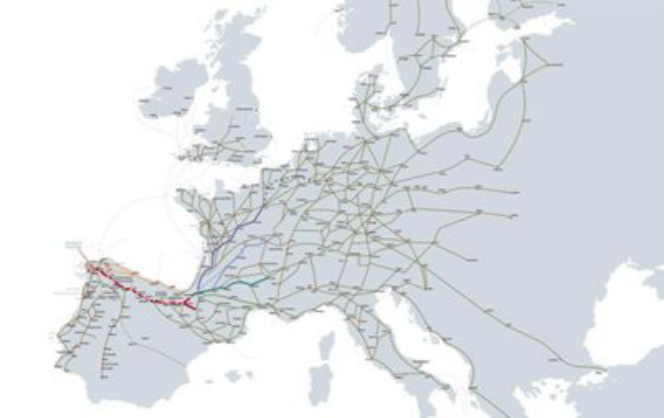
Santiago de Compostela, in Spain, is the destination of thousands of pilgrims and tourists who follow the Camino de Santiago (Way of Santiago) every year, choosing a route from Portugal, Spain or France. In 2018 a total of 327,000 pilgrims arrived, of whom 81,000 began their journey in Portugal (Antunes, 2019). The pilgrimage began in the 9th century, motivated by a visit to the remains of the apostle Saint James, located under the city’s cathedral. There is no single path, but several routes that together add up to about 2,000 km, giving the pilgrim or tourist the option to choose the one they want - including where they want to start or finish (Figure 1).
In 1987, the Way was declared the First European Cultural Itinerary and World Heritage Site in Spain (1993) and France (1998). At present, its impor- tance is growing in both spiritual and cultural aspects. The French Way is the
most traveled route and the second most traveled route is the Portuguese Way (Duarte, 2016).
The Pilgrims Every year, hundreds of thousands of travelers leave for Santiago de Compo- stela. Most travel on foot, some by bicycle and others on horseback (Duarte, 2016). This ancient route provides an intense human experience, creating a sense of brotherhood among travelers and a strong connection with the land (Council of Europe, 2019). Pilgrimages are becoming more prominent in the modern world, and religion seems to be less and less the justifying factor. Walking for several days, usually alone with your walking stick, and challenging the limits of the body, can lead to profound self-knowledge.
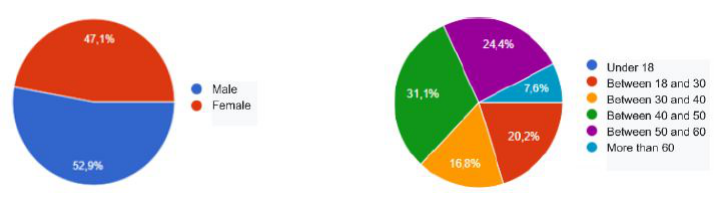
The survey was intended to gather a statistical response from the target audience. The data obtained through this survey were analyzed using a sample of 119 responses. Regarding the survey, in addition to the topics mentioned above, other issues fundamental to this study were gender and age group (Figure 2). Based on these data, we conclude that most pilgrims are male and aged between 40 and 50.
Figure 1: Map of Way of Santiago Pilgrim Routes (Source: Xunta de Galicia).Figure 2: Gender and Age of pilgrims.
Human-Centered Design on the Ways to Santiago de Compostela 475
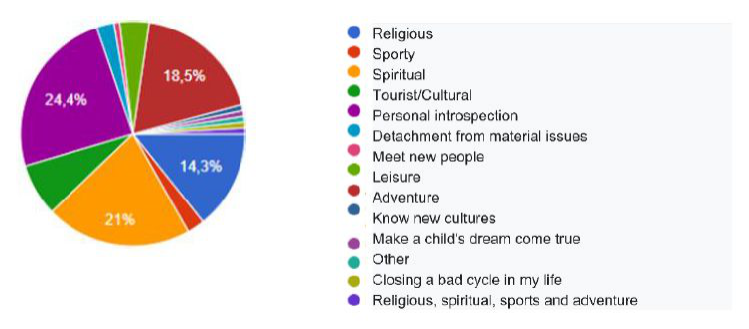
There are several reasons for making this pilgrimage. From the results of the survey, we can observe that most people make this pilgrimage as a personal introspection, for spiritual, religious and sporting reasons (Figure 3).
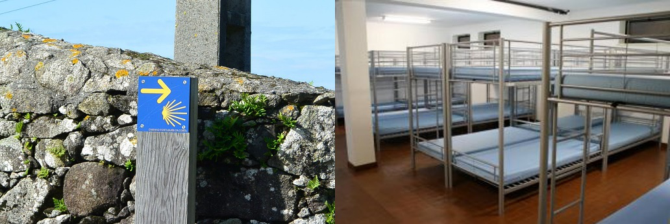
The Ways of Santiago The paths are marked by several symbols indicating the direction, the most relevant being a shell, which marks and differentiates this path from others. There are a variety of direction symbols, but the most frequent symbol is a yellow arrow attached to vertical supports of different materials, such as walls, poles, trees, pillars, stone frames, or even on the ground, among others with the iconographic drawing of a shell Factors as simple as the lack of criteria in the signs, due to not being homogeneous along the routes, disorient and confuse pilgrims, and are indicated as impeding “an integral and quality tourist experience (Fernandes, 2017). Pilgrim hostels aim to provide basic conditions for pilgrims. They offer a bed/bunk in a dormitory, bathrooms, laundry space, living space and a common kitchen where pilgrims can prepare their own meals (Figure 4).
Following the way to Santiago requires planning the itinerary, and in doing so the pilgrim must gather as much information about the relief, distance,
Figure 3: Motivations to follow the Ways of Santiago.Figure 4: Signs of Ways to Santiago de Compostela and bunk beds inside a support hostel for pilgrims to stay overnight (Source: authors).
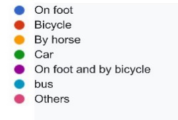
places for food and accommodation and about the itinerary to be covered in order to reduce the probability of “surprises”. The vast majority of people travel on foot along the ways of Santiago (Figure 5).
There are a number of Ways through Portugal to Santiago, depending on pilgrims’ point of departure, but currently three main ways can be identified: the Northern Way (the oldest), The Inland Way and the Central Portuguese Way (further south). The North Coast Way which today is marked, departs from city of Porto and the route goes via Vila do Conde, Esposende, Viana do Castelo and Caminha, where we can cross into Spain, or continue to Valença.
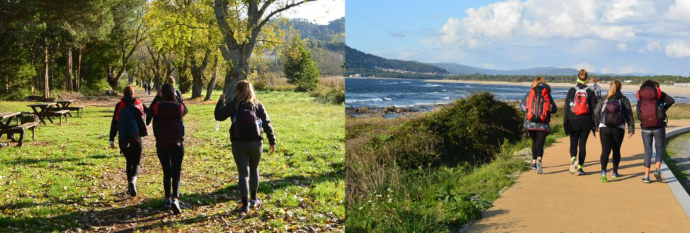
THE PATH TO NEW ARTEFACT IDEAS FOR THE WAYS OF SANTIAGO THROUGH DESIGN PROCESS The set of phases proposed in developing the project were adapted from methodologies proposed by different authors (Baxter, 1995; Lobach, 2001; Munari, 1982). The first stage involved theoretical research, due to the need to carry out a bibliographic study, in order to become familiarized with the theme and form the research problem, which later helped in the process of joining new knowledge with experiences already known. Fieldwork aims to promote student interaction with the environment in order to obtain a more real perception of what pilgrims or tourists feel and experience and to enhance creativity (Figure 6).
Figure 5: Means of transportation used on the Ways of Santiago.Figure 6: Students and teachers taking the North Coast Way of Santiago de Compostela.
Human-Centered Design on the Ways to Santiago de Compostela 477
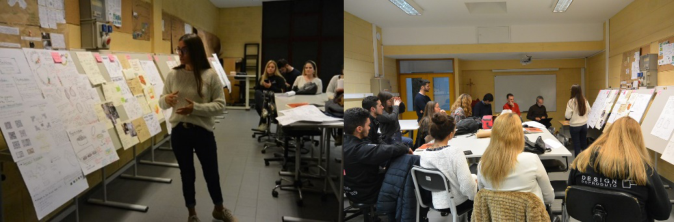
Design Process Defining and questioning the problem at the beginning of the design pro- cess was essential to know all the relevant aspects. In this first phase, broad thinking was promoted so as not to limit the success of the results. Asking, observing, thinking and learning led to action. In the creative phase, melancholic or stagnant approaches were discouraged, stimulating more thought-provoking and transformative ideas. For easier acceptance by the tar- get audience, it was necessary to integrate knowledge about their functional needs and sociocultural interactions, the use of artifacts, emotional aspects, habits and behaviors associated with the project context. In this phase, diffe- rent techniques to stimulate creativity were used, such as brainstorming, mind maps, function analysis and analogies (Milton & Rodgers, 2013). The discus- sion of the various ideas generated allowed reduced to a predominant concept helped to frame the option for a particular design approach (Figure 7).
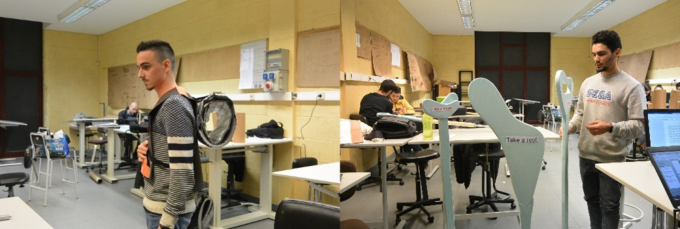
Physical or virtual modeling of the concepts was essential to confirm that they could be converted into real solutions. This established questions of functionality, usability, ergonomics, proportions, and forms related to the concepts, allowing their development (Figure 8).
The effective solution was addressed through perfectly functional physical or digital prototypes. In addition to testing the application of materials, tech- nologies and manufacturing processes, the prototype gave the possibility of
Figure 7: Discussion of the ideas and concepts of solutions generated by the students.Figure 8: Student demonstrates the functionality of a concept of a multifunctional back- pack through a full-scale study model (left). Student demonstrates the functionality of a concept of supports for different actions through a full-scale study model (right).
appreciation by users who, together, could give suggestions, as well as guiding final decision-making.
Results
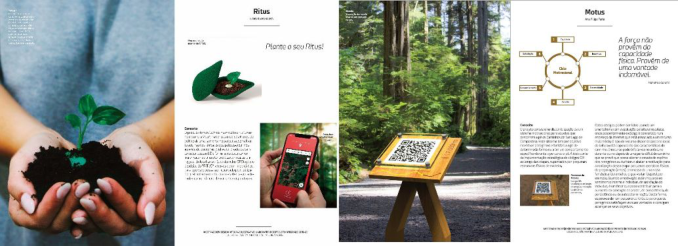
The challenge for sustainable development focuses on creating products and services that establish a perfect symbiosis between the economy, society and the environment (Bhamra, Lofthouse, 2008), with culture as the basis. This project resulted in sixteen proposals for physical products and pro- duct systems. Some of the projects presented below incorporate digital technologies such as applications, geolocation and QR codes (Figure 9).
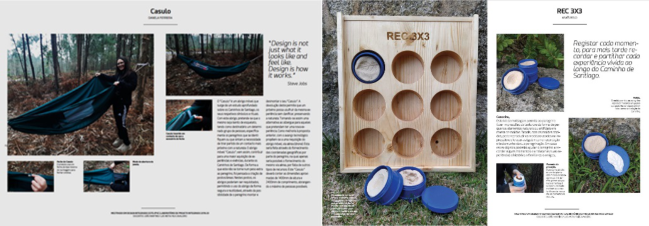
As the project evolved, students were encouraged to establish bridges betw- een the development of solutions to defined design problems and inclusion of the concepts of innovation, creativity, inclusive society and sustainable development (Papanek, 1984; Fuad-Luke, 2009; Margolin, 2014; Manzini, 2015). These were worked on collectively and are revealed in the final very different results (Figure 10).
Figure 9: Left: Project “Ritus” capsule that transports a tree seed to be left on the way to grow, signaling the pilgrim’s passage and contributing to afforestation (Student: Carlos Pereira, 2020). Right: The “Motus” project consists of a system of QR codes provided along the way through which useful information can be accessed to encou- rage the pilgrim to travel a few more kilometers to the destination (Student: Ana Faria, 2020).Figure 10: Left: Project “Casulo” wrapper that serves as a shelter for pilgrims in a forest (Student: Daniela Ferreira, 2020). Right: The project “REC 3x3” is a molding kit that allows pilgrims to make impressions of the texture and shape of small natural or artificial elements in mass to mold and later reproduce these objects and offer as a souvenir or to report their experiences during the way (Student: Anaïs Rolo, 2020)
Human-Centered Design on the Ways to Santiago de Compostela 479
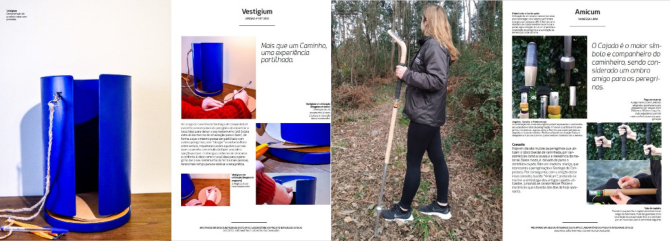
All products and product systems created show innovative aspects and a high capacity to become real products and be well accepted in the context of use (Figure 11). With these results, students realized that when they have ideas with potential for success, they will be able to move from thought to action and have an entrepreneurial vision, that is, identify potential market opportunities for their products.
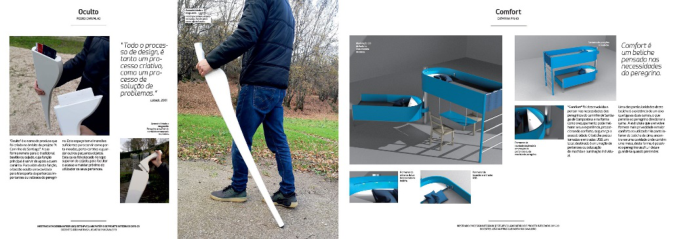
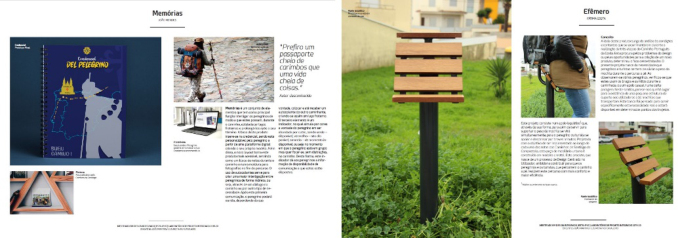
According to Krucken (2009), it is important to note that a product’s value is established interactively, as a balance between the “potential value”created by the producers and the “real value” attributed by the consumer and / or user after using the product (Figures 12, 13).
Figure 11: Left: “Vestigium” is a written message collector to be used in a hostel. Along the Way of Santiago de Compostela, pilgrims need to find the ideal place to leave their testimony so that it can be shared with other pilgrims (Student: Ariana Furtado, 2020). Right: Projet “Amicum” is a walking stick that combines the functionality of the old staffs, new physical characteristics and mechanics that today’s user requires, such as the LED light that allows the pilgrim to be signaled and the lighting of the floor where he walks (Student: Vanessa Lima, 2020).Figure 12: Left: The shape of the “Oculto” project refers to the traditional stick or staff, whose function main purpose is to support those who walk. In addition to this function, the stick hides a cavity for transporting important belongings or valuables of the pil- grim (Student: Pedro Carvalho, 2020). Right: The “Comfort” bunkbed was developed with the needs of pilgrims in mind and the way in which the equipment can improve their experience, providing comfort, safety and accessibility in the hostel. The bunk- bed has sockets and USB ports, a place for storing belongings or placement of the backpack, and individual lighting.Figure 13: Left: “Memories” is a set of elements whose main function is to connect pilgrims so that they can, along the way, establish bonds of friendship and extend them after their term. The base of this product is included in the credential, which can be customized by the pilgrim to from a digital platform, creating your own model (Student: João Mendes, 2020). Right: This project consists of an ischial support that in addition to serving supporting the weight of the backpack will do simultaneously for the pilgrim or tourist if support and rest for a few minutes. Designed with the objective of being implemented along the Ways of Santiago (Student: Fátima Costa, 2020).
CONCLUSION
Design is therefore a strategic tool to enhance the Ways to Santiago de Com- postela and the territory they cross, through products and product systems whose implementation will improve the preservation and dissemination of local identity and culture, enhancing the territorial and social capital. It is through knowledge of the quality value of the product and the context of use that relationships are established and that the network is perceived. The approach to the academic project is no longer as an exercise in which students must present solutions to a defined program. Instead, they must approach the project as a motor of development that promotes and mana- ges the most diverse relationships and partnerships, to obtain results and go beyond the classroom, with consequences in the most diverse areas of con- temporary societies. Faced with the scenarios of the Ways of Santiago and the relationships established between their users, design can create integrated innovative systems, differentiation factors based on synergistic development effects through new products or adaptations of known concepts. The value of the path can increase, and experiences can be improved. This analysis of the value chain has allowed us to identify major opportunities in need of a project to enhance this territory. Such action can enhance the articulation of skills along the value chain, and anticipate scenarios where values are added to this sector of tourism and pilgrimage.
REFERENCES
Baxter, M. (1995). Product design : a practical guide to systematic methods of new product development. London: Chapman & Hall. Bhamra, T., & Lofthouse, V. (2008). Design for Sustainability: A Practical Approach
(1st ed.). London: Routledge.
Human-Centered Design on the Ways to Santiago de Compostela 481
Duarte, A. (2016). Caminhos de Santiago: o Caminho Português como fator de desenvolvimento turístico no concelho de Barcelos. Universidade do Porto. Retrieved from https://repositorio-aberto.up.pt/bitstream/10216/87059/2/165050.pdf Fernandes, A. (2017). Debilidades gritantes nos Caminhos de Santiago. Artigo,
Jornal de Noticias Online, 2017. Retrieved from https://www.jn.pt/local/dossiers /conferencias-de-gaia/interior/debilidades-gritantes-nos-caminhos-de-santiagop orto-e-tui--entre-os-principais-pontos-de-partida-de-peregrinos-8489984.html. Consultado em 02 set. 2019. Fuad-Luke, A. (2009). Design Activism: Beautiful Strangeness for a Sustainable World. London, Sterling Earthscan. Krucken, L. (2009). Design e Território. Valorização de Identidades e Produtos
Locais. São Paulo: Studio Nobel. Lobach, B. (2001). Design industrial: bases para a configuração dos produtos industriais. São Paulo: Edgard Blucher. Manzini, E. (2015). Design When Everybody Designs: An Introduction to Design for
Social Innovation. Cambridge: MA: MIT Press Margolin, V. (2014). Design e Risco de Mudança. [Design and the risk of change].
Caldas da Rainha: Edições ESAD. Milton, A., & Rodgers, P. (2013). Research methods for product design. Portfolio skills Product design. London: Laurence King.Booher, Harold, ed. (2003). Handbook of human systems integration. New Jersey: Wiley. Munari, B. (1982). Das coisas nascem coisas. Arte e comunicação 16. Lisboa:
Edições 70. Papanek, V. (1984). Design for the Real World: Human Ecology and Social Change (2nd ed.). Chicago: Academy Chicago Publishers.
LISTED IN THE AHFE DIGITAL BOOKSTORE CATALOGUE
Explore the complete digital volume
Human Dynamics and Design for the Development of Contemporary Societies
Read this individual research paper free through the original publisher, or explore the full digital proceedings book.
ISBN 978-1-958651-01-8
Explore this ISBN in the AHFE Bookstore ↗Listed in the July 2026 bookstore catalogue; search by ISBN to confirm current availability · Digital book purchase optional