Manuela Maia (2022). The Challenge of the Development of Complexity Approach Skills in Design Education. A Study with Design Students. In: Human Dynamics and Design for the Development of Contemporary Societies. AHFE Open Access, vol. 25, pp. 70–76. https://doi.org/10.54941/ahfe1001373
Based on a set of questions about the conditions of design education to complexity approach in the 21st century, proposed for reflection by a previous exploratory study, we sought to deepen this problem with another study involving a greater number of design students. Our aim is a contribution to the expansion of the reflection on the designers' capacity to respond to the complexity of reality, allowing the approach to other dimensions of the problem. We search for a more precise understanding about specific learning needs of the students. Simultaneously, we intended to contribute to a more detailed understanding of the teaching-learning environment conditions that must be answered. Keeping the theoretical framework of the exploratory study, built from an important series of recent contributions on the subject, we research through a qualitative study to understand the behavior of students from different design specialties. The students were exposed to a real problem of a real organization previously known. The study was fully carried out in the students' teaching-learning environment. We defined as focus of our analysis the students’ knowledge needed for the translation of the objectives of the organization for accurately defining the problem and for the configuration of this particular design situation. The data revealed the students chose to describe possibilities for the solution, avoiding the constraints, as it was revealed by the exploratory study. We found that given the difficulty in defining the problem students focused on solutions, resorting to creativity and invention to solve the challenge. We conclude that the learning environment must be more dominated by collaboration between system different actors, with greater articulation with diverse knowledge areas. The students’ needs must activate ways for exploring the unknown, in an environment that equips them with effective tools to support learning, in addition to their motivation and commitment. The identification of concrete dimensions for framing the configuration of support tools for design education for complexity approach has already an important territory of contributions, with resources and experimented proposals for action. Powerful design learning support tools for understanding real problems in design education, must be above all useful for the inquiry base for creativity and able to be mastered by designers. With an entrepreneur attitude for the global challenges we face, these tools must allow design students to learn about possibilities for innovative solutions.
The Challenge of the Development of Complexity Approach Skills in Design Education 71
INTRODUCTION
The concept of complexity proposed by Edgar Morin (1990), define it as a fabric of events, actions, interactions, retroactions, determinations and accidents that constitute the phenomenal world, determined by disorder, ambiguity and uncertainty, and its interdisciplinary vision about the systems define the conceptual framework for our study of design education. Comple- xity, as Morin explain, requires interdisciplinarity in practice and discourse. For Morin (2001) complex thinking aims to conjugate, articulate and move different connected knowledges while maintaining their essence and par- ticularities, challenging the fragmentation in areas of knowledge favoring learning.
In the realm of practice, the approach to complexity has in the method, in the “way” (made of research and strategy), a sequence of actions that pre- pares from the beginning to receive the unexpected and modify its actions according to the emerging information (2001). According to Morin (2001) complexity contemplates the “I”, the expression of the individual in the con- text, defining the reintroduction of knowledge in all knowledge as one of the principles of his theory of complexity. For Morin, the human being is positioned in a universe where all phenomena maintain a relationship of interdependence.
To consolidate our conceptual framework, we started with the contribu- tions of leading thinkers in the field, researchers, precursors and educators, who have been reflecting on the future of design1 education, highlighting among them the contributions of Muratovski, Noël, Meyer and Norman. From the analysis of the various contributions, we extract two main dimensi- ons to which design education should respond: the structure of the approach to complexity and the student’s individuality. The recommendations for action propose that the most important thing in the design process is the content about the reality of the 21st century, being beyond the domain of the steps of the process by the students to conceive the solution to a problem (Whitney and Nogueira, 2020).
Muratovski (2020) points out people and their needs as two of the fundamental aspects in conducting research in the design process for the student to gain in-depth understanding. Weil and Mayfiel (2020) refer that research capacity should be based on data collection to approach kno- wledge quickly through thinking critically from multiple points of view, with data analysis and synthesis to extract ideas translating insights into opportunities.
Pontis and Van der Waarde (2020) refer to the central importance of systems thinking in the design process, allowing the understanding of the pro- blem as a system, fundamental for the domain of problem definition skills. The ability to integrate the unit into the whole is important to understand the impact of solutions and reduce their inconsistencies throughout the pro- cess. Voûte, Stappers, Giaccardi, Mooij and Van Boeijen (2020) consider that 1From a main set of articles published by She Ji magazine (In: The Journal of Design, Economics, and Innovation. Edition of Tongji University Press, Shanghai, China), distributed in two volumes, published in the spring and summer of 2020, about “Design Education”.
72 Maia
empathy is equally fundamental for seeing facts and contents and for the empirical validation of ideas going from the abstract to the concrete. On the need to configure areas of inquiry in the design process Pontis and Van der Waarde (2020) consider that it should be led by evidence-based research.
Lorraine Justice (2019) also points to the need for research with new meth- ods and with teams that are diverse in culture and skills. These conditions make the processes more chaotic, requiring greater organization and leader- ship, but allows a more conscious and clarifying discussion. Solutions must be based on research with more data, more information and more stimuli that enable connections that generate new possible solutions.
Voûte, Stappers, Giaccardi, Mooij and Van Boeijen (2020) consider essen- tial to connect inputs from various disciplines in the process, in cycles of divergent and convergent thinking, framing and reframing with synthesis and evaluation to promote discovery and creation. For Guillermina Nöel (2020) all the demand placed implies that the student’s voice is important in the teaching-learning process. Being able to choose the level of challenge in approaching the problems makes it easier for the student to configure the area of inquiry to understand and define the problem. All these recommenda- tions were considered in the construction of a reference for a first exploratory study with students.
Insights From a First Exploratory Study We carried out a first exploratory qualitative study to understand the abi- lity of students to respond to the complexity of problems, knowing the “path” taken to address them, seeking to identify their specific learning needs, articulating directly with the conditions of their teaching-learning environment. In order to carry out the study, students involved interacted directly with a real interlocutor to understand in depth a problem posed in order to define it, identifying knowledge needs in other areas and hypoth- eses for approaching the solution. From the records of direct observation of the student’s behavior during the interaction, it was possible to know their strategies to understand the problem. We found that their behaviors are consistent with how they feel about the challenge and with the level chosen to address it. The records allowed us to conclude that students do not effectively address the problem to understand it in depth to define it. Although they are able to ask their interlocutor questions about the pro- blem, demonstrating the ability to focus to in depth understand, they have difficulty in identifying the knowledge needed to address it. They are not able to identify what they do not know or what they need to know, instead they mainly triggering strategies to solve the problem. These students may have developed skills aimed mainly to solutions materialization that may not provide conditions for approaching complexity according to the concept pro- posed by Edgar Morin (1990). These results led us to the formulation of questions about the requirements that the teaching-learning contexts must respond to favor the approach to complex problems and what are the most appropriate conditions for the consolidation for learning in-depth problem definition.
The Challenge of the Development of Complexity Approach Skills in Design Education 73
A Study Expansion Involving More Students From the previous study insights, we carried out a second qualitative study with a greater number of design students, from communication and multimedia specialties, all from the same academic institution. A real organi- zation with a communication problem was presented to a 36 students’ group. In a preparatory phase of the student’s challenge, we research to under- stand their perception about the teaching-learning environment conditions to approach the problem proposed and the intrapersonal aspects inherent to the situation raised. We started by assessing this student’s perception with a survey. The answers reveal that 83% of the students consider that the school has an adequate environment to develop the project, considering it difficult (94%), mainly due to the novelty of the proposed theme (76%). Half of the 36 students felt prepared to tackle the challenge, and the answers revealed that 70% would like to create better solutions than existing ones and even innovate (20%). From the data collected in this preparatory phase, we veri- fied that the students felt motivated to approach the problem, despite the fact they did not feel prepared. They characterized the situation as new and the challenge as complex to very complex.
In a second phase, students were asked to define the problem and identify the knowledge needs placed by that problem, responding through a written document with a problem description, the design goals, the knowledge needs to adequately address this problem, and possibilities to address solutions. From the analysis of the students written documents 50% do not define the problem, we infer the students were not able to understand the challenge in terms of design. In the time available, only a very small number of these students (5,5%) manage to interpret the design situation during the process identifying the problem, as revealed by their written testimonies. Half of these students identify knowledge they need from other areas to understand the problem, but very few identify design goals. From these results we conclude that half of the students cannot understand the reality that was presented to them to describe it, which may allow us an evaluation: they cannot describe the problem to translate it in terms of design. The remaining 50% of students who were able to define the problem reveal great difficulties in the following dimensions requested, with most of them unable to present possibilities to approach the solution (about 80%). These students reveal in their documents initial redaction the ability to understand the reality presented to them, but they are unable to interpret it in terms of design, visible in the non-description of a translation of their understanding into the field of design work. Although the data collected at the first phase revealed the students’ predisposition to the challenge approach, the testimonies of the students written documents in the second phase revealed their major constraints in defining the problem and identifying the knowledge needs.
Comparing these results with the results of the initial survey, we can infer that the students positioned themselves in relation to the challenge presented with a desire to create new solutions, but that does not mean that they are able to define the problem or identify their knowledge needs to adequately address it. In our perspective these students reveal the same difficulties as the
74 Maia
students of the first study: they cannot effectively address a complex problem according to the concept proposed by Edgar Morin(1990).
The Design Students Learning Needs An in-depth understanding of problem and the capacity of describe it will allow students to be able to present an explanation for a possible solution, justifying its meaning (Muratovski, 2015). This mean that the creative pro- cess in design cannot be based solely on tacit knowledge, intuition, and personal assumptions, it must be based on more objective and in-depth knowledge of the complexity of reality.
Learning design practice cannot be restricted to classroom methods, stu- dents need to learn creatively and simultaneously be able to deal with reality in the design process to be able to deal with ambiguity and with the com- plexity. Education should propose problems that challenge students to delve into their different dimensions in order to learn to develop innovative solu- tions. The results of the studies carried out revealed that students have difficulty connecting their knowledge of design with the concrete nature of the proposed problems, namely, in the application of the learned meth- odology to understand a real problem and formulate the design problem. This “translation”, as we propose to call it, is difficult for students to operationalize.
The need to integrate knowledge from other areas in the process to under- stand the problem in depth was also revealed in the students’ difficulty in identifying their own knowledge needs. Eventually, the students’ learning context may be mainly focused on the development of skills to create solu- tions, as we mentioned, developing and mastering the creativity applied to solve design problems and not to the response to the complexity of rea- lity integrating people’s needs and their contexts. Knowledge, as stated by Morin (2001), must be combined, articulated and moved together for a com- prehensive understanding of reality. The fragmentation of knowledge does not favor learning since the phenomena have interdependent relationships. The teaching-learning environment must be able to connect with reality to address complex problems by integrating knowledge from different areas in articulation. In our view, collaborative work is essential for design education, promoting the development of student research competences in a context of articulated knowledge.
The Learning Tools The learning for approaching complexity implies using tools that leverage the process allowing students to achieve goals. The development of creativity in design education cannot only be part of the skills for creation, fantasy and imagination, but must be integrated in a broader perspective of rea- lity. The tools to support the learning process must contemplate objective dimensions of the analysis of reality, starting from the collection of data and translating them into units of analysis that are possibilities to explore and develop in solutions approach. The transition from the real to the imagi- ned, as the possibility of something new which does not yet exist, must be a
The Challenge of the Development of Complexity Approach Skills in Design Education 75
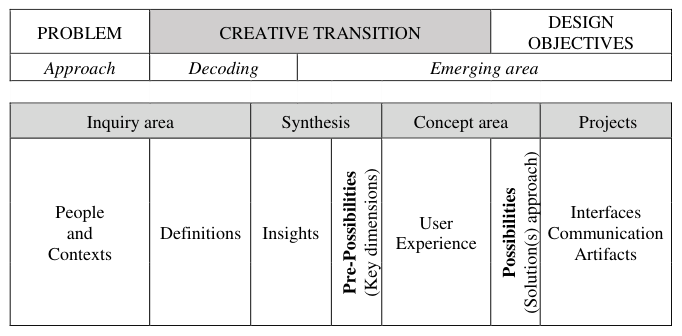
process made up of steps that may need to be reconfigured to build the tools that will help students to walk the “path”. Students must learn to appro- ach complexity by interacting with real problems connected with reality and in a continuum throughout the creative process on which the conception of solutions in design is based. The design process could be expanded with a more complete learning methodology for design students, with research at the beginning and evaluation at the end.
Table 1 present a systematic representation of the design process where a closer connection to reality is contemplated to approach complex problems. The transition from the real to the imagined, solving a problem and supplying a need, implies the ability to decode the interrelationships between people and context in environments mediated by technology. Not only the ambiguity, but also the transience, uncertainty and speed of phenomena imply the arti- culation of knowledge from other areas in design education. Viewing design process as a process of complexity creative transition may allow students a more favorable context for their development and preparation for solving complex problems. Our proposal for reflection (Table 1) is a vision for appro- aching complexity in the design process, from which creative learning tools should be built. Design students may need learning support tools for comple- xity approach for understanding real problems in design education, where the inquiry base for creativity can be mastered.
CONCLUSION
The pressure on education in the 21st century to address complexity challen- ges the future of design education, making necessary to understand which are the requirements of the teaching-learning environment and how they can be met. An environment that allows training conditions for students to conceive and configure innovative solutions to problems that are not mainly domi- nated by the growing demands of materialization is probably one of the requirements to be answered. The strategic importance of creativity in the skills of designers cannot keep them in a territory disconnected from reality
Table 1. Design process - complexity creative transition process.
76 Maia
as it is. The consolidation of learning for the in-depth definition of a problem should occur in an environment of shared connected knowledge, opposing the separation and even isolation of the different areas of knowledge that still dominant in education. Developing students’ autonomy, motivation and commitment and preparing them to master the skills of approaching com- plexity is an imperative for design schools in 21st century. Although the limitations of any study carried out at learning context, especially when we implement those studies in the socio organizational environment of our design schools, the benefits of developing this kind of research are valuable. The outcomes of interacting with the real conditions make possible the refle- ction and the fundamental awareness about what is missing in the dominat standards of design education.
REFERENCES
Justice, L. (2020) The future of Design Education. In: DMI Review, Design Education, Vol. 30, Issue 1, pp. 33–37. Boston, USA Meyer, M. W.; Norman, D. (2020) Changing Design education for the 21st Century.
In: She Ji, The Journal of Design, Economics, and Innovation, Vol. 6, No. 1, pp. 13–49. Edição: Tongji University Press, Shanghai, China Morin, E. (2001) Introdução ao pensamento complexo. In: Coleção Epistemologia e sociedade. Edição: Instituto Piaget, Lisboa Morin, E. (1990) Os sete saberes para a educação do futuro. In: Coleção Horizontes
Pedagógicos. Edição: Instituto Piaget, Lisboa Muratovski, G. (2020) The Making of an American Design School: Lessons Learned.
In: She Ji, The Journal of Design, Economics, and Innovation, Vol. 6, No. 1, pp. 67–82. Edição: Tongji University Press. Shanghai, China Muratovski, G. (2015) Research for Designers. A guide to Methods and Practice.
Sage Publications, Ltd. USA Noël, G. et al. (2020a) Fostering Design Learning in the Era of Humanism. In: She Ji, The Journal of Design, Economics, and Innovation, Vol. 6, No. 2, pp. 119–128. Edição: Tongji University Pres, Shanghai, China Noël, G. (2020b) We All Want High-Quality Design Education: But What Might
That Mean? In: She Ji, The Journal of Design, Economics, and Innovation, Vol. 6, No. 1, pp. 5–12. Edição: Tongji University Press. Shanghai, China Pontis, S.; Van der Waarde; K. (2020) Looking for Alternatives: Challenging Assumptions in Design Education. In: She Ji, The Journal of Design, Economics, and Innovation, Vol. 6, No. 2, pp. 228–253 Edição: Tongji University Press, Shanghai, China Voûte, E.; Stappers, P. J.; Giaccardi, E.; Mooij. S.; Van Boeijen, A. (2020) Innovating
a Large Design Education Program at a University of Technology. In: She Ji, The Journal of Design, Economics, and Innovation, Vol. 6, No. 1, pp. 50–66. Edição: Tongji University Press, Shanghai, China Weil, D.; Mayfield, M. (2020) Tomorrow’s Critical Design Competencies: Building a Course System for 21st Century Designers. In: She Ji, The Journal of Design, Economics, and Innovation, Vol. 6, No. 2, pp. 157–169. Edição: Tongji University Press, Shanghai, China Whitney, P.; Nogueira, A. (2020) Cutting Cubes Out of Fog: The Whole View of
Design. In: She Ji, The Journal of Design, Economics, and Innovation, Vol. 6, No. 2, pp. 129–156. Edição: Tongji University Press, Shanghai, China
LISTED IN THE AHFE DIGITAL BOOKSTORE CATALOGUE
Explore the complete digital volume
Human Dynamics and Design for the Development of Contemporary Societies
Read this individual research paper free through the original publisher, or explore the full digital proceedings book.
ISBN 978-1-958651-01-8
Explore this ISBN in the AHFE Bookstore ↗Listed in the July 2026 bookstore catalogue; search by ISBN to confirm current availability · Digital book purchase optional