Isabel Bieger (2022). Making Art Through Textile. In: Human Factors for Apparel and Textile Engineering. AHFE Open Access, vol. 32, pp. 192–198. https://doi.org/10.54941/ahfe1001555
Art is an important point in our life. Show our culture, our ideas, our knowledge, our creativity and our sensibility. Through art we can Know what the people think in the time of history. Art is the manifestation of beliefs, showing what people demonstrating critical capacity of the history that we are living or lived in some time. For doing art artists using different kind of material. Someone paints, others do sculptures, or even many materials are possible to use together for manifestation art and opinions. Here we will talk about textile material. The many facets of the fabric, how it can be transformed in art with creativity.We choose to talk about the work that Daisy May Collingridge do to transform simple textile in real work of art. How she manifests her opinion through art using textile like a base for after, transform into squishier. Sometimes criticized about the impact caused in the public, her brilliant idea of transforming fabric in sculpture show us her personality.
ART Frames art as essentially cognitive. Goodman’s argument is that art tis a symbolic system of human comprehension that shares with other knowledge areas including the sciences and the human pursuit for the identification of the symbols and characters within themselves, that denote and illustrate the interpretation of art works and the reorganization of the world in terms of work of arts but also in terms of the world they constitute. A significant part of our experience and many of our abilities are born and can be deve- loped, therefore our aesthetic attitude is tireless, in an action of creation and re-creation. The author also suggests that the vision of the subject in relation- ship to the world can be transformed by aesthetic encounter, and in this way, it affords comprehension, in other words, the ability to make us see, listen and read in a changed way, to create new connexions in between things (Nelson Goodman 1976).
Ana Bae Barbosa (2008) suggests that art has remarkable importance in the mediation in between human beings and the world of art/education is the mediation in between art and the public, having the museums as it’s place, considered by Ana Mae the experimenting ground of knowledge pro- duction, including curation and design as education. Art is essential to the development of human emotions.
Moreover, for Ana Mae Barbosa (2008, p. 21) art stimulates the sen- ses and translates meanings that cannot be translated to any other type of
language. Through art is possible to develop the perspective and imagination to learn the reality of environment, to develop critical thinking, allowing for the analysis of the perceived reality and develop creativity in a such as way that it changes the analyzed reality.
drove hundreds of human-centered design improvements. Efforts were concentrated to maximize total system performance through improvements in human workload, ease of maintenance, and personnel safety which resul- ted in a cost avoidance of billions of dollars and prevention of hundreds of fatalities and disabling injuries for the system (Booher and Minninger, 2003).
To Create Creating according to Duarte (2008, p. 5) supposes the production up to, action operated existing previous things by the imagination. Man creates a significant universe, in his encounter with the world through imagination. Imagination is fundamental in the human being and considered the engine of the creative act.
The creative act is supported by our experience and our feelings. When we think about the symbols and the underlying principles, or, the creative act does not exist alone, it is the result of thought, and therefore encompasses the entire history and experience of human beings, their values and their emoti- ons. Read (1986) argues that the purpose of art consists in the manifestation of feeling, in the reading and writing of the world, forming a link between itself and its (the creator’s) with its manifestation and expression, that is, the work is the creator of the creator. Contact with art allows and contributes to a rich imagination of many and great interpretations in life. Art has a central role in contributing to the self-fulfillment of the individual in society. He sta- tes that the promotion of aesthetic experience serves to expand and change our entire repertoire of feelings and values. It emphasizes that the aesthetic experience is manifested in the creation process (Brody 1987).
Feminism in Art Being feminine or being masculine implies structural and not necessarily saying to be a man or a woman, 2005.It was in the cultural field that Femi- nism asserted itself best, that is, building and reinforcing deep connections with the universe of arts and letters. Woman wants to compete and overcome the effort in search of a privileged place in thoughts and art in the colle- ctive. The center of poetry becomes the substance of the work, maintaining its sensitivity and changing its own destiny.
Feminist art is a movement, but it is not an artistic movement, it is with aesthetic innovations, or of style to interact with the world and how its representations, caring about the contents of the works to be marked by the content of denunciation, of revolt and nonconformity that prevails in various intellectual fields.
The art world, according to Reckitt and Phelan (2001) has been transfor- med by feminists and they are also among the main art critics. It was feminism that redefined art in the late 20th century.
194 Bieger
The promise of feminist art is the performative creation of new realities. Successful feminist art beckons us towards possibilities in thought and in practice still to be created, still to be lived (Reckitt & Phelan, 2001, p. 20).
In our society it is easy to identify and associate women with textiles. Alth- ough not exclusively associated with women, the role of gender in textile production continues to be significant, and several contributors touch on the use of textiles as an art medium in consciously gendered ways.
Textile Art Textile art has been present in the history of humanity since the beginning. In clothes and decoration, it is not difficult to find textile art as a means of expression.
The textile ranging from one-off produces of the different artistic imagina- tion to objects twisted for mass manufacture and global trade, encompassing numerous possibilities of transformation. In recent years, the study of tex- tiles and culture has fast become an active ground and interdisciplinary of research, reflecting new global, material and technological possibilities.
Textile has also become a very significant medium in contemporary art practice across the globe, transforming the traditional fabric in a contempo- rary creation. Fabrics are an excellent material do be used like a mode of expression. Reusing, associating and reinventing materials, are unlimited in art especially using textile as principal material. So, artists and designers use textile as a way of expression (Bryan-Wilson, 2017).
The versatility of fabrics results in designs with a defined purpose or mis- sion, not simply additions to a dominating industrial production process. Such approaches acknowledge and respect the materiality of cloth; not only as decoration, but for the enormous role it plays in the daily lives of all of us. They address the ways we might live better, while identifying the situations of our current existence. (Clark, 2016) For sustainability to be achievable in the perspective of textile art, it is fun- damental that it is created as a positive and creative prospect for textiles and fashion futures, and an intrinsic option of the systems. All investors must be invited to underwrite creatively to textiles and fashion futures, we talk about products, systems and paradigms. From the choice of experiences, interests and capabilities they respectively represent (Tham, 2016).
Feminism in Textile Art The future for feminist textiles pass thought a politics tough. It is proposed as a platform for social engagement through collaborative creation that overco- mes cultural and language barriers, supporting and strengthening the social fabric of the diaspora in urban centers.
The textiles are inter- woven into the private and public practices of every culture, both formal and informal, quotidian and ceremonial. Feminism’s assignation with textiles and, more broadly, craft and art, not only amplifies such ambiguities but touches them with contradiction. For one side the posi- tioning of domestic crafts as a key constituent of patriarchal domesticities, for another side, the essentially speared divisions of labor along gender lines,
Making Art Through Textile 195
pivoting on the misrecognition of feminized preservation labor as nonlabor (Kokoli, 2020).
Feminist tactics to textiles tend to crop alongside and occasionally poke through the borderlines of “art” and “craft” comparable. The upsetting que- stion of whether craft or art is a meaningful feminist occupation, whether it should be rightfully occupying the time and dynamisms of a feminist, stays uncomfortably, never being settled, perhaps because it is not expli- citly asked. Nothing is off limits, including the practice at hand (Kokoli, 2020).
Daisy Collingridge Daisy May Collingridge, London artist, was born in 1990. Since her gra- duating in fashion design at Central Saint Martins in 2014, her practice has become more focused on the investigation of how to create form using fabric. The consequent of working are wearable clothes, sometimes purely sculptu- ral but fashion design techniques often notify her repetition. Traditional craft and technique are at the foundation of her exercise. Her art is demonstrating a rebellion against that the fast fashion industry that relies on speed, not quality. Craft takes time to hone and is a slow process. Her sculptures are predominately hand stitched and hand dyed which inevitably takes time to create.
The wearable art series, which the artist gave the named ‘Squishies’, invite us to view and celebrate the human form in all of its fleshy, fabric glory. Daisy Collingridge produced a series of grotesque art, which brings us to the wrong idea about the perfect body, the body that we usually see in fashion magazines. Her history with fabrics came since her child, inspired in her mom who made fabric creations along the years, like patchwork, dresses and so one. With all these experiences wasn’t difficult to choose the technique to use and show her art. She uses traditional techniques like free machine quilting, applique and pattern cutting, her textile creations passing into the peculiar world of sculpture, theatre and performance.
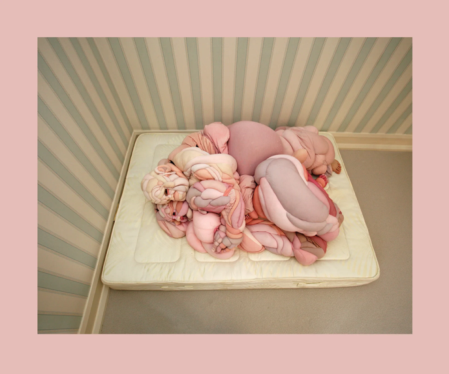
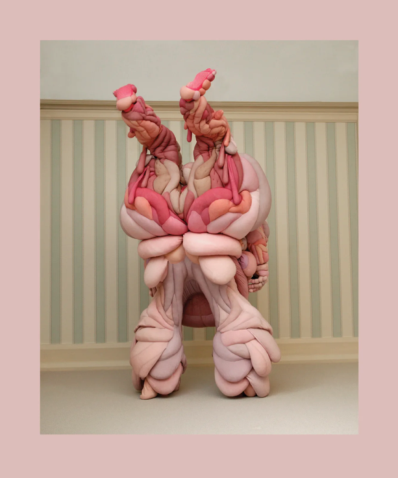
It is in the creation of wearable sculptures that Daisy Collingride focu- ses and explores her creativity. There are anatomical drawings in movement. The artist, through the human body, transforms reality and creates a new perception, a new meaning, completely different from the usual, to what the human body conveys to us. There are layers of fabric and quilting hand-sewn, which give shape to the sculptures.
‘Squishy’, this is how the artist names her creations. They have their own characteristics. They are fully wearable, made with textile in pastel colors. Even using pastel colors, thought them the artist enhance the shapes, giving highlighting to parts that she considers important. The idea of muscular ana- tomy is achieved through the useful colors. The process of dyeing the fabric allows the artist to master the palette she wants to use.
For Arnheim, the observation and contemplation are a part of the mind and vision of the world and intellect, translated into perception and creation, all together through the artist’s hands. Perception itself is a cognitive pheno- menon and the creation of images, regardless of the means involved, requires
196 Bieger
Figure 1: When two became (Daisy Collingridge 2021).
invention and imagination. Here we can see the specific look of the artist that she transposes into her work (Arnheim, 1993).
The ‘Squishys’ are voluptuous and mostly remember the bowels and viscera of the body. Each sculpture has own characteristic. Even the process is the same for all creations, the result is endowed with specific characteristics. Linear characteristics of all the sculptures, like fleshy suits, are the material, which is made of fabric and padded, and the movement, which is present in all the works.
The people who use the sculpture get a new identity. Using another per- sonality, that create a possibility to be a persona with other descriptions and individualities. Some feeling of freedom acquired through a mask. It is neces- sary to focus on the two ways of accessing art: through the artist and through the spectator, that is, in the creation and enjoyment of works of art. (Jr. J. F., 2008). In the sensory system, the senses play the activist role of guaranteeing the individual’s survival (Arnheim, 1991). The senses are an integral and inse- parable part of the entire cognitive system. When you see this kind of art the first thing that emerge in your mind is to touch it. Is a sense that occur when your eye sees something with attractive texture. When it is possible the sculpture turns interactive with the public. Each sculpture is unique.
CONCLUSION
Women began their emancipation with small conquests, being mostly in the background, today they occupy a significant place in all areas of knowledge and technique and in the arts. Women went in search of means and support for their ideas and ambitions. The artistic scene, as well as politics, gave them opportunities. Art, as well as politics, have this particularity of moving people.
Textiles had great cultural and social importance and should be factored into any important valuation of the past. Textile art is considered one of the
Making Art Through Textile 197
Figure 2: Butterfly (Daisy Collingridge, 2021).
oldest arts of humanity. and it is through the past that we predict the future and in its textile art gains its prominent podium. The field of textiles, fashion and sustainability, as discourse and practice, has reached certain maturity.
The alliance of the areas, architecture and textile art, empowers and expands the possibilities of practice. Both areas are strengthened. Not only does today’s generation of textiles provide new inspiration for architects, but they also present fresh possibilities for urban planners and developers. The joining of areas changes the experience of artists, designers, architects, especially spectators, continually, consequently creating became more refined practice of knowledge.
The future of design arises in these kinds of examples of upsetting inno- vation, as more and more textiles take up space for excellence, eliminating boundaries between sciences and continue to be the basis of our physical world. The variety of applications and design techniques in extreme textiles attests to the fact that textiles can be anything. They offer the versatility to be hard or soft, stiff or flexible, small or large, structured or arbitrary. A change of direction is taking place in everything that involves textiles. With the use of technologies, textiles are improved, and, in this way, they gain more space.
Daisy May Collingridge, the London-based artist chosen for this case study uses fabric as a material of expression. Chosen for having skin-like properties. Inspired by the magic of animation, the sculptures created arouse emotions in the spectator. It is impossible to remain indifferent to a sculpture of this magnitude. It awakens in us a repertoire of feelings and values through the pieces. She manages to capture the viewer.
From my point of view, I don’t consider it to be a difficult technique for executing. It took a lot of imagination and audacity to make them. Who uses
198 Bieger
the sculpture can be the feeling of being touched without be touched. The layers of fabric and padding allow an indirect contact, if someone touch, but due to barriers between the skins, the touch is something sensorial for the person receiving the sculpture, not for the person who wears the sculpture.
The artist’s work has deserved visibility. His work has expression and is genuinely creative.
ACKNOWLEDGMENT
Thanks to CIAUD, Research Centre for Architecture, Urbanism and Design, Lisbon School of Architecture, University of Lisbon.
REFERENCES
Arnheim, R., 1993. Consideraciones Sobre la Educación Artística. Barcelona: Paidós. Barbosa, A. M., 2008. Mediação Cultural é Social. Em: Arte/Educação como Mediação Cultural e Social. São Paulo: Unesp, pp. 13–23. Broudy, H. S., 1987. The Role of Imagery in Learning, California: The Getty Center
of Education in the Arts. Bryan-Wilson, J., 2017. Fray: art and textile politics. Chicago: The University of Chicago Press. Clark, H., 2016. New Approaches to Textile Design. In: The Handbook of Textile
Culture. London: Blomsbury, pp. 17–24. Daisy Collingridge platform: https://unitlondon.viewingrooms.com/viewing-room /17-platform-daisy-collingridge/ Daisy Collingridge Instagram: https://www.instagram.com/daisy_collingridge/ Duarte, C. L., 2003. Feminismo e Literatura no Brasil, São Paulo: s.n. Goodman, N., 1976. Languages of art: an approach to a theory of symbols.
Indianapolis - Cambridge: Hackett Publishing. Jr., J. F. D., 2008. Por Que Arte-educação? São Paulo: Papirus. Kokoli, A., 2020. Creative Tensions Making (It), Unmaking, and Making Do in Textiles Informed by Feminism. Em: A Companion to Textile Culture. Hoboken, NJ, USA: John Wiley & Sons, Inc., pp. 219–234. Mota-Ribeiro, S., 2005. Retratos de Mulher - Construções Sociais e Representações
Visuais no Feminino. Porto: Campo de Letras. Read, H., 1943. Educação Pela Arte. Lisboa: Edições 70. Reckitt, H. & Phelan, P., 2001. Art and Feminism. Nova York: Phaidon. Tham, M., 2016. Creative Resilience Thinking in Textiles and Fashion. In: Bloomsbury Academic. London: Bloomsbury Academic, pp. 225–240. Magazine Dezeen Website: https://www.dezeen.com/2020/02/11/daisy-may-collingr
idge-squishies-textiles/
LISTED IN THE AHFE DIGITAL BOOKSTORE CATALOGUE
Explore the complete digital volume
Human Factors for Apparel and Textile Engineering
Read this individual research paper free through the original publisher, or explore the full digital proceedings book.
ISBN 978-1-958651-08-7
Explore this ISBN in the AHFE Bookstore ↗Listed in the July 2026 bookstore catalogue; search by ISBN to confirm current availability · Digital book purchase optional