Miao Liu, Yitong Jiang (2022). Minimalist Design of Oven Products Based on Differences in User Needs. In: Kansei Engineering. AHFE Open Access, vol. 40, pp. 65–71. https://doi.org/10.54941/ahfe1001762
At present, the oven has become a popular electrical product for home life,and its appearance design is based on a minimalist style, pursuing the purity of appearance and streamlining of functions. However, different users have different perceptions of the simplicity and ease of use of the oven design, which may lead to differences in aesthetic preferences and design requirements, which in turn may lead to varying degrees of use obstacles and poor experience. How to grasp the "degree" of Minimalist Design to meet the differentiated needs of more users? It is the main problem of oven design at this stage. However, the method researches of related Minimalist Design are mostly theoretical reference and lack practical guiding significance. Therefore, this article will focus on the concept of Minimalist Design, combined with multi-level demand theory and Analytic Hierarchy Process, to explore the differences in users’ aesthetic preferences for minimalist oven design, construct a multi-level structural model of user needs, obtain the importance of user needs, and summarize differentiated minimalist oven designs methods. First, hot-selling ovens were selected as the research objects; compared the relative simplicity difference of each two products , a difference matrix was obtained; Multi-Dimensional Scaling Analysis, Cluster Analysis, and K-means Clustering were applied, the simplicity of ovens was classified and each category Typical products were obtained as simple prototypes; questionnaire surveys and statistical tests were used, the characteristics of the user groups of each prototype were obtained; based on the concept of Minimalist Design, user interviews and other methods were applied, the simplicity of users on three levels of stable performance, smooth interaction, and minimalist appearance Design demand factors were obtained; finally, the Analytic Hierarchy Process was applied, a hierarchical model of simple design factors were constructed, the weight of needs of each user group was obtained, and the differentiated design methods were summarized. As a result, a total of 12 hot-selling ovens were selected; a total of 3 minimalist prototypes ABC were obtained, The user group of prototype A is dominated by young women in higher education, prototype B is dominated by middle-aged women in secondary education, and prototype C is dominated by the elderly; a multi-level structure model of user needs was constructed, and The weight of the needs of the 3 user groups were obtained; based on the importance of the needs of each group, the targeted minimalist oven design methods were proposed. Therefore, the method which is based on the theory of multi-level needs and applying the Analytic Hierarchy Process, to construct a multi-level structure model of user needs can clarify the characteristics and design needs of different user groups, and improve the effectiveness and practical significance of the Minimalist Design of the oven. This method can provide a reference for enterprises and designers.
In the era of digitalization, the economy and technology are taking off day by day, fragmented information is numerous, and the fast-paced life makes people feel repulsive and rebellious, yearning for a pure and concise state (Xiangna Li et al. 2015). Widely concerned environmental issues also require the whole society to consider the green environmental protection and sustai- nability of design (Kezhong Cai et al. 2007). Therefore, Minimalist Design has become an inevitable trend of product design, which can meet the requi- rements of users’ pursuit of purity and truth, environmental protection and economic development. The current Minimalist Design not only requires attention to appearance, but also to streamline functions and conceptual models, and pay attention to sustainability in terms of structure, materials, and craftsmanship (Fang Xia et al. 2013).
As a popular product of current household appliances, oven products have various appearance styles, mostly Minimalist Design styles. Many scholars have proposed methods of Minimalist Design, such as Gestalt Design Method (Guiming Zhang et al. 2013), Appropriate Design Method (Zhihua Zhang et al. 2003) and so on. However, they are all theoretical references and lack practical guidance. In the practice of Minimalist Design of oven products, there are limitations in balancing functions and forms, often relying on the experience and intuition of designers. Therefore, how to analyze the differen- tiated needs of users, balance the simplicity and ease of use of products, and grasp the “degree” of Minimalist Design? It is a key issue in oven design at this stage. This paper will explore this issue.
Existing studies have shown that mining multi-level user needs can effe- ctively improve user satisfaction with products. According to Maslow’s Hierarchy of Needs and Emotional Design Theory, user needs are divi- ded into 3 levels: physical function, physical/psychological and subjective feelings (Yang Li et al. 2011), which can be expressed as 3 levels: per- formance, interaction and appearance. Yidan Qiao used different methods to mine and analyze the user requirements of performance, interaction and appearance, and obtained the weight of the requirements to con- struct a user requirement table and design task book (Yidan Qiao et al. 2021); Qing Feng proposed a method based on Maslow’s Hierarchy of Needs and Analytic Hierarchy Process (AHP) to construct a hierarchical model of food packaging design factors and obtain the weight of user needs, which can effectively guide the design and improvement of packaging (Qing Feng et al. 2019).
Therefore, this paper firstly identifies product simplicity categories and user group characteristics through market and user research; then around the concept of Minimalist Design, the multi-level demand theory based on perfor- mance, interaction and appearance is mapped to the Minimalist Design of the product, and a three-level user demand model of stable performance, smooth interaction and simple appearance is constructed. Finally, the AHP is applied to obtain the weight of demand at each level, clarify the design requirements of different user groups, and summarize the corresponding Minimalist Design methods.
Minimalist Design of Oven Products Based on Differences in User Needs 67
Table 1. Reliability and validity test results of the questionnaire.
Table available in the original PDF paper.
Minimalistic Prototypes A B C Reliability Analysis α 0.864 0.914 0.930 Validity Analysis KMO and Bartlett Test 0.703 0.760 0.749 Cumulative Variance Explained Rate 78.617 85.868 87.720
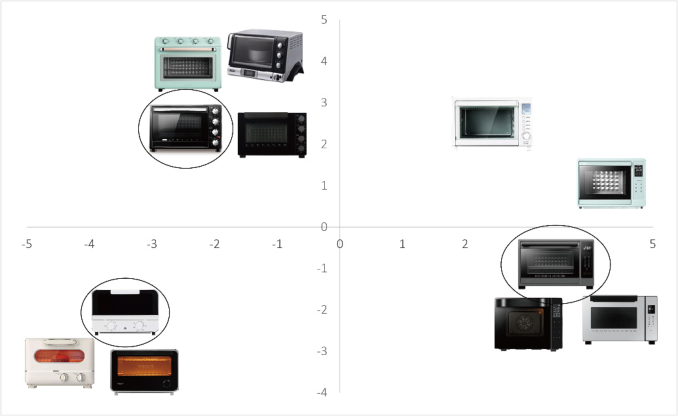
ANALYSIS OF THE CURRENT SITUATION OF THE OVEN Based on various e-commerce platforms, 12 representative hot-selling ele- ctric ovens were selected as the research objects. A 7-person evaluation group (including 3 women) was formed by industrial design professionals, the rela- tive simplicity differences of each two products were compared, the difference matrix was obtained. By applying Multi-dimensional Scaling Analysis and Cluster Analysis, the product dendrogram and 2D scatter plot were obtained. The products are roughly divided into three categories. The product characte- ristics of the coordinate axis can be summarized as follows: the positive axis of the horizontal axis represents toughness, and the negative direction repre- sents affinity; the positive axis of the vertical axis represents more mechanical controls, and the negative axis represents few mechanical controls. The first category is located in the positive direction of the horizontal axis, slightly off- set to the fourth quadrant. The products are mainly in a tough style, with few mechanical controls, mainly precise temperature control methods are compu- ter touch and electronic display with buttons; the second category is located in the second quadrant, the products are mainly in the affinity style, with many mechanical controls, mainly the simple temperature control method is the mechanical fixed frequency knob; the third category is located in the third quadrant, and the products are more friendly than the second category, with few mechanical controls, mainly based on the simple temperature control method of the mechanical fixed frequency knob. Finally, applying K-means clustering, the typical products of each category were obtained as parsimony prototype ABC. (See Figure 1 for the 2D distribution of oven, and the black circles in Figure 1 for the product prototypes).
ANALYSIS OF USER GROUP CHARACTERISTICS We speculated that differences in age (18-35 years old, 36-55 years old, and over 56 years old), gender (male, female) and education (middle school, junior college and undergraduate, Postgraduate) may affect users’ aesthe- tic preferences for Minimalist Design. Therefore, a web questionnaire was applied, Likert-5 scales was used (1= “totally disagree”, 5= “totally agree”), the user’s basic information and ratings on the 3 minimalist prototypes were collected. The measurement of user’s aesthetic preference includes the follo- wing three items: “I think this product is beautiful”, “I will be very happy when I see this product”, “In my mind, this product can be called beauti- ful”. A total of 79 questionnaires were recovered, with a recovery rate of 82.278%. The reliability and validity of the questionnaires were both good (see Table 1).
68 Liu and Jiang
Figure 1: 2D distribution of oven.
The normality test was performed on the questionnaire feedback data, and it was concluded that each sub-sample satisfies the normal distribution (P>0.100). Therefore, the analysis of variance was performed on the age, gender, and educational background subsamples. It was concluded that age and gender differences can cause differences in users’ aesthetic preferences for A-type ovens (P<0.05), among which the strongest aesthetic preferences are “male” (M = 3.778, 95% confidence interval: 3.480~4.076) and “36~55 years old” (M = 3.759, 95% confidence interval: 3.414~4.104); differences in educational background will lead to differences in users’ aesthetic prefere- nces for B-type ovens (P<0.05), among which the strongest is “middle school” (M = 3.688, 95% confidence interval: 3.250~ 4.125); differences in gender and educational background can cause differences in users’ aesthetic prefe- rences for C-type ovens (P<0.05), among which the strongest are “female” (M = 3.600, 95% confidence interval: 3.734~4.243) and “postgraduate” (M = 3.889, The 95% confidence interval: 3.516~4.262).
Based on the statistical test results, it was concluded that the main user group of Prototype A is middle-aged men, probably because this group has relatively stable income, high pursuit of life quality, and curiosity about tech- nology, so they are more inclined to the tough, business, restrained and elegant appearance, more easier to accept the new interactive methods of computer touch and electronic display; the main user group of Prototype B is the middle-educated people, who have higher requirements on the pro- duct’s easy to understand, so they are more inclined to the traditional and classic product appearance, more acceptable to the simple-to-operate mecha- nical controls and the interface design with rich and clear identifications; the main user group of Prototype C is the female group with higher education, probably because this group has a high academic and social status, and has richer spiritual needs, so they are more inclined to personalized, refined and culturally connotative products.
Minimalist Design of Oven Products Based on Differences in User Needs 69
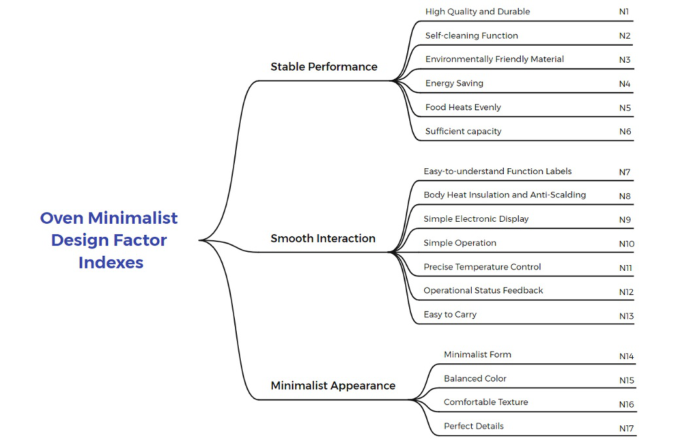
Figure 2: The hierarchical structure model of oven minimalist design factors.
CONSTRUCTION OF A HIERARCHICAL MODEL OF MINIMALIST DESIGN FACTORS Through user interviews and situational research, the Minimalist Design factors of the oven at three levels of stable performance, smooth interaction, and minimalist appearance were selected and sorted out as the corresponding evaluation indexes (Zhaoyuan Teng et al. 2018) (See Figure 2).
For 3 types of user groups, organized 20 evaluation groups respectively, including expert users and general users of the oven. The importance was assigned to the indexes of user needs at each level, and three sets of judgment matrixes were obtained with the Satty-9 scale. the power normalization was used, the eigenvector W corresponding to the maximum eigenvalue of the judgment matrix at each level was solved, and the C·R value was used as the consistency test index. The results show that the consistency of the judgment matrix at each level is good, and the result of the eigenvector W is reliable (See Table 2).
According to the weights and ranking results of design factors at each level, the factors that have a significant impact on the Minimalist Design of the oven are obtained, and the designer must meet the needs of these factors in the design. In terms of stable performance, the needs of the three types of users are consistent, the notable factors are “High Quality and Dura- ble” and “Food Heats Evenly”. Designers are required to focus on creating a sense of product quality, prolong the service life, polish and strengthen the main functions to highlight the advantages in performance. In terms of smooth interaction, the most significant factor is “Body Heat Insulation and Anti-Scalding”, which requires ensuring product safety and reducing users’ concerns about use. Secondly, A and C users are more inclined to “Precise Temperature Control”, requires more in-depth product functions. Designers
need to appropriately combine new technologies and materials to increase the refinement and professionalism of the product. B-type users are more incli- ned to “Easy-to-understand Function Labels” and have low requirements for functional accuracy. The functions should be simplified as much as possi- ble in the design to meet their basic needs, but the visibility of the product and the easy-to-understand of the conceptual model should be considered to reduce the learning cost. In terms of minimalist appearance, the most signi- ficant factor is “Minimalist Form”, it requires designers to reduce useless additional shapes and adopt minimalist lines and regular geometric shapes. Secondly, A-type users focus on “Comfortable Texture”. Designers should consider the innovation and application of materials and processes. B and C Users pay attention to “Balanced Color “, and designers need to keep eyes on color trends and try to diversify color schemes to meet aesthetic needs.
CONCLUSION
Based on the analysis of minimalistic prototypes and questionnaires, the cur- rent situation of minimalist oven design was analyzed, and three types of user group characteristics and aesthetic preferences were obtained; Based on Maslow’s Hierarchy of Needs and Emotional Design Theory, and guided by the multi-level needs of physical, physiological/psychological, and subjective emotional, a multi-level design factor structure model with stable performa- nce, smooth interaction, and minimalist appearance was constructed.; based on the Analytic Hierarchy Process, the importance of multi-level require- ments of different users was obtained. Through this method, differentiated user needs can be excavated more comprehensively and in-depth, and a more
Minimalist Design of Oven Products Based on Differences in User Needs 71
targeted design method can be obtained, which can provide a method refere- nce for the user positioning and the early development stage of the minimalist oven design.
REFERENCES
Fang Xia, Sheng Cheng, Yongyan Guo. The New Realm of Minimalist Design Under Contemporary Science and Technology [J]. Design, 2013(02): 162–163. Guiming Zhang. Simplicity and Efficience: Organization Strategy of the Human-
Computer Interface [J]. Art Design, 2013(09): 99–100. Kezhong Cai, Lei Wang. Discussion on Embodiment of Minimalism in Modern Product Design [J]. Packaging Engineering, 2007(10): 69–71. Qing Feng, Cheng yuan Zhang. Food Packaging Design with Traditional Cultural
Characteristics Based on Hierarchy of Needs [J]. Packaging Engineering, 2019, 40(24): 56–64. Xian-na Li, Weiqiang Wu. The design concept and aesthetic value of “Apple” products from the perspective of Marxist anthropology [J]. Journal of Wuhan University of Technology (Social Sciences Edition), 2015, 28(04): 622–626. Yang Li, Bochu Xu. Reviewing User-oriented Product Design Theory [J]. Mechanical
Science and Technology for Aerospace Engineering, 2011, 30(11): 1895–1899. Yidan Qiao, Dengkai Chen, Mengya Zhu, Yiwei Sun. Research on Knowledge Push Strategy of Design Method Based on Multi-Level User Requirements [J]. Modern Manufacturing Engineering, 2021(07): 117–127+161. Zhaoyuan Teng, Xiaogang Liu. Application Research of Color Design Factors
for Men’s Apparel Based on AHP [J]. Journal of Donghua University (Natural Science), 2018, 38(4): 414–417. Zhihua Zhang, Ran Wan. Appropriate Design: Contemporary Design Ideas for Product Styling [J]. Journal of Nanchang University (Humanities and Social Sciences), 2003(06): 121–123.
LISTED IN THE AHFE DIGITAL BOOKSTORE CATALOGUE
Explore the complete digital volume
Kansei Engineering
Read this individual research paper free through the original publisher, or explore the full digital proceedings book.
ISBN 978-1-958651-16-2
Explore this ISBN in the AHFE Bookstore ↗Listed in the July 2026 bookstore catalogue; search by ISBN to confirm current availability · Digital book purchase optional