Miao Liu, Yufeng Wu (2022). Design of electric bicycle for take-away delivery based on KANO model and TRIZ Theory. In: Usability and User Experience. AHFE Open Access, vol. 39, pp. 29–35. https://doi.org/10.54941/ahfe1001687
With the huge variables ushering in the Chinese takeaway market “COVID-19 pandemic”, there are more sinking user markets that continue to flood into it and the takeaway industry is booming. After the epidemic, the meaning of the word "takeaway" was extended from catering to food delivery, medicine delivery, and all kinds of necessities, and the takeaway delivery gradually accompanied the new retail consumption habits developed by users during the epidemic. In the whole service system of take-out delivery, with the increasing number of take-out delivery personnel, the take-out delivery e-bikes used are still ordinary travel e-bikes, lacking consideration and design of user behavior and usage scenarios. In the context of the new national standard "electric bicycle safety technical specifications" policy, there are still many takeaway delivery using electric bicycles do not meet the specifications, due to the delivery of limited time to arrive, a one-time delivery of overloaded goods and other cases of traffic accidents caused by frequent. This study introduces the KANO model and hierarchical analysis and TRIZ theory to study the real needs of users, and seeks to conduct innovative design research on take-away delivery electric bicycles.In the preliminary stage of the study, the secondary data research method was used to conduct preliminary summary research on a variety of businesses extending from the take-out industry, and the delivery process of riders in the take-out industry service system after receiving orders was derived through observation, interview, focus group discussion, and questionnaire research methods. Based on the KANO model framework to classify and prioritize user requirements, the non-linear relationship between product features and user satisfaction is identified based on the analysis of the impact of user requirements on user satisfaction. Recognize product and service requirements from the user's perspective, design and publish a valid questionnaire, summarize and classify the survey results, and build a quality model. Further research and analysis of the quality model to identify the sensitivity of specific measurement indicators. Combined with the hierarchical analysis method, the elements within the same level are compared in two-by-two analysis to determine their respective weights for the previous level, and finally give the importance ranking of all factors relative to the total goal, and finally tap into the real user needs. The TRIZ theory is then used to provide systematic theoretical and methodological tools for problem transformation, analysis and solution of needs creatively using innovative thinking methods and problem analysis methods, following the laws of technological system evolution. The KANO model and hierarchical analysis method are effectively combined with TRIZ theory to gradually quantify the qualitative analysis, which can generate more objective research data conclusions and provide innovative ideas for the design research of electric bicycle for delivery.In this study, the different needs of users are organized and differentiated in a hierarchical manner through KANO model analysis, combined with different emotional hierarchical need points of users. Predict the direction of users' emotional needs for the product, and match their emotional requirements with the product at different levels. Combined with the interview research, the design study was conducted taking into account the human-machine factors for the take-away delivery electric bicycle. In line with the new national standard policy, the delivery time of the rider is guaranteed at the same time, the area of the delivery goods and pick-up efficiency is improved, and the riding experience and safety of the rider are also taken into account. This is a research exploration of the takeaway delivery industry.This study combines the KANO model, hierarchical analysis and TRIZ theory to design a study on the process of users for take-out delivery. Through an in-depth study of user behavior, combined with the quantitative study of hierarchical analysis, different levels of demand are derived. Then, through TRIZ theory and emotional design, the take-out delivery service system was optimized and the innovative design of the take-out delivery bicycle was studied. In this study, based on the KANO model approach, the visual experience is designed from the appearance and user experience, giving the electric bicycle emotional factors to form a design that meets the user's needs. The whole design process also explored the correlation between design emotional needs and design form. The design solution evaluation results verified the effectiveness and feasibility of the KANO model approach to user needs analysis in product design and provided an effective solution for the design innovation of electric bicycle for take-away delivery.
With the rapid development of digital economy era, extended by the Internet to takeaway food, food and other business increasingly thriving, created a huge economic value of industry, but also created very heavy social problems, under the background of the new national standard policy, there are still many takeaway members use their modified electric bicycle delivery, there are great safety risks, such as often because delivery orders need to call and answer the call in cycling, and a bike, a call, very dangerous. Therefore, in this context of times, it is of social value to consider the innovative design ideas of this product, research the human-machine environment and its user use behavior, and clarify its pain points and needs.
The KANO model, proposed by Professor Kano at the Tokyo Univer- sity of Technology, to reflect the relationship between service quality and
satisfaction, is widely used in user demand analysis and acquisition. TRIZ theory is “invention problem solving theory”, is by the former Soviet inventor root rich atschule team by collecting, organize a large amount of literature, and induction, refining establish a system to solve invention problem the- ory, can be designers creatively find and solve problems to provide effective theory and method tools (Fengli. 2019).
In China, Zhou Qi (2020) used triz model to discuss and design ato- mization inhalers for children, Xu Yuwen et al. (2017) and others used KANO model for smartphone APP user interface design research for the elderly, Zhang Jing (2021) conducted in-depth investigation, classification and research on coffee machines, and used KANO model for emotional design. Tour (2018) visited children’s furniture on the market, summarizing the common principles of 40 invention principles in TRIZ theory in chil- dren’s furniture. In foreign countries, some scholars studied the use needs of urban identification system based on KANO model, and studied the service characteristics of libraries. This paper uses KANO model and TRIZ theory, KANO model to find and have insight into user needs, and uses TRIZ theory to quickly find design principle methods, to provide theoretical direction for the subsequent design and development.
ANALYSIS OF THE WORK STATUS AND PAIN POINTS OF THE TAKEOUT DELIVERY STAFF After investigation and interview, learned that the current market delivery staff is mostly for hungry and Meituan platform work, daily work time an average of 9-10 hours, usually open electric bicycle to deliver the most worry is to no electricity, need temporary road rescue, also delayed the work, at the peak sometimes go to the toilet, the car locked on the road, and lost delivery, I don’t know where to find. Encounter bad weather, the road is not conve- nient, and rainy day phone and mobile phone life often problems, the phone often out of power. In view of the above questions, I randomly interviewed 5 delivery workers near the company, school and restaurant. The interview time was 10min per person, and summarized the pain points according to the interview contents of Table 1.
According to the interview results, there are three main pain points: (1) poor endurance (2) poor safety and stability (3) the distribution box function is not perfect, and the storage experience is poor.
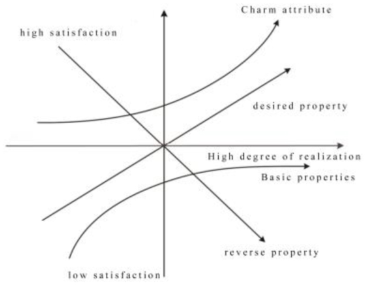
ANALYSIS OF TAKEOUT DELIVERY BASED ON KANO MODEL The Kano model divides the user requirements into three levels: basic, expe- cted, and excitatory requirements, as shown in Figure 1. Among them, the abscissa represents the realization degree of the user demand, and the verti- cal coordinate represents the user satisfaction. The three curves represent the relationship between the satisfaction of charm demand, expected demand and basic demand and user satisfaction from top to bottom respectively.
Design of Electric Bicycle for Take-Away Delivery Based on KANO Model and TRIZ Theory 31
Table 1. User interview table.
Table available in the original PDF paper.
Serial Number
Think there is room for improvement
Age When are you busy during work hours?
If you are willing to use it after the change
What do you think is the downside of electric bikes for food delivery?
Neutral
Not enough battery life
1 35 Usually busy at noon and evening meal times
You can use the battery swap station, which is more convenient Willing Poor security, often prone to things
2 24 11-13 pm, 5-7pm, 8-12 pm will be busy
Increases its cmf stability and striking appearance Willing Enhanced shock absorption
3 26 11-13pm, 5-7pm The stability is not good, and the takeout is often spilled
Willing
4 30 11-13pm, 5-7pm, 8-11pm There is no special distribution box, it is all scattered
Integrated distribution box design Willing
5 42 11-13pm, 5-7pm, 8-10pm Poor shelter from rain
For hanging rain shelters
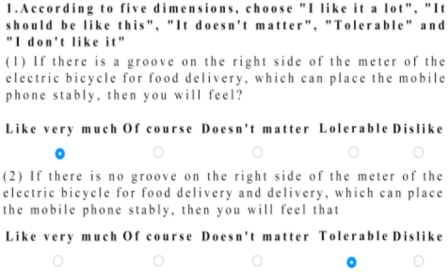
Figure 1: Schematic diagram of KANOmodel.Figure 2: KANO questionnaire design.
32 Liu and Wu
Table 2. Demand classification.
Table available in the original PDF paper.
Product Demand Negative Problem Like Very Of Doesn’t Tolerable Dislike Much Course Matter
Positive problem Like very much Q A A A O of course R I I I M Doesn’t matter R I I I M Tolerable R I I I M Dislike R R R R Q
Table 3. Questionnaire statistical results table.
Table available in the original PDF paper.
User Needs Quality Serial Number Total Satisfaction Coefficient Si
Dissatisfaction Coefficient Di
Kano Attribute A O M I R Q 19 1 12 15 5 4 56 0.43 0.28 A
1. Design of the groove to place the phone
12 5 14 18 6 1 56 0.35 0.38 M
2. Wireless/wired charging 18 6 10 16 3 3 56 0.48 0.32 A 3. Modular layered design of distribution box 16 6 12 12 6 4 56 0.48 0.39 O
4. Visual difference 17 5 11 15 4 4 56 0.46 0.33 A 5. Rental/battery replacement service 12 3 15 22 4 0 56 0.29 0.35 M
6. Consistent design of safety helmets
According to the pain points obtained by the user interviews, the corre- sponding solution function is proposed. When designing the questionnaire, the two directions of the demand indicators can be met and cannot be met. The questionnaire design is shown in Figure 2.
* Table A indicates excited demand, M indicates basic demand, O indicates expected demand, I indicates irrelevant demand, R indicates reverse demand, and Q indicates problem demand in Table 2. A total of 56 questionnaires were issued and 56 were valid questionnaires. The questionnaire set six demand indicators from four aspects: function, structure, pattern and appearance. Statistical results of the questionnaire are shown in Table 3. Formula (1) and (2) calculate each demand index satisfaction coefficient Si and dissatisfaction coefficient Di respectively to obtain the KANO attribute of each demand index.
Equation reproduced from the original PDF.
Among them, XA indicates the frequency of charm demand index, XM indicates the frequency of basic demand index, XO indicates the frequency of one-dimensional demand index, and XI indicates the frequency of irrelevant demand index.
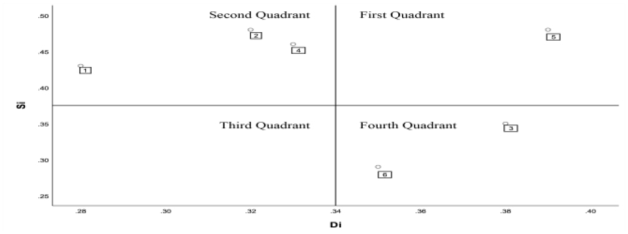
According to the research results in Table 3, SPSS analysis was used to con- struct a scatter map with satisfaction and dissatisfaction coefficient as vertical and abscissa, respectively, with the mean of Si and Di as the critical line, and
Design of Electric Bicycle for Take-Away Delivery Based on KANO Model and TRIZ Theory 33
Figure 3: User design four-quadrant diagram.
divided into four quadrants of the Kano model, see Figure 3. The first qua- drant belongs to the desired demand, can improve user satisfaction (Haili; Xiaobo, 2015); the second quadrant is exciting demand, can enhance the product charm (Yuwen et al., 2017); the third quadrant is irrelevant demand; the fourth quadrant belongs to the basic requirement (Zongming; Qianwen. 2020). Among them, once the user needs of the first and second quadrants are met, the product user satisfaction can be improved with (Yanli, et al, 2022). Therefore, the four user needs of modular rental / battery replacement service, setting groove for mobile phone, adding wireless / wired charging, and visual difference with other electric bicycles are taken as important user needs for takeout delivery of electric bicycles.
RESEARCH ON THE DESIGN OF DELIVERY DELIVERY ELECTRIC BICYCLE BASED ON TRIZ THEORY TRIZ Theory is an innovative approach founded in 1946 with a group of researchers led by G.S. Altshuller and others in the former Soviet Union. This theory is a theoretical method system that can guide the development of pra- ctical new products, and provides innovation theory and innovation tools (Yunfeng, Guiying. 2018) for designers from all walks of life.
Query and analysis and verification of technical contradiction matrix based on the four important requirements of “modular rental / battery change service, set groove placement mobile phone, add set wireless / wired charging, and visual difference with other electric bicycles” determined by kano model: among them:
1. The requirement function of “setting groove for placing mobile phone” corresponds to the technical contradiction matrix is “12 shape”, the para- meter leading to deterioration is “the volume of 12 static objects”, and the corresponding invention principle is “7,2,35” in the matrix;
2. “Demand function of adding setting wireless / wired charging” corre- sponds to the parameters needed to be changed in the technical contradiction matrix is “complexity of 36 device”, the parameter resulting in deterioration is “29 manufacturing accuracy”, and the corresponding invention principle is “26,24,32” in the matrix;
34 Liu and Wu
Table 4. Application frequency of invention principle.
Table available in the original PDF paper.
……
Principles of Invention
36 Principle of Phase Change
1 The Principle of Division
12 Equipo- tential Principle
7 The Principle of Nesting
32 Principles of Color Change
1 2 1 1 2 1
The Number of Occurrences
4. The requirement function of “Modular leasing / battery changing service” corresponds to the parameters needed to change in the techni- cal contradiction matrix is “33 operability”, the parameter leading to deterioration is “34 repairability”, and the corresponding invention principle is “12,36,1,32” in the matrix;
5. The requirement function of “visual difference with other electric bicycles” corresponds to the parameters needed to change in the techni- cal contradiction matrix is “32 fabricability”, and the parameter resul- ting in deterioration is “the difficulty of 37 monitoring and testing”. The corresponding invention principle is “6,28,11 and 1” in the matrix; According to Table 4, the two invention principles of “32 color change principle” and “1 segmentation principle” appear frequently, so the two invention principles as the main design principles.
CONCLUSION
In this study, the interview and questionnaire to understand users and their delivery service system, analyze the nonlinear relationship between the pro- duct function and user satisfaction and screening, produce the four quadrant scatter diagram, so that the charm demand and expectation demand, con- tradiction matrix analysis using TRIZ theory technology, and provide the innovative design and development of delivery electric bicycle industry. The disadvantage is that this paper integrates the advantages of KANO model and TRIZ theory (Wu, Xiaofeng. 2021), got the key requirements, but the design practice needs to be further extended and developed, and KANO que- stionnaire is usually longer, questionnaire questions from both sides and ask, may cause to the user to repeat, if the user does not answer seriously, it will cause the decline of data quality. It may affect the real needs of users to some extent and has certain limitations.
In the era of the rapid growth of China’s digital economy, Problems and safety risks in our food delivery industry always exist, In this study, the com- bination of KANO model with TRIZ theory, Investigate and study the user behavior and needs of the whole process of user delivery delivery, Through the KANO model born to study user behavior and needs, Get key user requi- rements “Modular rental / battery change service, slot placement cell phone, add wireless / wired charging, visually different from other electric bikes”, Combining the TRIZ theory again for the contradiction matrix analysis, The design directions and principles that can be applied to practice, The research basis and direction are provided for the future related studies. In this study,
Design of Electric Bicycle for Take-Away Delivery Based on KANO Model and TRIZ Theory 35
the KANO model innovatively found the real demand of Chinese and foreign sellers in the service system, which provides an effective experimental basis and solution for the future design practice and output.
REFERENCES
Gao Wu, Hao Xiaofeng. Study on the humidifier design based on the Kano model [J]. Industrial Design, 2021 (11): 156–158. Cheng, 2017, 38(16): 163–167. DOI:10.19554/j.cnki. 1001–3563.2017.16.036. Kano N. Attractive Quality and Must - Be Quality[J]. The Joumal of Japanese Society
for Quality Control, 1984, 41(02):3948. Liu Zongming, Li Qianwen. Study on Light Design of Children’s Furniture Based on KANO Model and TRIZ Theory [J]. Forest Production Industry, 2020, 57 (08): 41–46 + 52. Qi Yunfeng, Yao Guiying. Application study based on the functional analysis and
tailoring of TRIZ theory [J]. Mechanical Research and Application, 2018, 31(05): 27–29. DOI:10.16576/j.cnki. 1007–4414.2018.05.010. Tour. Innovative Design Based on KANO User Demand Model and TRIZ Technical Contradiction Matrix [D]. Sichuan Agricultural University, 2018. Tu Haili, Tang Xiaobo. KANO model analysis of wechat functional requirements [J].
Intelligence Journal, 2015, 34 (05): 174–179. Wei Yanli, Ang Lee, Xu Xi, Jiang Xiaoqing. Cloud Raising Pet APP Availability Design Study based on Kano-QFD [J]. Packaging Engineering, 2022, 43(02): 378–386. DOI:10.19554/j.cnki. 1001–3563.2022.02.051. Xu Yuwen, Li Yongfeng, Zhu Liping. Study on Elderly smartphone APP User
Interface Design Based on Kano Model [J]. packaging engineering Xu Yuwen, Li Yongfeng, Zhu Liping. Study on Elderly smartphone APP User Interface Design Based on Kano Model [J]. Packaging Engineering, 2017, 38(16): 163–167. DOI:10.19554/j.cnki. 1001–3563.2017.16.036. Zhang Jing, Yin Jiayi. Study on the Emotionality Design of the Coffee Machine Based
on the Kano Model Method [J]. Design, 2021, 34 (05): 76–78. Zhou Qi, Zhou Jiyan, Li Xu. Design of a pediatric atomization inhaler based on the —— field analysis theory of TRIZ objects [J]. Packaging Engineering, 2020,41(22):114–120. DOI:10.19554/j.cnki. 1001–3563.2020.22.018. Zhu Fengli. Study on the universal design of home cleaning tools based on TRIZ The-
Read this individual research paper free through the original publisher, or explore the full digital proceedings book.
ISBN 978-1-958651-15-5
Explore this ISBN in the AHFE Bookstore ↗Listed in the July 2026 bookstore catalogue; search by ISBN to confirm current availability · Digital book purchase optional