Miao Liu, Zhen Xu (2022). Innovative Design of Home Electric Nasal Washer based on Kansei Engineering. In: Kansei Engineering. AHFE Open Access, vol. 40, pp. 57–64. https://doi.org/10.54941/ahfe1001761
With the increasing problem of air pollution and the increase of rhinitis patients, nasal cleaning has become a problem, and the home electric nasal washer has a good market prospect as the main device for nasal rinsing. The study applied the methods related to Kansei Engineering to quantify the perceptual vocabulary, including collecting and screening the perceptual element vocabulary, selecting representative product samples, and establishing the perceptual imagery space using the semantic difference scale. Then the data evaluation results were input into the software SPSS for factor analysis and principal component analysis, and the key words of design elements that meet users' needs were determined to be "mild", "safe", "clean " "comfortable", representing the user's perceptual preference for the electric nose washer. Combined with the product samples, we analyzed the correlation between users' perceptual imagery and product elements, summarized the design points, and finally designed the product based on the design points. The study provides a new way of thinking and direction for the design of electric nasal wash for home use that is integrated with the user's affective needs.
With the acceleration of industrialization and urbanization, the threat of envi- ronmental pollution to human health, especially the respiratory system, is becoming more and more evident. And the incidence of rhinitis is increasing year by year, making nasal cleansing one of the problems that plague more and more people. Traditional treatment generally uses antibiotics and hormo- nes, but this treatment is hardly effective in solving the recurrent problems of rhinitis and other diseases, and is prone to side effects and drug resistance. In contrast, nasal irrigation has been widely used in the treatment of various nasal and sinus diseases because of its ease of operation, good tolerability and safety.
The electric nasal washer is a tool that uses stable electric pressure to clean the nasal cavity. With the sterilizing effect of saline itself and the impact of water flow, the pathogenic bacteria and dirt gathered inside the nasal cavity are expelled from the body, thus restoring the normal physiological environ- ment of the nasal cavity and achieving the purpose of protecting the nasal cavity. In the process of use, the structure, color, shape and other elements
of the nasal washer will affect the intuitive feeling of the user. Therefore, in the design process, the user’s perceptual needs need to be fully considered so as to achieve the effectiveness of the design. In order to explore the needs of rhinitis patient groups for home electric nasal wash, the study quantifies and transforms the perceptual vocabulary representing users’ subjective imagery into design elements based on Kansei Engineering theory. This work clari- fies the actual needs of users and provides a realistic basis for the design of electric nasal washers for home use.
PRODUCT DESIGN PROCESS BASED ON PERCEPTUAL ENGINEERING Overview of Sensual Engineering
“Kansei engineering” is a comprehensive interdisciplinary discipline between design, engineering and other disciplines, which was first proposed by the Japanese design community in the late 1980s. It is a new design technology and method that takes the irrational perceptual feelings that are difficult to quantify and analyzes them qualitatively and quantitatively through modern computer technology. The current design process of Kansei Engineering is divided into three main stages: acquisition of perceptual imagery, model buil- ding, and design optimization. Commonly used perceptual quantification methods include semantic difference method, eye tracking, and EEG signal measurement. The semantic difference method is one of the easiest meth- ods to operate, which can quantify the data of perceptual imagery without complicated instruments and can save a lot of experimental costs.
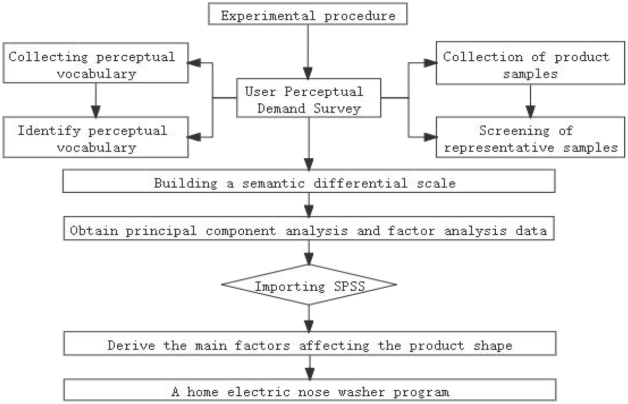
Research Process This study establishes a product design process oriented to the perceptual elements in Kansei Engineering, and explores the correspondence between perceptual vocabulary and product styling. First, a large number of perce- ptual vocabulary as well as product samples were collected, screened and identified, and the information was integrated to form a semantic differen- tial scale. By recovering the valid questionnaires, the data were organized to derive the evaluation data oriented to the user’s perceptual imagery. Using SPSS 24.0 software, principal component and factor analyses were conducted on the perceptual needs of the home electric nasal washer, and then the main factors affecting the styling design were derived. This was used to determine the design elements and guide the final design. The design research process is shown in Figure 1.
STUDY ON THE PERCEPTUAL IMAGERY OF ELECTRIC NASAL WASHER FOR HOME USE Collection and Determination of Perceptual Imagery Vocabulary
Perceptual vocabulary represents users’ subjective feelings and is an expres- sion of users’ perception of the product. In order to comprehensively reflect
Innovative Design of Home Electric Nasal Washer Based on Kansei Engineering 59
Figure 1: Design flow chart.
users’ perceptual cognition of the product, a large number of product perce- ptual vocabulary should be collected as much as possible. In this study, 103 perceptual words describing home electric nose wash were initially collected, mainly from internet search and literature survey. In order to ensure the accu- racy of the obtained perceptual vocabulary, it is necessary to reasonably select the first obtained perceptual vocabulary, use the KJ method to classify the vocabulary into cards, evaluate the preliminary obtained perceptual vocabu- lary, delete words with small relevance, merge words with similar meanings, and select more representative words, and finally obtain 40 advanced words.
Six designers from related industries and 10 patients with rhinitis were invited to select 8 representative words from them. According to the number of times they were selected, 6 more accurate perceptual words were finally selected, and their antonyms were taken to form imagery word groups, which were “mild - sharp” “easy to use - difficult to use “ “safe - dangerous” “clean - untidy” “comfortable - uncomfortable” “simple - complicated”. Accordin- gly, a semantic differential scale was created so that respondents could select the appropriate score in the questionnaire according to their feelings and understanding of the vocabulary.
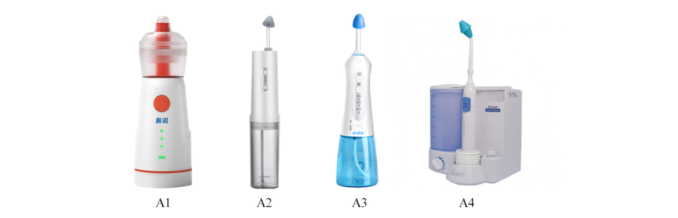
Collection and Determination of Product Samples The selection of typical product samples has an important influence on the experimental data of imagery evaluation. In order to ensure consumers’ com- prehensive understanding of home electric nasal wash, a large number of product sample images of home electric nasal washer were collected through the brand’s official website and e-commerce platform, and 16 typical samples were finally selected. And four representative samples of home electric nasal wash were obtained through card classification and expert evaluation, which were numbered according to A1-A4, as shown in Figure 2.
60 Liu and Xu
Figure 2: Household electric nose washer sample collection.Table 1. Semantic difference subscale.
Table 2. Average values for typical samples of kansei vocabularies.
Table available in the original PDF paper.
samples Mean value of perceptual vocabulary Mild Easy to use Safe Clean Comfortable Minimalist A1 0.98 0.8 1 1 0.73 0.98 A2 −0.02 0.87 0.76 1.67 0.44 1.44 A3 0.87 0.11 1.02 1.2 0.89 1.04 A4 −0.31 −0.31 0.64 0.71 −0.02 −0.64
Experimental Design and Analysis The experiment combined 6 pairs of perceptual imagery vocabulary with 4 representative samples into a semantic differential scale, and produced 7 sca- les of imagery space in the form of 3, 2, 1, 0, −1, −2, −3 ratings, forming a semantic differential method questionnaire for respondents to score and evaluate according to their intuitive impressions, as shown in Table 1.
Through questionnaires and interviews with rhinitis patients, 45 valid que- stionnaires were recovered, and the preferred imagery vocabulary of the respondents for each product sample was recorded. The reasons why the respondent thought the sample conformed to the perceptual imagery were also recorded by the interview method. The scores of the perceptual voca- bulary for each sample were summed and the mean was calculated, and the results were obtained as shown in Table 2.
The results of the data evaluation were entered into SPSS software, and the reliability test was first applied to the obtained data using reliability analysis, and the results are shown in Table 3. In the reliability test, the Clonbach value was 0.89, which was higher than 0.8, proving that the experimental
Innovative Design of Home Electric Nasal Washer Based on Kansei Engineering 61
data had strong credibility and could be analyzed by factor analysis. Factor analysis and principal component analysis of SPSS were applied to reduce the dimensionality of the data evaluation results.
As can be seen from Table 4, the values of the variance of the extracted common factors range from 0.983 to 1.000, and the closer their values are to 1, the more valid the factor analysis of the variable is, which shows that most of the data in the sample variables can be extracted and the results of factor analysis have validity.
As can be seen from Table 5, among the results obtained by the total vari- ance plot, the component eigenvalues of two are greater than 1 and the sum of the cumulative proportions is 99.352%, which is significantly higher than other components, indicating that the influence index is larger, so these two components are extracted as the principal components. Different styling desi- gns affect the perceptual imagery evaluation made by users on the product, so it is necessary to find the loadings of the larger imagery terms from the principal component factors, and the samples corresponding to them are analyzed.
From Table 6, among the principal components 1, the top ones are “mild” and “safe”. Based on the mean values of the perceptual imagery in each sam- ple, it can be seen that both samples A1 and A3 have higher scores in the two groups of perceptual words. The rounded and smooth lines of the edges give people a perceptual impression of “mild”, while the narrow top and wide bottom structural proportions present a stable and full visual impres- sion, giving people a perceptual impression of “safe”. The top rankings of principal component 2 are “clean” and “comfortable”. The mean value of perceptual evaluation shows that “clean” scores higher in samples A2 and A3. This indicates that the simple color scheme, the small number of com- ponents and the slim morphological features of both can give a perceptual impression of “clean”. “Comfortable” scored higher in samples A1 and A3 due to the well-proportioned and easy-to-hold shape.
The above analysis of the evaluation results of the perceptual imagery of the household electric nasal washer finally led to the conclusion that the main
62 Liu and Xu
Table 5. Diagram of explained total variance.
Table available in the original PDF paper.
Initial Eigenvalue Sum of squared rotating loads Ingredients Total Percentage of Cumulative
perceptual words influencing the design of the styling elements of the house- hold electric nasal washer are “gentle” “safe” “clean “ “comfortable”, and the sample that is more consistent with each perceptual vocabulary is sample A3.
DESIGN PRACTICE OF ELECTRIC NASAL WASHER FOR HOME USE Design Thinking
Design orientation. The main target users of this design are young adults with nasal diseases. In the design process, we need to consider the visual perception and operation experience, including the proportion of the product shape, component partition, texture, etc.
Based on the above analysis of the overall perceptual elements of the pro- duct, the expected perceptual objectives of the design of the home electric nasal washer can be determined as four key words, namely “gentle”, “safe”, “clean” and “comfortable”. with sample A3 as the main reference object, combined with samples A1 and A2.
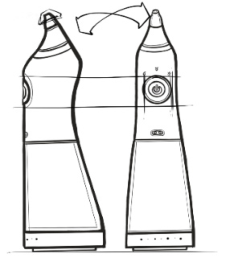
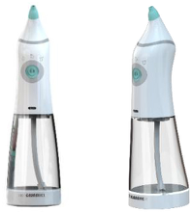
Design Case Show The 3D modeling and rendering of the product shape was carried out on the basis of the design sketch, see Fig. 3 and Fig. 4. The main features are as follows: 1 The overall proportional relationship between the narrow top and the wide bottom is still adopted, making it more stable as a whole, and maintaining the slim and easy-to-hold form of sample 3, weakening the visual sense of volume. 2 The connection between the nozzle and the body
Innovative Design of Home Electric Nasal Washer Based on Kansei Engineering 63
Figure 3: Design sketch of electric nasal washer for home use.Figure 4: The final effect of home electric nasal washer.
is designed to be more compact, and the design is divided into pieces while maintaining a strong integrity. 3 White resin-based color scheme and texture are used to reflect the visual characteristics of clean simplicity. 4 Consider the coordination of the overall shape, and choose the appropriate proportion of white elements at the bottom to echo the upper part of the body.
To verify the satisfaction level of the design solution, the Likert scale method was applied and the above-mentioned 45 test groups were invited to evaluate the final effect in terms of perceptual imagery. The results of the questionnaire showed that the design solution scored generally higher in the six pairs of perceptual vocabulary groups, thus indicating that the innovative design solution of the styling of the household electric nose washer is more in line with the perceptual needs of consumers.
CONCLUSION
Nasal rinsing is an excellent option for relieving nasal problems, and impro- vements and optimization of this product can help increase its usage. Nasal cleansing products that are affordable, simple, safe and easy to use will undoubtedly be welcomed by users and will gradually become a new hygiene habit as common as gargling and brushing.
Kansei Engineering is a design method that is based on experimentation and translates customer feelings and imagery into design elements. In this study, theoretically based on perceptual engineering, the electric nasal washer
64 Liu and Xu
for home use was used as the research object, and the semantic difference method and questionnaire were combined to explore the perceptual imagery of different nasal washer solutions. The experimental data provide reasonable design suggestions for the design of the electric nasal washer. In the expe- riment, the representative sample cannot cover all similar products, so the conclusion of the study has some limitations. This study aims to improve desi- gners’ attention to users’ perceptual imagery, and through the collection of perceptual elements, explore the correlation between users’ perceptual ima- gery and product shape, and provide an idea and direction for the design of electric nasal washer for home use, making it more scientific and objective.
REFERENCES
Chen Jin-liang, Zhao Feng, Li Yi, et al. (2019). Product Design Method Based on Kansei Engineering [J]. Packaging Engineering, 40(12): 146–152. Ding Man, Cheng Yu, Huang Xiao-guang, et al. Status and Progress of Kansei
Engineering Design Method [J]. (2020). Mechanical Design, 37(1): 121–127. Jiangsu Tide Pharmaceutical Co., Ltd. Treatment of nasal diseases with nasal irrigation [J]. (2013). Chinese Medical Digest, (Otolaryngology), 28(03):147–149. Li Yan-zu. Design Concept: Perceptual Engineering [J]. New Art, 2003(4): 20–25. Li Zhen-peng, Song Le-jing, Xiao Jin-hua, et al. Modeling Image of Anchor Chair
Based on Kansei Engineering [J]. (2021). Packaging Engineering, 42(18):239–246. Mitsuo N. Kansei engineering: a new ergonomic consumeroriented technology for product development [J]]. 1995, International Journal of Industrial Ergonomics, 15 (1): 3–11. Zhang Hao1, Zhang Wen. Innovative Design of Children’s Tableware Oriented by
Perceptual Elements [J]. (2021) Packaging Engineering, 42(20):202–209.
LISTED IN THE AHFE DIGITAL BOOKSTORE CATALOGUE
Explore the complete digital volume
Kansei Engineering
Read this individual research paper free through the original publisher, or explore the full digital proceedings book.
ISBN 978-1-958651-16-2
Explore this ISBN in the AHFE Bookstore ↗Listed in the July 2026 bookstore catalogue; search by ISBN to confirm current availability · Digital book purchase optional