Miao Liu, Jiaqi Fang (2022). Innovative Exploration of Art Toy Design Based on Personality Trait Theory. In: Human Factors, Business Management and Society. AHFE Open Access, vol. 56, pp. 291–298. https://doi.org/10.54941/ahfe1002280
With the prosperity of Chinese cultural industry, art toys are loved by more and more people and have become an emerging industry with great market potential in the field of cultural industry. Many art toys appear in the form of personification and have certain personality which can be recognized by consumers. it is the personality perception of art toys from consumers. The purpose of this research is to explore the association rules among self-rated personality traits, personality perception to anthropomorphic art toys from respondents and preference degree to anthropomorphic art toys from respondents in order to summarize some innovative sales and design suggestions and strategies about art toys based on personality traits theory by the method of clustering analysis and Apriori algorithm. The research results provide a quantitative reference tool and design route for the IP design of art toys in order to help the development of cultural and creative product design in China.
Art toys, which also are known as trendy toys and designer toys, refer to small-scale enameled 3D dolls created by designers or artists involving the field of art, design, painting, sculpture and trend (Zhu, 2019). Many art toys appear in the form of personification. At the beginning of design, such art toys are given a certain personality which can be recognized by consumers. Personality traits is a concept in personality psychology. It is a personality test unit, which can reflect the basic characteristics of personality. Each trait is a measurement dimension of personality. People have different personali- ties because of different levels of performance in each trait dimension. The Big Five Personality Traits model is the most influential personality research model at present and is widely used in various research. It divides persona- lity traits into five trait dimensions: E (extraversion), A (Agreeableness), C (Conscientiousness), N (Neuroticism) and O (Openness) (Yuan, 2020). The Big Five Personality Traits model was adopted in this research. Personality perception refers to the personality perception of others. The most common research of personality perception is to explore the correlation between perso- nality scores of others given by subjects and their own self-assessment scores in the same dimension (Yun, 2021).
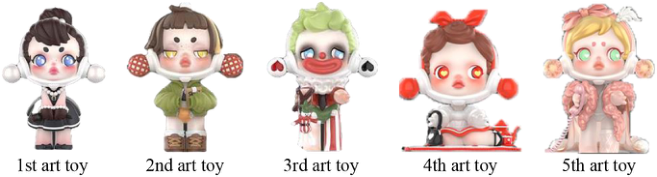
Figure 1: The 5 most representative sample models of art toys.
The purpose of this research is to cluster the total respondents and to mine the association rules among the self-assessment scores of each cluster in cer- tain dimension of personality traits, the scores given by respondents about personality perception and preferences degree to anthropomorphic art toys in the same dimension.
QUESTIONNAIRE DESIGN The research used network resources to carry out questionnaires, and recovered 108 valid questionnaires. The questionnaire consists of four parts:demographic variables questionnaire, Chinese Big Five Personality Inventory brief version, CBF-PI-B (Wang et al., 2011), Big Five Personality bipolar adjectives questionnaire (Gao, 2017) and art toy preference scale. Scales of CBF-PI-B is used in self-rated personality traits of respondents. Scales of bipolar adjectives is used to measure personality traits of art toys. Selected anthropomorphic art toys are shown in Fig. 1.
DATA ANALYSIS AND RESEARCH RESULTS Hierarchical Clustering Method Based on SPSS Statistics
H-K clustering method consisting of Hierarchical clustering and K-means clustering, is used to cluster (Chen, 2014). Hierarchical clustering is used to estimate the number of clustering K. K-means clustering method is used to cluster sample data.
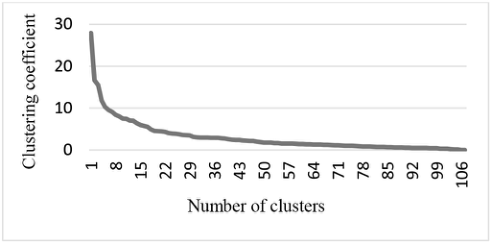
Hierarchical clustering is a common method in multivariate statistical clu- stering analysis. The process of data analysis is as follows: Firstly, after the sampling data analysis by the Hierarchical clustering based on SPSS Statistics, the clustering coefficient and the number of clusters were obtained. And then line chart was drawn with the number of clusters as horizontal coordinates and the clustering coefficient as vertical coordinates, as shown in Fig. 2. The graph illustrated that when the number of clusters is 4, the downward trend of the line slows down. Consequently, the clustering number K value can be set to 4 for the next steps of K-means clustering.
k means Clustering Algorithm Based on SPSS Statistics K-means clustering is the most classic clustering algorithm. The clustering number K is one of the key factors to influence cluster quality. The process of data analysis is as follows: Firstly, the K value was obtained by Hierarchical
Innovative Exploration of Art Toy Design Based on Personality Trait Theory 293
Figure 2: Clustering coefficient change with Number of clusters.Table 1. The final clustering analysis results.
Table available in the original PDF paper.
Cluster 1 Cluster 2 Cluster 3 Cluster 4
middle level in
M SD M SD M SD M SD N 5.36 0.85 5.15 1.02 3.66 0.81 2.21 0.76 C 5.29 0.91 4.49 0.64 4.58 0.80 6.00 0.50 A 5.03 0.85 4.97 0.75 4.47 0.58 5.76 0.78 O 5.75 0.85 3.58 0.95 4.51 0.65 5.92 0.63 E 4.70 0.87 2.84 0.91 4.08 0.61 4.81 0.89 n 23 18 37 30 label high extraversion high neuroticism mid- extraversion all dimensions
high conscientiousness low neuroticism
clustering and then the samples can be repeatedly divided into K clusters by using the K-means algorithm based on SPSS Statistics.
In this paper, the total samples were divided into four clusters with signifi- cant differences through Hierarchical clustering and K-means clustering, and the number of samples is 23, 18, 27 and 30, respectively. The final clustering analysis results are shown in Table 1.
Four clusters were marked different labels according to the analysis results. The first cluster was marked as “high extraversion”, the second cluster was marked as “high neuroticism and mid- extraversion”, the third cluster was marked as “middle level in all dimensions”and the fourth cluster was marked as “high conscientiousness and low neuroticism”, as shown in Table 1. It is convenient to mine the association rules among self-rated personality traits, personality perception to anthropomorphic art toys given by different cluste- ring population and preference degree to anthropomorphic art toys given by different clustering population.
Association Rules Analysis Based on SPSS Modeler Correlative Concepts of Association Rules Analysis Association rules analysis is one of the most important data mining technolo- gies reflecting the relationship between different transactions. It can be used to mine rules like “If some transactions happen, others happen” from the
294 Liu and Fang
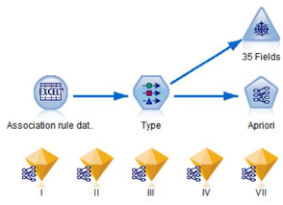
Figure 3: The diagram for association rule analysis flow.Table 2. Association rules in preference of the Cluster 1.
Table available in the original PDF paper.
Association rules S (%) C (%) L (%)
13.04 100 1.64
1 Self-rated high extraversion
→ high Preference degree to 1st art toy
30.46 70.0 1.16
→ high Preference degree to 2nd art toy
2 Self-rated high extraversion 2nd art toy has high extraversion
56.52 81.25 1.17
→ high Preference degree to 3 rd art toy
3 Self-rated high extraversion 3rd art toy has high extraversion
39.13 75 1.57
→ high Preference degree to 4th art toy
4 Self-rated high extraversion 4th art toy has high extraversion
52.17 80.0 1.22
5 Self-rated high extraversion
→ high Preference degree to 5th art toy
database. There are three main evaluation indexes for the validity of simple association rules: Support, Confidence and Lift. If the three indicators of an association rule reach the recommended level, it shows that this is an effective association rule (Qi et al., 2013).
Support is the probability that union sets (A ∪B) of item sets A and B appear simultaneously in transaction D, reflecting the universality of association rules. Support:
Support (A →B) = Support (A ∪B) (1) Confidence is the probability C of transaction D containing item set A and item set B, which reflects the possibility of B appearing under the condition of A appearing. It reflects the reliability of association rules. Confidence:
Equation reproduced from the original PDF.Equation reproduced from the original PDF.
Innovative Exploration of Art Toy Design Based on Personality Trait Theory 295
Table 3. Association rules in preference of the Cluster 2.
Table available in the original PDF paper.
Association rules S (%) C (%) L (%)
27.78 83.33 1.5
→ high Preference degree to 1st art toy
1 Self-rated high neuroticism Self-rated mid-extraversion 1st art toy has high neuroticism
27.78 83.33 1.36
→ high Preference degree to 2nd art toy
2 Self-rated high neuroticism Self-rated mid-extraversion 2nd art toy has mid-extraversion
11.11 100 1.8
3 Self-rated high neuroticism 3rd art toy has high neuroticism
→ high Preference degree to 3 rd art toy
43.48 100 1.44
→ high Preference degree to 4th art toy
4 Self-rated mid-extraversion Self-rated high neuroticism 4th art toy has mid-extraversion
11.11 100 1.8
→ high Preference degree to 5th art toy
5 Self-rated high neuroticism 5th art toy has low neuroticism
Table 4. Association rules in preference of the Cluster 3.
Table available in the original PDF paper.
Association rules S (%) C (%) L (%)
21.62 100 1.48
1 Self-rated mid-agreeableness Self-rated mid-neuroticism 1st art toy has high openness
→ high Preference degree to 1st art toy
10.81 100 2.64
→ high Preference degree to 2nd art toy
2 Self-rated mid-openness Self-rated mid-conscientiousness 2nd art toy has high openness 2nd art toy has high conscientiousness
10.81 100 1.61
3 Self-rated high extraversion 3rd art toy has high extraversion → high Preference degree to 3 rd art toy
13.51 83.33 3.43
4 Self-rated mid-agreeableness 4th art toy has high agreeableness 4th art toy has high neuroticism
→ high Preference degree to 4th art toy
21.62 100 1.48
→ high Preference degree to 5th art toy
5 Self-rated mid-agreeableness Self-rated mid-neuroticism 5th art toy has high agreeableness 5th art toy has high conscientiousness
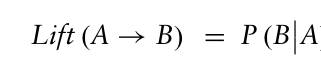
Lift is the ratio of confidence to expected confidence, and its value is greater than 1 to show that this is an effective association rule. Lift:
Equation reproduced from the original PDF.
A) /P (B) (3)
296 Liu and Fang
Table 5. Association rules in preference of the Cluster 4.
Table available in the original PDF paper.
Association rules S (%)
C (%)
L (%)
33.33 100 1.2
→ high Preference degree to 1st art toy
1 Self-rated high conscientiousness Self-rated low neuroticism 1st art toy has high conscientiousness 1st art toys 1 has low neuroticism
10.81 100 2.64
→ high Preference degree to 2nd art toy
2 Self-rated high conscientiousness Self-rated mid-neuroticism 2nd art toy has high conscientiousness 2nd art toy has high neuroticism
16.67 100 1.2
→ high Preference degree to 3 rd art toy
3 Self-rated high conscientiousness Self-rated mid-neuroticism 3rd art toy has high conscientiousness 3rd art toy has high neuroticism
20.0 85.71 1.71
→ high Preference degree to 4th art toy
4 Self-rated high conscientiousness Self-rated low neuroticism 4th art toy has high conscientiousness 4th art toys 1 has low neuroticism
13.33 100 1.2
→ high Preference degree to 5th art toy
5 Self-rated high conscientiousness Self-rated mid-neuroticism 5th art toy has mid-conscientiousness 5th art toy has mid- neuroticism
Apriori Algorithm Analysis and Analysis Results The Apriori algorithm is employed to mine the strong association rules. By using Apriori algorithm based on the SPSS Modeler, the association rules among self-rated personality traits, personality perception to anthropomor- phic art toys from respondents and preference degree to anthropomorphic art toys shown by respondents can be mined in order to summarize some innovative sales and design suggestions and strategies. The diagram for asso- ciation rules analysis flow in the SPSS Modeler is shown in Figure 3 and the association rules analysis results of different clustering population are shown in Table 2, Table 3, Table 4 and Table 5.
CONCLUSION AND PROSPECTS Based on the association rules derived from the research and combined with the corresponding psychological knowledge, this paper tries to explain the research results and summarize some innovative sales and design suggestions and strategies about art toys to online purchase platform and IP design of art toys.
Innovative Exploration of Art Toy Design Based on Personality Trait Theory 297
Principles of Similarity In social relations, people tend to choose individuals similar to themselves when choosing spouses. It is called the assortative mating phenomenon. (Zhuang et al., 2011) Similarly, combined with the multiple association rules obtained, it can be learned that the respondents with distinctive traits in cer- tain personality dimension prefer art toys with similar situation in the same dimension.
For online purchase platform of art toys, the platform can plan and lau- nch a personality test operation for users. Combined with the collected user personality dimension data, they can recommend art toys similar to them in characteristic to users.
For character design of art toys, designers can design character image of art toys similar to their target users in personality dimension.
Principles of Characteristics The interactive relationship between users and virtual images is called “para- social relationship”. which depend on unilateral behaviors of users including investing in cognition or emotion and making evaluation or consumption. It is similar to social interaction in reality and has some similar attributes. But it has some unique attributes, such as mapping idealized personality of users in anthropomorphic character images. For example, the third cluster (five personality dimensions are moderate score) showed the tendency to prefer art toys which were scored higher in all dimensions and had distinctive and unique personality traits. For them, it maybe can be explained that art toys are mapped idealized personality users.
For online purchase platform of art toys, They can plan and launch a perso- nality test operation for users. Combined with the collected user personality dimension data, and the platform can recommend art toys which score higher in certain dimension and are more personalized.
For character design of art toys, designers can design character image of art toys which have more distinctive and unique personality traits. From the perspective of life experience, such character images are also more artistic and attractive because of their distinctive and unique personality charm.
REFERENCES
Chen, R.J., Zhang, C. and Mao, Y.G. (2014). Research on null value estimation based on Mahalanobis distance and H-K clustering. Computer disc software and applications, (20), 86–88 + 91. Gao, J.Y. (2017). The personality research on Peking Opera painted Face. (aster
thesis, Zhejiang University). Qi, W.J., Yan, J., Huang, S.C., Guo, L., and Lu, R. (2013). Application of association rules mining in college students ’ mental health assessment system. Journal of Hunan University of Technology, (06), 94–99. Wang, M.C., Dai, X.Y., and Yao, S.Q. (2011). Development of the Chinese Big
Five Personality Inventory (CBF-PI) III: Psychometric Properties of CBF-PI Brief Version. Chinese Journal of Clinical Psychology, (04), 454–457.
298 Liu and Fang
Yuan, Y.L. (2020). Research on Strategies and Methods of Web Interface Design based on Personality Traits. (Master degree thesis, South China University of Technology). Yun, Z.Y. (2021). Relationship among self-personality personality perception and
preference of fictional character. (Master degree thesis, Zhejiang University). Zhu, X.Y. (2019). Analysis on the rise and development of art toy industry in China.
Technology and Industry in the Straits, (02), 141–146. Zhuang, J.Y., Zhang, J.M. and Ying, J.J. (2011). The kinship selection and spouse selection behavior based on self-similar faces. Psychological science progress, (09), 1371–1377.
LISTED IN THE AHFE DIGITAL BOOKSTORE CATALOGUE
Explore the complete digital volume
Human Factors, Business Management and Society
Read this individual research paper free through the original publisher, or explore the full digital proceedings book.
ISBN 978-1-958651-32-2
Explore this ISBN in the AHFE Bookstore ↗Listed in the July 2026 bookstore catalogue; search by ISBN to confirm current availability · Digital book purchase optional