Tomoya Koishi, Keiichi Watanuki, Kazunori Kaede (2022). Effects of Field-of-View Expansion Using a Wide-field HMD on Active Linear Motion. In: Affective and Pleasurable Design. AHFE Open Access, vol. 41, pp. 203–210. https://doi.org/10.54941/ahfe1001798
Field-of-view (FOV) expansion is a technology that exceeds the limits of the human FOV, which is approximately covers 200° horizontally and 130° vertically, by compressing and presenting out-of-field images obtained from a wide-angle camera on a head-mounted display (HMD). Previous studies have focused on improving the search efficiency of the human FOV and detecting hazards not covered by blind spots by expanding the visible range; their effectiveness has only been examined in static situations. Therefore, the effect of FOV expansion in dynamic situations, such as during walking and exercise, has not been fully investigated and elucidated. Therefore, we attempted to investigate the characteristics of FOV expansion in dynamic situations that utilized peripheral vision by using a wide-field HMD. Among these, we focused on human motion perception during straight-line motion, which is closely related to human vision.In daily life, we perform linear movements such as walking and driving. In such movements, the human body acquires various types of information from its receptors to understand its own motion and position in relation to the outside world. This cognitive function is called self-motion perception, and visual motion information is the largest component of it. Therefore, there are many cases wherein visual information is manipulated to create an illusion of relative distance and speed to the external world, thereby enhancing motor sensation and altering walking patterns.Returning to the principle of FOV expansion, it is a method of presenting visual information beyond the limits of a defined human FOV. Therefore, the visual distance to external objects and the motion of the external objects change significantly in the FOV during FOV expansion. Utilizing this property, we believe that motion perception can be intentionally manipulated during straight-line walking. In addition, since the effects on perception propagate to the psychological states and physical control of the individual, walking in the state of an expanded visual field may induce mental elevation and improve their motor skills. If these characteristics can be clarified, the technology of visual field expansion can be applied not only to searching for entities and detecting danger but also to improving motion support and gait control.Based on the above, this study aims to investigate whether there are any differences, among normal walking, walking with FOV expansion, and walking with FOV expansion under different angles, in terms of perception, emotion, and gait. Perception and emotion were subjectively evaluated using a questionnaire, and the gait pattern was analyzed using body coordinate information obtained by motion capture. To expand the visual field, we constructed an FOV expansion system using a wide-field head-mounted display (HMD), two omnidirectional cameras, and a control PC. The results of the experiment indicated that the greater the expansion of the FOV, the faster the subject perceived their own walking speed. In addition, there was one case wherein the faster the perceived walking speed was, the shorter the perceived walking distance was. These results suggested that FOV expansion could create the illusion of increased athletic performance.
Field-of-view (FOV) expansion is a technology that exceeds the limits of the human FOV, which is approximately covers 200° horizontally and 130° ver- tically, by compressing and presenting out-of-field images obtained from a wide-angle camera on a head-mounted display (HMD). Previous studies have focused on improving the search efficiency and detecting hazards in blind spots by expanding the visible range; their effectiveness has only been exa- mined in static situations (Ardouin, 2012; Orlosky, 2014). Therefore, the effect of FOV expansion in dynamic situations, such as during walking and exercise, has not been fully investigated and elucidated. In addition, the vie- wing angle of the HMD used to present the images is very narrow compared with the range of the original FOV. Therefore, there is insufficient research on the effects of out-of-field images presented in peripheral vision. Based on the above, we attempted to investigate the characteristics of FOV expansion in dynamic situations that utilized peripheral vision by using a wide-field HMD.
Among these, we focused on human motion perception during straight-line motion, which is closely related to human vision.
In daily life, we perform linear movements such as walking and driving. In such movements, the human body acquires various types of information from its receptors to understand its own motion and position in relation to the outside world. This cognitive function is called self-motion perception, and visual motion information is the largest component of it (Kano, 1991). Therefore, there are many cases wherein visual information is manipulated to create an illusion of relative distance and speed to the external world, thereby enhancing motor sensation and altering walking patterns (Okano, 2014; Yoshida, 2006). Returning to the principle of FOV expansion, it is a method of presenting visual information beyond the limits of a defined human FOV. Therefore, the visual distance to external objects and the motion of the external obje- cts change significantly in the FOV during FOV expansion. Utilizing this property, we believe that motion perception can be intentionally manipu- lated during straight-line walking. In addition, since the effects on perception propagate to the psychological states and physical control of the individual, walking in the state of an expanded visual field may induce mental elevation and improve their motor skills. If these characteristics can be clarified, the technology of visual field expansion can be applied not only to searching for entities and detecting danger but also to improving motion support and gait control.
Based on the above, in this study, we constructed a FOV expansion system and verified its characteristics during straight-line walking. This study aims to investigate whether there are any differences, among normal walking, wal- king with FOV expansion, and walking with FOV expansion under different angles, in terms of perception, emotion, and gait. Perception and emotion were subjectively evaluated using a questionnaire, and the gait pattern was analyzed using body coordinate information obtained by motion capture.
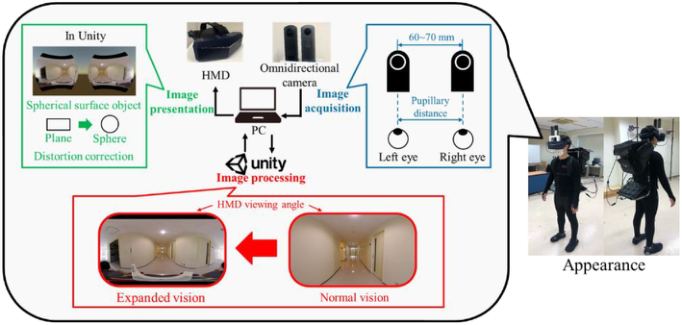
DEVELOPMENT OF FOV EXPANSION SYSTEM The FOV expansion system constructed in this study consisted of two omni- directional cameras (RICOH THETA Z1 and THETA V, RICOH Imaging Corporation, Tokyo, Japan), a wide-field HMD (Pimax Vision 8K X, Pimax Technology Co., Ltd, Shanghai, China) with a diagonal viewing angle of 200°, and a PC (Alienware M15 R6, Dell Technologies Inc., Texas, USA) for control (see Figure 1). The cameras acquired 360° images around the camera, and by positioning them such that the distance between them matched the interpupillary distance of a human eye, each camera acted as the right and left eyes of a human. The images acquired from the camera were transferred to a PC through USB cables and then processed by Unity, a game engine with a built-in integrated development environment (IDE), to expand the FOV. The processed plane image was projected onto the inner surface of a sphe- rical object in Unity to correct the distortion. In this way, by looking at the projected image of the object through the lens of the HMD, the FOV could be pseudo-expanded. In addition, the images from the two omnidirectional
Effects of Field-of-View Expansion Using a Wide-Field HMD on Active Linear Motion 205
Figure 1: Overview of the FOV expansion system.
cameras were presented to the right and left lenses in the HMD, allowing for simultaneous FOV expansion and binocular stereopsis. The HMD and omni- directional cameras were mounted on the head of each subject, and all the other necessary equipment was mounted on their backpacks. The total wei- ght of the equipment used in the system was approximately 10.1 kg, and the delay between video acquisition and presentation was approximately 0.28 s.
EVALUATION OF THE EFFECT OF VISUAL FIELD EXPANSION Gait Evaluation During Walking
Body coordinate information obtained from the motion capture system was used to evaluate the gait of the subjects during their straight 5 m section walk. From the obtained coordinates, the walking speed, stride length, and walking time of the subjects were calculated. Based on these values, we compared their normal gait with the FOV expanded gait.
Perception Evaluation During Walking The magnitude estimation method was used for the sensory evaluation of perception during walking. In this method, a reference stimulus was set at the beginning, and the sensory magnitude of this stimulus was directly estima- ted by comparing the numerical values with the reference stimulus value. In this study, the sensory quantity of three types of perceptual quantities during walking, walking speed, walking distance, and walking time, was evaluated by setting the sensory quantity during normal walking as a reference value of 100. Using this value as a reference, the sensory quantity during FOV expanded walking was evaluated as an integer value greater than 0.
Emotion Evaluation During Walking The POMS2-A Short (adult short version), a mood profile test, was used to assess the emotions of the subjects during walking. The test form consisted of 35 questions related to moods, each of which was classified into seven
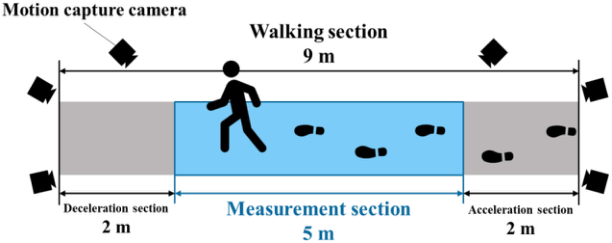
Figure 2: Walking environment.
scales of affective factors. The questions were asked on five levels, and each subjective evaluation value was standardized using T-scoring. These values were used to compare the psychological state of the subjects during normal walking with that during FOV expanded walking.
EXPERIMENTAL EVALUATION OF EFFECT OF FOV EXPANSION ANGLE ON ACTIVE LINEAR MOTION The purpose of this experiment is to evaluate the effects of the visual field expansion angle on the perception, emotion, and gait of individuals during straight-line walking. The experiment was conducted on 11 males (23.1±1.6 years old) whose visions were not corrected by glasses. The FOV expansion angles were set as 160, 280, and 360°. The 160° condition refers to the FOV when no image processing was applied to the camera image. Normal walking was added to these three conditions for a total of four conditions.
An indoor walking environment was used, and the distance from the start to the goal was a 9 m straight line. The first 2, middle 5, and last 2 m were used as the acceleration, gait measurement, and deceleration sections, respectively (see Figure 2). Before starting the experiment, the subjects practi- ced walking at a comfortable speed indoors under each walking condition. Since there were large individual differences in adaption to walking using the proposed system, the subjects practiced till safe walking became possible, without any fixed time limits.
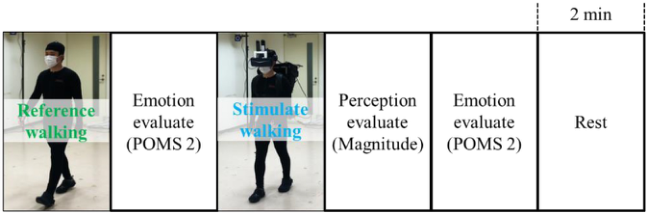
The flow of the experiment is shown below (see Figure 3). First, the subjects walked at a comfortable speed under normal conditions (refere- nce walking) and stored a sensory quantity of 100 as a perception of their own walking speed, distance, and time. After arriving at the goal point, a POMS 2 questionnaire was administered to the subjects immediately after the reference walk to assess their psychological states. Next, each subject wore an FOV expansion system and walked at a comfortable speed with their visual field expanded to a randomly selected angle among the three conditions (stimulated walking). After arriving at the goal point, the system was removed, and the motion perception of the subjects during the stimu- lated walking was subjectively compared to that during reference walking. The POMS 2 questionnaire was administered immediately after the stimulus
Effects of Field-of-View Expansion Using a Wide-Field HMD on Active Linear Motion 207
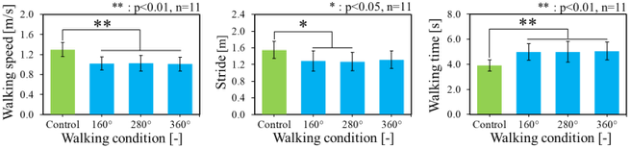
Figure 3: Task schedule.Figure 4: Results of gait.
walk, followed by a 2 min rest period. Similar trials were conducted for all the three viewing angles.
RESULTS
Experimental Results on Gait The mean values and standard deviations of the gaits of the 11 experimental subjects under each walking condition are shown in Figure 4. The Tukey- Kramer’s multiple comparison test for walking speed, stride length, and walking time revealed a significant difference (p<0.01) in the mean values of the walking speed and walking time under the reference walking and those under the three stimulated walking conditions. In addition, there was a signi- ficant difference (p<0.05) in the mean values of the stride length between the reference gait and the 160° stimulus gait, and that between the reference gait and the 280° stimulus gait.
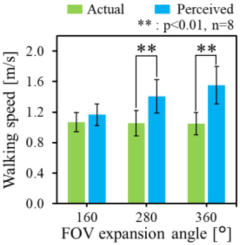
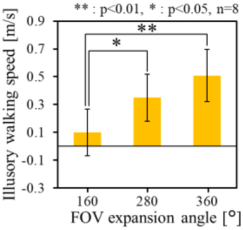
Experimental Results on Perception The mean values and standard deviations of the perceived walking speed and the actual walking speed of 8 experimental subjects are shown in Figure 5, except for those of three subjects whose walking ability during the stimulated walking was severely reduced, which strongly affected their speed perception. A corresponding T-test was performed for each visual field expansion angle, and a significant difference was found between the mean actual and perceived walking speeds under the 280 and 360° conditions. The difference between the perceived and actual walking speeds was calculated as the illusory wal- king speed, and its mean and standard deviation are shown in Figure 6. A Tukey-Kramer multiple comparison test was performed between each visual
Figure 5: Actual and perceived walking speed.Figure 6: Illusory walking speed.
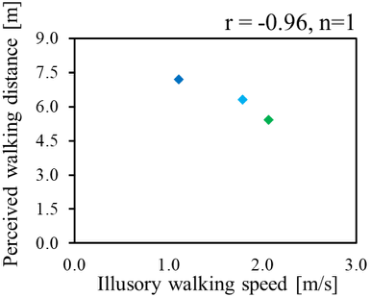
field expansion angle, and a significant difference was found between the means of the 160 and 280° (p<0.05) conditions and those of the 160 and 360° conditions (p<0.01). In addition, although there was no correlation between the three types of perceptions among whole the subjects in the experiment, when we correlated the perceived walking distance with the illusory walking speed of subject A, we found a very strong negative correlation with the correlation coefficient r = −0.96 (see Figure 7).
Experimental Results on Emotion Comparisons of the mean T-scores under the reference and stimulus walks and between the visual field expansion angles of the 11 experimental subjects revealed no significant differences or trends in the mean T-scores.
DISCUSSION
In terms of gait, there was no significant difference between the visual field expansion angles; however, walking speed and stride length were significantly decreased, and walking time was significantly increased in comparison under the reference and stimulated walking. This suggested that the weight of the system, delay in the image, and unfamiliarity with the change in viewpoint may have affected the gait of the subjects before the perceptual change caused by the FOV expansion in this experiment did.
Effects of Field-of-View Expansion Using a Wide-Field HMD on Active Linear Motion 209
Figure 7: Correlation between the illusion of speed and distance of subject A.Figure 8: Difference in gait under stimulated and reference walks.
In terms of perception, the results of Figures 5 and 6 show that the expan- sion of the FOV caused the subjects to perceive the walking speed as larger than it was. This illusion was assumed to be related to the visual effects of FOV expansion, such as an increase in visual stimuli presented to periphe- ral vision and an increase in the sense of acceleration due to depth change. In addition, the illusion of visual field expansion was found to be more dominant than the perception of speed through somatosensory perception.
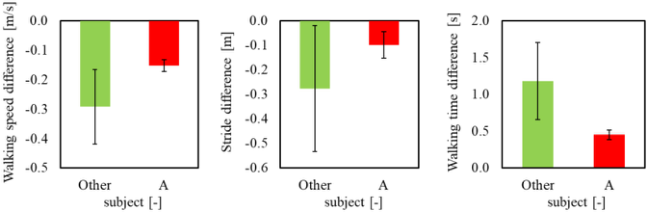
In the case of subject A, a peculiar tendency to perceive a shorter wal- king distance was observed as their illusory walking speed increased. To examine this cause, we focused on the difference of gait data between subject A and other subjects. As a result, it was found that this subject had a very small difference in gait data between the stimulate and reference walking compared to the other subjects (see Fig. 8). In addition, this subject could complete the practice of stimulate walking in a particularly short time. These means that this subject was able to walk while sufficiently adapting to the FOV expansion system. This suggested that further optimization of the FOV expansion system and sufficient training of the subject may induce the illusion of increased athletic performance through perceptual interactions.
In terms of emotions and time perception, there was no effect of or trend in FOV expansion owing to the large variability of data. This may have been because the walking environment was indoors, where these was little change in scenery, and the walking distance was too short. Therefore, to investigate
the effects of FOV expansion in a multimodal manner in the future, it will be necessary to investigate changes when walking in locations with diffe- rent environmental conditions, such as outdoors or when walking for longer distances or periods of time.
CONCLUSION
Based on the hypothesis that FOV expansion can affect the perception, emo- tion, and gait of an individual when walking, we constructed an actual FOV expansion system and verified its characteristics during straight-line wal- king. The conducted experiment could not properly evaluate the effects of FOV expansion on gait, emotion, and time perception, probably because of problems with the system or walking environment. However, in terms of perceived speed, walking speed was perceived faster when the visual field was expanded to 280 or 360°, and the perceived speed tended to increase as the range of the visual field increased. In addition, there was one case wherein the perceived distance decreased as the perceived speed increased, suggesting that with sufficient training, FOV expansion could induce the illusion of increased athletic performance. In the future, we will reduce the weight of the system, optimize processing, and evaluate the effects of walking outdoors and over longer distances on the FOV to explore the applicability of FOV expansion technology in the field of motion support.
REFERENCES
Ardouin, J., Lecuyer, A., Marchal, M., Riant, C., Marchand, E. (2012). FlyVIZ: a novel display device to provide humans with 360 vision by coupling catadioptric camera with hmd, in: Proceedings of the 18th ACM symposium on Virtual reality software and technology, pp. 41–44. Orlosky, J., Wu, Q., Kiyokawa, K., Takemura, H., Nitschke, C. (2014). Fisheye
vision: peripheral spatial compression for improved field of view in head mounted displays, in: Proceedings of the 2nd ACM symposium on Spatial user interaction, pp. 54–61. Kano, C. (1991). Self-Motion Perception and Visual Information, Japanese psychological review, Volume 34, No. 2, pp. 240–256. Okano, Y., Zoga, Y., Hashimoto, Y., Nojima, T., Kajimoto, H. (2008). A study on
the display method to the peripheral view for augmentation of speed sensation, IPSJ SIG Technical Reports Volume 2008, No. 11, (2008-HCI-127), pp. 145–150. Yoshida, T., Takenaka, T., Ito, M., Ueda, K., Tobishima, T. (2006). Guidance of Human Locomotion using Vection Induced Optical Flow Information, IPSJ SIG Technical Reports, Volume 2006, No. 5, (2006-CVIM-152), pp. 125–128.
LISTED IN THE AHFE DIGITAL BOOKSTORE CATALOGUE
Explore the complete digital volume
Affective and Pleasurable Design
Read this individual research paper free through the original publisher, or explore the full digital proceedings book.
ISBN 978-1-958651-17-9
Explore this ISBN in the AHFE Bookstore ↗Listed in the July 2026 bookstore catalogue; search by ISBN to confirm current availability · Digital book purchase optional