Yusuke Maeda, Keiichi Watanuki, Kazunori Kaede (2022). Evaluation of Attention Guidance through Visual Subthreshold Stimulus Using a HMD. In: Affective and Pleasurable Design. AHFE Open Access, vol. 41, pp. 211–217. https://doi.org/10.54941/ahfe1001799
Attention guidance is used as a means of conveying important information. Many attention guides use colors or color gradations that stand out from the surrounding environment, such as signs, or directional shapes such as arrows. In the past, some studies have used directional events such as the gaze of others, optical flow, and optical illusions to guide attention. However, such stimulus presentation methods may cause annoyance and discomfort to people because of their high degree of stimulation. For example, when an alert is displayed for a hazard that appears probabilistically when driving a car, it often causes annoyance and discomfort to the driver when the hazard does not appear. In this paper, we propose a new method of alerting the driver by affecting the unconscious region of the brain. In past research, it has been reported that displaying an object in the frame before the visual search task induced attention and shortened the reaction time. In addition, it has been reported that by displaying a short cue during eye movement, the gaze moved in the direction of the cue. The purpose of this study is to evaluate the validity of attentional guidance by presenting such visual subthreshold stimuli. The participants wore a head-mounted display and performed a visual search task in which they had to find and answer one search object different from the others among eight search objects. The time from the start of the visual search task to the finding of the target object and the trajectory of the gaze during the search were used as evaluation indicators. Ten healthy males in their twenties (22.8 years old ± 1.72 years old) with corrected eyesight cooperated in the experiment. The objects to be searched were placed 1 m away from the participants and at 30° to the up, down left, right. A masked image was inserted before the visual search task, and one of the explorers could be seen one frame (Approx. 0.01ms) before the visual search task, which was used as a visual subthreshold stimulus. These cues could be either consistent with or different from the search object to be found. The results of this experiment showed that there was no significant difference in mean reaction time between the three conditions: when the cue matched or differed from the search object to be found, and when the cue was not presented. However, there was a tendency that the position at which the participants first started their search was closer to the location of the cue. This suggests that the threshold stimulus has an effect of inducing attention, but there was no tendency to draw attention strongly. In addition, the speed of recognition was large for some participants, and cues were recognized in some cases. The reason for this result is thought to be the contrast ratio between the cue and the mask image and the presentation position of the cue. Therefore, it is necessary to examine the contrast ratio and the presentation position of the cue for each experimental collaborator.
In recent years, the virtual reality (VR) market has expanded, and the number of contents is expected to increase. VR allows users to enter a virtual space by wearing a head-mounted display (HMD); however, owing to its chara- cteristics, user attention is dispersed, and users do not always pay attention to what the content creators want them to see. For example, in 360° ima- ges such as VRCG animations, it is possible for the HMD wearer to decide the gaze direction, and attention may not be fixed in one direction alone. Therefore, if the HMD wearer’s attention is explicitly guided in one dire- ction, the immersion may be degraded. In “Invasion!”, a VRCG animation produced by Baobab Studios, attention is guided by the gaze of a character using the gaze cue effect (Friesen and Kingstone, 2003). Besides, there are other methods that use subthreshold stimuli to naturally guide the attention
of the information receiver. In particular, attention guidance using visual subthreshold stimuli suggests that the insertion of a brief blinking stimulus in a masked image before a visual search task with top-down attention can produce an attention guidance effect (Prasad and Mishra, 2019). However, attentional guidance by practical visual subthreshold stimulus has not been investigated, and there are no studies using them for VR.
In this study, we evaluate the attention guidance effect of a visual subth- reshold stimulus while wearing a head-mounted display (HMD). We explore a method for effectively presenting visual subthreshold stimuli in VR. We perform an experiment in which we utilize a darkening called blink inser- ted in the teleportation used for movement in VR as a masked stimulus, insert a visual subthreshold stimulus, and record the subsequent gaze infor- mation and reaction time of the visual search task. We use the recorded gaze information, reaction time, and stimulus perception feedback from the par- ticipants in the experiment to evaluate the attention guidance through visual subthreshold stimulus.
ATTENTION GUIDANCE EVALUATION EXPERIMENT Experiment on Attention Induction through Visual Subthreshold Stimulus
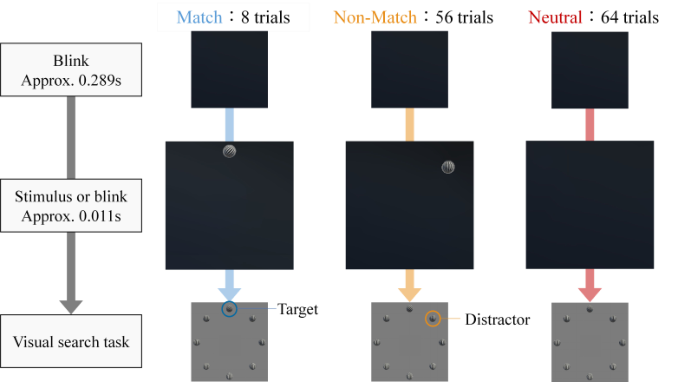
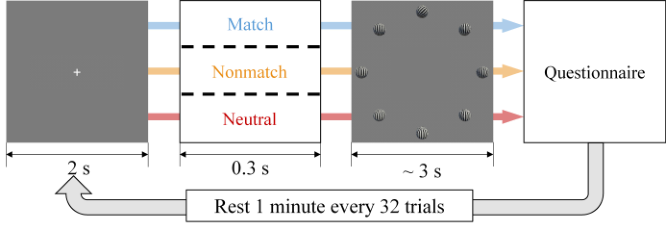
In this experiment, part of a search object in a visual search task is presented as a visual subthreshold stimulus to investigate whether attention is guided in a direction (Higuchi, Inoue, Endo and Kumada, 2019). The participants wore HMDs and viewed the images by moving their gaze. After 2 s of gazing, a 0.3-s dark period was shown, during which a visual subthreshold stimu- lus could be inserted. The presentation method for the stimuli is shown in Figure 1 and the video sequence is shown in Figure 2. The participant was required to find an object with a tilted stripe pattern among eight objects in a visual search task after the dark period and determine the direction of the tilt. The participants were 10 people who provided informed consent.
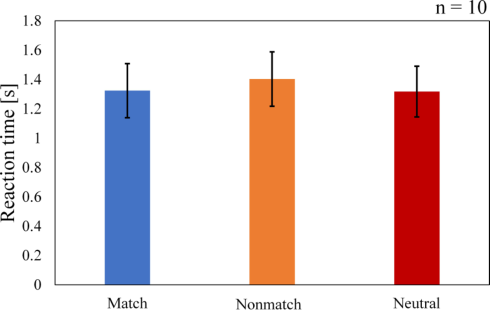
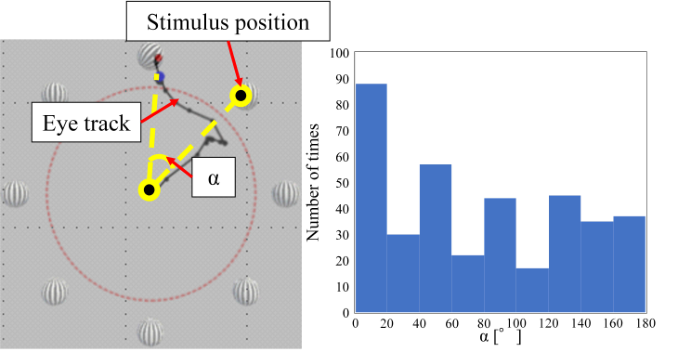
The mean value and standard deviation of the reaction time of all the par- ticipants under each condition are shown in Figure 3. In the figure, “match” denotes the appearance of the visual subthreshold stimulus and target at the same location, “nonmatch” denotes the appearance of the target at the same location as the distractor, and “neutral” denotes the case where the subthre- shold stimulus is not presented. The angle between the visual subthreshold stimulus at the gazing point and the point at which the viewpoint exceeds the 50° viewing angle for the first time are depicted in Figure 4. The resultant graphs show that there is no significant difference among the three conditions; however, the number of times the participants move their gaze in the direction of the visual subthreshold stimulus is the highest. This indicates that the visual subthreshold stimulus induces gazing. However, some of the participants perceived the stimulus. Because the stimulus used in this experiment contains white (#FFFFFF) in contrast to black (#000000), the contrast ratio between the color of the masked stimulus and that of the stimulus is high, which may have reduced the perceptual difficulty.
Evaluation of Attention Guidance through Visual Subthreshold Stimulus Using a HMD 213
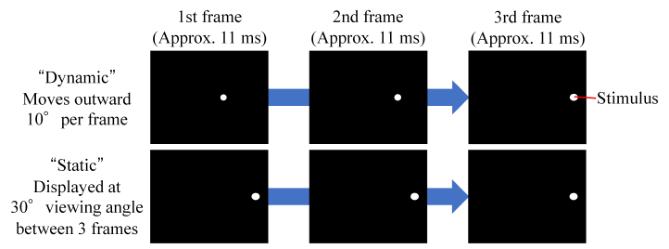
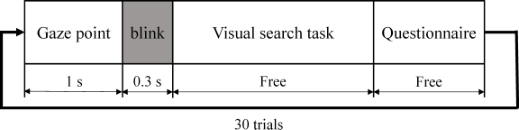
Figure 1: Visual subthreshold stimulus presentation method.Figure 2: Video presentation sequence.Figure 3: Reaction time of all the subjects under each condition.
Experiment on Attentional Induction through Visual Subthreshold Stimulus Considering the Stimulus Intensity In this experiment, the stimulus is presented as a visual subthreshold stimulus using different presentation methods, color brightness, and size in either the
Figure 4: Number of times the stimulus is perceived by all the participants under each condition.Figure 5: Stimulus presentation method.Figure 6: Video presentation sequence.
left or right direction to determine whether the attention direction is guided. The presentation method for the stimuli is shown in Figure 5 and the video sequence is shown in Figure 6. The participants wore HMDs and watched images by moving their heads and gaze. After 1-s of gazing, a blackout of 0.3 s was presented, during which a subthreshold stimulus could be inserted. The participant was required to find an object with a tilted stripe pattern among two objects in a visual search task after the dark period and determine the direction of the tilt. The participants were 10 people who provided informed consent.
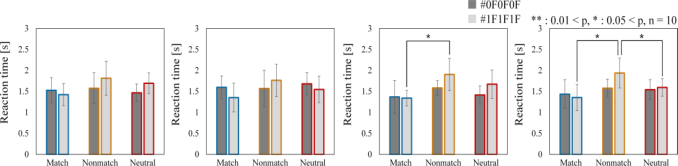
The mean value and standard deviation of the reaction time of all the par- ticipants under each condition are shown in Figure 7. The conditioning of
Evaluation of Attention Guidance through Visual Subthreshold Stimulus Using a HMD 215
Figure 7: Reaction time of all the subjects under each condition.Figure 8: Number of times the stimulus is perceived by all the participants under each condition.
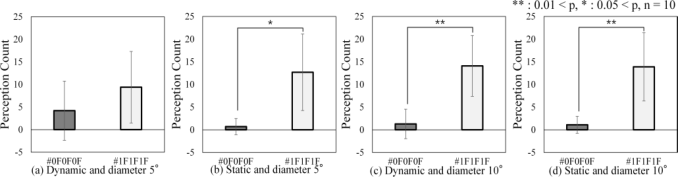
the reaction time is the same as that of the previous experiment. The mean and standard deviation of the number of times the stimulus is perceived by all the subjects under each condition are depicted in Figure 8.
The resultant graphs show that there is a significant difference when the brightness of the stimulus color is (#1F1F1F) with a size of 10°. However, the number of times the stimulus is perceived increases when the color brightness is (#1F1F1F), suggesting that the explicit stimulus may have induced an atten- tion effect. In addition, the effect of the contrast ratio of the color brightness on the masking stimulus may be the maximum in stimulus perception.
Experiment on the Discrimination Limits in the Color Brightness In this experiment, we investigate the extent of the color-discrimination limit of the stimulus against a black (#000000) masked stimulus. The participants were instructed to gaze at the red gazing point and perceive the stimulus in their peripheral vision. We conducted three trials each under two conditions: one in which the stimulus was flashed and flickered for approximately 0.011 s or 0.033 s and the RGB values were increased by one each (up condition), and the other in which the RGB values were reduced by one each (down condition). In the up condition, the RGB values of the stimulus commenced at (0, 0, 0), and when the stimulus blinks were first perceived, the RGB values were obtained and reduced by one. In the down condition, the RGB values were measured when the stimulus blinks were no longer perceived.
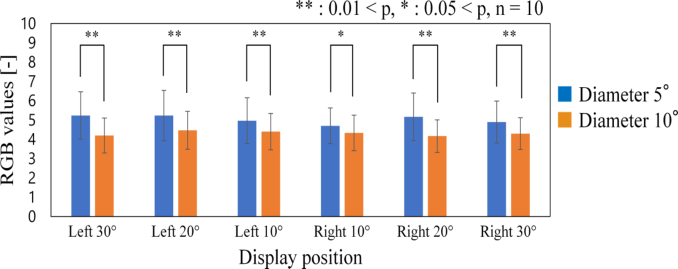
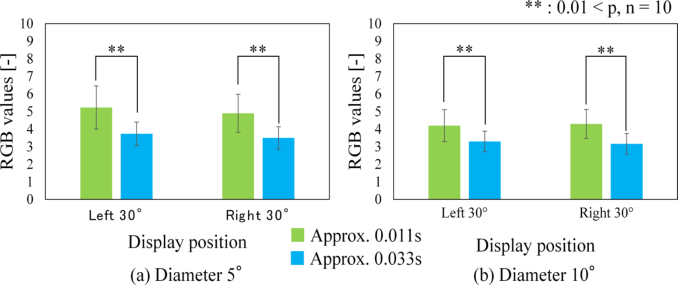
The mean and standard deviation of the RGB values of the imperceptible limit at the display position and the stimulus size for all the participants are shown in Figure 9. The mean and standard deviation of the RGB values of the imperceptible limit for the stimulus display time are depicted in Fig. 10.
The resultant graphs show significant differences between the stimulus size and display time conditions. However, there is no significant difference
Figure 9: RGB values of the imperceptible limit at the display position and the stimulus size.Figure 10: RGB values of the imperceptible limit of the stimulus display time.
between the stimulus position conditions. The mean size of the RGB values at the imperceptible limit suggests that the factors affecting the stimulus intensity are the display duration, size, and position in that order.
CONCLUSION
In this study, we used visual subthreshold stimuli such as a teleportation blink, which is a means of transportation in VR, and blink darkening as a masked stimulus to evaluate the effect of attention guidance through visual subthreshold stimulus and to consider the factors that change the difficulty of perception. Experimental results demonstrated that the visual subthreshold stimulus was effective in inducing attention. Moreover, the results indicated that the perceptual difficulty of a stimulus presented for a short duration did not depend on the position of the stimulus but on the size and duration of the stimulus in a 60° viewing angle. In future, we intend to evaluate the use- fulness of this system by setting the stimulus intensity to the limit that can be perceived by an HMD wearer.
ACKNOWLEDGMENT
I would like to express my sincere gratitude to my supervisor, Professor Keiichi Watanuki, for his guidance and encouragement throughout this study.
Evaluation of Attention Guidance through Visual Subthreshold Stimulus Using a HMD 217
I would like to thank Associate Professor Kazunori Kaede for his guidance as well. In addition, I would like to express my gratitude to my seniors in the laboratory for their advice and to everyone who willingly participated in the experiments.
REFERENCES
Friesen, K.C., Kingstone, A. (2003) “Abrupt onsets and gaze direction cues trigger independent reflexive attentional effects”, Cognition, Volume 87, No. 1, pp. B1–B10. Higuchi, Y., Inoue, S., Endo, T. and Kumada, T. (2019) “Task-irrelevant optic
flow guides attention in visual search”, Attention, Perception, & Psychophysics, Volume 81, No. 5, pp. 1327–1345. Ministry of Internal Affairs and Communications. (September 18, 2021) The 2021 edition of the White Paper on Information and Communications, Part 1; Ministry of Internal Affairs and Communications Website: https://www.soumu.go.jp/joho tsusintokei/whitepaper/ja/r03/pdf/index.html Prasad, S., Mishra, R.K. (2019) “The nature of unconscious attention to subliminal
cues”, Vision, Eye Movements and Visual Cognition, Volume 77, No. 3, pp. 1–18. Visual Industry Promotion Organization (NPO). (September 18, 2021) Report on the Project to Promote the Distribution of Advanced Content Technology, etc. in Fiscal 2009 Part I: Guidelines for the Use of VR and Other Content Creation Technologies 2018; Visual Industry Promotion Organization (NPO) Website: ht tps://www.vipo.or.jp/u/I-1_SenshinContents_Guideline.pdf
LISTED IN THE AHFE DIGITAL BOOKSTORE CATALOGUE
Explore the complete digital volume
Affective and Pleasurable Design
Read this individual research paper free through the original publisher, or explore the full digital proceedings book.
ISBN 978-1-958651-17-9
Explore this ISBN in the AHFE Bookstore ↗Listed in the July 2026 bookstore catalogue; search by ISBN to confirm current availability · Digital book purchase optional