Abhijit Sarkar (2022). Visual dictionary of human action in vehicular environment using computer vision. In: Human Factors in Transportation. AHFE Open Access, vol. 60, pp. 165–171. https://doi.org/10.54941/ahfe1002446
Every human behavior and actions can be divided in small sub-actions and attributes. Some of these sub-actions and attributes contain visually semantic meanings to human. We call the ensemble of them as visual dictionary. The visual dictionaries help to create an action like how words from dictionary helps to create sentences. In this work, we demonstrate the effectiveness of the visual dictionary by analyzing driver behavior inside the vehicle. We take the primary driving behavior which includes two hands on the wheel and 56 secondary behaviors that include talking over handheld phone, eating sandwich, drinking from bottle, smoking, reaching for objects, and dancing. Finally, we demonstrate how each of these dictionary elements can be automatically processed from videos using computer vision.
Human action is complex in nature. Human factor research often concentra- tes to understand how a series of human actions are completed, how human interacts with the visual scene, what is the effect of individual human acti- ons in completing a task, what is their effect of each task on the cognitive load (Sanders and McCormick, 1998; Wickens et al, 2004). As humans can perform simultaneous actions at any point of time, this makes the analysis of individual actions and their interactions more difficult. In this paper we propose a new method to systematically understand any human action using visual dictionary. As human performs any action in a three-dimensional scene, each action can be defined by a series of visual attributes. In recent years, arti- ficial intelligence (AI) has made enormous progress and can process a visual scene including human action and interactions. But most of the AI methods lacks explainibility. Therefore, in this paper, we introduce a set of visual attri- butes that are semantically explainable to humans but easily detectable buy a machine. We have specifically looked at driver’s behavior inside a vehicle through the construct of secondary behaviors using the elements of visual dictionary.
Secondary behaviors are often regarded as major reasons for crashes and near crashes (Klauer et al, 2014; Farmer et al, 2015). Drivers’ objective is to perform a primary task of driving which includes navigating a roadway scene
and perform appropriate longitudinal and lateral maneuver and safe intera- ction with other roadway agents including other vehicles, and pedestrians. However, drivers tend to engage themselves in different secondary tasks that can often distract them from their primary task of driving (Engström, Joh- ansson, and Östlund, 2005). These distractions include visual distractions, auditory distractions, and cognitive distraction. Each secondary task con- tributes to different amounts of distraction to drivers (Liang, Reyes and Lee, 2007). Interestingly due to the complex construction of each of the secondary tasks and the overlap of the secondary and tertiary tasks with the primary task of driving it is very difficult to properly understand the role of each secondary task in inattention as well as cognitive overload. This paper shows how to define each secondary task buy a collection of low-level visual attribu- tes. In computer vision research, researchers have often used visual attributes to define an object or an action. This work is partially inspired by them.
VISUAL DICTIONARY OF HUMAN ACTION (VDHA) Any human action has multiple visual components. We can define any action by a set of words and attributes. These attributes carry semantic meaning that human can understand. The VDHA aims to capture the temporal seque- nce of body parts, interaction between objects and parts in a systematic way such that any human action can be uniquely constructed. As a result, any human action can be defined in an analytical framework to apply advanced data analytics techniques and machine learning algorithms for automated discovery and analysis.
Definitions: A visual dictionary of human action is a collection of elements where each element captures unique attribute and/or relation of different human body parts, and interactions to the object and stuffs in their surroun- ding environment. Each element can be further defined by a predetermined set of values. Any human action can be uniquely constructed using these elements and their values.
The elements can either be i) micro actions like movement of head, move- ment of eyelid etc. ii) Spatial relation between different body parts like distance between face and hands iii) Direction of movements like forw- ard, sidewise etc. iv) interaction with objects in the surrounding world like holding, lifting etc. v) Temporal patterns like repetition of micro actions, fre- quency of micro actions etc. Each element can take multiple values including binary, nominal, or ordinal. All the combinations of the {element, value} pairs construct the feature space of the VDHA. It is expected that any human action can be constructed by a unique set of these {element, value} pairs.
Visual Dictionary for Secondary Behavior In this section we demonstrate the design of visual dictionary and use them to define secondary action for driving task. We further demonstrate how these dictionaries can be used to uniquely define any behavior and semantic relations between secondary tasks. We have designed a total of eight dicti- onary elements to define secondary behaviors as shown in Table 1 i) Head movement, hand movement, and mouth movement reflects the micro actions;
Visual Dictionary of Human Action in Vehicular Environment Using Computer Vision 167
Table 1. Examples of secondary behavior description using visual dictionary.
Table available in the original PDF paper.
face
Head
Hand
mouth
Body
At least
distance
Hand to
Pose off
normal?
one Hand
off wheel?
movement
movement
movement
Head pose
off normal
Presence
of object
Secondary task name
Y N N N N Y NA N
Cell phone, Talking Maybe N Y Y N N Close Y Adjusting radio Y Y N Y Maybe Maybe Far N Applying Makeup Maybe Y Maybe Y Maybe Maybe Close Y Eating with utensils Maybe Y Y Y N N Close Y Looking at pedestrian
ii) Body pose, head pose, and face to hand distance reflects the spatial rela- tion between different body parts; iii) Hands on wheel, and the presence of objects reflect the interaction with the surrounding world. as this visual dictionary is targeted to driving behaviors any normal attribute refers to the primary task of driving. Table 1 further shows how different secondary tasks can be uniquely defined by these eight dictionary elements. While constru- cting the task definition, we only assign values daughter is sensually required to perform the task. An element value “maybe” is used when the task can be performed with or without the attribute. For example, a person can adjust the radio with or without moving their head away from forward (which is normal value for primary task of driving). as we can see that each secondary task takes a unique combination of element and value, hence, giving them a unique signature.
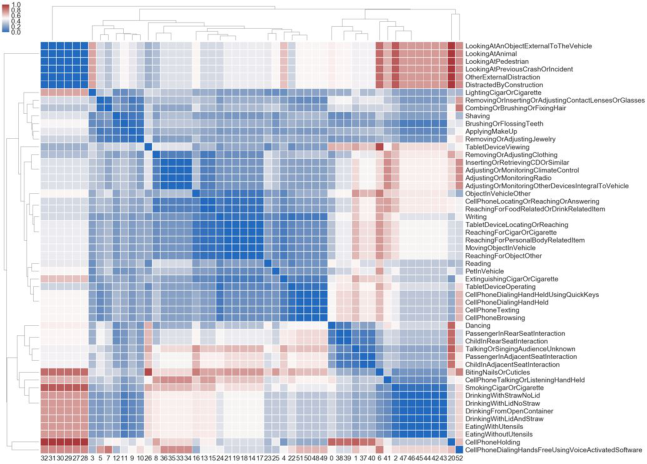
Using Visual Dictionary to Understand Relations Between Different Secondary Behaviors Once the dictionary elements are defined and the secondary task are con- structed, we can use the element value pairs to construct feature vector for each of the secondary tasks. After that we use the feature vector and calcu- late distance between these vectors in the high dimensional feature space to understand the similarities and differences between secondary behaviors. In this case, we have used Euclidean distance and clustering methods to iden- tify secondary tasks that are semantically similar to each other. We have used a total of 52 possible secondary behaviors from SHRP2 naturalistic driving study (Dingus et al, 2015). The secondary behaviors are selected by human annotators. The element-value pairs are annotated by six different annotators who are experts in human factor research and computer vision. As seen from the Figure 1 several secondary behaviors are clustered together. For example, any distraction-based behaviors are clustered together, but they are different from other secondary behaviors like eating, drinking or cell phone holding. Similarly, any task related to the instrument panel in the car is clustered toge- ther but they have differences from actions related to passenger interactions. This clearly shows how visual dictionary can be used to uniquely identify a human action, cluster similar actions together, and differentiate between actions which are semantically different.
168 Sarkar
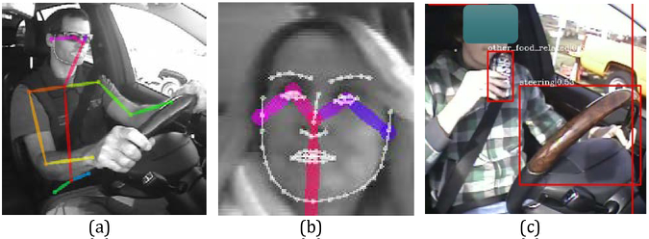
Figure 1: The relation between each of the secondary behaviors using visual dictionary. Blue represents those two actions have similar attributes (small distance), while red represents that the actions are different in nature. (Best viewed in electronic copy).Figure 2: Computer vision can be used to detect and track fiducial points. We repent results from Openpose using VTTIMLP01 dataset to show how each of the fiducial points from body (a) and face (b) can be identified. (c) shows how object detectors can be used to identify the location of all the objects inside the vehicle including steering and food items.
AUTOMATIC DETECTION OF VISUAL DICTIONARY USING COMPUTER VISION In recent years, computer vision (CV) and machine learning has made enor- mous advancements. Due to the development of deep convolutional neural network (Lecun, Bengio, and Hinton, 2015), we can process any image or video to accurately extract semantic elements. In this section we demonstrate how these advancements in computer vision can be used to automatically extract visual dictionary elements from images and videos. we specifically demonstrate the power of human body pose detection (Cao et al. 2017), head
Visual Dictionary of Human Action in Vehicular Environment Using Computer Vision 169
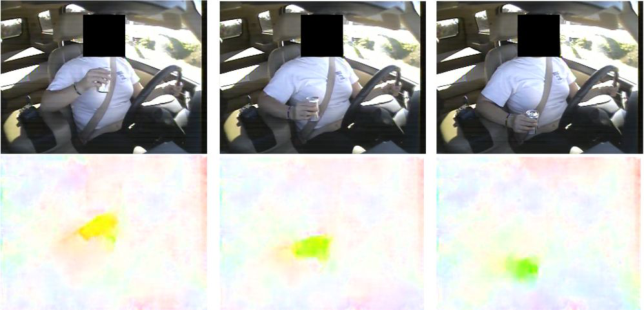
Figure 3: Optical flow-based methods to understand the movement of the fiducial points. In this example. The participant is seen to completing a ‘drinking from can’ task. The hand movement is downwards and away from mouth/face. Optical flow captures that movement.Table 2. Automatic visual dictionary processing using computer vision.
Table available in the original PDF paper.
Head pose Face key Temporal Body key Object detection points movement points detection Head movement Y Y Hand movement Y Y mouth movement Y Y At least one Hand off wheel? Y Y Body Pose off normal? Y Head pose off normal Y Hand to face distance Y Y Presence of object Y
pose detection, optical flow based temporal movement, and object detection (Ren et al, 2015). The body pose detection algorithm helps us to detect the pixel location of each of the joints in the body including the shoulder, elbow, neck, waist, and wrist (Figure 2 (a)). These special locations can be used to understand the relative positions between each body parts, and the posture of body. The key point locations in the face helps us to detect and track move- ment of different deformable parts like eyes, mouth, and jaws (Figure 2 (b)). An object detector helps us to detect all the objects that are present in the scene (Figure 2 (c)), their location and their distance from different fiducial points in the human skeleton. The temporal movement can be identified using optical flow based method which takes difference between two consecutive frames and reports movement of pixels (Baker et al, 2011). Figure 3 shows an example of hand movement of a participant who is completing “drin- king from a can”. the optical flow based method particularly indicates the spatial location of the movement and the speed of the movement. Using all these CV algorithms, the eight elements from secondary behavior visual dicti- onary can be automatically detected and located from the image on video of
170 Sarkar
a particular scene. Table 2 shows a summary of the CV tools for dictionary element processing.
CONCLUSION
In this paper, we introduce a visual dictionary to describe human action. Using these visual dictionaries, we have shown that any human action can be reconstructed and can have a unique signature. We believe that these dictionaries can be extended to other domains of applications and can be generalized. Due to its associative nature of modeling, concurrent behavior modeling is possible when a person is involved in multiple actions at the same time. This method also demonstrates a systematic way to understand task associated measures including cognitive load. Finally, we demonstrate an automated method using computer vision to automatically generate this dictionary elements and study their relations.
ACKNOWLEDGMENT
This work was supported in part by FHWA award no. 693JJ319C000004, “Video Analytics for Automatic Annotation of Driver Behavior and Driving Situations in Naturalistic Driving Data.”. The opinions in this paper are those of the author and do not reflect those of any government agency. The author would like to thank Calvin Winkowski for his help in data processing. The author would also like to thank Lynn Abbott, and Jeff Hickman from VTTI for their valuable suggestions.
REFERENCES
Baker, S., Scharstein, D., Lewis, J.P., Roth, S., Black, M.J. and Szeliski, R., 2011. A database and evaluation methodology for optical flow. International journal of computer vision, 92(1), pp. 1–31. Cao, Z., Simon, T., Wei, S.E. and Sheikh, Y., 2017. Realtime multi-person 2d pose
estimation using part affinity fields. In Proceedings of the IEEE conference on computer vision and pattern recognition (pp. 7291–7299). Dingus, T.A., Hankey, J.M., Antin, J.F., Lee, S.E., Eichelberger, L., Stulce, K.E., McGraw, D., Perez, M. and Stowe, L., 2015. Naturalistic driving study: Technical coordination and quality control (No. SHRP 2 Report S2-S06-RW-1). Engström, J., Johansson, E. and Östlund, J., 2005. Effects of visual and cognitive load
in real and simulated motorway driving. Transportation research part F: traffic psychology and behaviour, 8(2), pp. 97–120. Farmer, C.M., Klauer, S.G., McClafferty, J.A. and Guo, F., 2015. Relationship of near-crash/crash risk to time spent on a cell phone while driving. Traffic injury prevention, 16(8), pp. 792–800. Klauer, S.G., Guo, F., Simons-Morton, B.G., Ouimet, M.C., Lee, S.E. and Din-
gus, T.A., 2014. Distracted driving and risk of road crashes among novice and experienced drivers. New England journal of medicine, 370(1), pp. 54–59. Liang, Y., Reyes, M.L. and Lee, J.D., 2007. Real-time detection of driver cognitive distraction using support vector machines. IEEE transactions on intelligent transportation systems, 8(2), pp. 340–350. LeCun, Y., Bengio, Y. and Hinton, G., 2015. Deep learning. nature, 521(7553),
pp. 436–444.
Visual Dictionary of Human Action in Vehicular Environment Using Computer Vision 171
Ren, S., He, K., Girshick, R. and Sun, J., 2015. Faster r-cnn: Towards real-time object detection with region proposal networks. Advances in neural information processing systems, 28. Sanders, M.S. and McCormick, E.J., 1998. Human factors in engineering and
design. Industrial Robot: An International Journal. Wickens, C.D., Gordon, S.E., Liu, Y. and Lee, J., 2004. An introduction to human factors engineering (Vol. 2). Upper Saddle River, NJ: Pearson Prentice Hall. Yang, M., Zhang, L., Feng, X. and Zhang, D., 2014. Sparse representation based
fisher discrimination dictionary learning for image classification. International Journal of Computer Vision, 109(3), pp. 209–232.
LISTED IN THE AHFE DIGITAL BOOKSTORE CATALOGUE
Explore the complete digital volume
Human Factors in Transportation
Read this individual research paper free through the original publisher, or explore the full digital proceedings book.
ISBN 978-1-958651-36-0
Explore this ISBN in the AHFE Bookstore ↗Listed in the July 2026 bookstore catalogue; search by ISBN to confirm current availability · Digital book purchase optional