Ana P G Martins, Joonas Lieb, Max Friedrich (2022). The Ground Station Operator in Single Pilot Operations – Active or Passive role?. In: Human Factors in Transportation. AHFE Open Access, vol. 60, pp. 615–621. https://doi.org/10.54941/ahfe1002497
The introduction of single pilot operations (SPO) in commercial aviation for large passenger aircraft will require new operational procedures and the implementation of technical innovations on the ground and in the cockpit. Most concepts under investigation assume ground support at all times to monitor and support the onboard single pilot (SP). The question remains on the level of involvement of the ground station operator (GSO) in nominal situations in two phases of highest workload, departure and arrival. Current operational procedures of two-piloted aircraft assume a distribution of tasks and responsibilities between the pilot flying (PF) and the pilot monitoring (PM). In SPO the pilot will remain the pilot flying (arguably with more support from automation), but automation, the GSO or even the SP, will need to take over the tasks traditionally delegated to the PM. The extent of the support provided by the GSO depends on the chosen operational concept and the expected level of engagement. We present an analysis of the allocation of tasks for an active as opposed to a more passive role of the human operator on the ground during the departure and arrival phases, complementing the analyses conducted in previous research.
For almost two decades research has been underway to explore the feasi- bility of implementing single pilot operations (SPO) in commercial airlines (Comerford et al. 2013; Harris 2007). It is expected that in the longer term, these operations would lead to economic benefits, more efficient crew sche- duling and better aircraft availability (Malik and Gollnick 2016). Two major areas of research within SPO include its technical feasibility and concept of operations (Schmid and Korn 2018). Stanton et al. (2016) argue that exi- sting technology already allows SPO; consider, for example, the maturity and increasing levels of safety reached by general aviation, military aviation and Unmanned Air Vehicles. In addition, all commercial aircraft can already be flown by only one pilot (e.g., in case of pilot incapacitation; EASA 2015).
Nevertheless, commercial airline operations are currently required to have two pilots in the cockpit: the pilot flying (PF) and the pilot monitoring (PM). Once one pilot is removed from the cockpit, some of the advantages of having a second pair of eyes disappear. In particular, some redundancy is
lost, including error checking functions (for example, data entry into the Flight Management System), and other aspects such as workload manage- ment (through task delegation), support in building Situation Awareness and boredom prevention (Vu et al. 2018).
Most concepts of operations under consideration for SPO assume that a ground station would need to be established to assist the single pilot (SP) during periods of high workload and in case of non-nominal and emergency situations (Bilimoria et al. 2014; Lachter et al. 2017; Stanton et al. 2016). The ground station operator (GSO) would also be expected to intervene and take over control of the aircraft in case of pilot incapacitation. Several different configurations of task allocation to GSO have been considered, but they can be separated in two main modes of support (Lachter et al. 2017): the GSO is either assigned to one single aircraft (dedicated support view) or to several (multiple-aircraft support view). In one study addressing operating procedu- res, Schmid and Korn (2017) proposed to have a ground station supporting several SP by request during cruise (when workload is normally relatively low) and dedicated departure and arrival remote co-pilots with expert kno- wledge about the airport, including current weather conditions. However, the extent of the involvement of the dedicated GSO during take-off and landing is still unclear. According to ICAO (2013) these are critical phases, with the highest workload, and hence those in which the absence of a PM is felt the most. In this paper we investigate two constellations: One where the GSO’s tasks are similar to those of a co-pilot or PM, and one where the GSO would be less involved.
Within the European project SAFELAND, a future concept for SPO in the event of pilot incapacitation is being developed (see Martins et al. 2021 for more information). Even though the coverage of SPO in normal conditi- ons is out of scope for SAFELAND, in order to derive a concept for dealing with pilot incapacitation it was necessary to discuss the operational concept for nominal conditions and, in particular, the role of the GSO. This paper describes two possible constellations of GSO involvement discussed and the conclusions reached1.
TASKS OF THE GROUND STATION OPERATOR In a 2007 report prepared for NASA, Norman (2007) analyzed the impact of reduced crew operations on the responsibilities and duties traditionally assigned to the PM. For this paper, an initial selection of these functions was done, assuming that these would be transferred to the SP, to the GSO or to automation. Since the main focus of our analysis is on highlighting the differences between the two constellations (i.e., an active versus a passive GSO providing dedicated support), some of the traditional duties of the PM were not included. In particular, we consider that in both cases the GSO would always have the possibility to assume the role of pilot flying as required
1The views expressed in this paper are those of the authors and do not necessarily reflect those of the other project partners.
The Ground Station Operator in Single Pilot Operations – Active or Passive Role? 617
Table 1. Tasks delegated to automation.
Table available in the original PDF paper.
Task Reasoning Radio Frequency changes Automated change in frequencies, speech recognition. Checklists Checklists presented to the SP in a display and if some item is not executed, automation provides a warning (already implemented in some aircraft). Verbal callouts for speeds, altitudes, configuration states
Verbal callouts conducted by automation (e.g., takeoff rotation, 50 feet altitude, as well as any deviations). Check altitudes, headings and speeds against current clearances
Automation can check the values and issue a warning if the actual value deviates from the cleared value. Aircraft Configuration (e.g. landing gear and flaps setting)
Automation can execute the setting of flaps, landing gear, landing lights etc. with the single pilot monitoring and intervening, if necessary.
(especially in case of pilot incapacitation) and would be monitoring aircraft systems to detect any abnormal or emergency situations.
The next step was to identify which tasks or functions would be automa- ted or not necessarily require manual inputs from a human operator. This is mainly the case for tasks that can be described by consistent, rule-based beh- avior without the need for further cognitive processing or decision-making, such as changing radio frequencies (e.g. between sectors) or setting the flaps and the landing gear (at least during normal operating procedures). The sele- ction was also done considering current research taking place within SESAR and NextGen (Brooker, 2008). Table 1 presents these tasks, together with a short explanation on how they could be executed in a single-piloted aircraft by onboard automation. It is assumed that the pilot would still be monitoring automation at all times and be asked to confirm some of the actions before they are executed.
The next step was to allocate the remaining PM tasks to the GSO in both constellations under study. Even though the cruise GSO is out of scope for this paper, they are presented in Table 2 below for comparison purposes. Recall that in the concept of operations being assessed, the cruise GSO supports several aircraft concurrently (multi-support), whereas during take-off and landing the GSO is handling exclusively one aircraft. The dedicated GSO would also have an open-channel to communicate with the SP, unlike the cruise GSO. Therefore, general Situation Awareness is expected to be higher and reaction times lower for the dedicated GSO. Table 2 below describes the task distribution between these three roles.
From the initial list of ten tasks, three should remain with the SP. To handle a potential pilot incapacitation during take-off and landing, these would most probably be performed by a highly automated system, thus requiring that fli- ght guidance, autopilot and autothrottle configuration remain with the pilot. Arguably, the tasks of the cabin crew would also need to be adapted, with
Table 2. Tasks of the multi-aircraft support GSO for cruise, passive dedicated GSO and active dedicated GSO.
Table available in the original PDF paper.
Task Cruise GSO
Passive GSO
Active GSO No. Remains with the SP
Configure Flight Guidance, Autopilot and / Autothrottle system modes
No. Remains with the SP
Monitor External Hazards, including visual contact in Instrument Meteorological Conditions (possibly complemented by a system that detects objects of interest, such as a runway)
Yes Yes Yes
Cabin Crew Management No. Remains with the SP Communication with Flight Dispatch, AOC Yes Yes Yes Monitor Weather Conditions Yes Yes Yes System Monitoring including pressures, temperatures, voltage, as well as fuel balance, engine power, etc.
No Yes Yes
Monitor pilot mental state, overall judgment of actions (complemented by a pilot monitoring system)
No No Yes
Communication with ATC No No Yes Record flight information received via radio or the datalink system, for future recall (e.g., transmissions involving weather, NOTAMs, clearances, fix reporting requirements, etc.)
No No Yes
Configure a/c navigation systems including planning and executing routes, route and runway changes, etc.
at least one crew member having more responsibilities regarding passenger management and coordination with the SP, or even the possibility to directly contact the GSO, bypassing the SP in some specific situations (e.g. hijacking). Finally, a GSO can never directly replace the SP in the detection of external hazards due to their remote location and reduced access to sensory cues, even with the help of sensors and cameras.
In contrast, four of the tasks could be transferred to the ground without affecting overall safety levels or the ability of the pilot to perform the higher- level functions of aviate and navigate. In fact, one of these tasks correspond to the management of aircraft systems and engine, which has the lowest pri- ority of the four levels (the remaining being communicate). In addition, even though the pilot will most likely have an onboard weather radar and access to ground-based weather services like today, the dedicated GSO will have already supported other SP in the previous hour or so and can report on any difficulties experienced due to the weather conditions. In the same way, the GSO can aid the SP by handling all communications with Flight Dispatch and the Airline Operation Center (AOC). Lastly, the task of monitoring the SP will also certainly need to remain with the GSO, most probably complemented by an onboard pilot health monitoring system.
The Ground Station Operator in Single Pilot Operations – Active or Passive Role? 619
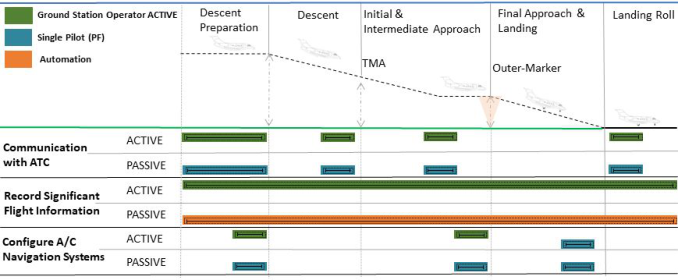
Figure 1: Task allocation diagram for the three selected tasks in both constellations (active and passive).
Three final tasks were identified that could eventually be displaced to the ground (active GSO), but which arguably should remain with the SP (pas- sive GSO). The advantages/disadvantages of each and the implications are discussed in the next section.
TASK ALLOCATION DIAGRAM In order to visualize the differences in task allocations for the two GSO constellations, a task allocation diagram was developed. This diagram is based on the Social Organization and Cooperation Analysis Contextual Acti- vity Template (SOCA-CAT), a method for visualizing function allocations in socio-technical systems (see e.g., Friedrich et al. 2017). In a SOCA-CAT, the functions are mapped against the different situations that a work system experiences. For each function and situation, it is marked, if (1) the function is active in the respective situation and (2) who is involved in its execution. Figure 1 shows the developed task allocation diagram for the descent, appro- ach and landing flight phases and for each of the three tasks, including the active GSO, SP and Automation. The passive GSO is not included, because they are not involved in these tasks, which are performed by either the SP or automation.
In current operations, communication with Air Traffic Control (ATC) is an important source of workload for the pilots, especially during take-off and landing when they are busy with other important tasks. Thus, one possibility would be to transfer this task to the (active) GSO, while the SP listens in to the exchange, potentially reducing pilot workload and improving levels of situation awareness of the GSO in case of an emergency. However, given the physical distance between them, it would be difficult for the GSO to initi- ate any communication/request without specific instructions from the SP. At the end of each exchange, the GSO would also need to confirm with the SP whether the clearances were understood and are accepted. In current opera- tions this acknowledgement would take place through simple body language. On the other hand, if communication with ATC remains in the cockpit, the implementation of new technology regarding datalink systems (e.g. LDACS,
L-band Digital Aeronautical Communications System, ICAO, 2019) would allow new clearances to be uploaded directly to the aircraft and ultimately to be transmitted to the appropriate navigation systems onboard, pending approval by the SP. For this reason, in the diagram above, the task “Record Significant Flight Information” is allocated to automation when communica- tion with ATC is under the responsibility of the SP, and not of the GSO. The active GSO could also be supported by such a system, but it is not required.
Finally, all “Configure Aircraft Navigation System” tasks could also be transferred to the ground to be performed by an active GSO, instead of the SP. In particular, planning and inserting the new route into the flight gui- dance computer can be done during climb so that the SP can concentrate of flying the aircraft. In the same way, if there is a runway change during the first phase of descent, the GSO can also update the FMS. However, as the aircraft approaches the airport, any such change would need to remain with the pilot due to the limited reaction time left during final approach and landing.
CONCLUSION
Starting from a list of tasks traditionally allocated to the PM in current ope- rations, this paper presents an analysis of the allocation of these tasks to an active, as opposed to a more passive GSO during the departure and arrival phases. There are potentially other ways of allocating the tasks, which can also vary by aircraft and operator, but we focused on two of them. We con- sidered that since there is already a dedicated GSO available, this support should be used to the greatest extent possible. In general, the aviate com- ponent should remain in the cockpit in nominal operations. In the concept of operations under study, we also consider that monitoring tasks associated with management of the aircraft systems could be transferred to the GSO. It is on the higher-level navigate and communicate functions that there is more room for argument in how to make this distribution. Regarding the two con- stellations described here, the question remains whether a more active GSO during take-off and landing reduces pilot workload levels at the expense of the pilot’s situation awareness and general safety levels (if communication with ATC and update of aircraft navigation system are done by the GSO). It is also not clear whether in case of pilot incapacitation the active GSO is able to react and take over the aircraft faster compared to the passive GSO (recall that take-off and landing would be fully automated to prepare for a sudden pilot incapacitation event). Therefore, we think that a more passive role for the GSO during take-off and landing would be more feasible.
ACKNOWLEDGMENT
The work presented here was partly performed in SAFELAND, a project that has received funding from the European Union’s Horizon 2020 SESAR Research and Innovation action under Grant agreement No 890599.
The Ground Station Operator in Single Pilot Operations – Active or Passive Role? 621
REFERENCES
Bilimoria, K. D., Johnson, W. W. and Schutte, P. C. (2014). Conceptual framework for single pilot operations. Proceedings of the International Conference on Human- Computer Interaction in Aerospace, pp. 1–8. Brooker, P. (2008). SESAR and NextGen: Investing In New Paradigms. Journal of
Navigation, 61(2), 195–208. https://doi.org/10.1017/s0373463307004596 Comerford, D., Brandt, S. L., Lachter, J., Wu, S.-C., Mogford, R., Battiste, V. and Johnson, W. W. (2013). NASA’s Single-Pilot Operations Technical Interchange. Meeting: Proceedings and Findings. Moffett Field, CA, USA. EASA, 2015. Certification Specifications and Acceptable Means of Compliance for
Large Aeroplanes: CS-25 Amendment 17. EASA, Cologne, Germany. Friedrich M., Papenfuß A., Hasselberg A. Transition from Conventionally to Remotely Piloted Aircraft – Investigation of Possible Impacts on Function Allocation and Information Accessibility Using Cognitive Work Analysis Methods. Proc. of the 8th Int. Conf. on AHFE, CA, USA, 17–21 July 2017. Harris, D. (2007). A human-centred design agenda for the development of single crew
operated commercial aircraft. Aircraft Engineering and Aerospace Technology, 79(5), pp. 518–526. International Civil Aviation Organization (2013). Phases of flight: Definitions and usage of notes. International Civil Aviation Organization (2019). LDACS White Paper – A Roll-out
Scenario. DCIWG/3-IP01. Lachter, J., Brandt, S. L., Battiste, V., Matessa, M. and Johnson, W. W. (2017). Enhanced ground support: lessons from work on reduced crew operations. Cognition, Technology & Work, 19(2), pp. 279–288. Malik, A. and Gollnick, V. (2016). Impact of Reduced Crew Operations on Airlines
– Operational Challenges and Cost Benefits. In 16th AIAA Aviation Technology, Integration, and Operations Conference.VA, USA: AIAA. Martins, A. P. G., Lieb, T. J., Friedrich, M., Bonelli, S., Celori, M., Vizioli, A. B., et al. (2021). Toward single pilot operations: A conceptual framework to manage in-flight incapacitation. SESAR Innovation Days, 7–9 December, 2021. Norman, R.M. (2007), Economic opportunities and technological challenges for
reduced crew operations. [Technical paper] NASA Langley Research Center. NNL06AA63T. Schmid, D. and Korn, B. (2018). The Operational Issue of an Airliner’s Reduced- Crew Caused by Data-link Break-up to Remote Support. Proceedings of the Human Factors and Ergonomics Society Annual Meeting, 62, pp. 71–75. Schmid, D., Korn, B., Wies, M., & Stanton, N. A. (2019). Managing a data-link
failure of a single-piloted airliner during flight: A system-theoretic process analy- sis. Proceedings of the Human Factors and Ergonomics Society Annual Meeting, pp. 106–110. SJU (2018). PJ19-W2-D4.0.0070 Human Performance Assessment Process V1 to V3 including VLD v00.03.01 Stanton, N. A., Harris, D. and Starr, A. (2016). The future flight deck: Model-
ling dual, single and distributed crewing options. Applied Ergonomics, 53, pp. 331–342. Vu, K.-P. L., Lachter, J., Battiste, V. and Strybel, T. Z. (2018). Single pilot operations in domestic commercial aviation. Human factors, 60, pp. 755–762.
LISTED IN THE AHFE DIGITAL BOOKSTORE CATALOGUE
Explore the complete digital volume
Human Factors in Transportation
Read this individual research paper free through the original publisher, or explore the full digital proceedings book.
ISBN 978-1-958651-36-0
Explore this ISBN in the AHFE Bookstore ↗Listed in the July 2026 bookstore catalogue; search by ISBN to confirm current availability · Digital book purchase optional