Sylwia Stefaniak (2022). The analysis of the lobbying actors regarding the adoption and implementation of the AI Policy in Poland. In: Human Interaction & Emerging Technologies (IHIET 2022): Artificial Intelligence & Future Applications. AHFE Open Access, vol. 68, pp. 213–220. https://doi.org/10.54941/ahfe1002734
The purpose of this article is to describe the participation of non-state actors who were involved in the process of creating and implementing the "Policy for the development of artificial intelligence in Poland from 2020" (further: AI Policy). The aim of the lobbying campaign of individual non-public entities related to the implementation of artificial intelligence (further AI) was to enable the most effective possibility of creating solutions based on this technology in the private and public sectors. The entire activity of non-state actors in the creation of these policies was based on overt expert lobbying, which was carried out within the framework of the Working Group on Artificial Intelligence (further: WGAI) established at the Ministry of Digitalization in Poland. This group was active in 2018 and then reactivated in 2021. It is worth separating these two periods, because in the first instance this group worked on the foundations of later policy documents together with representatives of ministries, and since 2021 it has already been working on the implementation of the AI Policy document adopted in 2020 in terms of design. The hiatus period between this group's work has changed the way it functions, the scope of its work, and the members involved. Therefore - although the group operates in the same place in the same form - practically it is a completely different entity with different adopted goals.
WGAI is an open group, which includes market experts who have experience in artificial intelligence in various scopes: technological, legal, organizatio- nal, sectoral. It also includes representatives of ministries and institutions that are or should be interested in the subject of artificial intelligence, and/or have jurisdiction over issues related to regulations that affect the develo- pment of artificial intelligence technology applications in Poland. The task of individual subgroups is to develop recommendations that will support the creation of appropriate conditions for the development of artificial intelli- gence, both in enterprises and the public sector. These recommendations are quite often reports that present the current state of the Polish economy in this field; assumptions of projects or legislative changes that according to them should be taken into account by public administration, as well as general
knowledge sharing and development of activities educating various groups of society in the field of new technologies. Assumptions, goals, actions and plans developed in particular subgroups do not constitute plans of the Mini- stry of Digitization – they may be taken into consideration in the future, but are independent opinions.
WGAI has been established in 2018 to assist the Ministry of Digitization in producing the first draft of the strategy for the AI development. The docu- ment they produced in November 2018 in the form of “Assumptions for the strategy of AI in Poland and the Ministry of Digitalization Action Plan on AI for 2018-2019” (Ministry of Digitalization, 2018) showed what the most important substantive scope was from the point of view of the influ- ence groups. Their work took place in four thematic subgroups, which is reflected in the final form of the developed report. After the announcement of the “Assumptions (...)”, the WGAI activity faded out, and the burden of producing policy related to the development of artificial intelligence was shif- ted first to the four ministries, and then to the Ministry of Digitization (since November 2019, The Chancellery of The Prime Minister – further KPRM), which is entirely responsible for the final document adopted by the Council of Ministers. Nevertheless, due to its wide substantive scope and the need for further consultations with market experts KPRM in 2021 decided to reacti- vate WGAI in order to plan further activities related to the implementation of the already adopted document. The following article will characterize how WGAI operate in those two episodes.
THE PROCESS OF ADOPTING AND CREATING AI POLICY IN POLAND AI Policy in Poland was adopted by the Council of Ministers on 28 Decem- ber 2020. However, the whole work on this regulation can be divided into three stages. First, on November 9, 2018, mentioned before “Assumptions to the AI Strategy in Poland” has been published. It was divided into four parts: Data-driven economy, Financing and development, Education, Ethics and law. This document was developed by the WGAI and became an inspi- ration for further actions, however, its overall scope did not translate into the shape of the final AI Policy document. The second step towards the ado- ption of an official version of the document was the announcement of public consultations of the draft “Policy for the Development of Artificial Intelli- gence in Poland for 2019-2027” (Ministry of Digitalization, 2019), which was developed on the basis of a memorandum concluded on 26 February 2019 by the Minister of Digitization, the Minister of Entrepreneurship and Technology, the Minister of Science and Higher Education, and the Mini- ster of Investment and Development. The key objective of this policy was to develop financial and strategic mechanisms to make Poland a place where it would be possible to develop solutions based on AI. Of all three documents mentioned here, this one is the most complete and elaborate. In addition to setting out a clear mission and goals for this public policy, it includes a dia- gnosis of the Polish ICT sector, along with an assessment of how the financial models for Polish innovation have worked so far, and the opportunities that
The Analysis of the Lobbying Actors Regarding the Adoption and Implementation 215
these investments can realize if implemented properly. It also identifies the AI ecosystem and strategic factors for building AI potential in Poland, such as the organization and management of policy, knowledge, data and infra- structure. In addition to the obligatory elements for public policy, the Policy includes very elaborate annexes that define exactly what AI is, its ethical and legal dimensions, and what the support mechanism for research, develo- pment and innovation for AI systems should look like. However, this policy was not accepted by the ministries and on December 28, 2020, the Council of Ministers adopted the “Policy for the development of artificial intellige- nce in Poland from 2020” (KPRM, 2020). Compared to the previous one, it was heavily truncated, no hard mechanisms to ensure the implementation of the policy were introduced, and the participation of ministries included in the editorial and analytical composition of the previous version was omitted. The adopted AI Policy describes actions that Poland should implement and goals it should achieve in the short term (until 2023), medium term (until 2027) and long term (after 2027). All goals and tools are divided into six areas: AI and society, AI and innovation, AI and science, AI and education, AI and international cooperation, and AI and the public sector. It is worth noting that at the beginning of each chapter of the AI Policy, which describes the next objective, the ministries and public institutions that are responsible for its implementation are listed. Unfortunately, it is not stated which institution is responsible for which points, and therefore – the execution of the objecti- ves is very fuzzy. The situation is similar in the case of financial resources. The document contains a summary table of available funding mechanisms for projects based on new technologies, but these mechanisms are not dire- ctly allocated to the implementation of the AI Policy document. Thus – the implementation of the assumptions has no budgetary resource. The shortco- mings in this regard make the activities of the WGAI even more important during the practical implementation of the AI Policy and, nevertheless, con- stitute the overall framework of the KPRM’s digitization department and the framework of the AI Working Group.
SUBSTANTIVE SCOPE OF NON-STATE ACTORS IN AI POLICY MAKING AND IMPLEMENTATION The first stage of WGAI’s existence was in 2018, when WGAI developed the previously described document “Assumptions (…)”. Market experts indica- ted what content coverage was most important from the perspective of the impact groups. Their work took place in four thematic sub-groups, which is reflected in the final shape of the developed report. Among other things, the subgroups developed assumptions for stimulating the development of a data-driven economy through active participation of the state as a commis- sioner of projects using solutions based on digital data, ways and financial mechanisms that could support the development of solutions based on arti- ficial intelligence, as well as goals of the public administration, which should appoint the right people to develop the appropriate ecosystem of cooperation between the private, public, regulatory and scientific sectors with a detailed
216 Sylwia
breakdown of how to do it. WGAI also identified preliminary ideas of pro- jects that should be implemented in the indicated sectors, discussed the need to train human resources in this area, and indicates how and what funds (mainly European) can be used in the implementation of artificial intellige- nce, what are the acceleration programs and what research work should be done first. WGAI mapped the obvious topic of education, where they pointed out many areas, both from initial education, secondary schools, universities, as well as supporting the continuous improvement of one’s competences after the official educational path. Ethical and legal aspects were also highlighted, consisting of ensuring effective protection of fundamental rights, or setting ethical standards for AI and supporting the establishment of high-quality laws governing areas related to the use of AI.
The assumptions developed in 2018, although not fully reflected in the adopted AI Policy document, are still referred to by many ministries and experts active in the reactivated group in 2021. Nevertheless, the continued activity of the WGAI is already talking about the practical implementation of the document and indicating directions for change so that AI-based solu- tions can be implemented. This can be seen, for example, by the fact that the WGAI no longer operates in 4 subgroups, but in 14. These include the subgroups develop topics such as Research, Innovation and Deployment, the Digital Skills, the Policy Framework, the Ethics and Legal, the Global Outreach, the Global Policy, and the Global Policy. Global Outreach, Data, Security, Robotics, Transportation and Mobility, Health, Environment, Agri- culture, Financial Sector and Energy. After the first year of activity, most of the subgroups have already defined their scope of action: it is aligned with the directions indicated in the AI Policy and, due to its structure, is most often divided into three time frames: short, medium and long term. Among the works that deserve special recognition are the reports on the state of the Polish market and those that indicate the challenges faced by entrepreneurs. The WGAI has developed an Artificial Intelligence Portal (www.gov.pl/ai) that is a collection of knowledge and good practices on AI implementation, including training and investment funding; the group is also working on edu- cational mechanisms for different levels of education, is in the process of developing a White Paper on the use of AI in clinical research, the use of AI in banking, transportation, energy, or the general use and value of data ready for use in algorithms. WGAI’s support is staggering and extends to more and more ministries that benefit from their practical knowledge.
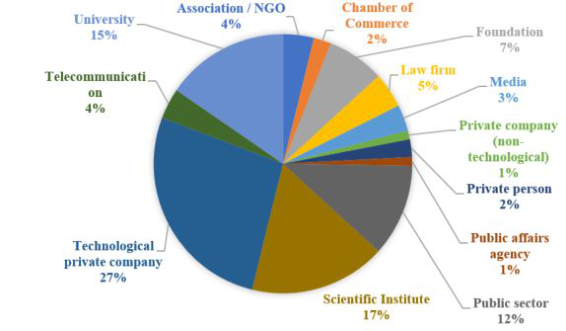
Market Representation in the WGAI According to the data provided by KRPM in 2018 182 people were acti- vely and openly involved in the group – they were representatives of both the public and private sectors. The distribution of the interest groups invo- lved is shown in Figure 1 and Table 1. They show that technology companies had the greatest influence on the above-mentioned substantive scope (27%), followed by representatives of the public sector (mainly ministries) – 12%, scientific institutes (which also represent the public sector) – 17% and univer- sities – 15%. At the time, the only sector with a strong presence in the work
The Analysis of the Lobbying Actors Regarding the Adoption and Implementation 217
Figure 1: Breakdown of unit types participating in WGAI in 2018. Compiled by the author.Table 1. Number of unit types participating in WGAI in 2018. Compiled by the author.
Table available in the original PDF paper.
Type of Unit Number of Participants
Type of Unit Number of Participants
4 Public sector 21
Association / NGO 7 Public affairs agency 2 Chamber of Commerce
2 University 28
Foundation 13 Scientific Institute 31 Law firm 8 Technological private company 49 Media 6 Telecommunication 7 Private company (non-technological) Private person 4
was telecommunications (4%). Interestingly – there was also negligible par- ticipation from chambers of commerce (2%) and public affairs type agencies (1%). The data below shows that in 2018 the topic of AI development mainly concerned researchers (research institutes and universities), as well as tech- nology companies. Thus, these were the types of stakeholders who interacted with this topic on an ongoing basis, and this interest was due to their daily challenges at work. We have virtually no participation of non-technology companies or representatives of industry sectors (agriculture, medicine, etc.).
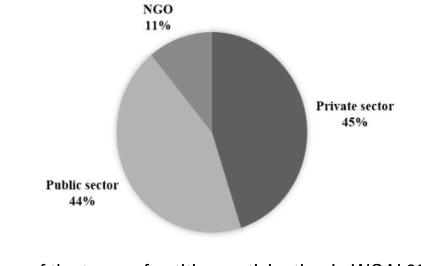
If we look at the types of stakeholders in terms of representation of public and private sector interests, their share is proportional. In the chart below (Figure 2), I have made a distribution in which universities, research units, and departmental representatives are included in the public sector, any private companies, law firms, individuals, chambers of commerce are in turn in the private sector, and the NGO category includes associations and foundations. After comparing the numerical share of each category, this distribution seems to be optimal for maintaining balance in reaching consensus and representing the needs of all parties in the final assumptions.
218 Sylwia
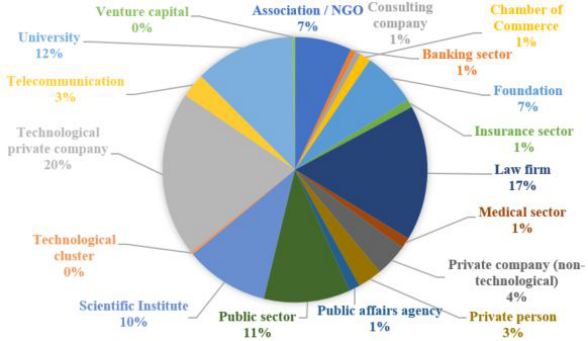
Figure 2: Breakdown of the types of entities participating in WGAI 2018 by private and public sector. Compiled by the author.Figure 3: Breakdown of unit types participating in WGAI in 2021. Compiled by the author.
In 2021, there were more than 300 people at WGAI – almost twice as many as three years earlier. Nevertheless, it is interesting to note the change in the proportion of stakeholders who participate in the WGAI (Figure 3). In the earlier formula, the largest group was technology companies – this is also the case here (20%), nevertheless, the second group is representatives of law firms (16%). The increase from 8 people to 50 is significant and may indicate two things: first, the topic related to new technologies is no longer seen as a technological challenge, but is instead a challenge related to the adaptation of the market to the new reality in terms of legislation. Second, the lawyers participating in the group’s work are mainly those representing the interests of large technology companies (including Microsoft and Goo- gle), whose task is to direct the activities of the central administration in such a way as to allow them greater influence on the Polish market. These law firms also quite often cooperate with industry representatives, whose parti- cipation has also strengthened. We deal with challenges (mostly legal) in the medical, banking, insurance or telecommunications sectors. Representatives of non-technological companies (4%) mainly represent these sectors and the agricultural sector, which is not visible on the chart. This sector is most often
The Analysis of the Lobbying Actors Regarding the Adoption and Implementation 219
Table 2. Number of unit types participating in WGAI in 2021. Compiled by the author.
Table available in the original PDF paper.
Type of Unit Number of Participants
Type of Unit Number of Participants
61
Association / NGO 21 Private person 9 Banking sector 2 Public affairs agency 4 Consulting company 2 Public sector 32 Chamber of Commerce 4 Scientific Institute 31 Foundation 20 Technological cluster 1 Insurance sector 3 Technological private company
12 Venture capital 1
Law firm 50 Telecommunication 9 Medical sector 4 University 37 Private company (non-technological)
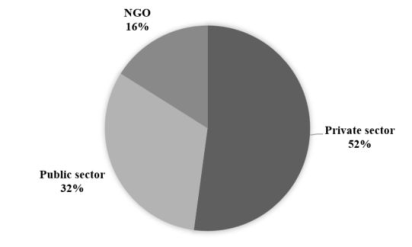
Figure 4: Breakdown of the types of entities participating in WGAI 2021 by private and public sector. Compiled by the author.
not represented by farmers, but by companies providing services to farmers. Invariably, the public sector with research institutes and universities has a large share in the representation of interest groups.
Also interesting is the change in the proportion between private and public sector participation (Figure 4). Just as the proportions were virtually equal in 2018, WGAI is now largely represented by the private sector. Of course, numerically the number of people from the public sector has increa- sed compared to 2018, nevertheless, this does not equalize the change in the proportions. This is not a signal of the public sector’s lack of interest in the topic of artificial intelligence. It just means that the private market has grown significantly, while the public sector is rather unchanged in terms of size and number of people employed.
CONCLUSION
All the above-described activities can emphasize the very substantial con- tribution of experts, their pointing to specific data justifying the chosen directions, or making a kind of prediction in which direction the Polish eco- nomy should go. Therefore, this lobbying is very necessary in supporting the central administration in developing the foundations for further action. The
220 Sylwia
AI policy that was adopted in December 2020 is a very important impetus to lead to further activities and developments in this area, among others in the private sector. It is certainly noteworthy that the topic of AI has appeared on the government’s agenda, has been mapped out, and the release of the document has enabled further conversations in this area at the European and global level. Nevertheless, it is saddening that the document is not treated as a priority by the public administration, and the activities are truncated to one department of the NPRM. Therefore, I believe that the expert support of the WGAI is a very good bottom-up impulse that provides a broad action in this field that combines the needs of the administration, the private sector and scientific entities. Without such initiatives, the AI Policy at present would be a dead document without successful implementation.
REFERENCES
“Assumptions to the AI strategy in Poland. Action Plan of the Ministry of Digitalization, Ministry of Digitalization” (2018), Ministry of Digitalization, Warsaw, Poland. “Policy for the Development of Artificial Intelligence from 2020”(2020) Chancellery
of the Prime Minister, Warsaw, Poland. “Policy for the Development of Artificial Intelligence in Poland for 2019-2027” (2019), Ministry of Digitalization, Warsaw, Poland.
Read this individual research paper free through the original publisher, or explore the full digital proceedings book.
ISBN 978-1-958651-44-5
Explore this ISBN in the AHFE Bookstore ↗Listed in the July 2026 bookstore catalogue; search by ISBN to confirm current availability · Digital book purchase optional