Miguel Cobos, Patricia Salvador (2022). From literary narrative to video game narrative. In: Human Interaction & Emerging Technologies (IHIET 2022): Artificial Intelligence & Future Applications. AHFE Open Access, vol. 68, pp. 445–452. https://doi.org/10.54941/ahfe1002763
Videogames have become a technological application that goes beyond entertainment; their participation in sociocultural processes is much more interesting and profitable than we might think. They have evolved from their original mission of entertainment to other fields such as social, cultural, medical, and other categories that fall into serious games.In the beginning they were developed by programmers and companies that began to emerge to meet the demand of new players. Now we know that consumers of this type of media have many requirements that have made their production involves a multidisciplinary team, among these requirements we can highlight the need to live the story at every moment.Videogames are present in our society, playing them is only one of the shores of this great sea, on the other side, there is an emerging-producing world that directs its work to various areas of human development. In the career of Graphic Design at Indoamerica University, students generate videogames based on the contents they receive, however, there has not been a deep emphasis on the narrative during the design process of these. For this reason, it is intended to identify a model that allows relating literary, graphic and videogame narratives, to involve narrative design within the creative process. Based on classroom experiences of the last five years, the academic work and the result of the products delivered by the students, an analysis was made that determined that the story is present but is not immersed in each of the elements that can be seen from the gameplay. Based on this, bibliographic research was made about literary narrative and its relationship with the narrative design for the video game, considering the significant contributions of Clara Fernández, Adrián Suárez, Jesse Schell, Alckmar dos Santos, Scott Rogers, Oliver Pérez, among others. This work presents a model of the relationship between literary, graphic, and video game narratives aimed at building the narrative design in new video games, on the other hand, to analyze these narratives in a current video game and tune it.We intend to automate this model in a video game prototype, in which the students participate, and then make use of it in the narrative design of new projects.
New Narrative Discourses Throughout the history of mankind, human beings have been creators and builders of life and its stories. They have learned to write and with it they have kept facts and events that involved their daily life. From the caves of Altamira, as substrates of cave paintings, we have gone through papyrus, parchment, cloth, paper, to digital devices, capable of storing large amounts of information, stories, events, images, and sounds, etc. These substrates have made the stories preserve the social, cultural, scientific, and economic kno- wledge of the people. Nowadays stories are not only told through a formal literary structure, there are stories that have other types of media and other ways of being narrated, an example of this are the videogames. These new creative products are a living representation of the reality we live in, a mixture of fable, narrative, technology, culture, entertainment, fun, among others, as stated by (Fernández-Vara, 2019).
Videogames are part of the new digital narratives, they are narrative discourses like literature and cinema, which show the reality of the medium that produced it, Lotman calls this reality the semiosphere. (Lotman and Navarro, 1996). Considering this, (Pérez Latorre et al., 2010) believes it is important to approach a study of the videogame and its design from a narrative perspective, as any other narrative text that produces semiosis.
Narratology Narratology is a discipline worked by several researchers of narrative discourse. in his dictionary of narratology, defines it as the discipline that studies the nature, form and functioning of narrative through its structu- ral elements and their relation to the narrative. These important elements are identified as: narration, narrator, characters, space, time and events, which support the story told through a narrator in space and time (Bal and Boheemen, 2009).
Several studies on videogames have been carried out entirely or partially from this discipline. The videogame, regardless of being built from a story, at the moment of playing it, inevitably creates in the player an innate narrator of the individual experience, of the interaction with the game.
Oliver Pérez, videogame researcher, states that narratology is fundamental and essential in these new narratives, it is applicable to all types of vide- ogames, where the level of narrativity and the narrative component of the game experience allow the construction of the plot in the mind of the player (“Interview Óliver Pérez: Ludología, videojuegos y gamificación.,” 2014).
Videogames as Narratives The videogame is a narrative structure, which is built within a semiosph- ere and manifests itself as a communicative product. It emerges from the combination and interaction of several types of traditional and technological discourses. As a narrative structure, its backbone is the story and the way it is told.
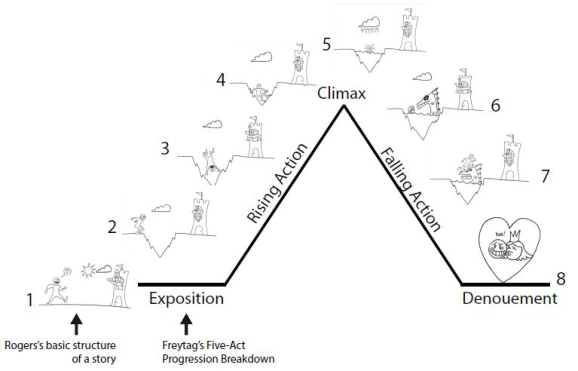
Gustav Freytag, a German dramaturge, studied the dramatic structure of literary works and identified a model capable of defining how plot is stru- ctured in narrative. This model is known as Freytag’s Pyramid. Based on the points of this pyramid structure, Kremers, in his book Level Design, propo- ses the Five-Act Progression’s in Level Design, which is a reaffirmation of the pyramid model in the actions of the character in each level of the game (Kremers, 2009).
Another important work where it is stated that a videogame always has a narrative, whether or not it starts from it, is the one proposed in the book Level Up. Where through a theoretical-graphical description of 8 steps, the basic structure of the story is visualized. In which the character makes the narrative journey in the videogame (Rogers, 2014). This description (see Figure 1) coincides with Kremers and Freytag.
From Literary Narrative to Video Game Narrative 447
Figure 1: Freytag’s & Rogers’s narrative model comparative.
Narrative Analysis in Videogames Indoamerica University students have been developing videogames as part of their training, have conducted research on the subject and published applications in mobile application stores.
This work is oriented to design a narrative analysis model, based on the experiences obtained in classes, the review of the state of the art in terms of narrative and videogames, to later apply it to the products generated by the students.
METHODOLOGY
This section describes the methods used in this paper. Starting from the review of relevant literature regarding the design and analysis of videogames, as well as the narrative from its origin to its application in these media. In this context it is important to ask ourselves the question, what is the relationship between literary narrative and video game narrative? To answer this question, it was necessary to understand the different positions on literary narration and its real incidence in the video game. In this sense, it was essential to start with a documentary approach, from the bibliographical research of topics related to relevant studies, to literary narratology and videogame narratology. From this, four outstanding authors and their studies were selected, which coinci- ded with the proposed theme. This allowed a comparative analysis of their proposals and the delimitation of an important theoretical structure for the development of this work (see table 1).
Thanks to the teaching experience and the bibliographic review, the formal elements that relate the literary narrative with the video game were identified, as well as the narrative experience that the player can have. For this reason, an initial guide was created and tested on several videogames. For this pur- pose, the Scrum methodology was used (Schwaber and Sutherland, 2020), with the objective of achieving fast and relevant results through permanent
448 Cobos and Salvador
Table 1. Comparative analysis of the structure of video games with a narrative focus.
Table available in the original PDF paper.
Author Structure Description Comments Clara Fernández
1. Context 2. Game Overview 3. Formal elements
- Overly long format - Focuses on the narrative without going into depth - Descriptive analysis document
- Game context - General description, main elements - Formal elements: design, technical parameters, player experience.
Scott Rogers
- One-Sheet - Ten-Pager - Beat chart
- Step-by-step description - Relationship between literary, graphic, and video game narratives - GDD
- One-Sheet: General game information. - Ten-Pager: Central axis of the video game - Beat chart: structure for each level
- Concept stage: general idea, target audience, role of the player. - Elaboration Stage: Mechanics, levels, story, prototypes. - Tuning Stage: Adjustment stage, design evaluation.
- Experimental versions of the game; trial-and-error - From the development stage, tests are carried out with different types of prototypes - The tuning stage allows adjustments to be made to mechanics and game- play
- Important elements for the design of the video game are covered. - Includes story for creating compelling cha- racters and narrative: string of pearls and story machine. - focuses on the player experience.
- Basic elements: mechanics, aesthetics, story, and technology. - Mental skills that make the game possible: modeling, focus, empathy, and imagination. - Indirect controls: sense of freedom focused on objectives. - Lenses: analysis of each step of the design to fine-tune it.
modifications. Based on the above, the construction process of the guide was carried out with videogames developed by the students during the last 5 years.
With all the described process, we proceeded to the construction of a descriptive-evaluative model of the relationship between the literary narra- tive and the narrative of the videogame. This structure exposes, in a clear way, elements and structural narrative relationships that contribute to the best playability of the videogame through the story. In addition, it shows the irreducible axes that allow the player-narrator to have all the tools to build the plot once the gameplay process of the interactive story is finished.
From Literary Narrative to Video Game Narrative 449
Table 2. Structure of the model for the narrative analysis of videogames.
The model presented here is oriented to the analysis of the narrative within a videogame, for which it is necessary to take all the available information of the product, play it several times and try to fill in the steps to follow (see Table 2).
Step 1. Context In this step, the generalities of the video game are identified, considering the structure proposed by (Fernández-Vara, 2019) and One-Sheet proposed in the Game Design Document of (Rogers, 2014), it is intended to contextualize the video game before analyzing the narrative present in it (see Table 3).
Step 2. Literary Narrative Step 2 shows the literary narrative and its elements as outlined by Bal(Bal and Boheemen, 2009). The story, the presence of the narrator, the chara- cters as acting elements, spaces, time, and events are identified. This structure builds the diegesis (Genette, 1989), that is, the fictional world from which the story emerges. It is important to identify them to determine their presence throughout the videogame (see Table 4).
Step 3. General Description This step incorporates general information about the video game (see Table 5). The first section identifies the world where the story is told, the levels and the organization of it. We have taken into account the considera- tions regarding the world worked by Henry Jenkins and the organization of the game space by levels developed by Jesse Schell (Schell, 2019). The type of argument is related to the narrative, for this purpose the contributions of (Pérez Latorre et al., 2010) and (Schell, 2019). The rules section defines the
450 Cobos and Salvador
Table 4. Literary narrative.
Table available in the original PDF paper.
Table 5. General description.
Table available in the original PDF paper.
structure of the videogame and they end up narrating the story, these attri- butes have been very well worked by (Salen and Zimmerman, 2003). Finally, maps with labels are used to help identify game elements and their location, based on the methodology proposed by (Kremers, 2009).
Step 4. Relationship Between Literary Narrative and Videogame Narrative This is the part where it is detailed what happens in each event, this step must be repeated for each identifiable level in the video game. Several sections
From Literary Narrative to Video Game Narrative 451
Table 6. Relationship between literary narrative and videogame narrative.
Table available in the original PDF paper.
have been placed that allow to assess the presence of the narrative in each of these. The first section, taken as a reference the proposal of (Fernández-Vara, 2019) has been labeled as Formal Structure, contains basic narrative criteria and others taken and adapted from the Beat Chart (Rogers, 2014). A section is established for the sense of freedom, these parameters are closely related to narrative and are based on the indirect controls recommended by (Schell, 2019). The next section is dedicated to the flow, theory worked by (Csiks- zentmihalyi, 2009) in which many favorable elements have been considered for this model, they have been taken and adapted from the lenses proposed by (Schell, 2019). Finally, the mechanics have been considered, as these are the ones that are present in the gameplay, for this purpose the structure of (Adams and Dormans, 2012) has been taken (see Table 6).
Step 4 must be applied for each level; the criteria are evaluated based on the history described in step 2. The results obtained are placed in a summary table (see Table 7) that allows to determine the aspects to be improved to achieve the best experience for the player.
452 Cobos and Salvador
Table 7. Results of the assessment of the video game narrative.
Table available in the original PDF paper.
Null low med high
Formal structure Freedom sensation Flow Mechanics Total
CONCLUSION
In this article, a narrative analysis model was proposed to be applied to the videogames developed by the students. This model was developed based on the contributions of major research and systematizing the experiences of several projects.
The proposed criteria were discussed in workshops with experts in the topics discussed with the participation of students, this helped to refine the proposal, until obtaining a document that can be applied in a simple way in the work done.
Considering narrative design in students’ future videogames can guarantee works of better acceptance by the public. Having a narrative analysis model allows to determine how much the narrative fits in the videogames worked on to improve them in favor of their playability.
It is intended in future works to improve this model to include it in the videogame design process and thus obtain better products; it is also expected to automate this model so that the results are obtained immediately.
REFERENCES Adams, E., Dormans, J., 2012. Game mechanics: advanced game design. New Riders, Berkeley, CA. Bal, M., Boheemen, C. van, 2009. Narratology: introduction to the theory of
narrative, 3rd ed. ed. University of Toronto Press, Toronto. Csikszentmihalyi, M., 2009. Flow: The psychology of optimal experience, Nachdr.
ed, Harper Perennial Modern Classics. Harper [and] Row, New York. Fernández-Vara, C., 2019. Introduction to game analysis, Second edition. ed.
Routledge, New York, NY. Genette, G., 1989. Figuras. 3, Palabra crítica. Lumen, Barcelona. Interview Óliver Pérez: Ludología, videojuegos y gamificación., 2014. Kremers, R., 2009. Level design: concept, theory, and practice. A.K. Peters, Wellesley, MA. Lotman, Y.M., Navarro, D., 1996. La semiosfera. Vol. 1, Vol. 1,. Cátedra, Valencia. Pérez Latorre, Ó., Ruiz Collantes, X., Berenguer, X., Universitat Pompeu Fabra,
Departament de Comunicación, 2010. Análisis de la significación del videojuego fundamentos teóricos del juego. Universitat Pompeu Fabra, Barcelona. Rogers, S., 2014. Level up! the guide to great video game design, 2nd ed. ed. Wiley, Chichester. Salen, K., Zimmerman, E., 2003. Rules of play: game design fundamentals. MIT
Press, Cambridge, Mass. Schell, J., 2019. The art of game design: a book of lenses, Third edition. ed. CRC PressTaylor & Francis Group, Boca Raton. Schwaber, K., Sutherland, J., 2020. The Scrum Guide The Definitive Guide to Scrum:
Read this individual research paper free through the original publisher, or explore the full digital proceedings book.
ISBN 978-1-958651-44-5
Explore this ISBN in the AHFE Bookstore ↗Listed in the July 2026 bookstore catalogue; search by ISBN to confirm current availability · Digital book purchase optional