With the aging of the population, the number of people aged 65 and over living alone is increasing every year. Accompanying this trend, the number of deaths due to falls is also on the rise. One of the characteristics of the walking style of people who fall down is that they walk with a frosted gait. The ultimate goal of this research is to construct a system that can issue a warning when it is determined from footsteps that a person is walking with a slipshod gait. The proposed method uses three types of audio data: normal footsteps, footsteps caused by a mildly slip walking, and footsteps caused by a slip walking. Two-step silence intervals and 1-12 dimensional MFCC were used as features, and P-values between footsteps were obtained for the silence intervals and MFCC of the three types of footsteps by Wilcoxon's signed-rank test. The results showed significant differences. Although significant differences were obtained when the silent interval was used as a feature, there is a possibility that footsteps are misrecognized as normal sounds because the silent interval varies depending on the speech data, even for the same walking style. On the other hand, with MFCC, significant differences were obtained, especially for the 6th, 7th, and 8th order coefficients, and the variation was small. Therefore, we decided to use MFCC in our identification experiments. As a discrimination model, we used Random Forest (RF), a type of machine learning, for three classifications and obtained a 91% correct response rate after evaluation by 10-fold cross-validation. The reason for the high correct response rate can be attributed to the fact that the footsteps were recorded at a stable volume in a quiet environment. It could also be attributed to the large differences among the three types of walking styles.
With today’s aging population, the number of people aged 65 and over living alone is increasing every year (Cabinet Office, 2020). Accompanying this trend, the number of deaths due to falls, is on the rise, with approxima- tely 20% of all unintentional accidental deaths reported as death due to falls (Ministry of Health, Labour and Welfare, 2018). Current monitoring systems for the elderly can detect falls as soon as possible, but they cannot prevent falling from occurring, and there are also privacy issues. In addition, gait detection by wearable sensors is prone to forget to attach the sensor and may not be able to detect falls stably. The most effective way to prevent falling is
Determination of Footstep Sounds for Elderly Fall Prevention 699
Table 1. dB measurements of the conference room.
Table available in the original PDF paper.
number of seconds [s] mean value[dB] greatest value[dB] minimum value[dB] 10.0 23.1 33.1 20.7
for the elderly themselves to be aware of their decline and to improve their physical functions through exercise (Suzuki, 2003). Therefore, we thought that by using footsteps, it would be possible to detect abnormalities without forgetting to attach sensors and with privacy in mind.
Currently, research on personal authentication using footsteps is unde- rway. Human footsteps vary from person to person, and it is possible to identify individuals to some extent. In addition, the characteristics of wal- king styles that are more likely to cause fall includes short stride lengths, large stride fluctuations, slow walking speed, and a tendency to slip and fall. In this study, we focus on the suripedal gait. Striped gait is a gait in which the person walks while scraping the ground due to the weakening of the tibi- alis anterior muscle, which is responsible for raising the toes during walking (Hyun-Kyung Kim, 2014). In a slip-foot gait, the likelihood of getting one’s feet tangled or tripping over something and falling is very high. However, many elderly people are unaware that they are in such a slipshod state. More- over, since the condition of slipping and falling gradually worsens, not only the elderly but even family members living with them are unlikely to notice that they are in imminent danger of a fall accident (Takadama and Komine, 2015) (Kawauchi et al. 2018) Therefore, in this study, footsteps are detected with stable footsteps that do not place a burden on the elderly and compared with the footsteps during normal walking to determine whether a slip-and-fall accident has occurred or not. As a preliminary step, we plan to examine effective features for discrimi- nating footsteps during normal walking from those during slippery walking and conduct discrimination experiments using a discriminator.
PREPARATION OF FOOTSTEPS SOUND DATA In this case, footsteps were recorded in a wooden-floored conference room with slippers in this study, footsteps were recorded in a wooden-floored con- ference room with slippers on, assuming footstep detection in the home. The dB measurements for the conference room are shown in Table 1. A circle with a radius of 80 cm was drawn from the omnidirectional microphone, and footsteps were recorded by walking counterclockwise around the circle (Kawauchi et al. 2018). Footsteps recorded by the microphone (U841R) were captured into a computer via an audio interface (M-Audio Fast Track Ultra 8R). The data to be recorded consisted of normal footsteps, sliding footsteps, and footsteps in between.
Normal footsteps are footsteps made while walking normally in normal clothes. Intermediate footsteps are footsteps made when the simulation mate- rial for the elderly is worn over clothing to reproduce a state in which muscles have deteriorated, joints have lost their ability to bend properly, and walking has become drowned out. Slipped footsteps are the footsteps made when
Figure 1: Silence interval detection method.Table 2. Setting of MFCC.
Table available in the original PDF paper.
dimension pre-emphasis coefficient Number of FFT samples Melfilter Bank 1-12 0.97 2048 20
a simulation material for the elderly is worn over clothing, and the person walks in a stooped posture.
The sampling frequency of the recorded data is 48 kHz, and the number of quantization bits is 16 bits.
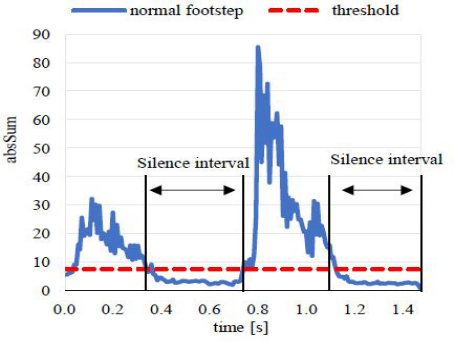
EXAMINATION OF EFFECTIVE FEATURES FOR IDENTIFICATION The temporal waveforms of footsteps were examined for features useful for identification. First, two phases were cut out as one data set from three diffe- rent footstep sounds to obtain 20 data sets. The starting point of the cutout was 0.01 [s] before the footstep start time. The endpoint of the cutout was 0.1 [s] before the start time of the third footstep (Shiota and Itai, 2019). As shown in Figure 1., the waveforms of the two footsteps were converted to absolute value waveforms, and the silent interval was used as the temporal feature, assuming that anything below the threshold value was silent. On the other hand, as shown in Table 2, MFCC was used as the frequency feature, and MFCC features ranging from 1 to 12 dimensions were used. P-values were obtained for the silence interval between the three footsteps and MFCC using the Wilcoxon signed-rank test to verify significant differences between the two groups.
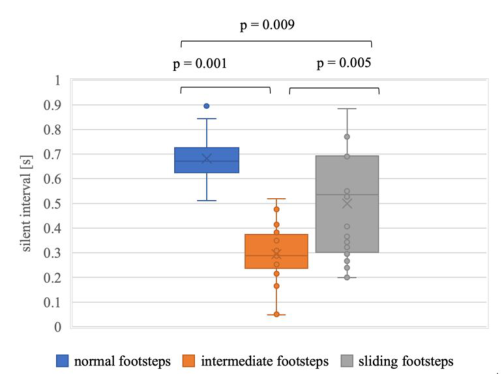
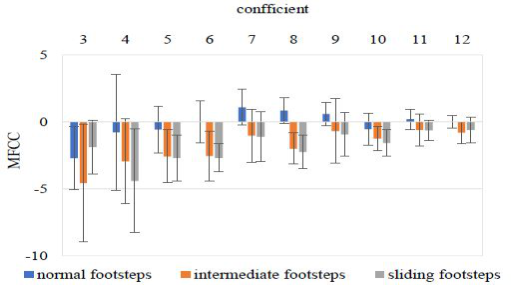
As shown in Figure 2, a p-value of <0.05 was obtained for the silent inte- rval, and significant differences were found for normal, intermediate, and sliding footsteps. However, the different silence intervals for the same gait data suggested that the footsteps with sliding footsteps may have been misre- cognized as normal sounds. On the other hand, as shown in Figure 4, MFCC showed significant differences among normal, intermediate, and sliding foot- steps, especially in the 6th, 7th, and 8th order coefficients. The range of
Determination of Footstep Sounds for Elderly Fall Prevention 701
Figure 2: Silence interval of three types of footsteps.Figure 3: Comparison of first order and second order MFCC coefficients for three types of footsteps.Figure 4: Comparison of 3rd to 12th order MFCC coefficients for three types of footsteps.Figure 5: Flow of the proposed method.
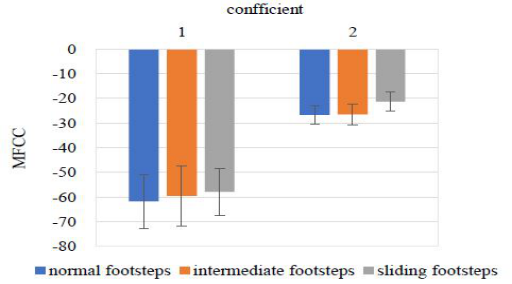
variation was also small. As shown in Figure 3, for intermediate and sliding footsteps, significant differences were found in the first-order coefficients, and a significant trend was found in the third-order coefficients.
Equation reproduced from the original PDF.
DISCRIMINANT EXPERIMENTS USING RANDOM FORESTS The flow of the identification experiment is shown in Figure 5. The foot- step sound data is divided every 2 seconds, and 100 data are used for each normal, intermediate, and sliding footstep sound. As features, MFCC, which was found to be significantly different in Chapter 3, was used and calcula- ted as acoustic features in openSMILE (openSMILE3.0, 2021). In this study, MFCCs were extracted from the Interspeech 2010 Emotion Challenge feature set (IS10). The average value of each MFCC coefficient is used as input for the discriminative model. Weka’s Random Forest (RF) (Weka3, 2021), a type of machine learning, is used for the discriminant model to classify footsteps into three types: normal footsteps, intermediate footsteps, and footsteps made by rubbing feet. The evaluation was performed by 10-division cross-validation to obtain the percentage of correct responses for each of the discriminant experiments using RF, which yielded a 91% correct response rate, as shown in Table 3. The reason for the high correct response rate can be attributed to the fact that the footsteps were recorded at a stable volume in a quiet envi- ronment. In addition, three walking styles are very different from each other, which is thought to have created a clear difference in the number of features contained in the footsteps and made discrimination possible.
CONCLUSION
In this study, we investigated footstep sound features in three different wal- king styles, showing significant differences between the silent section and the MFCC features. In addition, discrimination experiments were conducted to discriminate between normal footsteps, intermediate footsteps, and footsteps made in a slipshod manner, and a 91% discrimination rate was obtained. In the future, we will examine the feature values focusing on high-frequency
Determination of Footstep Sounds for Elderly Fall Prevention 703
components in order to discriminate mild footsteps. In addition, we will exa- mine the discrimination method in the presence of noise such as daily life noise.
REFERENCES
Cabinet Office. (2020). White Paper on the Elderly. Hyun-Kyung Kim. (2014). The Association Between Fall Risk and Walking, Journal of Biomechanics, Volume 38, No.4, pp234-239 Kawauchi, A., Kawaguchi, M., Nakamura, M. (2018). Feature Extraction for
Personal Authentication Using Footsteps Ministry of Health, Labour and Welfare. (2018). Number of deaths and death rates by cause of death by year due to unforeseen accidents Demographic Survey (Constant) Deaths Shiota, Y., Itai, A. (2019). Individual Identification and Feature Analysis of Footsteps
Using Time Frequency Analysis and Convolutional Neural Network, Research Report of Information Processing Society of Japan, Volume. 2019-HCI-182, No. 6 Suzuki, T. (2003). Journal of the Japan Geriatrics Society, vol. 40, No. 2, pp85-94 Takadama, k., Komine, T. (2015). An Environmentally Intelligent Slip-Foot Detection System Based on Time-Series Gait Data, Artificial Intelligence Volume. 30, No. 6, pp733 The University of Waikato. (2021). Weka3: Machine Learning Software in Java [online]. Available from: https://www.cs.waikato.ac.nz/ml/weka [accessed 1 December 2021] andEERING GmbH. (2021). openSMILE3.0 [online]. Available from: https://www.
audeering.com/opensmile/ [accessed 1 December 2021]
Read this individual research paper free through the original publisher, or explore the full digital proceedings book.
ISBN 978-1-958651-44-5
Explore this ISBN in the AHFE Bookstore ↗Listed in the July 2026 bookstore catalogue; search by ISBN to confirm current availability · Digital book purchase optional