The shortage of skilled workers in Germany caused by demographic change steadily increases. In the manufacturing sector, this situation leads to difficulties filling vacant positions and thus to extended vacancy periods of jobs in companies. Therefore, the turnover of skilled workers becomes a problem, especially in small and medium-sized manufacturing enterprises, as individual positions are not filled redundantly. High costs due to temporary workers or the rejection of orders can be the consequences. Turnover research has been conducted for a long time, but there is a lack of a standardized method to capture the turnover risk of skilled workers. This paper presents an approach for the systematic assessment of turnover risk in manufacturing work. The method is based on an employee survey. The results are transferred into a risk matrix in order to derive the level of risk for work-related turnover of individual employees. To ensure a cost-, personnel- and time-efficient implementation in the operations of SMEs, the method will be transferred into a software application. In this way, the turnover risk can be made transparent. The user can select specific measures evaluated according to manufacturing-specific performance indicators. These measures should help SMEs prevent the turnover of critical specialists and avoid high costs caused by long vacancy periods of jobs.
Due to demographic change, German manufacturing companies are seve- rely affected by a shortage of skilled workers (IHK, 2019). Especially small and medium-sized enterprises (SMEs) have significant recruiting problems and thus show a higher demand for skilled workers (Dettmann et al., 2019). That is, among other things, due to regional (urban and rural) or structural (human resource management or social benefits) differences to large compa- nies (Rozsa et al., 2021). The strong demand for labor and the high number of vacant jobs lead to an increased turnover of skilled workers (Armknecht and Early, 1972; Terborg and Lee, 1984). For companies, this means that vacant positions remain open, and the recruitment of new staff takes a very long time. Since SMEs, in particular, do not fill positions redundantly (Ber- gmann and Crespo, 2009), the termination of skilled employees has multiple and severe consequences, e.g., the loss of knowledge, extra work, and over- load for the remaining workforce, additional costs, longer lead times or even
the rejection of orders (DIHK, 2020). Therefore, turnover during a period of skilled worker shortage represents a significant business risk for SMEs.
To identify risk, analyze it, and take countermeasures, risk management plays a significant role in companies. It is the responsibility of the company’s management and helps secure the business operations, which is especially important in SMEs due to restricted resources (Kotaskova et al., 2020). The most significant risk for companies is the risk of operational interruptions (Buganova et al., 2020). Various types of risk can trigger these interruptions: hazard risks, financial risks, operational risks, and strategic risks, whereby personnel risk can be assigned to operational risk (Casualty Actuarial Society, 2003). Personnel risks are comprehensive and versatile and include, besides others, the turnover of employees (Fazey, 2020). For companies, risks can be divided into those that can be influenced and those that can slightly be influ- enced (Przybilla, 2008). Turnover is one of the risks that can be controlled, which offers SMEs great potential for action. However, there is a lack of a standardized procedure for identifying and classifying turnover risk.
This contribution focuses on providing a risk management approach for the turnover of skilled workers in manufacturing SMEs. It is structured in five parts. After the introduction, the following section gives an overview of the current state of risk management in manufacturing companies. General risk assessment tools and specific tools relating to personnel risks are presented. In section three, the need for research is derived, followed by the approach to assess the turnover risk of skilled workers in manufacturing SMEs. The final section concludes with a summary and outlook.
THEORETICAL BACKGROUND In today’s volatile, uncertain, and complex times, companies, especially SMEs, are exposed to various risks (Verbano and Venturini, 2013). The following subsections discuss the concept of risk, risk management, and assessment.
Definition of Risk and Risk Management Numerous definitions and interpretations of risk exist in the literature (Merna and Al-Thani, 2008). The International Organization for Standar- dization (ISO) developed the guide 73:2009 Risk Management – Vocabulary to create a common terminology. According to this, risk can be seen as an “effect of uncertainty on objectives” (ISO, 2009). The effect can be defined as a positive or negative “deviation from the expected” (ISO, 2009), and an objective covers various thematic areas (e.g., finance or health) and temporal as well as local ranges (e.g., strategic or organization-wide).
To perform “coordinated activities to direct and control an organization with regard to risk” (ISO, 2018), companies have to implement risk manage- ment. ISO has also developed a generally applicable standard for this process. It includes six main stages regarding ISO (31000:2018) (ISO, 2018):
Communication and consultation: interaction and understanding of all stakeholders (during all stages)
Towards a Work-Related Turnover Risk Management in Manufacturing SMEs 713
Scope, context, and criteria: definition of a customized framework for an effective risk management
Risk assessment: combines the essential and iterative steps of identifica- tion, analysis, and evaluation of risk
Risk treatment: selection and implementation of options to reduce or avoid risk
Monitoring and review: iterative process at all stages to ensure the quality of actions
Recording and reporting: documenting and sharing activities in the inte- rest of best practice In addition to this standard, other frameworks specifically address the risk management process related to working people. A well-known framework for this topic is the European Excellence Framework for Psychosocial Risk Management (PRIMA-EF), published by Leka et al. (2008). The core model is the risk management process consisting of a five steps cycle of risk assessment and audit, action plans, risk reduction, evaluations, organizational learning.
Flouris and Yilmaz (2010) research aims to manage human factors (HF) based risks. Therefore, they developed the Human Factor Risk Management (HFRM) model, similar to the PRIMA-EF framework. It is also structu- red in five steps and includes a SWOT-analysis, determination of HF-based risks, risk-handling options, assessment of the HFRM model performance and improvement of the HFRM system. As part of the assessment step, manufacturing companies have various methods at their disposal. The most important are explained in the following section.
Risk Assessment Tools in Manufacturing Failure Mode and Effects Analysis (FMEA): FMEA is a widely used team- oriented, systematic and qualitative analysis method to evaluate potential technical risks of a failure in the product or process. It examines the causes and consequences of such failures and documents detection and avoidance measures for risk reduction. Potential failure modes, failure causes, and failure effects are evaluated in terms of severity (S), occurrence (O), and detection (D). Until recently, the failures were quantified in the summarizing risk priority number (RPN) of SxOxD. (AIAG, 2019) After harmonizing the FMEA by the Automotive Industry Action Group and the German Associa- tion of the Automotive Industry, they replaced the long-used RPN with the action priority (AP). The AP, defined as high, medium, and low priority, is no longer used to prioritize risks but focuses on taking risk reduction measures (AIAG, 2019). A practical traffic light represents this adjustment in FMEA software tools (Eilers, 2013).
Risk Matrices: The risk matrix is a structured, simple, quantitative, or qualitative method for evaluating risk and assisting decision-making and is an established method in enterprise risk management (Cox, 2008). In addi- tion to other application areas, the matrix is also used in risk assessment and risk reduction for humans in the design of machinery (BAuA, 2012). A matrix or a coordinate system typically visualizes the risk matrix. The probability is shown on the x-axis and the severity of damage on the y-axis (Department of
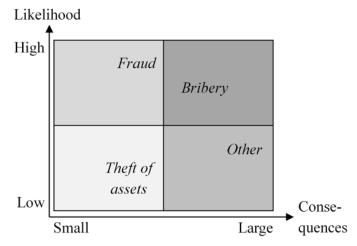
Figure 1: Example of a RSA after Blacker and McConnell (2015).
Defense, 2000). After marking the risk on the x- and y-axis, the risk evalua- tion can be quantitatively or qualitatively determined. A color scale depicts a low, a medium, and a high risk (BAuA, 2012; Department of Defense, 2000).
PDCA-Cycle: A cycle well known and widely used in Lean Production is the PDCA-Cycle or Deming-Cycle (Glass et al., 2016; Jagusiak-Kocik, 2017). The PDCA-Cycle is a standardized process consisting of the phases Plan, Do, Check, Act and has the goal of continuous improvement by repeating its steps repeatedly. In addition to quality management, the PDCA-Cycle can also be used in risk management (Bakos and Dumitra¸scu, 2021; Jagusiak- Kocik, 2017).
Personnel Risk Assessment Tools In addition to general risk assessment tools, employee-related assessment tools are also presented in the literature.
Survey: In the risk assessment and audit phase of the before presented PRIMA-EF framework, Leka et al. (2008) recommend using surveys or other qualitative measures, such as observations recommended for SMEs. Kobi (2012) also considers the survey suitable for employee feedback on risk factors. The survey can ask targeted questions about possible job satisfaction and resignation.
Risk Self-Assessment: Blacker and McConnell (2015) published a more specific method. They consider risk caused by people on a social respective interpersonal level. They highlight the importance of analyzing different sta- keholders (e.g., colleagues, supervisors, and suppliers) and possible risks in the interaction with them. After these have been identified, they must be analyzed for personal significance. The Risk Self-Assessment (RSA) is inten- ded to achieve this. As a standard method for identifying operational risks, the aim is to create transparency about possible risk factors for individual persons in the company. The risk factors are then classified in a coordi- nate system regarding likelihood and consequences. In Figure 1, an RSA of a hypothetical manager is shown as an example. (Blacker and McConnell, 2015). Structural analysis: Nieder (1999) presents a more turnover-related appro- ach. The so-called structural analysis is intended to act as an early warning system by measuring absenteeism and turnover indicators to reduce losses.
Towards a Work-Related Turnover Risk Management in Manufacturing SMEs 715
Table 1. Risk table after Lappalainen et al. (2000) and Przybilla (2008).
Table available in the original PDF paper.
The main objective of the structural analysis is to identify absenteeism and turnover risks and localize them within the company. Four key questions must be asked in the analysis before measures can be taken. How many peo- ple have increased absenteeism? In which departments do they work? How many employees have not been absent at all? In which departments do they work?
Risk table: The risk table of Lappalainen et al. (2000) is specifically appli- cable to personnel risks and is similar in its basic structure to the risk matrix. The columns contain the consequences, while the probabilities of the event are entered in the rows. Finally, a risk level between meaningless and intolera- ble can be determined in the cells. As shown in Table 1, Przybilla (2008) has extended this method by focusing on measures and adding an action-taking dimension to each cell.
RESEARCH DEMAND As described in the introduction, the turnover of skilled workers is a parti- cular business risk for SMEs. Standardized risk management procedures are available to companies, as shown in the previous section. These are gene- ric and applicable to different use cases. However, according to Leka et al. (2008), individual company conditions must be considered to manage risk successfully. Especially the phase of risk assessment “should take into consi- deration diversity issues and should not ignore the wider context such as the occupational sector characteristics” (Leka et al., 2008).
As shown before, companies can use various risk assessment methods. Przybilla’s (2008) approach is applicable for turnover risk assessment. Never- theless, it has weaknesses for identifying the turnover risk of skilled worker in manufacturing SMEs: First, the target group of the approach is individual performers, which is why it is not suitable for the whole workforce in pro- duction. Second, the method estimates whether measures need to be taken, but it does not provide information on which measures should be taken and how they should be prioritized. In particular, since SMEs have few person- nel resources (Kotaskova et al., 2020), concrete measures must be derivable to support them in the best way possible according to time and resource efficiency.
Rubenstein et al. (2018) see the promising potential for future research in work-related turnover factors. They see the potential to influence the indi- vidual probability of turnover by specifically influencing factors that could lead to work-related employee turnover. Therefore, this contribution introdu- ces an approach to work-related turnover risk management in manufacturing SMEs in the following section.
TURNOVER RISK MANAGEMENT First, the procedure of the general method is presented based on the risk management process steps. Then, the individual steps are explained, toge- ther with a presentation of the user interfaces of the planned prototypical implementation in a software application.
The Turnover Risk Management Process The overall risk management is based on the ISO process (ISO, 2018). Due to SMEs’ limited personnel and time resources, the procedure should only contain necessary steps. Since hierarchies are flat in SMEs and structures and communication channels are not very complex, the first step (communication and consultation) and the last step (recording and reporting) were not inclu- ded. The essential steps defined are scope, risk assessment, risk reduction, and review. If the scope is initially defined, the remaining steps are iteratively run through comparable to the PDCA-Cycle. The individual steps are explained in more detail below.
Scope In the turnover risk management, the scope in terms of a particular team, a team’s department, or a work area has to be defined first. Following the German risk assessment of machines, the area of consideration is defi- ned (Einhaus et al., 2017). It is essential to pay attention to comparable working conditions, working tasks, and working environment during the selection process. A similar work context plays an important role, especially for deriving measures in the third risk reduction step (section 4.4).
Turnover Risk Assessment The risk assessment is the core of the process. It is where the identification of specific risk factors and the evaluation of risk take place.
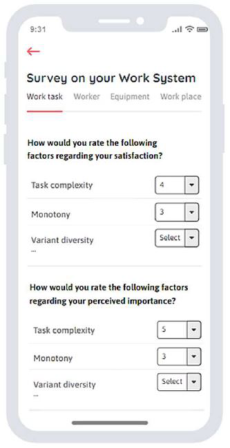
The actual data collection process in the department defined in the scope (section 4.2) is carried out using a survey, as recommended by Leka et al. (2008). In this survey, the employees rate each turnover factor listed in Table 2 regarding their satisfaction and perceived importance. The correla- tion between satisfaction and the intention to quit was confirmed in various studies (Lee et al., 1999) why it was selected as evaluation size. Personal importance is used as a weighting factor to take the subjectivity of the topic into account. A five-point Likert scale from one (low) to five (high) is used as the rating scale for the two selected evaluation variables. The exemplary implementation of the survey is shown in Figure 2. After conducting the survey, the risk identification is finished.
Towards a Work-Related Turnover Risk Management in Manufacturing SMEs 717
Table 2. Work system related turnover factors.
Table available in the original PDF paper.
Figure 2: Risk identification survey.
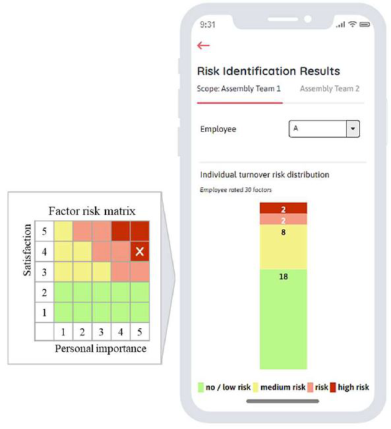
Risk evaluation: This step aims to provide a standardized approach to clas- sify the turnover risk for individual workers. The survey of each employee is evaluated by transferring each factor into a risk matrix to classify the turno- ver risk. The axes of the matrix are adjusted according to satisfaction and personal importance, as shown in Figure 3. A no and medium risk thresh- old was set between satisfied and neutral satisfaction (color code green and yellow).
All factor matrices are summed up per employee and transferred into an employee-individual risk ranking based on the traffic light representation of the FMEA to get an overview of the risk distribution for each emplo- yee (Eilers, 2013). In Figure 3, employee “A” rated two factors as high, two factors as risky, eight as medium, and 18 as not risky. With this risk ranking, a transparent overview of the risk distribution of the worker is given, and the risk evaluation step is completed.
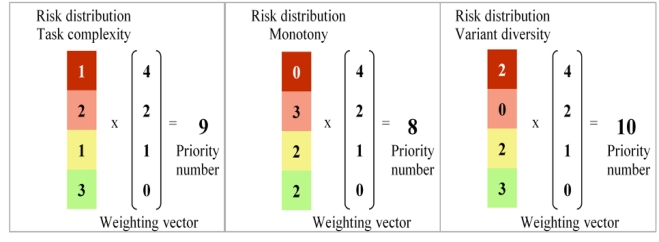
Figure 3: Employee-individual risk distribution.Figure 4: Weighting and determination of the priority number.
Turnover Risk Reduction This step aims to reduce the risks by taking countermeasures. The focus is placed on the entire department selected in the scope (section 4.2). The con- sideration of the whole department has economic reasons. If the costs are lower than the benefits in the medium term, the procedure and measures can be justified financially (Meifert, 2013). Therefore, the frequencies of factor ratings in the department should be considered. Firstly, this helps prioritize the measures, as the most frequent negative rating must be addressed first. Secondly, the application of measures is scalable and efficient. Risk reduction, shown in Figure 4, takes place in three steps:
Summation of matrix scores per factor (in Figure 4, one employees rated task complexity at high risk, two employee at risk, one at medium risk three at no risk)
Weighting of the results according to the color scale with 4 = highest priority and 0 = no measures have to be taken
Calculate the priority number from the weighted factor ratings
Towards a Work-Related Turnover Risk Management in Manufacturing SMEs 719
In the example in Figure 4, the results of seven employees were prioritized. Since variant diversity has the highest priority number, the company must first take action on this factor. Measures should be taken in collaboration with the employees who rated it poorly. SMEs will be provided a catalog of measures for each factor in the turnover risk reduction step. The detailed catalog is currently under development.
Review Finally, the implemented measures are checked in the review step by con- ducting the risk identification survey again (section 4.2). The timing of the review can be chosen individually depending on the previously implemented measures. If the turnover risk has not been sufficiently reduced, the risk is reassessed, and the cycle begins again.
SUMMARY AND OUTLOOK This publication presented a work-related turnover risk management appro- ach in SMEs. It is structured in the four steps scope, risk assessment, risk reduction, and review and aims to retain skilled workers in manufacturing companies. In the scope, the area under consideration is defined. As part of the assessment, the risk is identified and evaluated. Finally, measures to reduce the identified risks are derived, and the effect is validated.
The approach is part of an ongoing research project. As already mentioned, the catalog of measures in the risk reduction step has to be finished. The evaluation of the turnover risk management will be carried out afterwards. Finally, the approach will be implemented in a software tool to simplify its use for SMEs.
ACKNOWLEDGMENT
The authors thank the German Federal Ministry for Economic Affairs and Climate Action (BMWK) for its financial and organizational support of the “Mittelstand-Digital Zentrum Augsburg” [Grant no. 01MF22002B].
REFERENCES
AIAG (2019) FMEA Handbook: Design FMEA, Process FMEA, and Supplemental FMEA for Monitoring and System Response. Armknecht, P. and Early, J. (1972) ‘Quits in manufacturing: a study of their causes’,
Monthly Labor Review, vol. 95, no. 11, pp. 31–37. Bakos, L. and Dumitra¸scu, D. D. (2021) ‘Decentralized Enterprise Risk Management Issues under Rapidly Changing Environments’, Risks, vol. 9, no. 9, p. 165. BAuA (2012) Risikobeurteilung im Maschinenbau, Dortmund, Bundesanst. für
Arbeitsschutz und Arbeitsmedizin. Bergmann, L. and Crespo, I. (2009) ‘Herausforderungen kleiner und mittlerer Unternehmen’, in Dombrowski, U., Herrmann, C., Lacker, T. and Sonnentag, S. (eds) Modernisierung kleiner und mittlerer Unternehmen, Berlin, Springer, pp. 5–29. Blacker, K. and McConnell, P. (2015) People risk management: A practical approach
to managing the human factors that could harm your business, London, Kogan Page Ltd.
Buganova, K., Holla, K. and Moskova, E. (2020) ‘Continuity management and risk management as a tool for prevention to origin of crisis situations and increasing the resilience of the enterprise’, in Da Lorga Silva, A., Rados, T. and Kaurova, O. (eds) Economic and Social Development (Book of Proceedings), pp. 127–135. Casualty Actuarial Society (2003) Overview of Enterprise Risk Management. Cox, L. A. (2008) ‘What’s wrong with risk matrices?’, Risk analysis : an official
publication of the Society for Risk Analysis, vol. 28, no. 2, pp. 497–512. Departement of Defense (2000) Standard Practice for System Safety (MIL-STD- 882D). Dettmann, E., Fackler, D., Müller, S., Neuschäffer, G., Slavtchev, V., Leber, U.
and Schwengler, B. (2019) Fehlende Fachkräfte in Deutschland – Unterschi- ede in den Betrieben und mögliche Erklärungsfaktoren: Ergebnisse aus dem IAB-Betriebspanel 2018 DIHK (2020) Fachkräftesuche bleibt Herausforderung: DIHK-Report Fachkräfte 2020, Berlin Eilers, J. (2013) What’s New – Risk Matrix, APIS Informationstechnologien GmbH.
Available at https://www.apis-iq.com/wp-content/uploads/2016/04/whats_new_ risk_matrix-en.pdf. Einhaus, M., Häußinger, C. and Lugauer, F. (2017) Arbeitsschutz und Sicherheitstechnik: Der Schnelleinstieg für (angehende) Führungskräfte: Basiswissen, Haftung, Gefährdungen, Rechtslage, München, Carl Hanser Verlag GmbH & Co. KG. Fazey, M. (2020) Human Resource Policy: Connecting Strategy with Real-World
Practice Flouris, T. and Yilmaz, A. (2010) ‘The Risk Management Framework to Strategic Human Resource Management’, International Research Journal of Finance and Economics, no. 36 Glass, R., Seifermann, S. and Metternich, J. (2016) ‘The Spread of Lean Production in
the Assembly, Process and Machining Industry’, Procedia CIRP, vol. 55, pp. 278– 283. IHK (2019) IHK Fachkräfte-Report 2019: Ergebnisse für Bayern. ISO (2009) 73:2009: Risk management — Vocabulary. ISO (2018) 31000:2018: Risk management — Guidelines. Jagusiak-Kocik, M. (2017) ‘PDCA cycle as a part of continuous improvement in the production company - a case study’, Production Engineering Archives, vol. 14, no. 14, pp. 19–22. Klicken oder tippen Sie hier, um Text einzugeben. Kobi, J.-M. (2012) Personalrisikomanagement, Wiesbaden, Gabler Verlag. Korder, S., Kulessa, S., Breuherr, D., Vernim, S. and Reinhart, G. (2022) ‘The role
of work system-related factors on skilled workers’ turnover intentions: A study in small and medium-sized manufacturing enterprises in Southern Germany (Under Review)’, International Journal of Industrial Ergonomics, no. 90. Kotaskova, A., Belas, J., Bilan, Y. and Ajaz Khan, K. (2020) ‘Significant Aspects of Managing Personnel Risk in the SME Sector’, Management & Marketing. Challenges for the Knowledge Society, vol. 15, no. 2, pp. 203–218. Lappalainen, J., Mikkonen, P., Murtonen, M., Piispanen, P., Salminen, S. and Vuori,
M. (2000) Der Schlüssel zu einer sicheren Zukunft: Personalrisikomanagement 4–1. Lee, T. W., Mitchell, T. R., Holtom, B. C., McDaneil, L. S. and Hill, J. W. (1999) ‘The Unfolding Model of Voluntary Turnover: A Replication and Extension’, Academy of Management Journal, vol. 42, no. 4, pp. 450–462.
Towards a Work-Related Turnover Risk Management in Manufacturing SMEs 721
Leka, S., Cox, T. and Zwetsloot, G. (2008) ‘The European Framework for Psychosocial Risk Management (PRIMA-EF)’, in The European Framework for Psychosocial Risk Management Meifert, M. T. (2013) Strategic human resource development: A journey in eight
stages Merna, T. and Al-Thani, F. F. (2008) Corporate risk management, 2nd edn, Hoboken, NJ Nieder, P. (1999) ‘Fehlzeiten- und Fluktuationsrisiken: Erfassung, Bewertung,
Abbau’, in Ackermann, K.-F. (ed) Risikomanagement im Personalbereich: Rea- ktionen auf die Anforderungen des KonTraG, Wiesbaden, Gabler, pp. 133–152. Przybilla, A. (2008) ‘Personalrisikomanagement - Mitarbeiterbindung und die Relevanz für Unternehmen’. Rozsa, Z., Belas, J., JR., Khan, K. A. and Zvarikova, K. (2021) ‘Corporate social
responsibility and essential factors of personnel risk management in SMEs’, Polish Journal of Management Studies, vol. 23, no. 2, pp. 449–463. Rubenstein, A. L., Eberly, M. B., Lee, T. W. and Mitchell, T. R. (2018) ‘Surveying the forest: A meta-analysis, moderator investigation, and future-oriented discussion of the antecedents of voluntary employee turnover’, Personnel Psychology, vol. 71, no. 1, pp. 23–65. Terborg, J. R. and Lee, T. W. (1984) ‘A Predictive Study of Organizational Turnover
Rates’, Academy of Management Journal, vol. 27, no. 4, pp. 793–810. Verbano, C. and Venturini, K. (2013) ‘Managing Risks in SMEs: A Literature Review and Research Agenda’, Journal of technology management & innovation, vol. 8, no. 3, pp. 33–34.
Read this individual research paper free through the original publisher, or explore the full digital proceedings book.
ISBN 978-1-958651-44-5
Explore this ISBN in the AHFE Bookstore ↗Listed in the July 2026 bookstore catalogue; search by ISBN to confirm current availability · Digital book purchase optional