Vera Van Der Nulft, Stefan De Vries, Josien Visschedijk, Reon Smits, Franka Meiland, Esmee Adam, Hanneke Smaling, Erwin Meinders (2023). Impact of real-time stress monitoring in people with an intellectual disability. In: Cognitive Computing and Internet of Things. AHFE Open Access, vol. 73, pp. 56–67. https://doi.org/10.54941/ahfe1003974
1 Leiden University Medical Center, Department of Public Health and Primary Care, Leiden, The Netherlands - University Network of the Care Sector Zuid Holland ↗
2 Mentech Innovation, Eindhoven, 5624 CL, The Netherlands ↗
People with an intellectual disability are vulnerable to stress, which can result in challenging behaviour, such as apathy, self-harm, or aggression. By monitoring stress in real-time, professional caregivers can timely intervene to prevent escalations and improve the quality of life for both the client and themselves. The aim of this study was to investigate the impact of real-time stress monitoring using the stress-detection system HUME on the quality of life of people with a severe intellectual disability and their professional caregivers. The study comprised two parts. A case series study (n=12) was conducted with long-term care clients with intellectual disabilities to validate the HUME. HUME stress measurements, based on physiological data and trained artificial intelligence models, were collected, and compared with labelled video observations of professional caregivers. A second study was conducted to measure the impact of HUME and the induced interventions on quality of life. Physiology data and quality of life scores were collected. The HUME stress prediction was used 1) for early warning to deploy interventions based on what the professional caregiver deemed best, and 2) as an assessment tool to understand the effectiveness of care interventions. The quality of life for both the client (n=41) and professional caregiver (n=31) was evaluated via a questionnaire. Results showed that the HUME was able to detect stress in all cases, and stressful events detected by the HUME were consistent with the behavioural observations. The real-time stress monitoring using HUME, along with subsequent interventions, was effective. Clients with intellectual disabilities experienced reduced stress and an improvement in their perceived quality of life. Also, professional caregivers perceived an increase in the quality of life during the period the HUME was used. In most of the cases, HUME-based interventions led to a reduction in escalations, fixations, and self-harming behaviour. Further randomized controlled studies are needed to substantiate these results.
Impact of Real-Time Stress Monitoring in People With an Intellectual Disability 57
individuals resided in long-term care (LTC) facilities (Volksgezondheid en Zorg, n.d., 2020). Intellectual disabilities are characterised by limitations in intellectual functioning, social-emotional functioning, and adaptive beh- avioural skills (National Academies of Sciences, Engineering, and Medicine, 2015). Adaptive behavioural skills consist of a wide set of abilities that are necessary for daily functioning, including the ability to communicate with others (Oakland and Harrison, 2008). Deficits in communicative abilities are commonly seen in individuals with intellectual disabilities (Belva et al., 2012; Smith et al., 2020), especially in people with more severe forms (Sat- tler, 2002). Communicative impairments hamper the expression of emotions and internal states (Adams and Oliver, 2011), placing these individuals at risk for being misunderstood, having unmet needs, and receiving suboptimal care (Smith et al., 2020; Martin et al., 2010).
People with intellectual disabilities have reduced abilities to express their level of experienced stress and limited strategies to cope with stressful situ- ations, making them highly vulnerable to stress (Janssen et al., 2002). Stress and communication difficulties are common risk factors for challenging behaviour in people with intellectual disabilities (Janssen et al., 2002; Busker- molen et al., 2012; Bowring et al., 2017). Challenging behaviour is defined as ‘behaviour of such an intensity, frequency or duration as to threaten the quality of life and/or the physical safety of the individual or others and is likely to lead to responses that are restrictive, aversive or result in exclusion’ (Banks et al., 2007). Examples of challenging behaviour include aggres- sion, apathy, self-injury, and resistance to care. A recent survey among 922 Dutch professional caregivers and managers showed a prevalence of 37% - 86% of challenging behaviour in people with an intellectual disability (Olivier-Pijpers et al., 2020).
Challenging behaviour seems to be persistent across the lifespan among people with intellectual disabilities (Totsika et al., 2008), although some studies have reported a decrease in frequency or intensity of some challen- ging behaviours as individuals get older (Cooper et al., 2009; Hartley and MacLean, 2007). Challenging behaviour can have negative consequences for the quality of life of people with intellectual disabilities, as it impacts daily functioning and may cause health problems (e.g., due to self-injury) (Gur, 2018; Emerson, 2001). Furthermore, some studies indicate that challenging behaviour is associated with mental health problems, such as depression (Bowring et al., 2019).
For caregivers, challenging behaviour can be stressful and potentially dan- gerous (Bowring et al., 2019), has a negative impact on their quality of life (Griffith and Hastings, 2014) and complicates care (Whittington and Burns, 2005). This has noticeable consequences: informal caregivers often feel over- burdened (Green, 2007) and professional caregivers report above-average percentages of workplace absenteeism and staff turnover (Smyth et al., 2015; Hatton et al., 2001). Moreover, challenging behaviour is associated with long-term institutionalisation and increased use of healthcare or social care services (Banks et al., 2007). It is a prevalent cause for transitioning from community care to more expensive institutionalised care (Embregts et al., 2019).
Current methods for assessing stress in individuals with intellectual disa- bilities typically consist of behavioural observations by caregivers, structured or semi-structured interviews, and self-report questionnaires (Bramston and Fogarty, 2000). As these methods are often subjective and time-consuming, there is a need for alternative methods to identify early stress built-up in people with intellectual disabilities. Wearable sensor devices that measure physiological arousal may aid caregivers to effectively prevent, predict, and manage stress.
The physiological stress response is characterised by increased activation of the sympathetic nervous system and inhibition of the parasympathetic nervous system, causing an increase in heart rate (HR), electrodermal activity (EDA) and blood pressure (BP) (Ziegler, 2012). These physiological changes, especially in HR and EDA, can be reliably detected and monitored by wea- rable sensor devices at an early stage of stress development (Alberdi et al., 2016). In recent years, sensor technology and artificial intelligence (AI) models have reached a level of technical maturity that allows these technologies to detect and manage stress in real-time (Nath et al., 2020). Emerging evi- dence supports the effectiveness of sensor-based technologies in predicting challenging behaviour based on physiological stress responses in different clinical populations, especially people with autism spectrum disorder (e.g., Taj-Eldin et al., 2018; Goodwin et al., 2019) and dementia (e.g., Goerss et al., 2019). Research on sensor-based technologies for people with intellectual disabilities and challenging behaviour is still limited, although this resea- rch field is currently growing (e.g., Palix et al., 2017; Simons et al., 2021; Frederiks et al., 2015). However, the current available consumer wearables are yet to match the medical-level devices in terms of sensor and signal quality (Saganowski et al., 2020). Furthermore, the applicability of such wearables, in terms of user acceptance and implementation in LTC, for people with intellectual disabilities is currently not known.
An earlier study showed that the stress detection system HUME can detect stress in healthy adults based on changes in several key physiological features, such as EDA and HR, during stress and relaxation (de Vries et al., 2022). The current study examines the use and applicability of the HUME for detecting and regulating stress in individuals with intellectual disabilities and challen- ging behaviour living in LTC facilities, to enhance the quality of life of clients and their professional caregivers.
METHOD
The study consists of two parts. Study A has a descriptive case series design, in which the HUME stress outcome was validated against video observations of professional caregivers in situations of stress built-up. In total, 6 male and 6 female clients of eight LTC facilities for people with intellectual disabilities in the Netherlands were included in the study, in the age between 22 and 65 years. During moments of challenging behaviour and moments of rela- xation, HUME stress measurements and video observations were performed. For each client, the situations in rest and during stress were filmed. The obse- rvers (i.e., the professional caregivers and behavioural specialists) labelled the
Impact of Real-Time Stress Monitoring in People With an Intellectual Disability 59
video recordings using personalised signalling plans. Signalling plans, which are part of standard care in the LTC facilities, are observation plans which include necessary or helpful reactions of professional caregivers to specific behaviour of the clients, like Positive Behaviour Support plans in Applied Behaviour Analysis interventions (Johnston et al., 2006). They rated the pre- sence of stress (zero, mild stress, high stress), the arousal phase (i.e., duration of the stress) and the valence of the arousal (i.e., low, or high and positive or negative arousal). Inter-rater reliability scores were calculated regularly using Gwet’s AC1, yielding an average score of 0.679 (SD = 0.271). If the inter-rater reliability was <0.70, the observers were asked to discuss diffe- rences in classifications and reach consensus. All observers were blinded to the physiological measures before and during the labelling the video recor- dings. During the analysis, the labels from the observers were also converted to binary measures (stress yes/no) to effectively compare this data with the model predictions from the HUME.
Study B had a pre-test and post-test design using a convenient sample, with the application of real-time stress monitoring with HUME. The study B aimed to enhance the quality of life for both the client and the caregiver in long-term care facilities through the implementation of HUME. Prior to the active use of stress monitoring, a reference stress level was determined with HUME (baseline) during a period of approximately one month in which the professional caregiver did not see and use the stress predictions. The HUME stress prediction was subsequently used by the professional caregivers for early warning and diagnostics applications. A total of 41 clients with intelle- ctual disabilities from 14 LTC facilities with their care teams were included in the study. Male as well as female clients were included, with ages varying between 14 to 70 years. The intended impact of HUME was determined from the use of HUME-based interventions to mitigate the observed stress deve- lopment. The effect of HUME was assessed from a questionnaire deployed among the involved professional caregivers (n = 31), including several que- stions related to the impact of HUME (with respect to challenging behaviour, better understanding of client’s need, the effect on the professional caregiver, etc.) and a quality of life (QoL) assessment for both the client and the profes- sional caregiver on a 5-point scale, according to the Outcome Rating Scale (ORS; Miller et al., 2013). The QoL answers ranged from 1 for very bad well-being to 5 for very good well-being. The QoL survey was administered at the beginning of HUME deployment to establish a baseline. The survey was re-administered after three months of HUME use to evaluate changes.
Inclusion Criteria The following inclusion criteria applied for study A and study B: 1) The client is diagnosed with an intellectual disability and shows challenging behavi- our. The situational nature of the challenging behaviour can be described by the behavioural specialist or a physician; 2) The client accepts the wearable sensors, based on an adjustment period before the start of the study; 3) Infor- med consent is given by the legal representatives; 4) Professional caregivers are willing to participate. Reasons for rejecting included: lack of time of the
client, staff shortage, physical limitations that made it impossible to wear the sensor devices, or involvement in another study or treatment that would interfere with the current study.
Ethical Considerations The HUME was validated in a clinical study with eight care institutions for people with intellectual disabilities in the Netherlands (de Vries et al., 2023). The study protocol was assessed by the medical ethical committee of the VU medical centre (protocol number 2019.255, the Netherlands), and dee- med exempt from the Medical Research Involving Human Subjects Act. The HUME is registered as a class 1 medical device for stress detection.
The clients and their legal representatives received patient information letters and signed informed consent forms. Project teams, consisting of a beh- avioural specialist, a physician, and a professional caregiver, were formed for each client. The professional caregivers were trained to use the HUME.
Measures The HUME is a smart sensor system that can detect stress from physiological signals. The HUME consists of wearables to measure the EDA at the inner side of the foot and the HR and inter-beat interval (IBI) at the chest. The real-time data were processed via a trained artificial intelligence model. The HUME model architecture consists of a neural network with two layers, a shared layer that accounts for general physiological changes related to stress, and personal layers that reflect person-specific physiological changes. The model was trained with labelled data from over 100 healthy individuals expo- sed to stress-inducing stimuli (videos, VR videos, games, and exercises). The model was validated using a 5-fold cross-validation method, achieving a bala- nced accuracy of 75-80%, both for heart rate and skin conductance-based models (de Vries et al., 2022). The HUME model calculates a stress index ranging from 0 to 1, representing the likelihood of real-time stress. This stress index outcome can be used as an assessment tool for the evaluation of the effectiveness of care interventions. It can also be displayed as a traffic light on a smartphone or tablet to alert a caregiver.
The following data were collected to examine the applicability of the HUME in clinical practice: a) personal characteristics of the clients (i.e. age, sex and residential location); b) clients’ physiological data; c) video and sound recordings of the situation in which the data were collected (only for study A); d) environmental characteristics (i.e. presence of other people and day pro- gram); e) medical data that could potentially impact the physiological data; f) behavioural data of the client (such as stress or observations of challenging behaviour); and g) questionnaire with questions related to the quality of life of client and professional caregiver and the impact of HUME.
RESULTS STUDY A – VALIDATION WITH VIDEO OBSERVATIONS The 12 clients included in study A showed challenging behaviour, such as self- harming behaviour, refusal of meals, verbal and physical aggression towards
Impact of Real-Time Stress Monitoring in People With an Intellectual Disability 61
other clients and professional caregivers, yelling, mourning, etc. For study A, two examples are described.
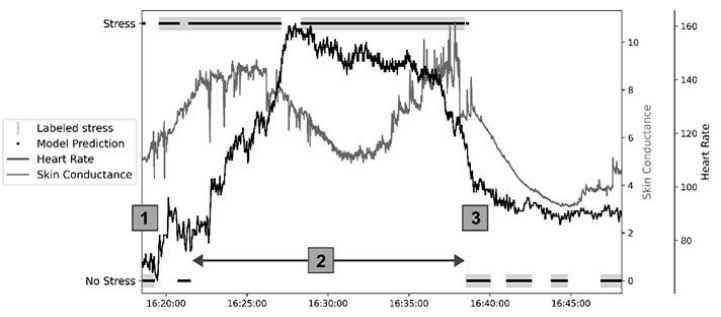
Client 1 could suddenly begin to shake from head to toe. During these moments, he would lay down and adopt a foetal position, which was often accompanied by shouting. These episodes ranged from 30 minutes to two hours. A representative example of such an event of challenging behaviour is given in Figure 1. The event is marked with three key moments: 1) Both the HUME and the observers labelled the first moment as non-stressful. The client was lying on the couch, seemingly calm and uneventful; 2) A tremor became visible in his hands, and he started to yell, which resulted in more yelling from other clients. Both the observers and the HUME indicated the presence of stress during this moment; 3) The client was brought to his dar- kened room by a caregiver and the stress disappeared, as indicated by both the observers and the stress detection model. The agreement between the observations and HUME predictions is very good.
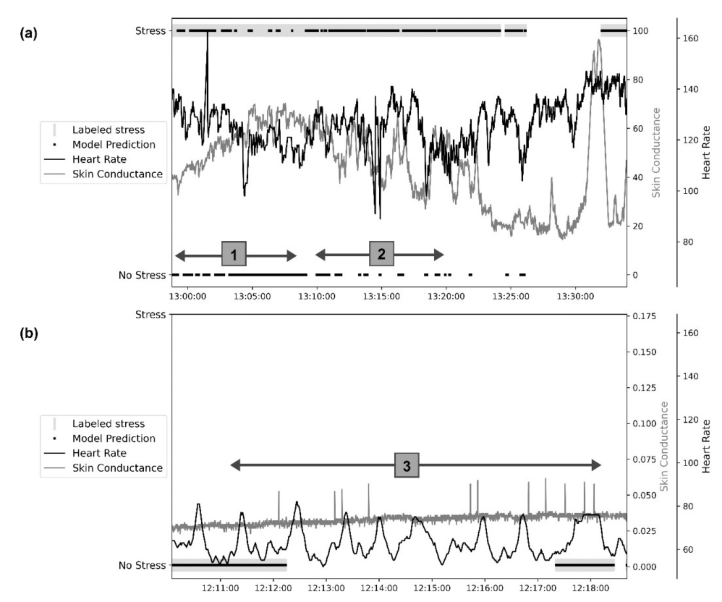
The second example refers to a client with self-mutilation. The client often stuck one of his hands deep in his throat. While doing this, he stop- ped breathing for a long time and played with his saliva on his hands. A representative example of such an event is given in Figure 2: 1. The client begins to hold his breath and play with his saliva. The observers labelled this period as stressful, the HUME indicated stress when he started to hold his breath and indicated more frequent rest detections when his breathing started to return to normal. 2. The client started to move a lot and started to hold his breath again. During this period, the stress detection system and observers indicated that stress was present. 3. The client sits at a table and appears relaxed. Both the observers and HUME indicated that this moment was not stressful. In general, the HUME detected more stress when the fre- quency and intensity of the client’s behaviour increased throughout the day. He played with his saliva after taking it out of his mouth during stres- sful and non-stressful moments. Therefore, it was concluded that putting
Figure 1: Physiological data (heart rate and electrodermal activity), stress detection system output, and observer labels during challenging behaviour of client 1.Figure 2: Physiological data (heart rate and electrodermal activity), stress predictions from HUME and observer labels during challenging behaviour of client 2.
his hand in his mouth and playing with saliva was not directly related to stress.
In general, the HUME was able to detect stress in all cases in study A. More specifically, stressful events detected by the HUME were consistent with behavioural observations. Moreover, the stress detections of the HUME could also be linked to individual instances of challenging behaviour in all cases and to contextual information (such as triggers of stress).
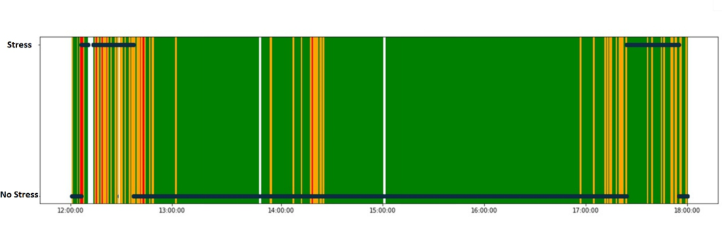
RESULTS STUDY B - STRESS-BASED INTERVENTIONS In study B, the professional caregivers used the HUME actively for early war- ning and diagnostics applications at 41 clients in 14 LTC facilities, to provide better care and to improve the quality of life of clients and professional care- givers. An example of a HUME stress prediction is given in Figure 3. HUME stress outcome is indicated in colour (green = relaxed, orange = stress deve- lopment, red = stress), stress annotations from the professional caregiver are given as labels (stress and no stress). The HUME stress outcome was visible to the professional caregiver on their smartphone. Around 12:00 the HUME stress prediction correlated well to the observations of the professional care- givers. This moment was classified as an escalation. The event around 17:30
Impact of Real-Time Stress Monitoring in People With an Intellectual Disability 63
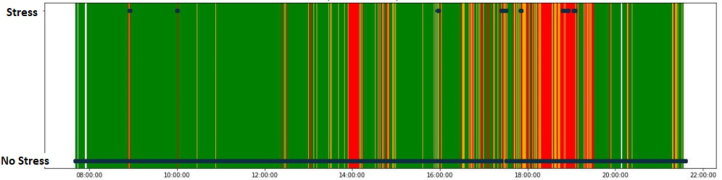
Figure 3: HUME stress predictions in colour and event labels (stress / no stress) from professional caregivers during the day of client 3.Figure 4: HUME stress predictions in colour and event labels (stress / no stress) from professional caregivers during the day of client 4.
was identified by HUME as relaxation and confirmed by the professional caregivers as a moment of emotion regulation. A second example is given in Figure 4. Both HUME and the professional caregiver identified the event between 18:00 and 19:00 as stressful (an escalation occurred). The onset to this escalation was well captured by HUME stress predictions.
The professional caregivers used the HUME stress outcome to their discre- tion to mitigate the challenging behaviour by providing timely interventions. The interventions led to a decrease between 5-25% in measured stress during HUME use. Regarding the impact on quality of life, a total of 31 professional caregivers completed the ORS questionnaire at the baseline (with complete data on client and caregiver). The averaged QoL of the client improved from 2.9 to 3.3 after three months of HUME deployment. The averaged QoL of the caregiver improved from 3.7 to 4.1 after three months of HUME deploy- ment. The deployment of HUME leads to a significant increase in the quality of life of both the caregiver and the client.
Based on the deployed questionnaires with the professional caregivers responsible for the use of HUME, HUME interventions led to a reduction in escalations, fixations, and self-harming behaviour. HUME-based interven- tions also contributed to self-control and workplace safety as reported in testimonials from care organizations (Philadelphia testimonial, 2022, Prima testimonial, 2022).
DISCUSSION
Some limitations were identified in the study. Firstly, the sample size was for both studies A and B relatively small. A larger scale study would be recommended to substantiate the findings. Next, moments of stress were labelled by behavioural experts. This may have introduced some subjectivity because of potential bias (Alekhine et al., 2020). The HUME stress predi- ctions were compared to video observations of the included 12 clients in study A. The results demonstrate that the developed stress detection metho- dology based on the physiological response and artificial intelligence models can accurately detect stress in people with an intellectual disability. Additi- onally, both studies A and B aimed to demonstrate that stress detection in people with an intellectual disability is feasible. The model performance was therefore not highly optimized. Further research will be required to improve the model performance. Also, the model was developed to be integrated into a real-time system. The model performance may therefore have been limited by the restrictions of the real-time system. Nevertheless, the findings suggest that HUME could detect stress well in people with an intellectual disability. This paves the way for future studies investigating the benefits of automatic stress detection in care for people with an intellectual disability.
CONCLUSION
The study aimed to validate the HUME stress measurements and to evaluate the impact of real-time stress monitoring on the quality of life of both pro- fessional caregivers and clients with an intellectual disability residing in LTC. Study A demonstrated that the HUME was able to detect stress in people with an intellectual disability. Stress detected by professional caregivers from video observations and signalling plans was well reproduced by the HUME. The findings show that stress detections from the HUME can be used to aid caregivers in identifying (triggers of) stress and help with the implementa- tion of specific interventions to prevent stress and stress-induced challenging behaviour. Study B demonstrates that the use of HUME by professional care- givers leads to less stress and challenging behaviour, and to an increase of the quality of life of both the client and the professional caregiver. Further randomized controlled studies are needed to further validate these findings.
ACKNOWLEDGMENT
The authors acknowledge the contribution of S. Hesselmans, F. van Oost, E. vd Cruijs, A. Vonk and D. Dillen. All authors declare no conflict of interest.
REFERENCES
Adams D and Oliver C (2011) The expression and assessment of emotions and internal states in individuals with severe or profound intellectual disabilities. Clinical Psychology Review 31(3): 293–306. Alberdi A, Aztiria A and Basarab A (2016) Towards an automatic early stress reco-
gnition system for office environments based on multimodal measurements: A review. Journal of biomedical informatics 59: 49–75.
Impact of Real-Time Stress Monitoring in People With an Intellectual Disability 65
Alekhine PF, Rouillac L and Granry J (2020) Subjective versus Objective Assessment of Short-Term Occupational Stress: Bias and Analysis of Self Assessment of High Stress Levels. Journal of Advances in Medicine and Medical Research 32(10): 50–64. Banks R, Bush A and Baker P (2007) Challenging Behaviour: A Unified Approach,
Royal College of Psychiatrists, British Psychological Society and Royal College of Speech and Language Therapists, London, CR 144. Royal College of Psychiatrists London. Belva BC, Matson JL, Sipes M, et al. (2012) An examination of specific communication deficits in adults with profound intellectual disabilities. Research in developmental disabilities 33(2): 525–529. Bowring DL, Painter J and Hastings RP (2019) Prevalence of Challenging Behaviour
in Adults with Intellectual Disabilities, Correlates, and Association with Mental Health. Current Developmental Disorders Reports 6(4): 173–181. Bowring DL, Totsika V, Hastings RP, et al. (2017) Challenging behaviours in adults with an intellectual disability: A total population study and exploration of risk indices. British Journal of Clinical Psychology 56(1): 16–32. Bramston P and Fogarty G (2000) The assessment of emotional distress experie-
nced by people with an intellectual disability: A study of different methodologies. Research in developmental disabilities 21(6): 487–500. Buskermolen W, Hoekman J and Aldenkamp AP (2012) Risk factors leading to behavioural problems in individuals with hearing impairments and intellectual disabilities. International Journal on Mental Health and Deafness 2(1). Cooper SA, Smiley E, Allan LM, et al. (2009) Adults with intellectual disabilities: pre-
valence, incidence and remission of self-injurious behaviour, and related factors. Journal of Intellectual Disability Research 53(3): 200–216. De Vries S, Smits R, Ronckers M, et al. (2022) Accurate stress detection from novel real-time electrodermal activity signals and multi-task learning models. Cognitive Computing and Internet of Things 43: 111–117. De Vries S, van Oost F, Smaling H, de Knegt N, Cluitmans P, Smits R, Meinders E
(2023) Real-Time Stress Detection based on Artificial Intelligence for People with an Intellectual Disability, submitted. Embregts P, Kroezen M, Mulder E, et al. (2019) Multidisciplinary guideline Challenging behavior in adults with a intellectual disability, Nederlandse Vereniging van Artsen voor Verstandelijk Gehandicapten (NVAVG), The Netherlands. Emerson E (2001) Challenging behaviour: Analysis and intervention in people with
severe intellectual disabilities. Cambridge, UK: Cambridge University Press. Frederiks K, Croes M, Chen W, et al. (2015) Sense–a biofeedback system to support the interaction between parents and their child with the Prader-Willi syndrome: A pilot study. Journal of Ambient Intelligence and Smart Environments 7(4): 449–459. Goerss D, Hein A, Bader S, et al. (2019) Automated sensor-based detection of chal-
lenging behaviors in advanced stages of dementia in nursing homes. Alzheimer’s & Dementia. Goodwin MS, Mazefsky CA, Ioannidis S, et al. (2019) Predicting aggression to others in youth with autism using a wearable biosensor. Autism research 12(8): 1286–1296. Green SE (2007) “We’re tired, not sad”: Benefits and burdens of mothering a child
with a disability. Social Science & Medicine 64(1): 150–163. Griffith GM and Hastings RP (2014) ‘He’s hard work, but he’s worth it’. The Experience of Caregivers of Individuals with Intellectual Disabilities and Challenging
Behaviour: A Meta Synthesis of Qualitative Research. Journal of Applied Research in Intellectual Disabilities 27(5): 401–419. Gur A (2018) Challenging behavior, functioning difficulties, and quality of life of adults with intellectual disabilities. International Journal of Developmental Disabilities 64(1): 45–52. Hartley SL and MacLean WE (2007) Staff-Averse Challenging Behaviour in Older
Adults with Intellectual Disabilities. Journal of Applied Research in Intellectual Disabilities 20(6): 519–528. Hatton C, Emerson E, Rivers M, et al. (2001) Factors associated with intended staff turnover and job search behaviour in services for people with intellectual disability. Journal of Intellectual Disability Research 45(3): 258–270. Janssen CGC, Schuengel C and Stolk J (2002) Understanding challenging behavi-
our in people with severe and profound intellectual disability: a stress-attachment model. Journal of Intellectual Disability Research 46(6): 445–453. Johnston JM, Foxx RM, Jacobson JW, et al. (2006) Positive behavior support and applied behavior analysis. The Behavior Analyst 29(1): 51–74. Martin AM, O’Connor-Fenelon M and Lyons R (2010) Non-verbal communication
between nurses and people with an intellectual disability: a review of the literature. Journal of Intellectual Disabilities 14(4):303–314. Miller SD, Duncan BL, Brown J, et al. (2013) The outcome rating scale: A preliminary study of the reliability, validity, and feasibility of a brief visual analos measure. Journal of Brief Therapy 2(2): 91–100. National Academies of Sciences, Engineering, and Medicine (2015) Mental Disorders
and Disabilities Among Low-Income Children. Washington, DC: The National Academies Press. Nath RK, Thapliyal H, Caban-Holt A, et al. (2020) Machine learning based solutions for real-time stress monitoring. IEEE Consumer Electronics Magazine 9(5): 34–41. Oakland T and Harrison PL (2008) Chapter 1 - Adaptive Behaviors and Skills: An
Introduction. In: Oakland T and Harrison PL (eds) Adaptive Behavior Assessment System-II. San Diego: Academic Press, pp. 1–20. Olivier-Pijpers VC, Cramm JM and Nieboer AP (2020) Cross-sectional investigation of relationships between the organisational environment and challenging behavi- ours in support services for residents with intellectual disabilities. Heliyon 6(8): e04751. Palix J, Akselrod M, Cungi C, et al. (2017) Changes in heart rate variability recorded
in natural situation with t-shirt integrated sensors and level of observed behavioral excitation: a pilot study of patients with intellectual disabilities and psychiatric disorders. Frontiers in psychiatry 8: 4. Philadelphia ([datum]). Available online: https://www.philadelphia.nl/actueel/ nieuws/detail/-/wcl/xK5eXYhUgy39/86363004/sok-geef-inzicht-in-spanning-bij- bewoners (accessed on 15 February 2023). Prisma (n.d.). Available online: https://www.prismanet.nl/actueel/nieuws/inzet-va n-zorgtechnologie-draagt-bij-aan-kwaliteit-van-leven (accessed on 15 February 2023). Saganowski S, Kazienko P, Dzie˙zyc M, et al. (2020) Consumer wearables and
affective computing for well being support. arXiv preprintarXiv:2005.00093. Sattler JM (2002) Assessment of children: Behavioral and clinical applications, 4th ed. La Mesa, CA, US: Jerome M Sattler Publisher. Simons R, Koordeman R, de Looff P, et al. (2021) Physiological Measurements of
Stress Preceding Incidents of Challenging Behavior in People With Severe to Pro- found Intellectual Disabilities: Longitudinal Study Protocol of Single-Case Studies. JMIR research protocols 10(7): e24911.
Impact of Real-Time Stress Monitoring in People With an Intellectual Disability 67
Smith M, Manduchi B, Burke É, et al. (2020) Communication difficulties in adults with Intellectual Disability: Results from a national cross-sectional study. Resea- rch in developmental disabilities 97: 103557. Smyth E, Healy O and Lydon S (2015) An analysis of stress, burnout, and work
commitment among disability support staff in the UK. Research in developmental disabilities 47: 297–305. Taj-Eldin M, Ryan C, O’Flynn B, et al. (2018) A review of wearable solutions for physiological and emotional monitoring for use by people with autism spectrum disorder and their caregivers. Sensors 18(12): 4271. Totsika V, Toogood S, Hastings RP, et al. (2008) Persistence of challenging beha-
viours in adults with intellectual disability over a period of 11 years. Journal of Intellectual Disability Research 52(5): 446–457. Volksgezondheid en Zorg (n.d.). Available online: https://www.vzinfo.nl/verstandelij ke-beperking (accessed on 17 August 2021). Whittington A and Burns J (2005) The dilemmas of residential care staff working
with the challenging behaviour of people with learning disabilities. British Journal of Clinical Psychology 44(1): 59–76. Ziegler MG (2012) Psychological stress and the autonomic nervous system. Primer on the autonomic nervous system. Elsevier, pp. 291–293.
LISTED IN THE AHFE DIGITAL BOOKSTORE CATALOGUE
Explore the complete digital volume
Cognitive Computing and Internet of Things
Read this individual research paper free through the original publisher, or explore the full digital proceedings book.
ISBN 978-1-958651-49-0
Explore this ISBN in the AHFE Bookstore ↗Listed in the July 2026 bookstore catalogue; search by ISBN to confirm current availability · Digital book purchase optional